
A $4 Billion Plot With a $2 Billion Development Bill? What the Tyersall Land Tells Us About Singapore's True Land Value
Singapore's Tyersall land near the Botanic Gardens, valued at $4 billion, faces a potential $2 billion Land Betterment Charge. This highlights that land value isn't just about selling price, but also the costs to unlock development potentia
Earlier this year, I was helping a buyer search for a Good Class Bungalow.
It was quite an interesting exercise because when you start seriously looking at GCBs, you begin to see Singapore land very differently.
We spent time understanding the different GCB areas, studying transactions, driving through neighbourhoods and eventually viewing suitable homes.
During one of those drives around the Holland Road and Tyersall area, we passed this enormous piece of land beside the Singapore Botanic Gardens.
Naturally, the property people in us started talking.
How many prime GCBs could you potentially create from something this size?
My client even jokingly commented that if the opportunity ever came up, he would consider it too!
Of course, we eventually found him something else and he purchased a property in prime District 9.
But that conversation came back to me this week.
Because the piece of land we were talking about is now potentially at the centre of what could become one of Singapore's biggest private land transactions.
And the numbers being discussed are quite extraordinary.
The land?
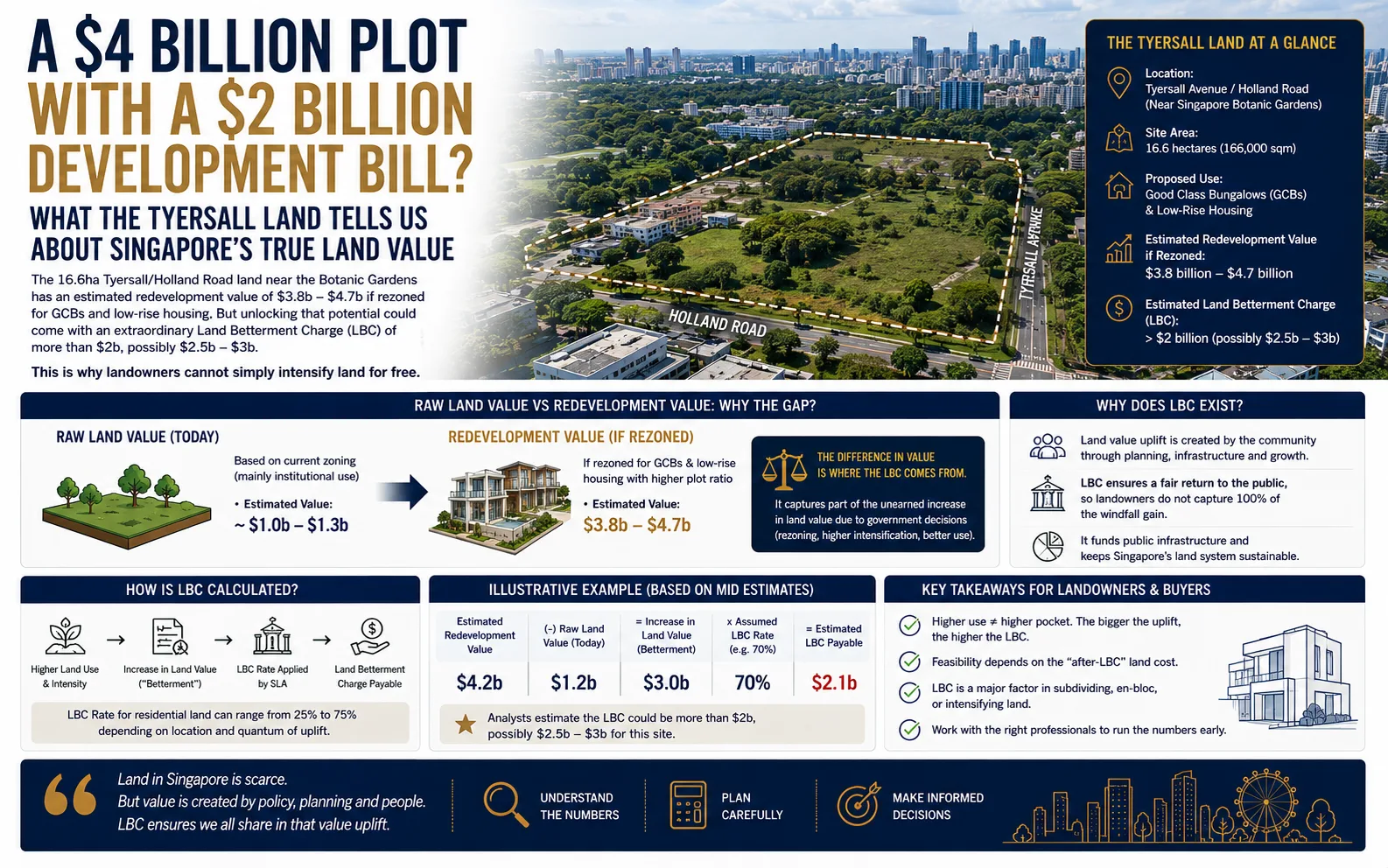
Approximately 16.6 hectares — or 1.79 million sq ft — around Holland Road and Tyersall Avenue, owned by the Regent of Johor, Tunku Ismail Sultan Ibrahim.
Its potential value after rezoning?
Approximately:
$3.8 billion to $4.7 billion.
But there is a catch.
The potential Land Betterment Charge (LBC) associated with developing the land could reportedly exceed:
$2 billion.
Some estimates put it at around $2.5 billion to $2.7 billion.
Others suggest it could approach:
$3 billion.
Suddenly, a piece of land potentially worth $4 billion does not sound quite as straightforward.
And I think this is a fantastic real-world example of something many property buyers misunderstand:
The value of land is not simply what the land can eventually be sold for.
What you are legally allowed to do with the land — and what it costs you to unlock that potential — can matter just as much.
First: What Exactly Is This Tyersall/Holland Road Land?
The story has actually been developing for some time.
The Johor royal family has owned land around Tyersall Park for more than a century.
The estate is famously associated with the fictional Tyersall Park in Kevin Kwan's Crazy Rich Asians universe, which is probably why the story attracts so much mainstream attention.
But forget the movie connection for a moment.
From a real-estate perspective, the actual site is far more interesting.
Following a land swap between the Singapore Government and the Regent of Johor, the Regent now owns two adjoining parcels — Plot A and Plot B — totalling approximately:
16.6 hectares.
URA announced in March 2026 that it had received a development application for the land.
The proposal is to develop:
low-rise, low-density residential housing
with a maximum gross plot ratio of:
1.4
together with:
Good Class Bungalows.
URA has proposed rezoning the relevant land from its existing Special Use and Open Space zoning to Residential. Part of the land could also be designated as a new Good Class Bungalow Area.
Read URA's official Holland Road rezoning announcement
Already, that tells us this is not going to become another 40-storey condominium development.
The site sits beside one of Singapore's most sensitive and prestigious locations — the Singapore Botanic Gardens UNESCO World Heritage Site.
The development therefore has to remain relatively low-rise and sensitive to the surrounding environment.
Then Came The $2 Billion Question
On 3 September 2026, Business Times/Bloomberg reported another development.
The owner is reportedly seeking to sell the 16.6ha site.
And discussions with potential purchasers have apparently run into one very big issue:
Who pays the Land Betterment Charge?
According to the report, three property analysts estimated that the LBC could exceed $2 billion.
Nicholas Mak of Mogul.sg estimated approximately:
$2.5 billion to $2.7 billion.
Tay Kah Poh of the Singapore Institute of Surveyors and Valuers suggested it could potentially approach:
$3 billion, while cautioning that the eventual figure could be lower because the precise calculation depends on information including the land's value before rezoning.
At the same time, estimates of the land's potential value after rezoning range from approximately:
$3.8 billion to $4.7 billion.
Read the Business Times/Bloomberg report
Those are staggering numbers.
But they give us an opportunity to understand how land actually works in Singapore.
What Exactly Is Land Betterment Charge?
I recently wrote about Land Betterment Charge in the context of landed owners who want to subdivide or intensify their properties.
The concept is basically the same here — only with a few more zeros behind the numbers.
In simple terms:
If a planning decision allows your land to become substantially more valuable, you do not necessarily get to keep all of that increase for free.
Land Betterment Charge allows the Government to capture part of the increase in land value arising from certain planning decisions.
That could include:
rezoning,
increasing allowable intensity,
changing the permitted use,
increasing floor area,
or other planning approvals that enhance development potential.
Think of it this way.
Imagine you own a piece of land worth $10 million under its existing permitted use.
Then planning permission allows you to develop something significantly more valuable and the land is now worth $20 million.
That additional $10 million did not arise because you renovated the house beautifully.
It arose partly because the development rights attached to the land changed.
LBC is one mechanism through which part of that uplift is returned to the community.
And Tyersall could potentially become one of the most extreme examples we have seen.
Why Could The LBC Be So Enormous?
Because the potential transformation is enormous.
URA's proposal involves changing land currently zoned Special Use and Open Space into residential land capable of supporting low-rise housing at a gross plot ratio of up to 1.4, together with GCBs.
Think about what that does to the economic potential of the site.
Before:
land with heavily restricted or non-residential development potential.
After:
prime District 10 residential land beside the Botanic Gardens.
That is a completely different asset.
And this is exactly why I think the headline:
"$4 billion piece of land"
doesn't tell the full story.
The better question is:
How much does it cost to unlock that $4 billion value?
Raw Land Value Is Not Development Value
This is something I constantly explain when looking at landed properties.
Two pieces of land can have exactly the same land area but completely different values.
Why?
Because we need to consider:
zoning,
plot ratio,
tenure,
shape,
frontage,
road reserve,
drainage reserve,
setbacks,
height controls,
redevelopment potential,
and sometimes LBC.
The same principle applies here.
You cannot simply say:
1.79 million sq ft × $X psf = value.
You need to ask:
What can actually be built?
Then:
What approvals are required?
Then:
What charges are payable?
Then:
What will construction and infrastructure cost?
Then:
How long will development take?
Then:
What can the finished homes actually sell for?
Only then can a developer determine what the raw land is worth to them.
This is why I always say:
Land area is only the starting point of landed-property valuation.
Imagine Buying The Site For $4 Billion
Let's simplify the mathematics dramatically just to understand the scale.
Suppose a buyer pays:
$4 billion for the land.
Then assume an LBC of:
$2.5 billion.
You are already at:
$6.5 billion.
And you haven't built anything yet.
You still potentially need to account for:
planning and professional fees,
infrastructure,
roads,
drainage,
utilities,
environmental mitigation,
construction,
financing costs,
marketing,
taxes,
holding costs,
and developer profit.
This is why a multi-billion-dollar valuation does not necessarily mean somebody can simply buy the land and immediately make billions developing it.
The development economics still have to work.
But Look At What The Buyer Could Potentially Create
Now we come to the exciting part.
This is almost 1.8 million sq ft of land in one of Singapore's most prestigious residential locations.
And part of it could potentially become a new GCB Area.
That is extraordinary.
Singapore currently has only 39 designated Good Class Bungalow Areas.
If part of Tyersall is eventually formally designated for GCB development, we could potentially be witnessing the creation of a new ultra-prime landed enclave.
That does not happen often.
Actually, "not often" is probably an understatement.
How Many GCBs Could They Build?
This was exactly the conversation my client and I had while driving past the site earlier this year.
At first glance, you look at 16.6 hectares and think:
Wah. How many GCBs can you put inside?
But again, headline land area is misleading.
You cannot divide 1.79 million sq ft by the minimum GCB plot size and conclude that's the answer.
Land will potentially be required for:
roads,
access,
landscaping,
drainage,
infrastructure,
environmental buffers,
setbacks,
and other residential uses.
Part of the development is also proposed for low-rise housing rather than purely GCBs.
The actual subdivision and master planning will determine how many GCB plots eventually emerge.
But even if only a portion becomes GCB land, we are talking about something exceptionally scarce:
brand-new GCB plots in prime District 10 beside the Botanic Gardens.
That is not a normal residential product.
And This Brings Us Back To GCB Scarcity
I previously wrote about the debate surrounding GCB land in my article:
Singapore Needs More Homes — But Where Are We Going to Build Them?
In that article, I asked an uncomfortable question.
In a country where land is incredibly scarce, how much land should remain permanently low-density for a very small number of households?
I still think that is a legitimate question.
But Tyersall adds another dimension to the discussion.
Here we potentially have new land being deliberately planned partly for GCBs.
Why?
Because Singapore's property market is not only about maximising the number of homes per hectare.
Different forms of housing serve different purposes.
GCB areas preserve:
low-rise urban form,
greenery,
large mature trees,
privacy,
architectural diversity,
and a particular segment of Singapore's residential landscape.
And whether we like it or not, GCBs have become one of Singapore's globally recognised ultra-prime property asset classes.
Why Are GCBs So Valuable?
The answer is not simply:
big house.
There are plenty of large detached houses in Singapore that are not GCBs.
The value comes from scarcity.
To qualify as a GCB, the property generally needs to sit within a designated GCB Area and comply with planning requirements, including the well-known minimum plot size of approximately 1,400 sqm or 15,070 sq ft, subject to the applicable planning controls.
More importantly, you cannot simply create a GCB anywhere you want.
The location itself matters.
That is why a GCB at:
Nassim,
Cluny,
Dalvey,
Queen Astrid,
Chatsworth,
or Gallop
belongs to a completely different market from a normal bungalow elsewhere in Singapore.
Tyersall would sit among some of the strongest names on that list.
What Would A New Tyersall GCB Be Worth?
This is where things become interesting.
We do not yet know:
the subdivision,
plot sizes,
road layout,
number of GCBs,
architecture,
sale structure,
or even whether the current owner will ultimately sell the entire site or proceed differently.
So any estimate today is speculative.
But imagine eventually having a brand-new:
15,000,
20,000,
30,000
or even larger square foot plot beside the Botanic Gardens.
Freehold.
Brand-new enclave.
Prime District 10.
Potentially with carefully controlled landscaping and architectural planning.
The eventual quantum could easily move into the tens of millions of dollars per house.
For exceptional plots, perhaps substantially more.
And this is why someone may still be willing to swallow an enormous development bill.
The end product is incredibly difficult to reproduce.
The Buyer Pool Is Tiny — But It Doesn't Need To Be Large
This is another interesting aspect of GCB development.
If you build 1,000 condominium units, you need hundreds and hundreds of buyers.
If you create a small number of exceptional GCB plots?
You may only need:
20,
30,
40,
or however many qualified buyers eventually correspond to the final subdivision.
That is a very different development strategy.
And these buyers are not comparing:
$2,800 psf versus $3,000 psf condo.
They are asking:
Can I find another piece of land like this?
Scarcity becomes the product.
But Who Can Actually Buy A GCB?
This is another reason the buyer pool is unusual.
Generally, Singapore citizens can acquire landed residential property subject to the relevant rules.
Foreigners require approval under Singapore's Residential Property Act to purchase landed residential property, and GCB ownership is even more tightly controlled in practice.
So this isn't a product you can simply market globally to every billionaire.
That restriction reduces the buyer pool.
But it also reinforces the unusual nature of the asset.
GCBs effectively sit within a very small intersection of:
extreme scarcity + extreme wealth + restricted ownership.
That is why individual transactions attract so much attention.
The Crazy Rich Asians Connection Is Fun — But It Isn't The Real Story
Yes, Tyersall Park inspired the fictional estate associated with Crazy Rich Asians.
That makes for a fantastic headline.
But to me, the more interesting story is not Hollywood.
It is:
Singapore land economics.
This site demonstrates almost every concept landed buyers need to understand.
Land area.
Zoning.
Plot ratio.
Planning permission.
GCB designation.
Environmental restrictions.
Development potential.
Land Betterment Charge.
Subdivision.
Scarcity.
And ultimately:
highest and best use.
This is essentially a giant real-life landed-property case study.
The Same Principle Applies To A $6 Million Landed House
Obviously, most of us are not deciding whether to buy a $4 billion piece of land.
But the underlying principle is exactly the same.
Imagine you are comparing two detached houses.
House A:
$6 million
House B:
$6.5 million
House A looks cheaper.
But then you discover House A has:
an awkward plot,
road reserve,
limited frontage,
major structural work required,
and restrictions affecting redevelopment.
House B has:
regular land,
better frontage,
better access,
clean redevelopment potential,
and a configuration that allows you to build the house you actually want.
Which is really cheaper?
Not necessarily House A.
This is why I wrote previously about how landed properties should actually be assessed.
The price on the listing is only one number.
The cost of unlocking the property's potential is another.
Tyersall is simply this concept multiplied by a few billion dollars.
This Is Also Why Land Betterment Charge Matters To Ordinary Landed Owners
A few days ago, I wrote about the latest increase in Land Betterment Charge rates and what it could mean for someone buying a detached property intending to subdivide it into two semi-detached homes.
That sounds worlds apart from Tyersall.
It actually isn't.
The underlying question is identical:
"If I change the development potential of this land, what will it cost me?"
A buyer may look at a 10,000 sq ft detached plot and think:
"Great. I buy one detached house, subdivide it into two semi-Ds and immediately unlock value."
Maybe.
But before you calculate your profit, you need to investigate:
planning feasibility,
minimum plot dimensions,
road and drainage issues,
existing development baseline,
LBC exposure,
construction,
financing,
and eventual selling price.
Otherwise, you are calculating the value you hope to create while ignoring the cost of creating it.
The Tyersall numbers make that lesson impossible to miss.
There Is Another Interesting Question: Is $4 Billion Actually Expensive?
This sounds ridiculous.
How can $4 billion not be expensive?
But property valuation is relative.
If someone pays $4 billion and eventually creates something worth:
$5 billion,
$6 billion,
$8 billion
or more,
then perhaps it works.
If the total development cost reaches $8 billion and the finished product is only worth $7 billion?
Then $4 billion was far too expensive.
This is why developers do not simply ask:
"How much does the land cost?"
They ask:
"What can the finished development support?"
Then they work backwards.
Expected sales value.
Minus construction.
Minus LBC.
Minus infrastructure.
Minus financing.
Minus professional costs.
Minus taxes.
Minus risk.
Minus required profit.
What remains?
That's what the land is worth to that developer.
Different developers may therefore arrive at very different answers.
Which Explains Why The LBC Could Complicate A Sale
According to the Business Times/Bloomberg report, the size and uncertainty surrounding the potential LBC has become an issue in discussions with prospective purchasers.
That doesn't surprise me.
Imagine negotiating a multi-billion-dollar land acquisition where another potential:
$2 billion to $3 billion
charge sits in the feasibility.
That is not something you casually estimate.
Every assumption matters.
And the eventual LBC is not simply whatever analysts estimate today.
The Singapore Land Authority has said that the actual amount payable will be determined following the grant of permission to develop the land in accordance with the Land Betterment Charge Act.
So I would be very careful treating today's $2.5 billion or $3 billion estimates as confirmed figures.
They aren't.
They are market estimates.
The final number could be different.
This Is Exactly Why Due Diligence Matters In Landed Property
When buying a condominium, much of the development work has already been done for you.
The boundaries are defined.
Your strata area is defined.
Your permitted use is defined.
The building exists.
Landed property is different.
The more redevelopment potential you are buying, the more questions you need to ask.
That is why my landed-property discussions increasingly revolve around:
What am I actually buying?
not simply:
How many square feet am I buying?
The two are not the same.
Tyersall Also Raises A Bigger Singapore Land-Use Question
This is where I think the story connects very nicely to another article I recently wrote:
Singapore Needs More Homes — But Where Are We Going to Build Them?
In that piece, I discussed:
Maju Forest,
golf courses,
GCB areas,
brownfield redevelopment,
nature,
and Singapore's long-term housing requirements.
Tyersall puts that debate under a microscope.
Here we have:
16.6 hectares of prime central land.
If you maximise density, theoretically many more households could live there.
Instead, the current proposal is for:
low-rise, low-density housing and GCBs.
Is that the best use of scarce Singapore land?
There isn't a simple answer.
The site sits beside the Singapore Botanic Gardens UNESCO World Heritage Site.
URA has specifically said the proposed development needs to be compatible and sensitive to the surrounding neighbourhood and existing height restrictions protecting the visual amenity of the Gardens.
Environmental studies will also be required before works commence.
So this is not simply:
"Why don't we build 40-storey HDBs here?"
Urban planning is more complicated than that.
But I think the question is still worth discussing.
Do GCBs Still Have A Place In Modern Singapore?
I think they do.
But I also think it is healthy to debate why.
Singapore cannot consist entirely of high-rise buildings.
Different neighbourhoods create different urban experiences.
GCB areas contribute:
greenery,
tree cover,
heritage,
architectural diversity,
and low-density landscapes.
They also represent one of the rarest forms of private housing available in Singapore.
At the same time, we should be honest.
A 20,000 sq ft GCB plot houses one household.
Twenty thousand square feet used differently could accommodate many more families.
That trade-off is real.
And as Singapore's population and housing needs evolve, I think questions about how we allocate scarce land will only become more important.
Perhaps Tyersall Could Become Something Singapore Has Never Really Had
This is the part that gets my imagination going.
If this development eventually proceeds, I hope it does not simply become:
another collection of enormous houses behind enormous walls.
This is an extraordinary piece of land.
Beside an extraordinary national asset.
What if the developer created a genuinely world-class low-density residential enclave?
Imagine:
carefully preserved mature trees,
beautiful landscaped streets,
architecture that responds to the Botanic Gardens,
walking connections,
exceptional biodiversity planning,
low-rise luxury residences,
GCBs,
and perhaps elements of the landscape that create value beyond simply maximising saleable area.
If you're going to create ultra-prime housing on land like this, I think the ambition should be higher than:
"How many expensive houses can we fit?"
It should be:
"Can we create one of the world's great low-density residential neighbourhoods?"
That would be much more interesting.
And Maybe That's Where The $2 Billion LBC Story Comes Full Circle
At first glance, the Land Betterment Charge looks like the villain.
Owner has $4 billion land.
Government potentially wants $2 billion-plus.
Deal becomes difficult.
But that is too simplistic.
The land's enormous value exists partly because the planning framework may allow it to become something much more valuable than what it was previously permitted to be.
So perhaps the correct question isn't:
"Why is the LBC so expensive?"
It is:
"How much additional value is being created by allowing this land to become residential?"
That is the whole philosophy behind land betterment.
And it is something every landed buyer thinking about redevelopment should understand.
My Take
I find the Tyersall story fascinating.
Not because of Crazy Rich Asians.
Not because a Malaysian royal owns it.
And not simply because someone might write a cheque for $4 billion.
I find it interesting because it demonstrates something I deal with regularly in landed property:
Land value is not just about land size.
It is about:
what you can do with it,
what you cannot do with it,
what it costs to unlock its potential,
and ultimately:
who will pay for the finished product.
Earlier this year, my client and I drove past this land and casually discussed how many GCBs could potentially sit there.
At that time, it was simply one of those property conversations you have while driving around looking at houses.
Today, with a possible multi-billion-dollar sale and potentially multi-billion-dollar LBC being discussed, that conversation suddenly feels much more relevant.
My client eventually bought his GCB elsewhere in prime District 9.
But I will definitely be watching what happens at Tyersall.
Because if this development eventually proceeds, we may be watching something exceptionally rare:
the creation of an entirely new prime luxury residential enclave in the heart of Singapore.
And perhaps even:
a new chapter in Singapore's GCB market.
So Let Me End With Two Questions
I would genuinely love to hear different views on this.
Do you think Good Class Bungalows are still relevant in Singapore today?
In a country where land is so scarce, should we continue preserving and even creating ultra-low-density residential enclaves?
Or do GCB areas provide enough value through greenery, heritage, housing diversity and urban character to justify their existence?
And secondly:
If Tyersall really does get developed, what would you like to see built there?
More GCBs?
Low-rise luxury apartments?
A mixture of both?
More publicly accessible greenery?
Or something completely different?
There isn't necessarily a right or wrong answer.
But with 16.6 hectares beside the Singapore Botanic Gardens, whatever eventually gets built there could remain part of Singapore's landscape for generations.
So I think it is a conversation worth having.
Want the tailored version for your portfolio?
Every article here generalises. A 20-minute conversation makes it specific to your numbers.
What is the Tyersall/Holland Road land?
Why is Tyersall associated with Crazy Rich Asians?
What is proposed for the land?
How much could the land be worth?
How much could the Land Betterment Charge be?
Why would such a large LBC be payable?
Does the buyer automatically have to pay the LBC?
Is the $2 billion to $3 billion LBC confirmed?
Will the entire site become GCBs?
Could Tyersall become Singapore's 40th GCB Area?
Why can't the land simply be developed into high-rise condos?
Could HDB flats be built there instead?
What does this have to do with ordinary landed-property buyers?
What is the biggest lesson from Tyersall?

Written by
Christopher Ng (CEA R014394H)
Singapore Property & Asset Progression Strategist with ERA Realty Network. A NUS Real Estate graduate, Christopher has advised homeowners, investors and property owners since 2004.