
HDB Prices Have Finally Started Falling. Is This the Beginning of a Correction — Or Just a Healthy Pause?
HDB resale prices saw their first quarterly decline in Q1 2026 after years of growth, followed by another drop in Q2. This shift, combined with recent policy changes, suggests the market is entering a more selective phase rather than a broa
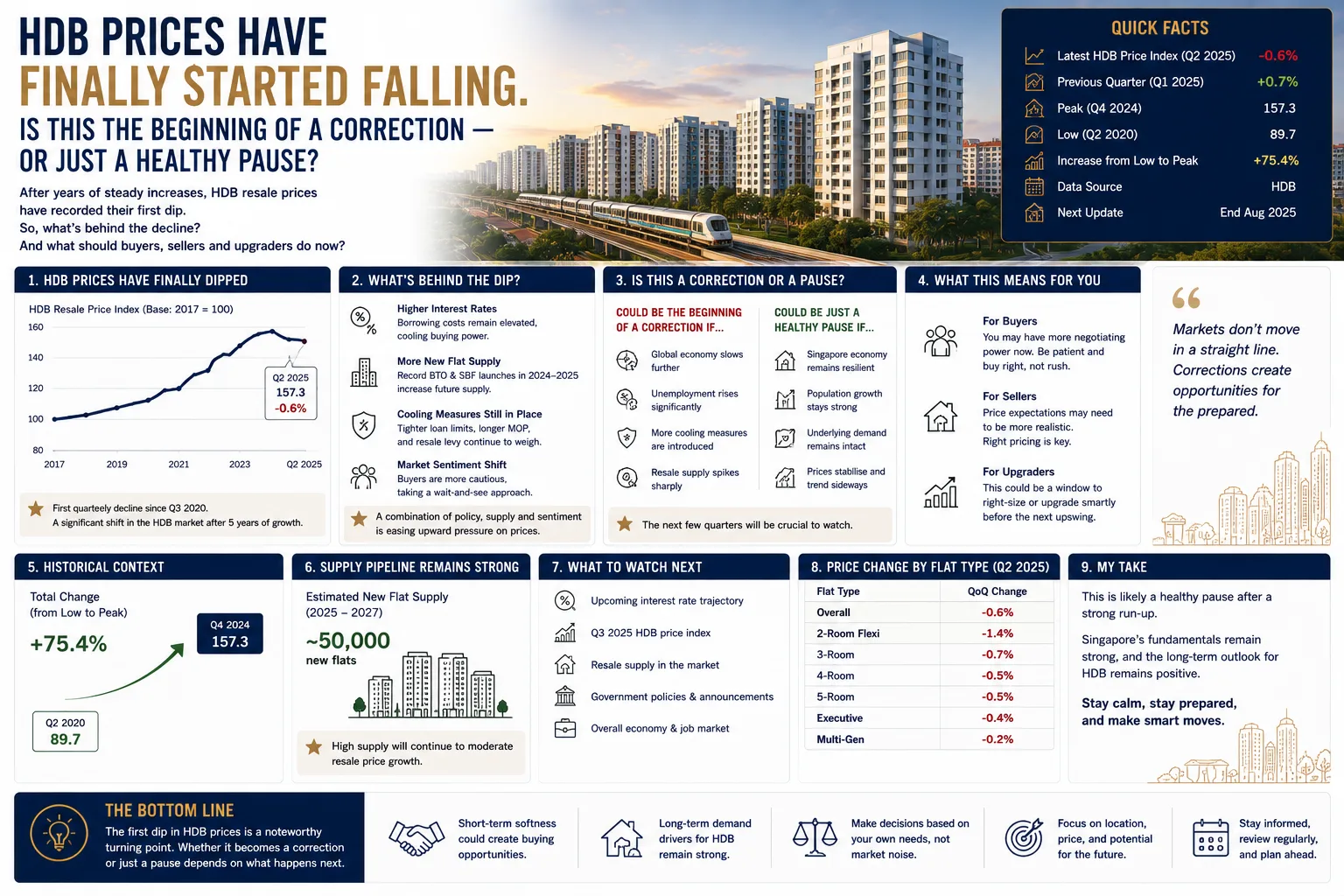
For almost seven years, HDB resale prices seemed to move in only one direction.
Up.
Quarter after quarter, buyers got used to paying more.
Sellers got used to expecting more.
And perhaps most importantly, the psychology of the market changed.
Many buyers became worried that if they waited, they would simply have to pay more later.
That cycle has now been interrupted.
HDB’s Resale Price Index fell 0.1% in Q1 2026, its first quarterly decline since Q2 2019, after five consecutive quarters of slower or no price growth.
Then Q2 followed with another 0.3% decline, bringing the index down to 202.8.
Two consecutive quarters of falling prices.
And then, almost immediately after that, the Government removed the 15-month wait-out period for eligible private property owners buying non-subsidised HDB resale flats without an HDB housing loan.
That creates a very interesting question.
Has the HDB market entered a genuine correction — or has it simply paused long enough for the Government to loosen one of its temporary cooling measures?
My view is that this is not the beginning of a broad HDB crash.
But I do think we have entered a much more selective phase of the market.
And that matters for both buyers and sellers.
The First Decline in Nearly Seven Years Is Significant
A 0.1% fall may look insignificant.
But the number itself is less important than what it represents.
For years, the HDB resale market was characterised by:
strong demand,
tight supply,
construction delays,
buyers competing aggressively,
and sellers having very strong pricing power.
The fact that the index finally turned negative after five quarters of slowing growth tells us that the market had already been cooling before prices actually fell.
Then Q2 confirmed that the moderation was not just a one-quarter anomaly.
That does not mean prices are collapsing.
It means the balance between buyers and sellers is changing.
Why Are HDB Prices Finally Moderating?
There is no single reason.
Several things are happening at the same time.
More Resale Supply Is Coming Back
One important factor is the return of newly MOP-ed flats.
ERA’s Q2 analysis noted that higher MOP supply in 2026 has added more resale stock and placed some downward pressure on prices.
This is important because the resale market had previously been supported by relatively limited fresh MOP supply.
When more newer flats become available, buyers have more alternatives.
And once buyers have more choice, sellers lose some of the pricing power they enjoyed during the tighter years.
BTO Supply Has Improved
The BTO market also matters.
Every buyer who secures a new flat is one less buyer competing immediately in the resale market.
As new flat supply improves, resale buyers have more options and less urgency.
That alone can soften price growth.
Buyers Have Hit Affordability Limits
This is perhaps the most natural cooling mechanism of all.
Prices cannot rise indefinitely faster than household incomes.
At some point, monthly instalments, loan eligibility and cash-over-valuation become limiting factors.
Buyers may still want a flat.
They may still be financially sound.
But they simply become less willing to chase.
And once enough buyers stop chasing, prices start to stabilise.
Does This Mean The HDB Market Has Turned?
I would say:
The market has changed.
But I would not say:
The market has collapsed.
Those are very different things.
What I think we are seeing is a transition from a broad seller’s market into a much more balanced market.
And within that balanced market, different types of flats are behaving very differently.
We Are Already Seeing A Two-Speed Market
This is probably one of the most important trends.
Even while the overall HDB resale index fell in Q2, million-dollar transactions actually increased.
ERA recorded 491 million-dollar HDB transactions in Q2 2026, up 19.5% from the previous quarter and 18.3% year-on-year. They accounted for 7.7% of all resale transactions.
That is fascinating.
Overall HDB prices are softening.
Yet premium transactions are increasing.
This tells us the market is not weakening evenly.
Buyers are becoming more selective.
They are still prepared to pay large premiums for the right product.
Particularly:
newer MOP flats,
larger units,
good locations,
mature estates,
strong MRT connectivity,
and rare flat types.
In Q2, younger resale flats aged 15 years or below accounted for 51% of all million-dollar transactions, with recently MOP-ed homes commanding especially strong premiums.
So the real story is not:
“HDB prices are falling.”
It is:
“Average flats are facing more resistance, while scarce and desirable flats continue to command strong prices.”
That is a much more useful way to understand the market.
Then Government Removed The 15-Month Wait-Out Period
This is where the timing becomes very interesting.
The 15-month wait-out period was introduced in 2022 when HDB resale demand and prices were rising strongly.
The objective was to reduce competition from private property owners, who often entered the resale market with greater purchasing power after selling their private homes.
By July 2026, HDB resale prices had declined for two consecutive quarters.
The Government then removed the temporary wait-out period for eligible private property owners purchasing non-subsidised HDB resale flats without an HDB housing loan.
To me, that tells us policymakers are comfortable enough with current market conditions to restore some demand.
That is quite significant.
Is Government Worried Prices Will Fall Too Much?
I wouldn't interpret the policy that way.
The more likely reading is that the original cooling measure had served its purpose.
When the market was overheated, demand was restrained.
Now that prices and transaction conditions have moderated, that friction can be removed.
This is policy recalibration rather than policy rescue.
But it does create a new demand source.
And that could shape the second half of 2026.
What Happens When Private Right-Sizers Return?
This is the big question.
Eligible private property owners can now enter the HDB resale market without serving the 15-month wait.
That means some households that postponed right-sizing decisions may finally act.
But I don't expect them to buy every type of flat.
Private right-sizers are likely to have different preferences.
Many are used to private housing.
They may value:
space,
good layouts,
mature estates,
convenience,
MRT access,
and better-quality surroundings.
That naturally points towards:
5-room flats.
Executive Apartments.
Executive Maisonettes.
larger DBSS units.
newer MOP flats.
premium central or mature-estate homes.
And that is exactly why I think the HDB market may become even more bifurcated.
The Policy May Support The Top End More Than The Broad Market
This is an important distinction.
If private right-sizers return with substantial housing equity, they are not necessarily going to compete for a $450,000 suburban four-room flat.
They may instead compete for a $900,000, $1 million or $1.2 million home that gives them the lifestyle they want while still allowing them to unlock capital.
That means the removal of the wait-out period could provide extra demand precisely where supply is already limited.
So the average HDB price index could remain relatively flat while selected premium categories stay firm or even strengthen.
This is why I don't think it is useful to talk about “the HDB market” as though every flat moves together.
What Does This Mean For Buyers?
For buyers, I think 2026 is healthier than the market we saw a few years ago.
There is less urgency.
More choice.
Greater bargaining power.
And less fear that every delay means paying substantially more.
That is good.
But buyers should not assume every seller will become desperate.
Good flats still sell.
Rare flats still attract competition.
And premium locations still command premiums.
If you're buying a standard unit with plenty of alternatives, you may have room to negotiate.
If you're buying a rare Executive Maisonette near the MRT, the situation could be completely different.
Buyers Should Stop Looking Only At The Index
The HDB RPI tells us the direction of the overall market.
It does not tell you whether the particular flat you want is overpriced or good value.
Instead, compare:
recent transactions in the same block or cluster,
remaining lease,
renovation condition,
floor level,
orientation,
MRT proximity,
school proximity,
and competing supply.
In a selective market, unit-level analysis matters more.
What Does This Mean For Sellers?
Sellers need to recalibrate expectations.
The market of 2022–2024 rewarded ambitious pricing.
Today's market may punish it.
If you list 10% above recent comparables simply because another unit achieved a record price last year, buyers may simply move on.
The first few weeks of a listing become extremely important.
If you are consistently getting viewings but no offers, the market is telling you something.
That does not mean you need to slash the price.
But it may mean the asking price is ahead of what buyers currently perceive as value.
ERA similarly noted that sellers do not necessarily need dramatic price cuts, but realistic pricing and avoiding excessive COV are increasingly important.
Will HDB Prices Fall Further In 2H 2026?
My base case is for stability rather than a sharp correction.
There are forces pulling in both directions.
On one side:
more MOP supply,
better BTO availability,
buyer affordability limits,
and greater negotiation power.
On the other:
the removal of the 15-month wait-out period,
private right-sizer demand,
continued interest in newer flats,
and scarcity of premium flat types.
That creates balance.
And balanced markets usually produce slower, more differentiated price movements rather than dramatic swings.
I Think 2026 May Be The Year HDB Becomes More Segmented
The last few years were unusual because almost everything rose together.
Going forward, I think the gap between average and exceptional flats may widen.
Consider two homes.
A standard four-room flat with many competing listings.
And a rare Executive Maisonette near an MRT station.
Both are HDB.
But their supply dynamics are completely different.
One can be replicated relatively easily.
The other cannot.
As buyers become more selective, scarcity becomes more valuable.
That is why I believe we will see stronger performance from:
newly MOP-ed flats,
large five-room units,
Executive Apartments,
Executive Maisonettes,
rare DBSS homes,
and premium mature-estate locations.
Meanwhile, older or less convenient flats with plenty of competing supply may face greater price resistance.
Is This A Correction Or A Healthy Pause?
My answer is:
A healthy pause — for now.
After several years of strong growth, some moderation is necessary.
A market where prices rise 8% every year indefinitely would eventually create serious affordability problems.
A few quarters of flat or slightly negative growth allows:
income to catch up,
buyers to regain confidence,
supply to increase,
and sellers to reset expectations.
That is not necessarily bad for homeowners.
In fact, a sustainable market is better for everyone in the long run.
My View
I don't think HDB prices have entered a major correction.
I think the HDB resale market is transitioning into its next phase.
The broad market is losing momentum.
But the premium market remains very much alive.
The Government's decision to remove the 15-month wait-out period reinforces that view.
It suggests that policymakers believe the market has moderated enough to accommodate additional demand without recreating the conditions of 2022.
So I wouldn't look at the first two quarterly declines and panic.
But I also wouldn't assume the easy price growth of the past few years will return.
For buyers, this is a market to negotiate intelligently.
For sellers, this is a market to price realistically.
And for homeowners thinking about their next move, this is a market where asset selection matters more than ever.
The question is no longer simply:
“Will HDB prices rise?”
The better question is:
“Which HDB flats will buyers still fight for when the overall market becomes more balanced?”
That, in my opinion, is where the real opportunity lies.
Want the tailored version for your portfolio?
Every article here generalises. A 20-minute conversation makes it specific to your numbers.
Are HDB resale prices falling in 2026?
When was the last time HDB resale prices fell before 2026?
Is Singapore’s HDB market crashing?
Why are HDB resale prices moderating?
Are million-dollar HDB transactions falling too?
Why did the Government remove the 15-month wait-out period?
Will removing the 15-month wait-out period push HDB prices up again?
Which HDB flats could perform best in 2H 2026?
Is 2H 2026 a good time to buy a resale HDB?
Should HDB sellers reduce their asking prices?
Will HDB prices rise again in 2027?
Is this a correction or just a pause?

Written by
Christopher Ng (CEA R014394H)
Singapore Property & Asset Progression Strategist with ERA Realty Network. A NUS Real Estate graduate, Christopher has advised homeowners, investors and property owners since 2004.