
Resale Condos Are Quietly Making a Comeback. Is Singapore's New Launch Premium Getting Too Expensive?
Singapore's property market sees resale condos gaining traction, questioning if new launches are becoming too expensive. Learn why many buyers are choosing resale properties over new developments.
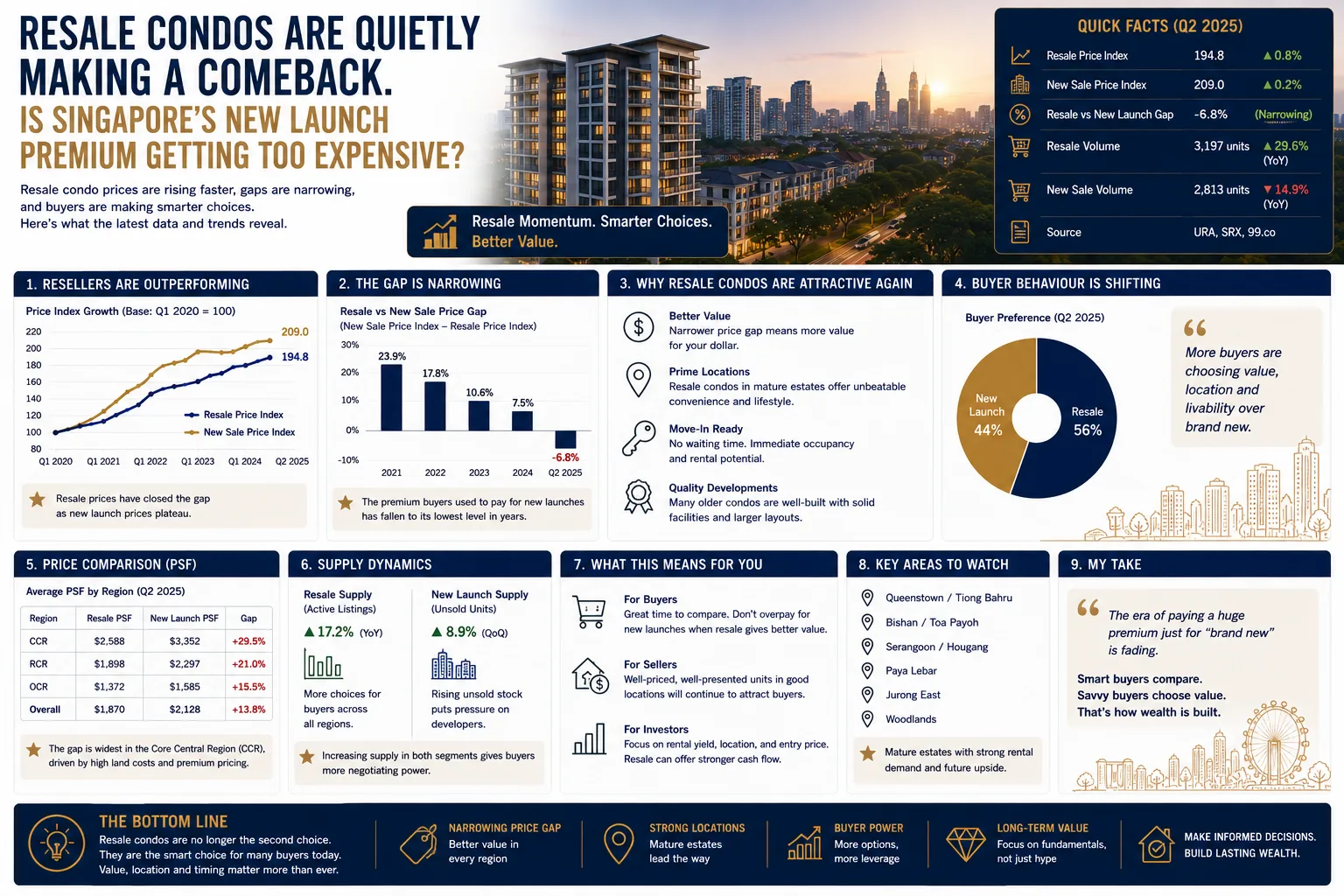
For the past few years, much of the conversation in Singapore's private property market has revolved around new launches.
Every few weeks, we hear about another project.
Balloting.
Launch weekend.
75% sold.
90% sold.
New benchmark PSF.
And understandably, buyers start to believe that the only way to make money in property is to buy a new launch.
But something interesting is happening quietly in the background.
Singapore buyers are buying a lot of resale condos.
In fact, significantly more resale condos changed hands in Q2 2026 than new homes were sold by developers.
According to URA, there were 3,813 private residential resale transactions in Q2 2026, compared with 2,141 units sold by developers.
Resale transactions accounted for 62% of all private residential sale transactions, increasing from 59.6% in Q1 2026.
That gets my attention.
Because this is happening during a period when Singapore has no shortage of exciting new launches.
So the question I think buyers should be asking is:
Why are so many people still choosing resale?
And perhaps the more important question:
Has the price premium for buying brand-new property become too wide?
New Launches Are Getting Expensive
Let's look at where pricing has moved.
Dunearn House launched recently as the first private residential project in the new Turf City precinct.
Prices started from around $2,799 psf, but its launch weekend achieved an average selling price of approximately $3,140 psf.
It still sold 212 out of 380 units, or about 56%, with all its three-bedroom units taken up.
That tells us something important.
$3,000 psf is no longer exclusively an Orchard Road conversation.
Buyers have demonstrated that they are prepared to cross $3,000 psf for the right project outside the traditional prime districts.
And I don't think Dunearn House will be the last.
The upcoming freehold The Serra Residences in Novena will enter a market where these $3,000 psf benchmarks have already been established. The development itself is a boutique 133-unit freehold project in District 11, which gives it a very different scarcity proposition.
Whether Serra eventually launches around, below or above that $3,000 psf conversation remains to be seen.
But the direction of travel is quite obvious.
Replacement costs are moving higher.
Land Prices Are Telling Us What's Coming Next
Whenever I analyse a new launch, I don't only look at today's selling price.
I look at tomorrow's land price.
Because today's GLS transaction eventually becomes tomorrow's new launch.
And developers aren't charities.
They need to account for:
land,
construction,
financing,
marketing,
ABSD,
professional fees,
and ultimately, profit.
So when land costs rise, future selling prices usually need to rise as well.
That is why the recent GLS tenders we have been discussing matter.
A higher land benchmark today creates a higher replacement-cost benchmark tomorrow.
This creates a very interesting situation.
The future new launch can actually make today's resale condo look cheap.
This Is Where The Resale Market Becomes Interesting
Imagine you're looking at two properties in broadly comparable locations.
One is a new launch asking:
$2,900 psf.
The other is a seven-year-old resale development asking:
$2,200 psf.
That's a $700 psf difference.
On a 1,000 sq ft home, we're talking about approximately:
$700,000.
Now ask yourself:
What exactly am I receiving for that additional $700,000?
A newer facade?
Brand-new facilities?
A fresh lease?
A more efficient layout?
Several years without major maintenance?
Perhaps those benefits are worth it.
But perhaps they aren't worth $700,000.
This is the conversation I think buyers increasingly need to have.
New Doesn't Automatically Mean Better Investment
I want to make this very clear.
I'm not against new launches.
Far from it.
I've sold many new launches and I continue to believe there are excellent opportunities in the primary market.
But I don't believe in this idea:
"Buy new launch = sure make money."
Property doesn't work that way.
A good investment is ultimately about the relationship between:
Price and value.
If you buy an excellent project at too high a price, your returns can still disappoint.
Likewise, if you buy an overlooked resale property significantly below replacement cost, there may be an opportunity.
The property doesn't know whether you bought it from a developer or from another owner.
Eventually, the market only asks:
What is this home worth?
Buyers Are Already Voting With Their Wallets
This is why the Q2 numbers are interesting.
Resale volume increased from 3,225 transactions in Q1 to 3,813 transactions in Q2.
At the same time, developer sales increased much more modestly, from 2,013 units to 2,141 units.
I don't interpret that as buyers rejecting new launches.
Clearly they're not.
Many new launches continue to sell extremely well.
Instead, I think buyers are becoming more comfortable asking:
"What else can my $2.5 million buy?"
And that is exactly the question they should be asking.
The $2.5 Million Buyer Has Choices
Imagine you're an HDB upgrader with a budget of around $2.5 million.
Depending on location, that may buy you:
a relatively compact new three-bedroom,
or...
a considerably larger resale three-bedroom,
or...
an older freehold condo,
or...
perhaps even a four-bedroom in another location.
Which one is correct?
There isn't a universal answer.
A young family may value space more.
An investor may value tenant demand.
Someone planning to stay for 15 years may value freehold.
Another buyer may prioritise new facilities and lower maintenance.
That's why I don't like starting a property conversation with:
"Which project should I buy?"
I prefer starting with:
"What are you trying to achieve?"
The New Launch Premium Can Be Justified
There are very good reasons why new launches command premiums.
Firstly, new projects are generally more efficient.
Under today's GFA rules and design standards, developers have become extremely good at maximising usable space.
Secondly, buyers enjoy a fresh lease for 99-year projects.
Thirdly, newer developments often offer better facilities, landscaping, smart-home features and more contemporary designs.
And importantly for investors, buyers purchasing during construction have historically benefited in certain market cycles from progressive price increases before completion.
So paying a premium isn't automatically wrong.
The question is:
How much premium is reasonable?
10%?
15%?
25%?
30%?
At some point, the gap becomes large enough that resale starts becoming very compelling.
I Would Watch The 5- To 10-Year-Old Condo Segment Closely
If I were looking for resale opportunities today, this is one segment I would study carefully.
Why?
Because these developments are often in a sweet spot.
They're not brand new.
But they're not old either.
Facilities are generally still modern.
Layouts remain relevant.
The lease is still relatively fresh.
And importantly:
You can see exactly what you're buying.
You can walk through the actual unit.
See the view.
Hear the traffic.
Test the afternoon sun.
Look at the maintenance of the development.
Check actual rental demand.
Talk to residents.
Study actual resale transactions.
There's much less imagination required.
And Some Resale Condos Have Something New Launches Cannot Recreate
Space.
This is particularly relevant for families.
Older condos can have:
proper living rooms,
large dining spaces,
enclosed kitchens,
yards,
utility rooms,
larger bedrooms,
and sometimes layouts that would be extremely expensive to recreate today.
A 1,300 sq ft older condo and a 1,000 sq ft new launch may both technically be called a three-bedroom.
But they're not necessarily comparable homes.
For someone buying primarily for own stay, that distinction matters enormously.
What About Older Freehold Condos?
This is another segment I think deserves attention.
Suppose you can buy an older freehold condo at $2,000–$2,200 psf while nearby new 99-year launches are moving towards $2,800–$3,000 psf.
The new project may deserve some premium.
But a $600–$1,000 psf gap deserves investigation.
Not every old freehold condo is undervalued.
Some have inefficient layouts.
Some have high maintenance.
Some need major upgrading.
Some have poor facilities.
And freehold itself does not guarantee capital appreciation.
But when the price gap becomes sufficiently wide, buyers should at least ask whether the older development offers better risk-adjusted value.
There Is Another Reason Resale Could Benefit: Future Supply
URA estimates around 60,600 private residential units including ECs will be completed over the coming years.
The Government is also keeping GLS supply high, with 9,320 Confirmed List units for 2026—more than 50% above the average annual Confirmed List supply of the previous decade.
I recently wrote about why I don't think this automatically means Singapore is facing an oversupply problem.
But it does mean buyers will have more choices.
And when buyers have more choices, entry price becomes increasingly important.
If I'm buying a new launch at $3,000 psf today, I need to ask:
What will competing new launches cost when I sell?
What will surrounding resale condos cost?
And why would my future buyer choose my five-year-old unit over everything else available then?
That exit question is becoming increasingly important.
Resale Has One Huge Advantage: You Know Today's Market
With resale, today's market value is relatively transparent.
There are actual transactions.
Actual rents.
Actual competing listings.
Actual tenant demand.
With new launches, part of the investment thesis inevitably depends on what the market will look like three, four or five years from now.
That isn't necessarily bad.
But investors need to recognise the difference.
You're buying more future expectation.
And the more future expectation already priced into your purchase, the less room there may be for error.
So Which Will Make More Money: New Launch or Resale?
This is the question everyone wants answered.
My answer is probably less exciting.
Neither.
The better purchase will make more money.
There will be new launches bought in 2026 that outperform resale condos significantly.
There will also be resale properties bought in 2026 that outperform new launches.
The distinction isn't:
New vs resale.
It is:
Value vs price.
A well-selected new launch bought at an attractive entry price can be excellent.
A resale condo purchased significantly below replacement cost in an improving location can also be excellent.
What I wouldn't do is decide which category to buy before looking at the numbers.
If I'm Buying For A Five-Year Exit, Here's What I Would Look At
My priorities would be:
Entry price.
How does my PSF compare with surrounding properties?
Future supply.
How many competing units will exist when I sell?
Buyer pool.
Who realistically buys this from me?
Quantum.
Can my future buyer comfortably afford it?
Scarcity.
What does my unit or development offer that isn't easily reproduced?
Replacement cost.
What will a brand-new equivalent likely cost five years from now?
These factors matter much more to me than whether the property comes with a developer sales brochure.
What Would Make Me Choose A New Launch?
I would lean towards new launch when:
the developer secured land at an attractive cost,
the entry price isn't excessively ahead of surrounding resale,
the area has a strong transformation story,
future supply is manageable,
the layout and unit selection are good,
and there is a clear future buyer pool.
In those circumstances, I'm comfortable paying a reasonable premium.
What Would Make Me Choose Resale?
I become interested in resale when:
the new-launch premium becomes excessive,
I can buy significantly more space for the same money,
the development is still relatively young,
the location is already established,
rental and resale demand are proven,
or I'm buying a scarce freehold property at a large discount to replacement cost.
That's where I think some very interesting opportunities may appear over the next few years.
My View
I don't think resale condos are suddenly "beating" new launches.
And I certainly don't think buyers should stop considering new projects.
What I think is happening is healthier.
Buyers are becoming more discerning.
When new-launch prices were much closer to resale prices, the decision was easier.
Pay a little more.
Get something brand new.
Potentially enjoy developer price progression.
Wait for TOP.
But as the gap grows, the calculation changes.
If I'm being asked to pay $600, $700 or even $1,000 psf more than a comparable resale development, I need a very good reason.
The developer needs to give me something meaningful for that premium.
Location.
Transformation.
Scarcity.
Better product.
Lower quantum.
Future pricing advantage.
Something.
Because "it's new" is not enough.
The Q2 2026 numbers are perhaps telling us that buyers already understand this.
Despite one of Singapore's most active new-launch markets, resale properties still accounted for 62% of private residential sale transactions.
That's not a small side market.
That's the majority of the market.
So perhaps the next big opportunity isn't about choosing between resale and new launch.
It's about becoming disciplined enough to compare both.
Because ultimately, my job isn't to recommend the newest property.
It's to help my clients identify the property that gives them the best chance of achieving their objectives.
And sometimes...
the best new-launch opportunity may actually be the resale condo sitting right beside it.
Want the tailored version for your portfolio?
Every article here generalises. A 20-minute conversation makes it specific to your numbers.
Are resale condos becoming more popular in Singapore in 2026?
Are buyers abandoning Singapore new launches?
Why are Singapore new launches becoming so expensive?
Is $3,000 psf becoming normal for Singapore new launches?
How much more should I pay for a new launch compared with resale?
Is a 5- to 10-year-old resale condo a good investment?
Is an older freehold condo better than a new 99-year condo?
Which is better for a five-year investment: new launch or resale condo?
Could resale condo prices rise because new-launch prices keep increasing?
Should HDB upgraders consider resale condos?
What is the biggest mistake buyers make when comparing new launch and resale?
So is Singapore's new-launch premium getting too expensive?
What am I getting for the premium I'm paying?

Written by
Christopher Ng (CEA R014394H)
Singapore Property & Asset Progression Strategist with ERA Realty Network. A NUS Real Estate graduate, Christopher has advised homeowners, investors and property owners since 2004.