
HDB Prices Are Falling While Condo Prices Keep Rising. Should Upgraders Be Worried?
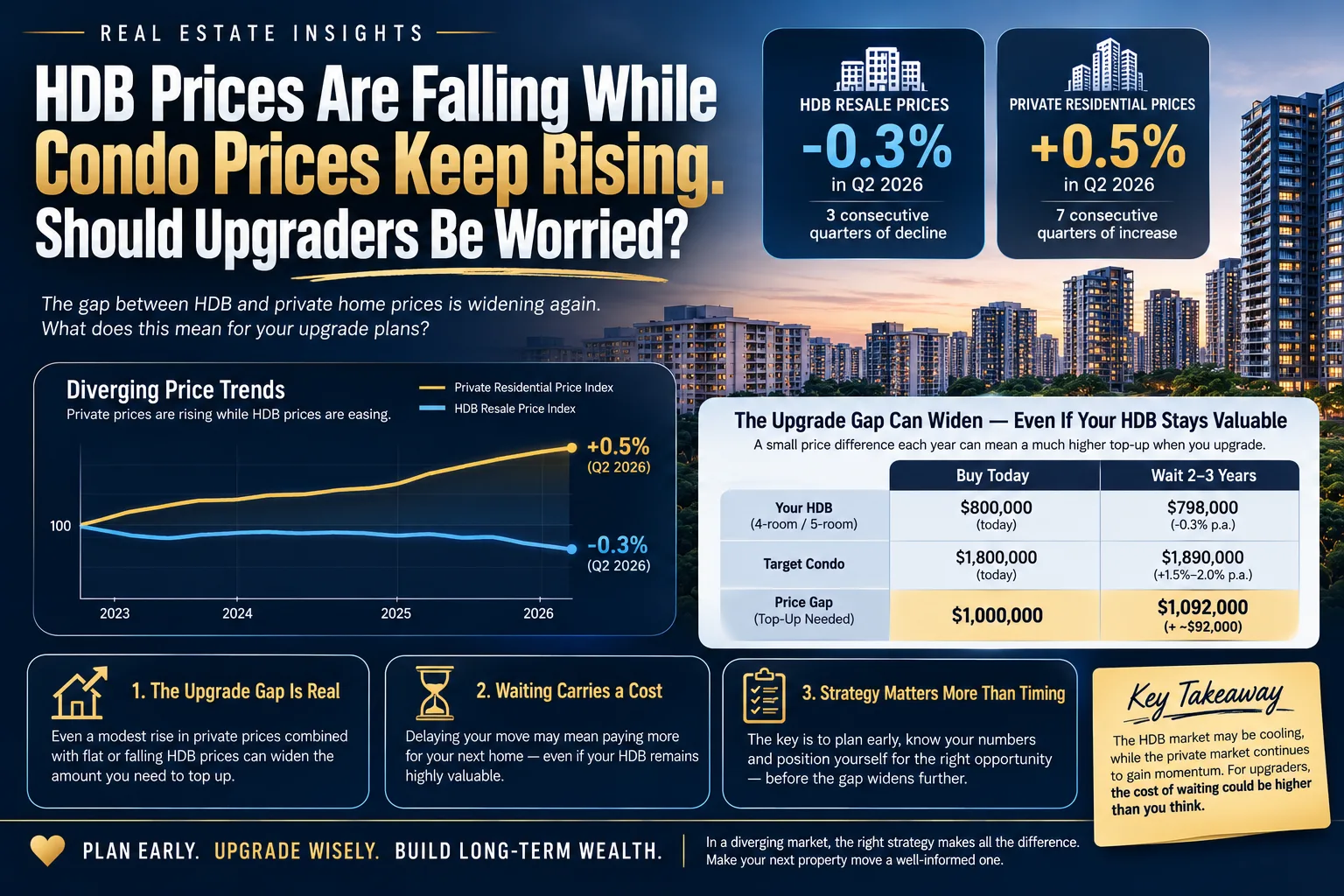
HDB prices are softening while condo prices continue to rise, creating a widening upgrade gap for HDB owners eyeing private property. This divergence makes asset progression more challenging if not carefully planned.
For years, one of the biggest advantages HDB owners enjoyed was simple.
Their home kept appreciating.
Many families bought a flat, waited for MOP, watched their property value grow and eventually used the accumulated equity as the springboard into private property.
It became an almost natural progression:
HDB → accumulate equity → sell → upgrade to condo.
But something interesting is happening in 2026.
The two markets have started moving in different directions.
HDB resale prices declined 0.1% in Q1 2026 and another 0.3% in Q2 2026. Q1 was the first quarterly decline in almost seven years.
Private residential prices, on the other hand, increased 0.9% in Q1 and another 0.5% in Q2, bringing private-home price growth to approximately 1.4% for the first half of 2026.
Neither movement looks dramatic on its own.
But put them together and an important problem emerges for HDB owners who eventually intend to upgrade.
The upgrade gap can become wider even when your HDB is still worth a lot of money.
And I think many homeowners underestimate this.
Your HDB Doesn't Need to Fall Much for You to Fall Behind
Suppose your current HDB is worth:
$800,000.
The condominium you would like to upgrade into costs:
$1.8 million.
Today, the difference is:
$1 million.
Many owners may look at that and say:
"Never mind. I'll wait another two or three years. My HDB should be worth more by then anyway."
For much of the previous market cycle, that thinking worked reasonably well.
But what happens if the two markets no longer move together?
Let's use a deliberately simple illustration.
Assume your $800,000 HDB remains completely flat.
And assume the $1.8 million condo appreciates at a fairly modest 3% annually.
After two years, that condo would cost approximately:
$1.91 million.
Your HDB is still worth $800,000.
The upgrade gap has grown from:
$1 million → approximately $1.11 million.
You now need another $110,000 just to buy exactly the same type of property.
Wait three years and that $1.8 million condo becomes roughly:
$1.97 million.
Your upgrade gap is now around:
$1.17 million.
Without doing anything, the goalpost has moved approximately $170,000 further away.
That's the part many owners don't see.
Now Imagine Your HDB Softens Slightly Too
Let's take the same example.
HDB today:
$800,000
Target condo:
$1.8 million
Suppose the HDB declines by just 0.5% a year for the next three years.
Nothing dramatic.
After three years, it would still be worth approximately $788,000.
Meanwhile, if the condo grows by 3% annually, it reaches approximately $1.97 million.
The upgrade gap becomes roughly:
$1.18 million.
Compared with $1 million today, the family effectively needs almost $180,000 more.
Again, nothing crashed.
Nothing boomed.
But the upgrader became significantly worse off.
That is why I constantly tell clients:
Asset Progression is about relative movement, not simply whether your own property goes up.
"But My HDB Has Already Made Me A Lot Of Money"
This is another conversation I hear frequently.
And it may be completely true.
Someone may have bought their flat for $450,000.
Today it is worth $800,000.
That's a very respectable increase.
Naturally they feel comfortable waiting.
But your historical profit doesn't determine whether upgrading becomes easier tomorrow.
What matters is what your existing property does from today onwards relative to the asset you're trying to purchase.
If your HDB rises from $800,000 to $820,000 but your target condo moves from $1.8 million to $2 million...
Technically, both properties appreciated.
Emotionally, the HDB owner feels richer.
But financially?
The upgrade became more expensive.
This is why looking only at your property's percentage gain can be misleading.
The Real Number Upgraders Should Track Is The Price Gap
Instead of asking:
"How much is my HDB worth?"
I think homeowners considering private property should also ask:
"How far am I from the property I want?"
That second number is much more meaningful.
Think of it this way.
Scenario A
HDB: $800,000
Condo: $1.8 million
Gap: $1 million
Scenario B
HDB: $850,000
Condo: $2.05 million
Your HDB has appreciated $50,000.
Sounds good.
But the gap has widened to:
$1.2 million.
You became $200,000 further away from your target despite making money on your HDB.
That is the upgrader's dilemma.
Why Could This Gap Continue Widening?
There are several reasons.
1. HDB Supply Is Improving
The Government has been increasing new-flat supply, while more flats are also reaching MOP.
Greater choice reduces some of the urgency that previously pushed HDB resale prices aggressively higher.
HDB's official figures already show two consecutive quarters of declining resale prices, while Q2 resale volume was also lower year-on-year.
That doesn't mean HDB prices are going to collapse.
I don't expect that.
But the period where almost every HDB segment appreciated rapidly together may be behind us for now.
2. Private Replacement Costs Remain High
At the same time, developers continue buying land at substantial prices.
Construction costs remain elevated.
Financing costs money.
Every new GLS tender creates the cost base for tomorrow's condominium.
This is why we've been seeing new-launch prices reach levels that would have seemed extraordinary only a few years ago.
$2,500 psf.
$2,800 psf.
$3,000 psf and above in selected locations.
So even if private-property price growth moderates, the replacement-cost floor can remain high.
3. HDB and Private Housing Have Different Supply Dynamics
This is perhaps the most important structural point.
HDB exists primarily to fulfil Singapore's public-housing objectives.
Government can increase BTO supply considerably when housing demand requires it.
Private housing operates differently.
Land supply is managed through GLS, while development costs and market conditions strongly influence selling prices.
That means the two markets do not have to appreciate at the same speed.
And when they diverge, upgrading becomes harder.
Does This Mean Every HDB Owner Should Upgrade Now?
Absolutely not.
That would completely miss the point.
I don't believe in telling everyone:
"Your HDB isn't moving, quickly buy condo."
Property decisions need to make sense financially and personally.
Some families should remain in HDB.
Some should upgrade later.
Some should never buy private property because their capital can be deployed more effectively elsewhere.
I've advised clients who could comfortably afford private property but deliberately chose to remain in HDB because that suited their financial philosophy better.
There is nothing wrong with that.
The problem arises when someone definitely intends to upgrade, can comfortably afford to do so, but delays purely because they expect their HDB to appreciate sufficiently to fund the next move.
That assumption now deserves closer scrutiny.
Waiting Has A Cost
We often think waiting is free.
It isn't.
Every property decision has an opportunity cost.
If you wait three years, three things can happen.
Your property appreciates faster than the target property.
Great.
The upgrade becomes easier.
Both appreciate at roughly the same pace.
Fine.
The gap stays manageable.
Or...
Your property underperforms the target asset.
Then waiting becomes expensive.
What concerns me in 2026 is that we are finally seeing evidence of the third scenario.
HDB resale prices are moderating while private residential prices remain positive.
It may reverse next quarter.
It may not.
Nobody knows.
But the possibility itself should change how potential upgraders plan.
The Removal Of The 15-Month Wait-Out Period Adds Another Interesting Dimension
The Government recently removed the temporary 15-month wait-out period for eligible private property owners buying non-subsidised HDB resale flats without an HDB loan.
The move came after several quarters of HDB price moderation.
This is important because it effectively reopens the HDB market to a group of financially strong private-property right-sizers.
On the ground, we've already seen renewed interest in larger HDB formats.
That could provide support to:
5-room flats.
Executive Apartments.
Executive Maisonettes.
DBSS flats.
And premium homes in mature estates.
So I don't expect the HDB market to simply decline across the board.
Quite the opposite.
I think it will become increasingly segmented.
Good HDB assets may continue doing very well.
Average ones may struggle more.
This Makes Asset Selection Important On Both Sides
An upgrader should therefore not simply compare:
HDB versus condo.
You need to compare:
your specific HDB versus the specific condo segment you're targeting.
Imagine someone owns a rare Executive Maisonette near an MRT.
That asset may behave very differently from an ordinary four-room flat surrounded by hundreds of competing units.
Likewise, a mass-market resale condo may behave very differently from a new integrated development or a project near a major transformation area.
There is no longer one HDB market.
There is no longer one private market either.
I Would Ask Every Potential Upgrader These Five Questions
Before deciding whether to move, I would want to know:
What is your current HDB realistically worth today?
Not the highest asking price in the neighbourhood.
Actual achievable value.
How much equity can you unlock after your outstanding loan and CPF refund?
This tells us what you genuinely have available.
What private property are you actually targeting?
$1.6 million?
$2 million?
$2.5 million?
The target matters.
How has that target segment been moving compared with your current HDB?
This is where the upgrade gap becomes visible.
Can you comfortably hold the next property through a weak market?
Upgrading should improve your long-term position.
It should not create financial stress.
Sometimes Upgrading Earlier Can Actually Reduce Risk
This sounds counterintuitive.
People tend to think:
"I'll wait until I have more money, then upgrading will be safer."
That can be true.
But sometimes waiting increases the amount you eventually need to borrow.
Go back to our $800,000 HDB and $1.8 million condo.
If the gap increases by $180,000 over three years, you may eventually need:
more cash,
more CPF,
or a bigger mortgage
to buy exactly the same category of home.
So the important question isn't simply:
"Can I afford the condo today?"
It is:
"If I intend to own this type of property eventually, what is the cost of waiting?"
That's a very different conversation.
What If Condo Prices Fall Instead?
Absolutely possible.
Property markets don't move in straight lines.
Singapore is also bringing substantial private housing supply to market. URA says around 60,600 private residential units including ECs are expected to be completed over the coming years, while 2026 GLS Confirmed List supply is significantly above the past decade's annual average.
That could moderate future price growth.
Economic uncertainty could also affect buyer sentiment.
So I am certainly not arguing:
"Condo prices will definitely keep rising. Buy now."
What I am arguing is much simpler:
Potential upgraders should stop making decisions based only on what they think their HDB will be worth later.
You need to track both sides of the equation.
The Biggest Mistake Is Waiting Without A Plan
This is the situation I worry about most.
A family says:
"We'll probably upgrade in three years."
Why three years?
No particular reason.
They aren't monitoring their financial position.
They aren't tracking the condo market.
They aren't building additional cash reserves.
They're simply waiting.
Three years later, they check again.
Their HDB has appreciated $30,000.
Great.
But their target condo is $250,000 more expensive.
Suddenly, the move feels impossible.
That isn't bad luck.
That's a planning problem.
My View
The divergence between HDB and private residential prices in 2026 is not something I would panic about.
HDB prices have only softened modestly.
Private prices are rising much more slowly than during some earlier periods.
But I think this divergence gives homeowners an important reminder.
Your property journey cannot be planned by looking at one asset in isolation.
If your long-term objective is to remain in HDB and grow wealth through other investments, that's perfectly fine.
If your objective is eventually to own private property, then you need to understand the relationship between the asset you own and the asset you want.
That's Asset Progression to me.
Not blindly upgrading.
Not telling everyone to buy private property.
It's understanding where you are today...
where you want to be tomorrow...
and whether the gap between the two is getting smaller or larger.
HDB owners have accumulated tremendous wealth over the past several years.
That puts many families in an excellent financial position.
The important thing now is not to become complacent because your home has already appreciated.
Because sometimes the biggest property risk isn't your home losing value.
It's the home you eventually want appreciating faster than the one you already own.
And for potential HDB upgraders, that may be the most important number to watch in the next phase of Singapore's housing market.
Want the tailored version for your portfolio?
Every article here generalises. A 20-minute conversation makes it specific to your numbers.
Are HDB resale prices falling in Singapore in 2026?
Are private property prices still increasing?
What is the “upgrade gap”?
Can my upgrade gap increase even if my HDB appreciates?
Should HDB owners upgrade before condo prices rise further?
Does falling HDB prices mean I should sell now?
Will the removal of the 15-month wait-out period support HDB prices?
Which HDB owners should pay most attention to the upgrade gap?
Is it better to upgrade to a new launch or resale condo?
How should I decide whether to upgrade now or later?
What is the main lesson for HDB upgraders in 2026?

Written by
Christopher Ng (CEA R014394H)
Singapore Property & Asset Progression Strategist with ERA Realty Network. A NUS Real Estate graduate, Christopher has advised homeowners, investors and property owners since 2004.