
Singapore Needs More Homes — But Where Are We Going to Build Them?
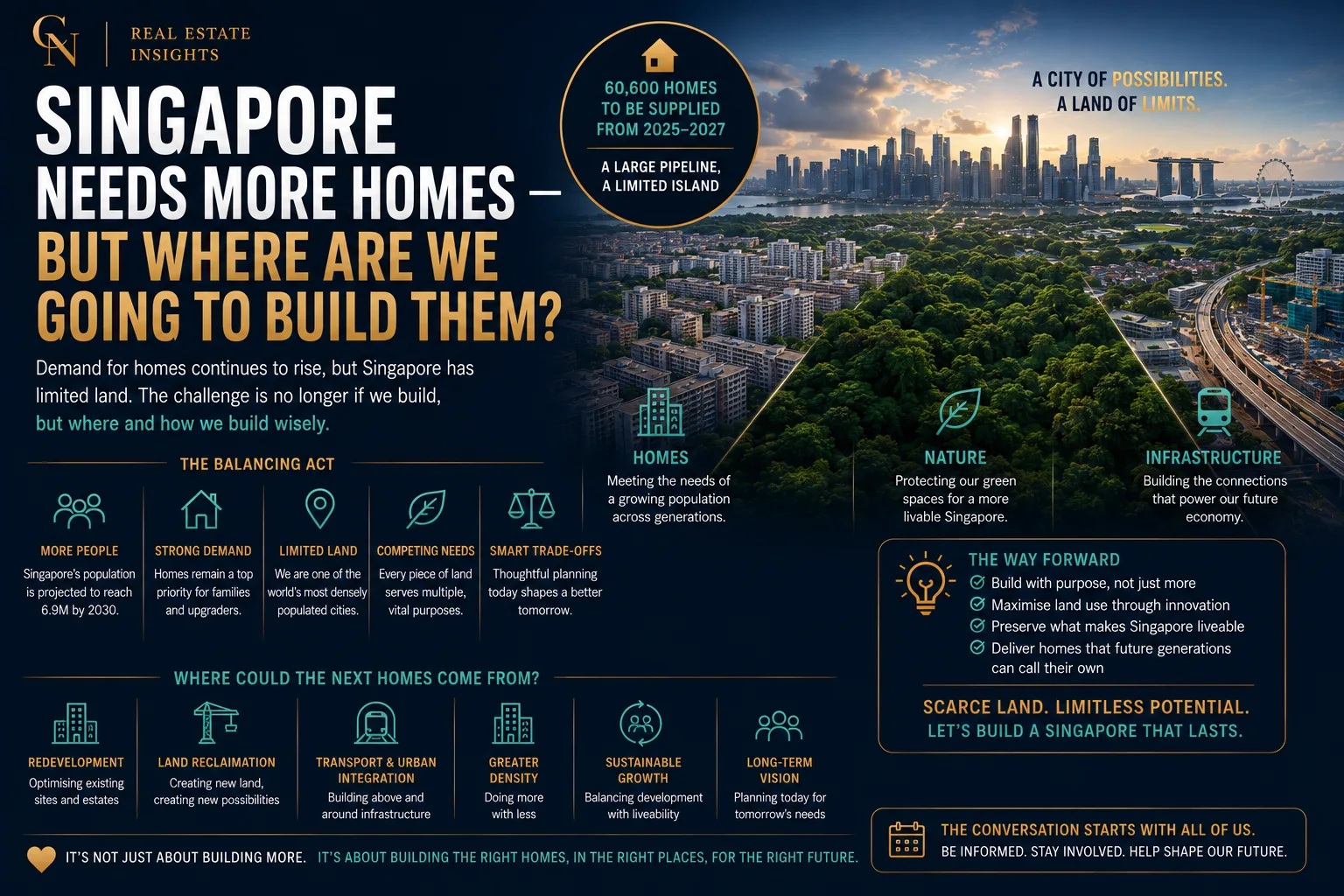
Singapore faces a land scarcity challenge, balancing the need for more housing with preserving natural spaces. This article explores how rethinking land use, from golf courses to GCB areas, can help meet demand without sacrificing vital gre
Maju Forest has suddenly become much more than a story about trees.
It has become a conversation about Singapore.
About housing.
About population.
About nature.
And ultimately, about one resource we simply cannot manufacture more of:
Land.
The original proposal for Maju Forest involved developing around 15 hectares of the 23-hectare secondary forest, while retaining about 8 hectares for greenery, wildlife movement and a nature trail. Following public concern, including petitions attracting more than 49,000 signatures, the Government has said the plans will be revised to retain more greenery, although the final configuration has yet to be announced.
I understand both sides of the debate.
Singapore needs homes.
Young families want somewhere affordable to live.
Parents want their children to stay close by.
At the same time, once an established forest is cleared, we cannot simply plant another row of trees somewhere else and pretend we have replaced what was lost.
So perhaps the real question shouldn't simply be:
“Should we build at Maju Forest?”
The bigger question should be:
“Before we develop more natural land, have we made the best possible use of the land we already have?”
And I think that question deserves a much wider discussion.
The Housing Need Is Real
Let's start there.
This isn't a manufactured problem.
Singapore continues to need more homes.
On the private housing side alone, the 2026 GLS Confirmed List will supply 9,320 residential units, more than 50% above the average annual Confirmed List supply over the previous decade. About 60,600 private homes including ECs are expected to be completed over the coming years.
Public housing demand obviously adds another very large requirement.
And this isn't simply about population growth.
Households are changing.
Families are getting smaller.
People are living longer.
Singles form households of their own.
Older parents may live separately from their adult children.
All these trends mean Singapore can require more homes even without population increasing at the same rate.
Housing therefore has to come from somewhere.
And Singapore Has Already Been Recycling Land
One thing Singapore has done remarkably well is to constantly reconsider how land is being used.
Industrial estates move.
Ports move.
Military facilities relocate.
Old school sites are reused.
Racecourses are redeveloped.
And golf courses are progressively being taken back.
The former Keppel Golf Course is perhaps one of the best examples.
The 48-hectare site is being transformed into a major new neighbourhood at the Greater Southern Waterfront. URA's latest plans indicate the precinct will eventually accommodate around 10,000 public and private homes.
Bukit Timah Turf City is another.
The former racecourse is planned to accommodate approximately 15,000 to 20,000 homes over the next 20 to 30 years, while retaining elements of greenery and heritage within the new estate.
To me, these are very important examples.
They demonstrate that land use is never permanent simply because something has occupied the site for decades.
As Singapore's needs evolve, the way we use land has to evolve too.
Which Brings Me To Golf Courses
I say this as someone who enjoys golf.
Golf is a wonderful sport.
But if we are having an honest national conversation about scarce land, golf courses have to be part of it.
An 18-hole golf course can occupy an enormous amount of land while serving a relatively limited number of people at any one time.
And Government policy already recognises this trade-off.
MND has said that by 2030, more than 400 hectares of golf-course land will have been taken back for redevelopment, including land from Keppel Club, Jurong Country Club, Raffles Country Club, Marina Bay Golf Course and eventually Orchid Country Club.
More changes are already scheduled.
Warren Golf and Country Club's 51-hectare site and Orchid Country Club's 107-hectare site are among land parcels whose future use is changing, while Singapore is expected to have fewer golf courses over time.
I think that is the right direction.
Not because golf should disappear.
But because in a land-scarce city, every activity requiring a large dedicated footprint should periodically justify that footprint.
Could Golf Be Provided Differently?
Perhaps we don't always need traditional 18-hole courses.
We could have:
driving ranges,
short courses,
nine-hole facilities,
simulators,
regional access to courses outside Singapore,
and more intensive recreational formats.
The question isn't whether Singaporeans deserve leisure.
Of course we do.
The question is whether the same recreational outcome can be achieved using less land.
If it can, then that should be part of the calculation before an irreplaceable natural area is cleared.
And What About Good Class Bungalows?
This is where the discussion becomes more uncomfortable.
Singapore has 39 designated Good Class Bungalow Areas. URA safeguards these areas as part of Singapore's landed housing landscape, and some bungalow precincts also carry architectural, historical and landscape value.
I understand why GCB areas exist.
They create a different urban form.
They preserve established low-rise neighbourhoods and greenery.
They are part of Singapore's housing diversity.
And importantly, GCB land is privately owned residential land—not simply a Government reserve that can be converted overnight.
So I would not suggest that Maju Forest can simply be “saved by building HDB flats in GCB areas”.
It isn't that simple.
But the philosophical question is still worth asking.
In a country where land is extraordinarily scarce, how much land should permanently remain low-density for a very small number of households?
That is a legitimate planning question.
And I think it becomes more relevant as the price of housing and the competition for land increase.
There Is A Strange Irony Here
Many GCB areas themselves are extremely green.
Large gardens.
Mature trees.
Low building coverage.
Open landscapes.
In some respects, that low-density environment contributes to Singapore's greenery.
But ecologically, a manicured private garden is not necessarily equivalent to a regenerating forest ecosystem.
That distinction matters.
A forest provides biodiversity, ecological connectivity and habitat that cannot always be recreated through landscaping.
So when deciding what greenery to retain, perhaps we also need to distinguish between:
green-looking land and ecologically valuable land.
They are not always the same thing.
Perhaps We Need A Better Framework For Deciding What Goes
Rather than treating every piece of land equally, I would evaluate competing uses through four questions.
1. How Irreplaceable Is It?
A golf course can be recreated elsewhere.
A football field can be relocated.
A clubhouse can be rebuilt.
A mature ecological habitat may take decades to regenerate—and some biodiversity may never return.
That should carry weight.
2. How Many People Benefit?
Housing for thousands of families clearly provides substantial public benefit.
So does a large public park.
A facility serving a very narrow group should face a higher threshold when competing for scarce land.
3. Can The Activity Be Intensified?
This is where Singapore has traditionally excelled.
Instead of one function occupying one piece of land, we increasingly stack uses.
Sports facilities can potentially sit above community facilities.
Schools can share sporting infrastructure.
Stadiums can serve several sports.
Buildings can combine transport, retail, healthcare and housing.
URA explicitly identifies co-location of compatible uses as one of Singapore's strategies for optimising land.
Why shouldn't the same thinking apply even more aggressively to recreation?
4. Can The Decision Be Reversed?
This matters enormously.
A temporary sports facility can eventually become housing.
A golf-course lease can expire.
A low-rise development can one day be redeveloped.
But once a mature forest ecosystem is cleared and roads, foundations and utilities are built through it, restoring the original habitat becomes much harder.
When decisions are effectively irreversible, I think the threshold for development should be higher.
This Principle Should Apply Beyond Golf
Golf is simply the most obvious example because of its enormous land footprint.
But I would apply the same question to any sport or recreational activity that requires large areas of dedicated land.
Equestrian facilities.
Large standalone sporting grounds.
Motor-sport facilities.
Certain club complexes.
Even football, rugby and cricket facilities deserve constant consideration of how spaces can be shared.
I am not arguing that Singapore should eliminate these activities.
A liveable country cannot consist only of apartments, offices and shopping malls.
Sport matters.
Recreation matters.
Culture matters.
Nature certainly matters.
But perhaps the future is less about giving every activity its own dedicated piece of land and more about designing multi-purpose spaces.
One field used by several sports.
One complex shared by schools and the public.
One recreational facility integrated into a larger development.
Singapore's Recreation Master Plan is already moving towards providing a broader mix of recreational opportunities, while URA's planning strategy increasingly emphasises multi-functional spaces.
That, to me, is how a land-scarce city should evolve.
Should Brownfield Land Always Come Before Forest?
Wherever practical, I think the answer should be yes.
And that is broadly consistent with Government planning policy.
MND says Singapore seeks to make better use of existing land through higher densities, co-location and redevelopment of brownfield sites such as golf courses, schools and industrial land. It also says a science-based approach is used to identify important biodiversity areas and buffers.
But “brownfield first” cannot mean “forest never”.
Singapore simply may not have enough brownfield sites in the right places and at the right times to meet every housing requirement.
Government has argued precisely this in relation to Maju Forest: brownfield alternatives alone are insufficient to meet anticipated housing needs.
That is the uncomfortable reality.
The real debate is therefore about sequence and threshold.
Before we clear ecologically meaningful land:
Have we intensified elsewhere?
Have we recycled old sites?
Have we reviewed low-intensity land uses?
Have we properly quantified the ecological cost?
Could fewer homes be built while retaining a larger green core?
Could the buildings be taller and occupy a smaller footprint?
Those are the questions I think Singaporeans are really asking.
The Maju Forest Response Is Actually Encouraging
One part of this story I find encouraging is that Government has responded to the feedback.
In August, Minister of State Alvin Tan said more greenery would be retained at both Maju Forest and Gillman Barracks, although doing so would mean fewer homes could be built there.
That is exactly what planning is.
Trade-offs.
There is no outcome where everyone gets everything.
More forest means fewer homes.
More homes may mean taller buildings elsewhere.
More golf courses mean less land available for other uses.
More low-density housing means higher density has to be accommodated somewhere else.
The important thing is that those trade-offs are made consciously and transparently.
What Does All This Mean For Singapore Property?
There is also a property-market lesson here.
Every debate like Maju Forest reminds us just how difficult it is to create new housing supply in Singapore.
Before a single home is built, planners must resolve:
ecology,
transport,
infrastructure,
community concerns,
heritage,
recreation,
and competing national uses.
Land does not simply appear because housing demand increases.
This is one reason I remain fundamentally constructive about Singapore real estate over the long term.
Not because prices must always go up.
They won't.
Not because supply is permanently limited.
Government is actively increasing it.
But because creating well-located housing in Singapore is inherently difficult.
That underlying land scarcity is real.
And as we become more conscious about preserving natural areas, perhaps genuinely developable land becomes even more precious.
But Property Owners Shouldn't Celebrate The Loss Of Greenery
This is another point I feel strongly about.
Someone might argue:
"If less land gets developed, my property becomes more scarce. Good for prices."
I think that's far too narrow.
A city where every available green area is developed may ultimately become a less desirable place to live.
And if Singapore becomes less liveable, property values don't win.
Nature itself contributes to real-estate value.
Look at the premiums people pay to live beside:
Botanic Gardens,
MacRitchie,
Bukit Timah Nature Reserve,
East Coast Park,
the Rail Corridor,
and our reservoirs.
Greenery is not the enemy of property value.
Very often, it is part of the value.
The goal therefore should not be maximum development.
It should be optimal development.
My View
I don't think the Maju Forest debate has a simple answer.
Singapore genuinely needs more homes.
Young families genuinely need affordable housing.
And Government cannot solve every housing requirement purely by recycling old buildings.
But I also think society is right to ask difficult questions before we sacrifice natural spaces.
And perhaps those questions should extend beyond forests.
If land is scarce enough that we need to clear ecologically valuable areas for housing, then it is reasonable to ask whether every existing low-intensity use still deserves the same amount of land it enjoys today.
Golf courses.
Large private clubs.
Certain dedicated sporting facilities.
And yes, over the very long term, even the way we preserve extensive low-density residential zones deserves thoughtful discussion.
That doesn't mean eliminating them.
It means continually asking whether the balance remains appropriate.
Singapore's great strength has always been its ability to plan decades ahead.
The former Keppel Golf Course is becoming homes.
Turf City is becoming homes.
Ports will become neighbourhoods.
Paya Lebar Air Base will eventually become a new town.
At the same time, URA is strengthening ecological corridors, park networks and green-blue spaces as part of the Long-Term Plan.
Perhaps that is ultimately the Singapore model.
Not choosing homes over nature.
Not choosing nature over homes.
But constantly finding ways to use every hectare better.
And before we remove something that nature took decades to create, I think it is fair to ask whether there are other pieces on the board that can be moved first.
Because Singapore will always need more homes.
But the kind of Singapore those homes are built in matters just as much.
Want the tailored version for your portfolio?
Every article here generalises. A 20-minute conversation makes it specific to your numbers.
What is happening at Maju Forest?
Why does Singapore want to build housing there?
Is Maju Forest protected nature reserve land?
Why not use golf-course land instead?
Should Singapore get rid of all golf courses?
Why not redevelop Good Class Bungalow Areas instead?
Are private gardens equivalent to natural forests?
What other sports should Singapore review for land use?
Is Singapore running out of land for housing?
Does land scarcity mean Singapore property prices will always rise?
What is the main lesson from the Maju Forest debate?
Written by
Christopher Ng (CEA R014394H)
Singapore Property & Asset Progression Strategist with ERA Realty Network. A NUS Real Estate graduate, Christopher has advised homeowners, investors and property owners since 2004.