
60,600 Private Homes Are Coming: Is Singapore Heading Towards an Oversupply Problem?
Singapore is set to welcome 60,600 new private homes, raising questions about potential oversupply. This article explains why the next property cycle will prioritize careful selection over simply buying new launches, focusing on location, t
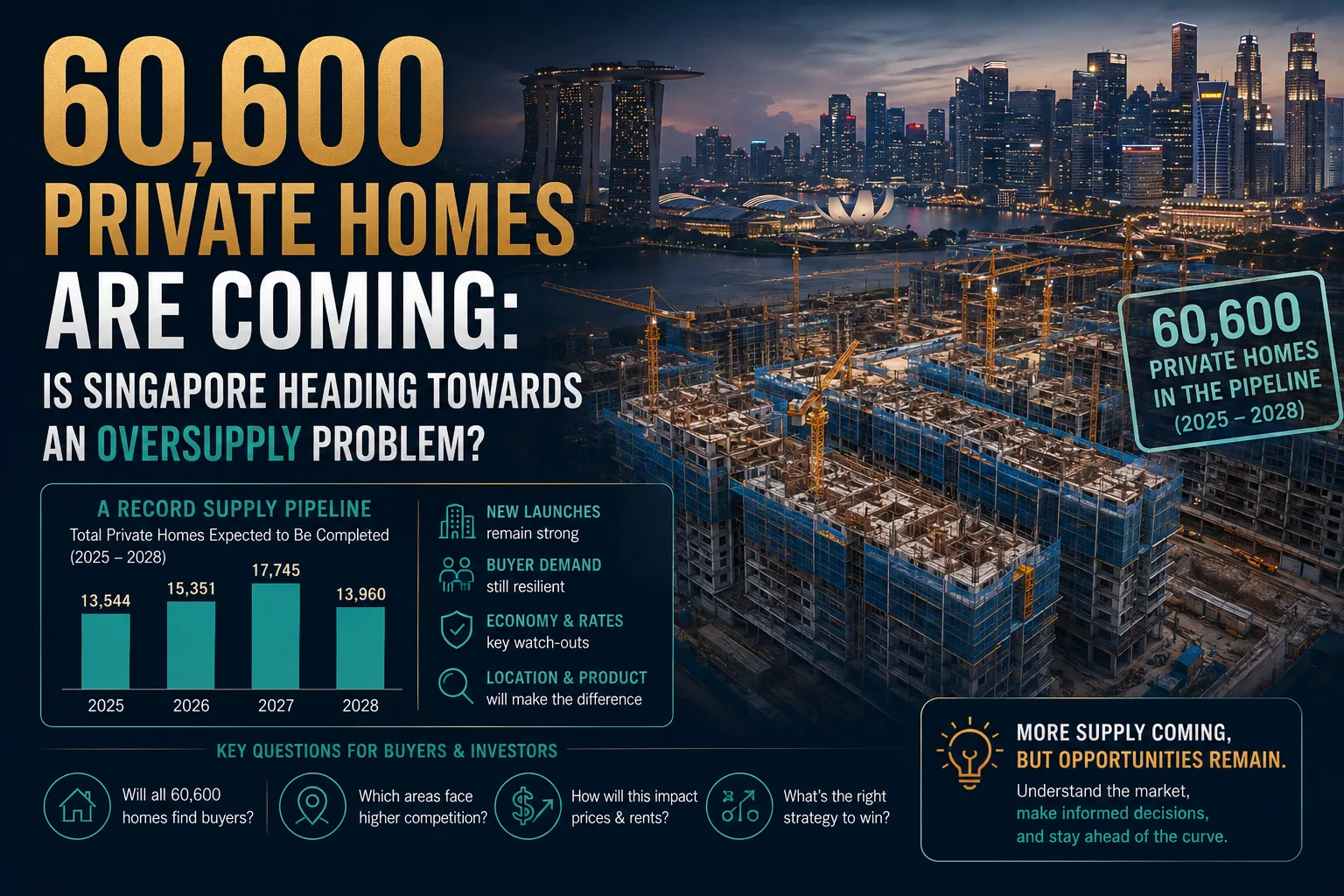
Why I think the next Singapore property cycle will be about project selection, not simply buying new launches.
60,600.
That is a number Singapore property buyers should pay attention to.
According to URA's latest figures, approximately 60,600 private residential units, including Executive Condominiums, are expected to be completed over the coming years.
At the same time, the Government continues to keep land supply high.
For 2026 alone, the Confirmed List of the Government Land Sales (GLS) Programme will provide 9,320 private residential units, more than 50% above the average annual Confirmed List supply over the past decade.
Naturally, I've started getting questions.
"Chris, are we building too many homes?"
"Will there be an oversupply?"
"Should I still buy a new launch?"
"Will condo prices fall when all these units TOP?"
These are very valid questions.
And my answer is:
Yes, supply risk is increasing. But 60,600 homes does not automatically mean 60,600 competing homes.
That distinction is going to become extremely important.
Because I believe the next phase of Singapore's property market will be very different from the last.
The easy strategy of simply buying a new launch and assuming that rising replacement costs will eventually lift everything may no longer be enough.
The next cycle will increasingly be about selection.
Where are you buying?
What are you buying?
What price are you entering at?
What competing supply will exist when you eventually sell?
And most importantly:
Who is going to buy your property from you five or ten years from now?
First, Let's Understand the 60,600 Number
The headline sounds enormous.
But we need to understand what it actually represents.
As at the end of Q2 2026, there were 42,472 private residential and EC units in the supply pipeline with planning approval. Of these, 15,810 remained unsold.
There were another 18,153 unsold units without planning approval yet, including the upcoming GLS supply.
And importantly, the 60,600 homes aren't all arriving next year.
URA expects approximately:
25,900 units to be completed by 2028, and
34,700 units from 2029 onwards.
That's the first misconception we need to clear up.
We aren't waking up one morning with 60,600 empty condominiums looking for buyers.
This supply will enter the market progressively over several years.
And some of those 60,600 units have already been sold.
So the headline number isn't the same thing as 60,600 unsold homes.
That matters.
But We Shouldn't Ignore the Supply Either
While I don't think we should panic, I also wouldn't dismiss the number.
Government policy is quite clear.
Singapore wants more housing supply.
The 2H2026 Confirmed List alone will contribute another 4,745 private residential units, bringing 2026's full-year Confirmed List supply to 9,320 homes. URA says this is more than 50% higher than the average annual Confirmed List supply over the previous decade.
This isn't accidental.
It is deliberate supply management.
When demand remains resilient and prices continue rising, increasing land supply is one of the ways Government can maintain a more stable housing market.
And we can already see price growth moderating.
Private residential prices increased 0.5% in Q2 2026, bringing the increase for the first half of 2026 to 1.4%, compared with 1.8% during the same period last year.
So yes.
More competition is coming.
The question is where that competition will be felt most.
Headline Supply Isn't The Same As Competing Supply
This is probably the most important point in this entire article.
When analysing supply, I don't just ask:
"How many units are coming?"
I ask four questions.
Where?
When?
At what price?
What type of units?
Because property markets are local.
A new 1,000-unit development in Tengah doesn't directly compete with a freehold boutique development in Novena.
A two-bedroom investment unit in one-north doesn't necessarily compete with a four-bedroom family home in Upper Thomson.
A $1.8 million OCR condominium isn't targeting the same buyer as a $4 million CCR apartment.
Yet all of them are counted as "private residential supply".
This is why headline numbers can sometimes be misleading.
Location Will Matter Much More
Imagine two developments.
Project A has another 3,000 new homes being completed within its immediate surroundings over the next five years.
Project B has almost no meaningful new supply nearby.
Everything else being equal, which owner has the stronger negotiating position when selling?
Probably Project B.
This is why buyers need to start studying micro-supply, not just islandwide supply.
Ask:
How many GLS sites are nearby?
How many units can those sites produce?
What older developments could potentially be redeveloped?
How many new launches will compete with me?
When will they TOP?
What prices are developers paying for those sites?
This is increasingly how I look at property selection.
Timing Matters Too
Two projects can have exactly the same future supply but experience very different outcomes.
Suppose 3,000 units are coming into an area.
If they arrive gradually over ten years, the market has time to absorb them.
But if 3,000 homes TOP within two years?
That could create considerably more competition for tenants and resale buyers.
This is particularly important for investors.
Your biggest competition five years from now may not be the development beside you today.
It could be the three GLS sites being sold today that will become completed condominiums around the time you want to exit.
That's why investing based purely on today's surroundings can be dangerous.
We need to buy based on tomorrow's competition.
Price May Become The Biggest Differentiator
This is where our recent GLS discussions become relevant.
Land prices have been rising.
Construction costs remain substantial.
Developers still need margins.
And increasingly, new projects are establishing higher price benchmarks.
We've already seen buyers accept the $3,000 psf conversation in several parts of Singapore.
But there is a limit to how far price gaps can stretch.
Imagine a future market where:
A new launch costs $3,000 psf.
A five-year-old condo nearby costs $2,300 psf.
An older freehold development costs $2,000 psf.
At some point, buyers start comparing.
Is being brand new worth another $700 psf?
Sometimes the answer is yes.
Sometimes absolutely not.
This is why I think resale properties may become increasingly important in the next cycle.
The Resale Market Is Already Telling Us Something
In Q2 2026, developers sold 2,141 new private homes, excluding ECs.
During the same quarter, there were 3,813 resale transactions.
Resale therefore represented 62% of all private residential sale transactions, up from 59.6% in the previous quarter.
That gets my attention.
Despite all the excitement surrounding new launches, the majority of actual private residential transactions are still happening in the resale market.
Why?
Because buyers compare value.
A new launch may offer:
better facilities,
newer design,
lower initial maintenance,
efficient layouts,
and a fresh 99-year lease.
But resale can offer:
more space,
immediate occupation,
established surroundings,
visible rental demand,
and sometimes a very substantial price discount.
As new-launch prices move higher, that comparison becomes increasingly important.
What Type of Homes Could Face Greater Supply Risk?
I would be particularly careful with generic investment units in locations with significant future supply.
For example, if you buy a compact two-bedroom primarily because it appears affordable, ask yourself:
How many similar two-bedroom units will exist nearby when I sell?
If another five developments complete around the same time and all contain hundreds of similar units, your future buyer has plenty of choice.
Your tenant has plenty of choice too.
That reduces your negotiating power.
This doesn't mean small units are bad investments.
It means fungible units require stronger entry discipline.
If buyers can easily substitute your unit with 500 others, price becomes the deciding factor.
Scarcity Will Become More Valuable
The opposite is also true.
As Singapore builds more homes, genuinely scarce products may become increasingly interesting.
These could include:
Freehold developments in supply-constrained locations
Large family-sized units
Developments within highly sought-after school belts
Integrated developments
Properties beside major transport nodes
Unique waterfront or landed-facing units
Large-format resale condos that are difficult to reproduce today
Scarcity doesn't guarantee appreciation.
But it gives future buyers fewer substitutes.
And fewer substitutes usually improve pricing power.
The Rental Market Is Another Area To Watch
There is one statistic in the Q2 figures that I think investors shouldn't ignore.
The vacancy rate for completed private residential properties increased from 6.2% to 6.4%.
More interestingly, the number of occupied private residential units actually declined by 387 units during the quarter.
At the same time, private residential rents still increased 0.7%.
So I wouldn't call this a rental problem yet.
But with tens of thousands of homes progressively completing, investors need to watch the relationship between:
new supply + tenant demand + rents + vacancy.
If supply grows faster than rental demand in a particular micro-market, landlords may eventually have to compete harder.
Again, location matters.
An apartment surrounded by major employment nodes may behave very differently from a development where tenant demand is primarily discretionary.
Will 60,600 Homes Cause Singapore Property Prices To Crash?
I don't think the evidence supports that conclusion.
At least not from the supply number alone.
Singapore isn't simply releasing 60,600 homes randomly.
The Government actively calibrates land supply according to housing demand and market conditions. URA has explicitly said that it will continue monitoring economic and property conditions and adjust GLS supply to maintain a stable and sustainable market.
There is also a structural point that is sometimes forgotten.
Singapore can require more homes even without equivalent population growth because households are becoming smaller.
The average resident household size declined from 3.43 persons in 2014 to 3.09 persons in 2024.
URA has similarly highlighted demographic change and evolving household needs as reasons Singapore will continue requiring additional housing.
So I don't interpret 60,600 homes as:
"Government thinks we have too many buyers."
I interpret it as:
"Government wants supply to remain ahead enough to prevent excessive market tightness."
That's very different.
But Could Some Projects Underperform?
Absolutely.
And I think this is the more important conversation.
We don't need the entire Singapore property market to fall for someone to make a poor investment.
You can have an overall market that rises 15% while your particular development rises only 3%.
That is underperformance.
And opportunity cost matters.
This is why I've become increasingly cautious about statements like:
"Singapore property always goes up."
Even if the broad market appreciates over time, individual projects can perform very differently.
The next five years could make that divergence much more obvious.
The Next Property Cycle Will Be About Selection
For much of the previous cycle, buyers benefited from several powerful forces.
Low supply.
Strong household formation.
Construction delays.
Rising replacement costs.
Low interest rates initially.
And strong upgrading demand.
Many properties benefited together.
I don't think the next cycle will be as forgiving.
With supply increasing, buyers need to become more selective.
For every property I'm considering today, I increasingly want answers to five questions:
What is my entry price compared with surrounding resale properties?
What competing supply will exist when I want to sell?
Who is my future buyer?
What does my property offer that buyers cannot easily find elsewhere?
If the market becomes flat for three years, would I still be comfortable owning this property?
If I cannot answer those questions confidently, I would think twice.
Should Investors Still Buy New Launches?
Yes.
But not simply because they're new launches.
There will still be excellent opportunities.
A developer may secure land at an attractive price.
A project may be the first mover in a major transformation area.
A particular unit type may have very limited competing supply.
A launch may be priced close enough to surrounding resale properties to create a compelling value proposition.
Those are reasons to buy.
"New launch always makes money" is not.
In a higher-supply environment, entry price becomes even more important.
What About Resale Condos?
I think resale deserves much more attention.
Especially where the price gap against new launches becomes excessive.
If I can buy a relatively young development at $2,200 psf while the new launch beside it is asking $2,900 psf, I want to understand why.
Perhaps the new launch genuinely deserves the premium.
But perhaps the resale property is simply being overlooked.
That is where opportunities can emerge.
The same applies to older freehold developments.
Sometimes the best investment isn't the newest building.
It's the property where the price-to-value gap is widest.
My View
So, are 60,600 private homes going to create an oversupply problem?
At an islandwide level, I don't think we should jump to that conclusion.
The supply is spread over multiple years, locations, market segments and price points. Some of those homes have already been sold, and Government continues to calibrate supply according to market conditions.
But I do think something important is changing.
Buyers will have more choice.
And when buyers have more choice, mediocre properties become harder to sell.
That is why I believe the next Singapore property cycle will be increasingly about asset selection rather than simply asset ownership.
Don't just ask:
"Should I buy property?"
Ask:
"Why should someone buy MY property from me five years from now?"
If your answer is simply:
"Because Singapore property prices always go up,"
I don't think that's good enough anymore.
Look at the future supply.
Look at replacement costs.
Look at resale alternatives.
Look at your future buyer pool.
Look at the price you're entering today.
Because 60,600 homes aren't necessarily 60,600 competitors.
But somewhere inside that number are the homes that will compete directly with yours.
Those are the numbers that really matter.
Want the tailored version for your portfolio?
Every article here generalises. A 20-minute conversation makes it specific to your numbers.
Are 60,600 private homes really coming to Singapore?
Does Singapore currently have 60,600 unsold private homes?
Is Singapore facing a private property oversupply?
Will Singapore condo prices fall because of the new supply?
Which condos are most vulnerable to oversupply?
Which properties could perform better despite increasing supply?
Should I still buy a Singapore new launch in 2026?
Is a resale condo better than a new launch now?
What should a five-year property investor focus on?
What is the biggest lesson from Singapore's 60,600-home supply pipeline?
How many homes will compete with mine when I eventually want to sell?

Written by
Christopher Ng (CEA R014394H)
Singapore Property & Asset Progression Strategist with ERA Realty Network. A NUS Real Estate graduate, Christopher has advised homeowners, investors and property owners since 2004.