
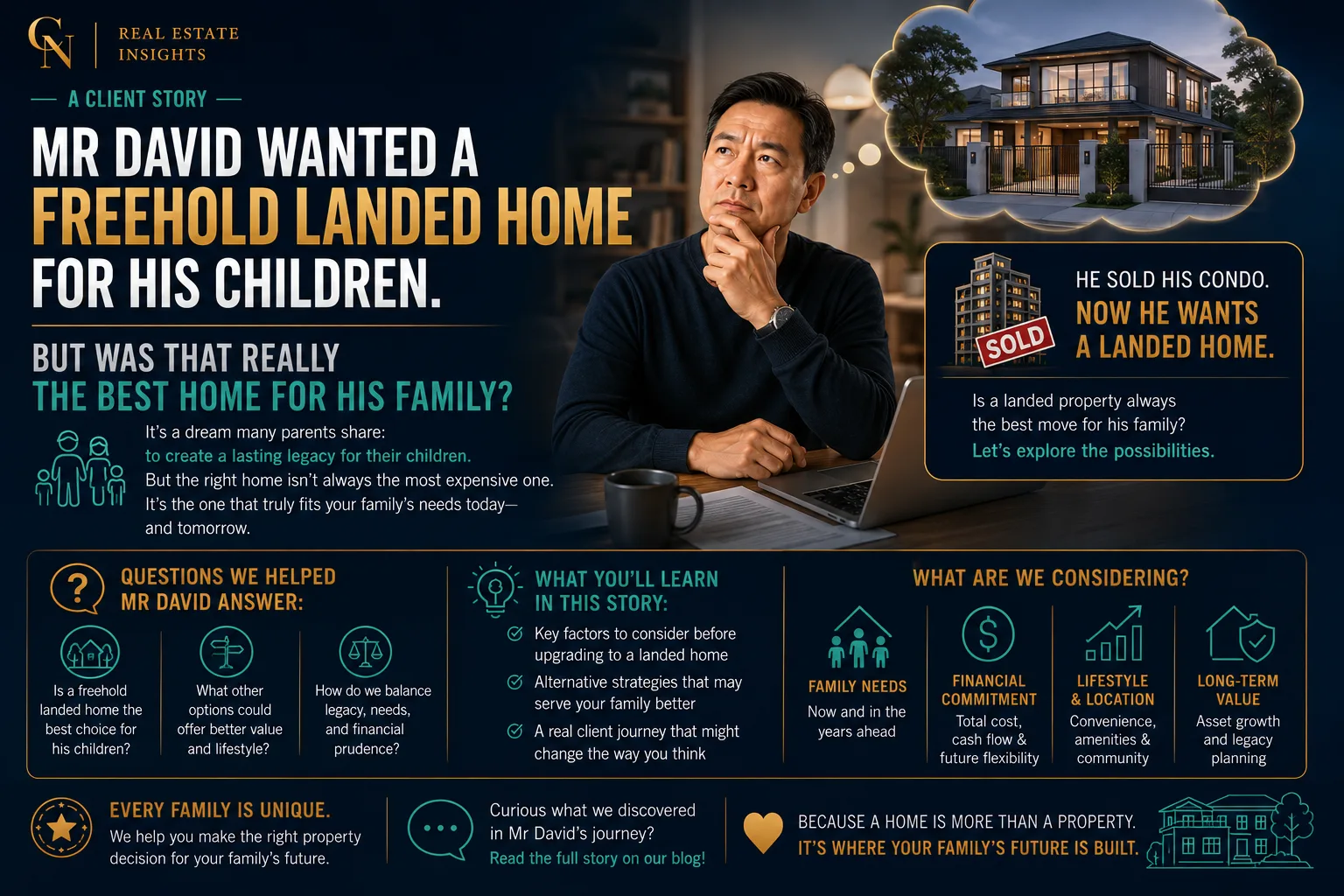
Mr David Wanted a Freehold Landed Home for His Children. But Was That Really the Best Home for His Family?
A client wanted a freehold landed home for legacy, but the right home for his family's enjoyment and current needs was a different solution. This case study explores balancing long-term assets with immediate family well-being.
There are some clients you meet once.
And there are others whose property journey you somehow become a part of.
Mr David is one of them.
We first met about six years ago when David called us from one of our marketing flyers.
At that time, Jasmine and I were staying near his estate ourselves, and we had embarked on a very focused marketing campaign covering five Executive Condominiums in that geographical area.
David's EC had just reached MOP.
He was staying in a 3-bedroom apartment with his family, and the problem was actually quite straightforward.
They were running out of space.
That phone call eventually started a relationship that has lasted six years.
And today, David has come back to us for the next chapter of his Asset Progression journey.
This time, he wants to move from a condominium into a landed home.
But what started as a fairly straightforward request —
"I want freehold landed."
eventually turned into a much deeper conversation about property, family, legacy and what we are actually working so hard for.
Six Years Ago: He Didn't Need A New Development. He Needed A Bigger Home.
When we first met David, we did what we normally do with our clients.
We sat down and went through a proper consultation.
What does the family need?
What do they want?
What resources do they have?
What can they comfortably afford?
What are their longer-term plans?
And after going through the numbers and considering the alternatives, we realised something.
David didn't actually need to leave his development.
He liked the estate.
His family was familiar with the surroundings.
The location worked for them.
The development worked for them.
The only thing that wasn't working anymore was the size of their home.
So the solution became quite obvious.
Sell his existing 3-bedroom apartment and buy a larger 4-bedroom apartment in the exact same development.
And that was exactly what we did.
We marketed and sold David's 3-bedroom apartment at a good price.
Then we helped him purchase a spacious 4-bedroom apartment in the very same development — seven storeys above his old home.
He literally upgraded seven floors.
No change of estate.
No change of development.
No need to chase a shiny new project just because he was selling.
His problem was space.
So we solved the space problem.
I've always liked this story because it captures what Asset Progression means to me.
It isn't about making the most dramatic property move. It is about making the right move.
Six Years Later, David Called Again
Fast forward to today.
David recently reached out again.
The 4-bedroom apartment has served his family well over the past six years.
His career has progressed.
His financial position has strengthened.
And the Asset Progression decision we made together six years ago has had time to seed and grow.
Now, he feels ready for his next move.
This time:
Landed property.
And I increasingly see this among Singaporeans who reach a certain stage in life.
The first home is often about affordability.
The next home is about family needs.
And if life and career progress well, eventually the conversation starts changing.
"What do I actually want?"
"What have I been working towards all these years?"
"What kind of home would make me feel that I've arrived?"
For some people, it is a luxury condominium.
For others, a penthouse.
But for many Singaporeans, the ultimate aspiration remains:
A piece of land to call our own.
I sometimes describe this as a self-actualisation property move.
It is no longer simply about making money from property.
It is also about enjoying what you've worked so hard to build.
David's First Requirement Was Very Clear: Freehold
David had a budget of around $3.5 million.
And initially, he was quite clear.
Freehold landed only.
I understood exactly where he was coming from.
Like many Singaporean parents, when David thinks about landed property, he isn't only thinking about himself.
He is thinking about his children.
If I am going to spend $3.5 million buying landed property, shouldn't I buy freehold?
Then one day, I can leave it to my children.
And perhaps they can eventually leave it to theirs.
Legacy.
It is a very Singaporean way of thinking about property.
So we started searching.
And we were quite open on location.
At this stage, finding the right property was more important than insisting on one particular district.
But at around $3.5 million, reality quickly set in.
We Viewed Three Freehold Landed Homes
Nothing really caught our eye.
They had land.
They had freehold tenure.
They technically fulfilled the brief.
But what David was really buying was largely the land.
The houses themselves required substantial improvement before his family could enjoy the kind of home he imagined.
Renovation.
Structural improvements.
Possibly significant A&A depending on the property.
Suddenly, a $3.5 million purchase wasn't really a $3.5 million decision anymore.
And more importantly, David would be spending a substantial amount of money simply to get the house to a standard that suited his family.
That's when our first assumption started to unravel.
Are You Buying A Home Or Buying Land?
There is a difference.
At certain price points in Singapore's landed market, particularly at the entry level, buying freehold can effectively mean:
You are buying the land first and accepting whatever building happens to be sitting on it.
And there is nothing wrong with that.
For someone whose primary objective is long-term land ownership, that may be exactly the right strategy.
Buy the freehold land.
Accept the older building.
Improve it gradually.
Hold it for decades.
Pass it to the next generation.
Perfectly logical.
But was that really David's priority?
We weren't so sure anymore.
So we explored Plan B.
What About Freehold Strata Landed?
This seemed like a reasonable compromise.
David could retain the freehold tenure he wanted.
He could technically upgrade into landed living.
And perhaps we could find something more modern and move-in ready within budget.
So off we went again.
We viewed four freehold strata-landed developments.
And then another problem emerged.
David walked through the homes and realised:
The internal space felt smaller than his current 4-bedroom apartment.
That created a strange contradiction.
On paper:
Condo → Strata Landed = Upgrade.
But in actual living experience:
Spacious 4-bedroom → Smaller home = Downgrade.
He would have achieved the property type he wanted.
But compromised on the very thing that started his first Asset Progression journey with us six years ago.
Space.
That was when I felt we needed to stop looking at properties for a moment.
We needed to go back to the consultation.
"David, Why Is Freehold So Important To You?"
I like asking clients this question.
Not:
"What do you want?"
But:
"Why do you want it?"
Because sometimes the answer completely changes the property search.
And when we dug deeper, we realised David's obsession with freehold wasn't really about tenure.
It was about his children.
He wanted to build something that could eventually be passed down.
He wanted his property journey to create a legacy for the next generation.
And I completely understand that.
As parents, many of us eventually start thinking this way.
We work.
We save.
We invest.
We accumulate assets.
And somewhere along the journey, our definition of success starts to include:
"What can I leave behind for my children?"
But that led to another question.
And I think this was the question that ultimately changed our search.
How much should you compromise on your family's enjoyment today in order to leave something behind tomorrow?
The Singaporean Love Affair With Freehold
We Singaporeans love freehold property.
And there are perfectly good reasons for it.
A freehold landed property has no fixed lease expiry.
Land in Singapore is scarce.
The redevelopment potential can be valuable.
And psychologically, there is enormous comfort knowing that the asset can potentially remain in the family indefinitely.
For someone thinking about intergenerational wealth, freehold is naturally attractive.
If your objective is:
"I want an asset my children can inherit and potentially pass down again,"
then freehold deserves serious consideration.
But I think we sometimes take the next step too quickly:
Freehold = good.
Leasehold = bad.
Property isn't that simple.
Tenure is only one characteristic of an asset.
We still need to consider:
Location
Land size
Plot shape
Building condition
Built-up area
Internal space
Accessibility
Renovation requirements
Entry price
Future redevelopment potential
Family suitability
A freehold title cannot compensate for everything.
After Two Weeks, David Finally Said: "Okay, Let's Look At 99-Year Landed."
This was when the search changed completely.
We had spent roughly two weeks looking at alternatives.
Three freehold landed houses.
Four freehold strata-landed developments.
Many conversations in between.
Eventually, David became comfortable opening the search to 99-year leasehold landed properties.
And suddenly, we started finding homes that were much closer to what his family actually wanted.
The budget worked.
The buildings were better.
The usable space made sense.
The layouts suited the family.
Instead of walking into every house and asking:
"How much more do I need to spend to make this work?"
we could finally start asking:
"Can you actually see your family living here?"
That's a very different property-viewing experience.
And importantly, some of the properties we are considering have more than 80 years of lease remaining.
Which led us into another interesting conversation.
If There Are More Than 80 Years Left, Is There Really No Legacy?
Suppose David buys a landed property today with more than 80 years remaining on the lease.
He stays there for 20 years.
His children grow up there.
Birthdays happen there.
Christmas happens there.
Friends come over.
Grandparents visit.
His children eventually become adults.
Twenty years later, the property could still have more than 60 years of lease remaining.
Even after 30 years, there could still be more than 50 years left.
So does buying leasehold automatically mean:
"Nothing left for my children"?
I don't think the discussion should be that simplistic.
The better question may be:
What kind of legacy are you trying to create?
Is Legacy Only What We Leave Behind?
This case made me think quite a bit.
Sometimes we become so focused on leaving our children an asset that we forget something obvious.
Our children are living with us today.
If David buys the freehold landed property but spends the next 20 years in a house that doesn't really suit the family...
while another property would have given them considerably more space, comfort and enjoyment...
which one actually created the better legacy?
I don't think there is one correct answer.
Some parents genuinely prioritise preserving capital across generations.
That's perfectly valid.
They may willingly compromise on location, house condition or lifestyle today because they value owning freehold land for the long term.
Other parents may say:
"I've worked hard. I want my family to enjoy what I've built while we're all still living together."
Also perfectly valid.
Nothing right or wrong here.
What matters is understanding which one matters more to you.
Property Is Both An Asset And A Home
This is something we sometimes forget in Singapore because we are very good at talking about property as an investment.
PSF.
Capital appreciation.
Rental yield.
Freehold.
Lease decay.
Exit strategy.
All important.
But a residential property gives another kind of return that doesn't appear on an Excel spreadsheet.
The quality of life it gives you while you own it.
A bigger dining table where everyone can eat together.
A garden for the children.
A bedroom for each child.
Space for grandparents.
A living room where friends can gather.
A neighbourhood the family enjoys coming home to.
You can't calculate the IRR on those things.
But that doesn't mean they have no value.
Freehold Landed vs 99-Year Landed: How I Would Think About It
I wouldn't start with tenure.
I would start with priorities.
If your number-one objective is multi-generational wealth preservation
Then freehold becomes very important.
You may be prepared to accept:
An older house
A less convenient location
More renovation
A smaller built-up area
A higher entry price
because preserving the underlying land across generations matters more.
That can be the correct decision.
If your number-one objective is family enjoyment over the next 20 to 30 years
Then a well-selected 99-year landed home with a long remaining lease deserves serious consideration.
At the same budget, you may get:
Better condition
More usable space
A layout that actually works
Less immediate capital expenditure
A home your family enjoys from Day One
That can also be the correct decision.
Neither approach is universally superior.
The mistake is buying according to Priority A when your life actually requires Priority B.
And There Is A Nice Full Circle To David's Story
I find myself thinking back to our first conversation six years ago.
His problem then was:
"My 3-bedroom is no longer big enough for my family."
Our solution was:
Sell the 3-bed → buy the 4-bed → same development → seven storeys higher.
Today, we're facing a surprisingly similar question.
David wants landed.
But does buying landed make sense if the home itself gives him less usable living space than the 4-bedroom apartment we helped him buy six years ago?
That's why I think this journey has come full circle.
Six years ago, we learnt that the property label was less important than solving his family's actual needs.
Today, we are rediscovering exactly the same lesson.
Only the numbers — and the property type — have become bigger.
Six Years Ago, David Needed Space. Today, He Needs Clarity.
The first move was relatively straightforward.
His family needed more space.
We sold his 3-bedroom and bought him a 4-bedroom in the exact same development, seven floors higher.
Problem solved.
And importantly, that move didn't compromise his future financial position.
Six years later, he has progressed to the point where landed property is now a realistic conversation.
But this time, the decision is more philosophical.
What does he want his next property to do for his family?
Preserve wealth?
Create legacy?
Improve lifestyle?
Give the children more space?
Provide a home for the next 20 or 30 years?
Ideally, we want everything.
But at $3.5 million — or frankly at almost any budget — there will always be compromises.
The job is to decide which compromises you are prepared to make.
My Take: Set Your Priorities Before You Set Your Property Filters
We haven't bought David's landed home yet.
We're still searching.
And that's okay.
Because I think we've already achieved something important.
The search is much clearer today than it was two weeks ago.
Initially:
Freehold landed only.
Then:
Maybe freehold strata landed.
Today:
Let's find the landed home that actually works for the family.
If it happens to be freehold and within budget?
Fantastic.
If the better home turns out to be a 99-year property with more than 80 years remaining?
We will evaluate that properly too.
Because Asset Progression isn't about blindly climbing:
HDB → Condo → Landed → Freehold Landed.
It isn't a game where the person with the fanciest property label wins.
To me, Asset Progression means using property to progressively improve your family's financial position and your life.
Sometimes that means buying a more expensive property.
Sometimes it means buying a larger one.
Sometimes it means choosing the asset with better investment fundamentals.
And sometimes it means accepting a technically "inferior" tenure because the actual home is significantly better for your family.
There is no absolute right or wrong answer between freehold and leasehold.
There is only:
What matters most to you?
Once you know that answer, make sure the property you buy actually reflects it.
Because there is little point spending millions building a legacy for your children...
if you forget to enjoy the years when they're still living under the same roof with you.
Want the tailored version for your portfolio?
Every article here generalises. A 20-minute conversation makes it specific to your numbers.
Is freehold landed always better than 99-year leasehold landed in Singapore?
Why do Singaporeans prefer freehold landed property?
Is 99-year landed property a bad investment?
Is a landed property with more than 80 years of lease remaining worth considering?
Can I leave a 99-year leasehold landed property to my children?
Should I choose freehold landed or a better 99-year landed home?
Is freehold strata landed a good compromise?
Is moving from a condo to strata landed always an upgrade?
Why did David buy a 4-bedroom in the same development six years ago?
Why is David considering landed property now?
Why did David initially reject 99-year landed property?
What is a “self-actualisation” property move?
Does Asset Progression always mean upgrading to a more expensive property?
What is the biggest lesson from David's story?
Investment returns?

Written by
Christopher Ng (CEA R014394H)
Singapore Property & Asset Progression Strategist with ERA Realty Network. A NUS Real Estate graduate, Christopher has advised homeowners, investors and property owners since 2004.