
National Day Rally 2026 Part 2: Long Island, Pulau Tekong & Western Island — Singapore’s Next Chapter of Real Estate Planning and Land Use
Singapore is preparing for its next chapter of land creation, with major long-term projects like Long Island, expanded Pulau Tekong, and a new Western Island. These initiatives address future needs for housing, infrastructure, and industry,
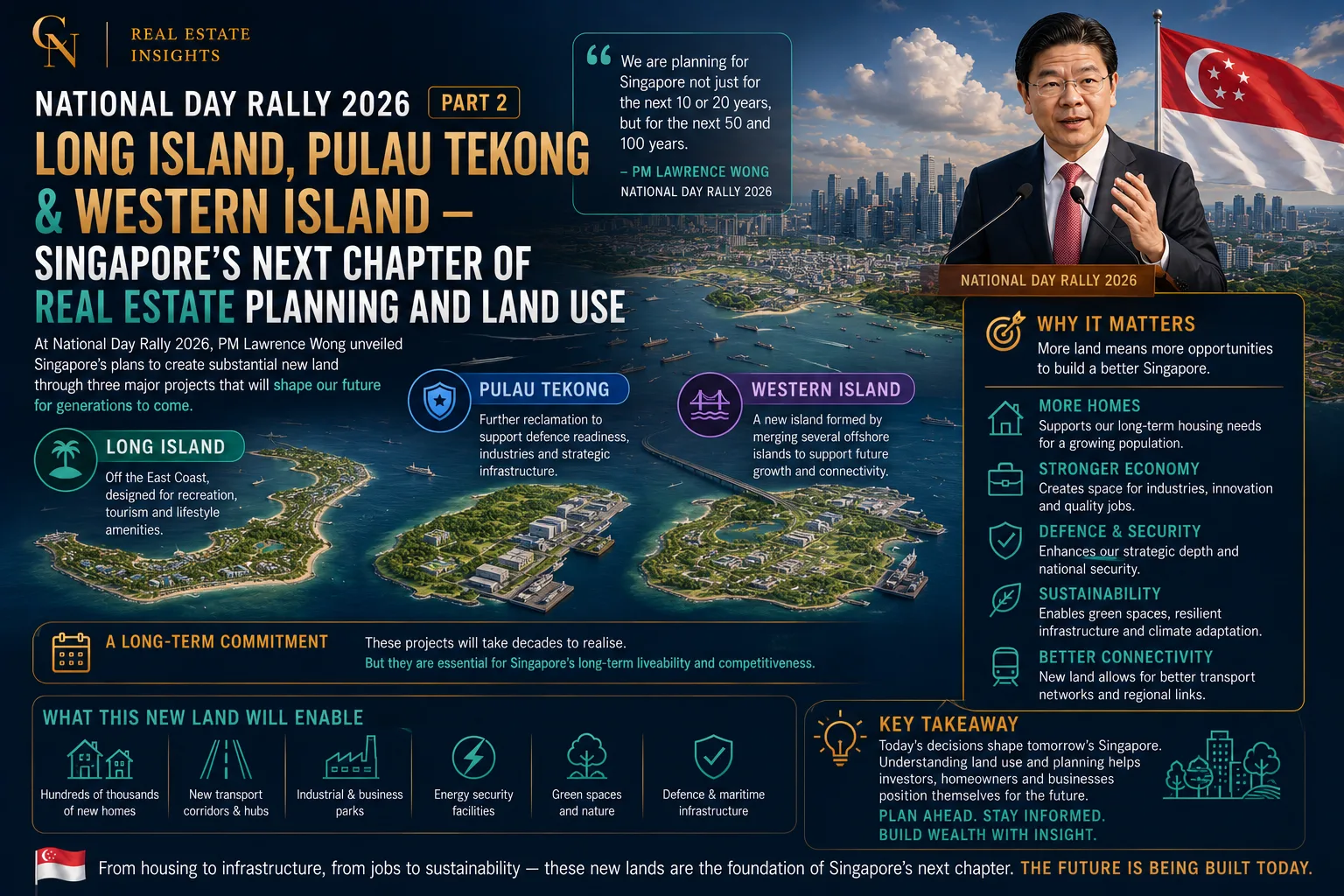
This is Part 2 of my National Day Rally 2026 real estate series. In Part 1, I looked at the housing changes that affect buyers today — from higher BTO and EC income ceilings to additional ballot chances for families. In Part 2, I want to zoom out much further. Not to the next BTO exercise or the next property cycle, but to what Singapore could look like several decades from now.
While the immediate housing changes naturally received much of the attention at National Day Rally 2026, I thought another part of Prime Minister Lawrence Wong's speech was potentially even more significant.
Not for someone buying a property tomorrow.
Perhaps not even for someone buying over the next five years.
But for the Singapore our children will eventually inherit.
Singapore is preparing for another major chapter of land creation.
Three long-term projects stood out:
Long Island off East Coast
Further reclamation at Pulau Tekong
A new Western Island created by merging several offshore islands
These are projects measured not in years, but decades.
And I find them fascinating because they answer a question we Singaporeans have been asking for as long as I can remember:
If Singapore is already so built up, where are we going to find the land for the next generation?
The answer, apparently, is that we may not simply find it.
We may create it.
Why Does Singapore Need To Create More Land?
Whenever we talk about land scarcity, the conversation very quickly becomes about housing.
Where will the next BTOs go?
Where will the next GLS sites come from?
Which forest will be developed?
Which golf course will eventually disappear?
But housing is only one part of Singapore's land problem.
We need space for:
Public and private housing
Roads, MRT lines and transport infrastructure
Employment centres
Industrial activities
Energy generation
Defence
Greenery and nature
Coastal protection
Schools
Healthcare
Recreation and community facilities
Every hectare used for one purpose is potentially a hectare that cannot be used for something else.
This is why the recent debate over places such as Maju Forest is so important.
We can keep intensifying existing areas.
We can recycle brownfield sites.
We can redevelop golf courses, industrial estates and old infrastructure.
We can build higher.
We can even build underground.
But eventually there are limits.
And developing every remaining green area is neither desirable nor sustainable.
So Singapore is doing something it has done throughout its history.
We are redrawing our coastline.
1. Long Island: An Entirely New East Coast Waterfront
The most immediately recognisable of the three projects is Long Island.
The proposal involves approximately 800 hectares of reclaimed land off East Coast.
To put 800 hectares into perspective, this isn't simply another housing parcel.
We are talking about enough land to potentially create an entirely new district.
And what makes Long Island particularly interesting is that it is intended to solve several problems simultaneously.
The reclaimed land could potentially provide:
Coastal protection against rising sea levels
Future housing
Parks and recreational areas
Transport infrastructure
Community facilities
A completely new waterfront
That is Singapore planning at its most Singaporean.
If we have to spend billions protecting East Coast from rising sea levels anyway, can that infrastructure simultaneously create land for future generations?
Instead of simply building a wall against the sea...
Can we build a new part of Singapore?
Could Long Island Become The Next Major Housing District?
Very possibly.
But I think we should be careful about jumping too far ahead.
Long Island is a long-term project.
We don't yet know exactly:
How many homes will eventually be built
The HDB/private housing mix
Development density
Exact MRT connections
Commercial centres
School locations
Detailed phasing
Final development timeline
Those details will ultimately determine its property-market impact.
But conceptually, the possibilities are enormous.
Imagine a future East Coast where today's coastline is no longer the end of Singapore.
There could eventually be entire neighbourhoods beyond it.
That fundamentally changes how we think about the eastern region.
What Could Long Island Mean For Existing East Coast Property?
This is where I think property buyers need to be careful.
Whenever a major transformation is announced, the immediate instinct is:
"Good news! Existing property prices must go up."
Not necessarily.
Long Island creates both opportunity and competition.
On one hand, better infrastructure, coastal protection, recreational facilities and an enlarged waterfront district could strengthen the attractiveness of the entire East Coast.
On the other hand, imagine thousands—or eventually tens of thousands—of brand-new homes appearing nearby.
Some existing properties will suddenly have new competition.
Older leasehold developments may have to compete against modern waterfront projects.
So I wouldn't simply conclude:
Long Island = all East Coast properties benefit.
The winners will depend on how the new district connects with existing neighbourhoods.
Some locations may become important gateways into Long Island.
Some may gain new MRT accessibility.
Others may benefit from new commercial amenities.
And some older developments may find themselves competing against much newer housing stock.
That distinction matters.
Should You Buy An East Coast Property Today Because Of Long Island?
I wouldn't.
Or more accurately:
I wouldn't buy a bad property today because of Long Island tomorrow.
The property should still make sense based on what exists now.
Look at:
MRT accessibility
Schools
Amenities
Tenure
Layout
Condition
Entry price
Surrounding supply
Existing liveability
If all those fundamentals already work and Long Island eventually becomes an additional upside, wonderful.
But paying a huge speculative premium today for something that may take decades to fully materialise is a different matter.
Long Island should be the bonus, not the entire investment thesis.
2. Pulau Tekong: Another 500 Hectares For Possible Civilian Use
The second announcement received less attention, but I actually find it equally interesting.
Further reclamation is planned at the southern end of Pulau Tekong.
Part of the reclaimed area will support additional military training needs.
But approximately 500 hectares could potentially be reserved for future civilian use.
For perspective, that is roughly the size of Toa Payoh.
Think about that for a moment.
We are potentially creating enough land for something approaching the physical scale of an established Singapore town.
And today?
We don't even know exactly what we need it for.
I think that's the interesting part.
Is Singapore Building A New Town On Pulau Tekong?
Not yet.
And this distinction is important.
There has been no confirmed announcement of:
A Pulau Tekong HDB town
Number of homes
Housing tenure
MRT stations
Commercial centres
Schools
Development timeline
The Government is creating optionality.
Perhaps decades from now Singapore needs more housing.
Perhaps we need another major employment district.
Perhaps we need infrastructure we haven't even conceived today.
Or perhaps the land eventually accommodates several functions.
The point is that the land will be there.
This Is National Land Banking On A Massive Scale
In property, we often talk about land banking.
A developer acquires land today because it believes the land will become more valuable or useful tomorrow.
Singapore is effectively doing something similar on a national scale.
Except our investment horizon isn't five years.
It could be 30, 40 or 50 years.
That is why I find Pulau Tekong's 500 hectares particularly interesting.
The Government doesn't need to know exactly what Singapore in 2070 requires.
It simply needs to make sure that Singapore in 2070 has options.
3. Undersea Tunnels Could Change What “Offshore” Means
Of course, creating land on Pulau Tekong is one thing.
Getting people there efficiently is another.
The Government is therefore studying the feasibility of undersea vehicular tunnels connecting mainland Singapore with Pulau Tekong.
Bridges may interfere with major shipping routes.
So instead of travelling over the sea, we may eventually travel underneath it.
Again, this is currently a feasibility study—not confirmed transport infrastructure.
But strategically, it is very important.
Transport Unlocks Land
We've seen this repeatedly throughout Singapore.
Land doesn't become truly valuable simply because it exists.
It becomes useful when people can access it.
An MRT station can completely change a neighbourhood.
A new expressway changes commuting patterns.
A bridge can transform an island.
And an undersea tunnel could potentially change Pulau Tekong from somewhere Singaporeans primarily associate with National Service into a place that could one day support much broader uses.
A tunnel could:
Improve military access
Reduce reliance on ferries
Support future civilian activity
Make large-scale development more feasible
Bring the eastern offshore islands functionally closer to mainland Singapore
But buyers should not price this into property decisions yet.
A feasibility study is very different from a funded project under construction.
4. The Western Island: Singapore May Create Another Jurong Island
The third proposal may have less direct relevance to residential property, but strategically it could be enormous.
Singapore intends to study the creation of a much larger Western Island by merging offshore islands over the coming decades.
The plan centres around:
Pulau Semakau
Pulau Bukom
Pulau Sudong
The broader reclamation concept could also involve areas around:
Pulau Hantu
Pulau Jong
Pulau Sebarok
The eventual objective is to create a large offshore district capable of supporting:
Advanced manufacturing
Future power-generation infrastructure
Defence
Energy
New industries beyond traditional petrochemicals
Does this sound familiar?
It should.
Because Singapore has done something like this before.
Jurong Island.
Seven separate islands were progressively joined through reclamation to create the industrial island we know today.
We could now be looking at the next evolution of that strategy.
But What Does An Industrial Island Have To Do With Property?
Potentially quite a lot.
Just indirectly.
Think about Singapore's land equation.
If a new power facility needs 50 hectares, that land has to come from somewhere.
If an advanced manufacturing cluster requires another 100 hectares, same problem.
If defence requires additional land, again, something else cannot occupy it.
Now imagine some of these functions can instead be located offshore.
Suddenly, mainland land becomes available—or doesn't need to be consumed in the first place.
And mainland land can then support:
Housing
Commercial centres
Parks
Schools
Healthcare
Transport
Community facilities
Sometimes the biggest housing policy has nothing to do with housing.
Moving another land use somewhere else can create the capacity for homes.
The Bigger Strategy: Put The Right Things In The Right Places
When I look at Long Island, Pulau Tekong and the Western Island together, I don't see three separate reclamation projects.
I see a broader strategy.
Long Island
Potentially combines:
housing + recreation + infrastructure + coastal protection.
Pulau Tekong
Provides:
defence capacity + future civilian land reserve.
Western Island
Potentially provides:
industry + energy + defence capacity offshore.
Each project allows Singapore to use land more efficiently.
And that matters because our biggest constraint isn't necessarily that we have no land.
Our biggest constraint is that every type of land use wants the same limited land.
This Also Changes The Debate About Greenery
I've written recently about the debate surrounding Maju Forest.
And I think these announcements add another dimension to that conversation.
When Singapore needs more homes, the choices don't have to be limited to:
build on forest
or
don't build homes.
There are other levers.
Reclaim land.
Redevelop golf courses.
Recycle industrial sites.
Move suitable uses offshore.
Build underground.
Increase density around transport nodes.
Co-locate facilities.
And preserve ecologically important areas where possible.
Of course reclamation itself has environmental consequences.
Creating hundreds of hectares of new land is not environmentally free.
Marine habitats can be affected.
Coastlines change.
Construction requires enormous resources.
So reclamation isn't a magical solution either.
Every option has a cost.
But having more options means Singapore doesn't have to rely excessively on any single solution.
What Does This Tell Us About Singapore Property Long Term?
For me, it reinforces something fundamental.
Singapore property is ultimately shaped by land planning.
Not simply interest rates.
Not simply the latest new launch.
Not simply this quarter's transaction volume.
The city itself is constantly evolving.
Today's military land may become tomorrow's housing.
Today's golf course may become tomorrow's town.
Today's port may become tomorrow's waterfront district.
And now...
Today's sea may become tomorrow's neighbourhood.
This is why looking at Singapore property over a 20- or 30-year period requires a very different mindset from looking at it over two years.
The map itself changes.
But Don't Invest Based On A 30-Year Artist's Impression
This is probably the most important practical point for buyers.
There are different levels of planning certainty.
Planning stage | How I would treat it |
|---|---|
Broad concept / feasibility study | Interesting, but highly uncertain |
Detailed approved master plan | Relevant to long-term assessment |
Confirmed infrastructure with funding and timeline | Meaningful investment consideration |
Project under construction | Can be factored much more confidently into value |
Long Island, Pulau Tekong and the Western Island are predominantly long-term planning stories.
They are not reasons to rush out tomorrow and buy the nearest condominium.
Plans evolve.
Timelines change.
Infrastructure alignments move.
Land uses get revised.
And sometimes projects conceived decades earlier end up looking very different when they are eventually built.
My Take: Singapore Isn't Simply “Running Out Of Land”
We often hear this argument:
“Singapore property must go up because Singapore has no more land.”
I think that's far too simplistic.
Singapore is land-scarce.
Absolutely.
But history shows that our response to land scarcity has never simply been to accept that we have run out of space.
We reclaim.
We redevelop.
We intensify.
We decentralise.
We build underground.
We move industries.
We recycle land.
And increasingly, we design one piece of infrastructure to perform several jobs simultaneously.
Long Island may protect East Coast from rising seas while simultaneously creating housing and recreation.
Tekong reclamation may meet defence needs while creating a huge reserve for future civilian use.
The Western Island may accommodate future industry and energy requirements while reducing pressure on mainland land.
That is much more sophisticated than simply saying:
“Singapore has limited land, therefore property prices must rise.”
The Real Scarcity Is Well-Located, Well-Connected Land
And this is where I think the property lesson becomes more interesting.
Singapore can create land.
But we cannot instantly create:
Mature neighbourhoods
Established schools
MRT connectivity
Employment clusters
Amenities
Community
Familiarity
Accessibility
Those take time.
An 800-hectare island can be reclaimed.
But transforming it into somewhere thousands of families genuinely want to call home takes decades of infrastructure and placemaking.
So from an investment perspective, I would distinguish between:
land scarcity
and
scarcity of desirable, connected, mature locations.
They are not the same thing.
That is why simply knowing that Singapore can reclaim more land shouldn't make existing property owners pessimistic either.
The question will always be:
What kind of land is being created, where is it, what will be built there and how well will it connect to the rest of Singapore?
Perhaps This Is The Most Singapore Story Of All
I find these announcements strangely inspiring.
Singapore began as a small island with very few natural resources.
Generations before us looked at the limitations they inherited and asked:
What can we do with what we have?
They reclaimed Marina Bay.
They created Jurong Island.
They built Changi Airport partly on reclaimed land.
They expanded Tuas.
They moved our ports.
They built MRT lines underground.
Now another generation is looking at a different set of challenges:
Climate change.
Housing.
Energy security.
Economic transformation.
An ageing population.
Nature conservation.
And once again, the answer seems to be:
Plan early. Create options. Think decades ahead.
Long Island, Pulau Tekong and the Western Island may not materially affect the property you buy in 2026.
But our children—or their children—may one day live, work and raise families on land that doesn't exist today.
That is the scale on which Singapore is planning.
And perhaps the biggest takeaway from National Day Rally 2026 isn't simply that Singapore needs more land.
It is that when we eventually reach the edge of today's map...
we are prepared to draw a new one.
Want the tailored version for your portfolio?
Every article here generalises. A 20-minute conversation makes it specific to your numbers.
What did National Day Rally 2026 announce about Singapore's future land supply?
How big will Long Island be?
Will there be HDB flats on Long Island?
Will Long Island increase East Coast property prices?
Should I buy an East Coast property now because of Long Island?
How much land could be created at Pulau Tekong for civilian use?
Is Pulau Tekong going to become a new HDB town?
Will Pulau Tekong be connected to mainland Singapore by tunnel?
Why build a tunnel instead of a bridge to Pulau Tekong?
What is Singapore's proposed Western Island?
Which islands could form part of the Western Island?
Is the Western Island another Jurong Island?
How does creating an industrial island help Singapore's housing supply?
Does reclamation mean Singapore will never run out of land?
Does Singapore's ability to reclaim land weaken the argument that land scarcity supports property values?
Will these projects affect Singapore property prices in the next five years?
What should property investors watch next?
What is the biggest property lesson from these announcements?
Written by
Christopher Ng (CEA R014394H)
Singapore Property & Asset Progression Strategist with ERA Realty Network. A NUS Real Estate graduate, Christopher has advised homeowners, investors and property owners since 2004.