
National Day Rally 2026 Housing Changes: Who Benefits and What Buyers Should Do Next
Singapore's National Day Rally 2026 brings significant housing policy updates, raising income ceilings for BTOs, singles, and ECs. These changes aim to expand access and offer more options for homebuyers, but also introduce new consideration
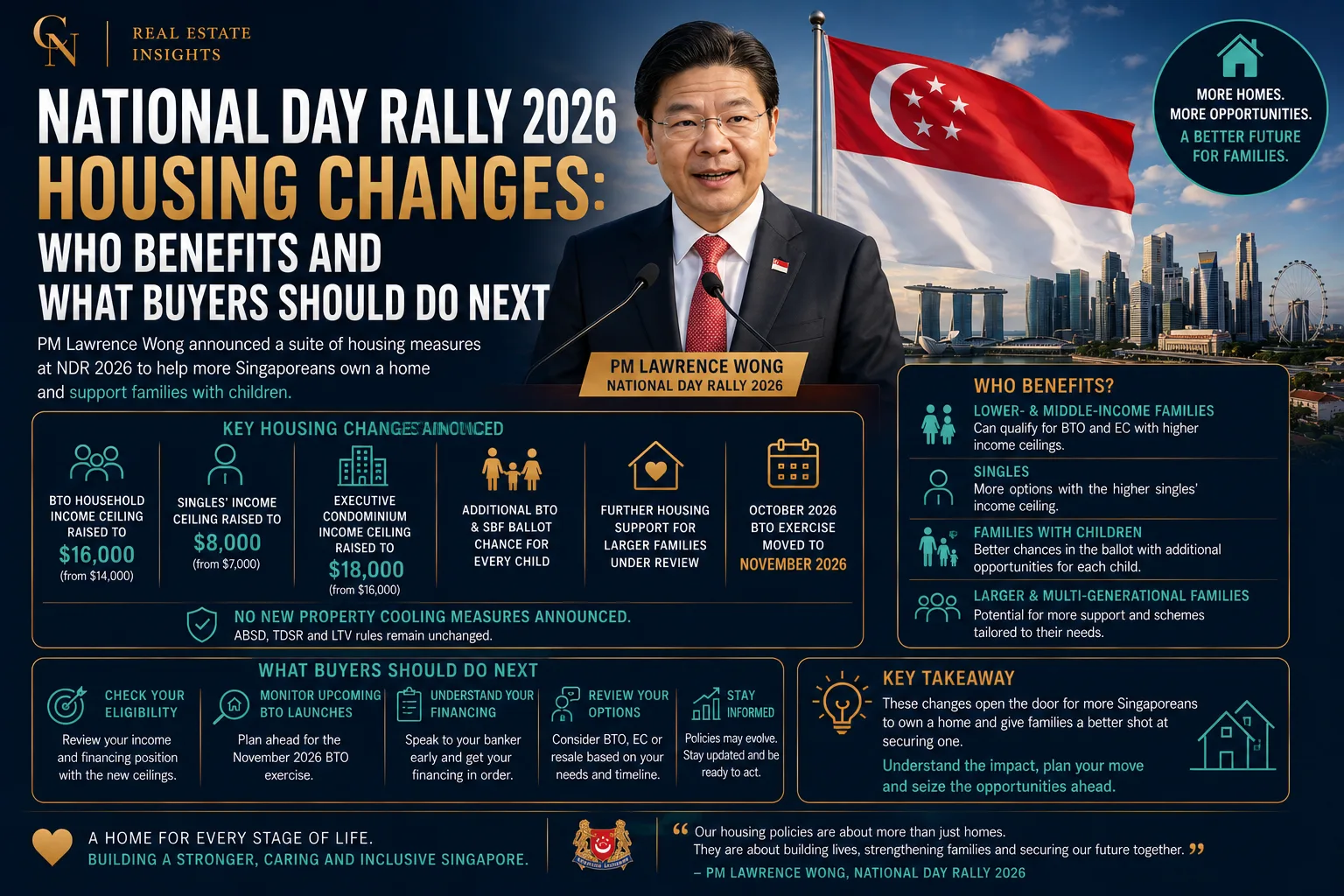
Every year, National Day Rally night is one of those evenings where those of us in real estate are almost glued to the updates.
Not because we expect a new cooling measure every year.
But because housing policy in Singapore can change buying power, eligibility and even the property options available to thousands of families almost overnight.
And this year, there were several real estate nuggets that matter to me — and probably to you too.
The biggest changes announced at National Day Rally 2026 were not about cooling the market.
They were about expanding access to housing and giving families more options.
Among the key changes:
BTO household income ceiling raised to $16,000
Singles’ income ceiling raised to $8,000
Executive Condominium income ceiling raised to $18,000
One additional BTO and SBF ballot chance for every child
Further housing support for larger families under review
The October 2026 BTO exercise moved to November
Just as importantly, there were no new property cooling measures.
ABSD, Seller’s Stamp Duty, TDSR, MSR and loan-to-value limits remain unchanged.
So what do these changes actually mean?
More importantly:
Who benefits — and what should buyers do now?
1. BTO Income Ceiling Raised to $16,000
The monthly household income ceiling for families buying a new HDB flat will increase from $14,000 to $16,000.
For eligible singles aged 35 and above, the ceiling will increase from $7,000 to $8,000.
The revised ceilings apply to eligible buyers submitting an HDB Flat Eligibility application from 24 August 2026. The ceiling was last raised in 2019, when it moved from $12,000 to $14,000 for families.
Why This Matters
The clearest beneficiaries are couples earning between $14,000 and $16,000 a month.
Previously, many of these couples were effectively pushed out of the new BTO market.
Their main options were often:
Resale HDB
Executive Condominium
Private property
That may sound fine on paper.
But the reality is that many Singaporeans are marrying later.
By the time they are ready to settle down, both partners may already be established in their careers.
A combined household income of $14,000 to $16,000 does not necessarily mean they are wealthy.
They may still be buying their first home.
They may also be planning for children, childcare, ageing parents and other major expenses.
The new ceiling brings more upper-middle-income couples back into the subsidised public housing system.
Will The Higher BTO Income Ceiling Push BTO Prices Higher?
This is one of the first questions I have been asked.
My answer is:
Not directly.
BTO flats are not auctioned to the highest bidder.
A household earning $16,000 does not get to offer $20,000 more than another applicant to secure a flat.
HDB still determines new-flat selling prices and provides subsidies so that new flats remain affordable to the target buyer segments.
So simply allowing more households to qualify does not mechanically increase BTO prices.
Where I do expect an impact is on application demand.
A project in an attractive location now has a slightly larger eligible buyer pool.
That could mean stronger application rates for selected BTO projects, especially larger flats in highly sought-after areas.
In other words:
The pressure may initially show up in ballot competition rather than the BTO price tag.
Could This Lead To More Aggressive Offers In The HDB Resale Market?
Possibly — but I would not expect it across every segment.
There are two competing effects.
Some households earning $14,000 to $16,000 who previously had to buy resale can now consider BTO.
That could actually remove some demand from the resale market.
But there is another group that may still prefer resale because they cannot or do not want to wait several years for a BTO.
They now know that the Government considers households at their income level part of the public-housing target market.
Many also have stronger borrowing capacity than the average HDB buyer.
If these households want:
a large 5-room flat,
a rare Executive Apartment or Executive Maisonette,
a newer MOP flat,
or a premium mature-estate location,
they may be willing to compete harder for the right home.
So I do not expect:
“Higher ceiling = all resale HDB prices rise.”
I expect something more selective:
more competition for scarce, desirable HDB products while ordinary flats with abundant alternatives remain price-sensitive.
This also comes shortly after the removal of the 15-month wait-out period for eligible private property right-sizers, which has already widened the potential buyer pool for larger resale HDB homes.
That makes the top end of the HDB resale market particularly interesting to watch.
What Should Buyers Do?
The first thing is simple:
Recalculate your options.
If you previously assumed you were no longer eligible for BTO, that assumption may now be outdated.
Buyers should:
Apply for a fresh HFE letter
Compare the November BTO projects with suitable resale flats
Work out a comfortable mortgage, not merely the maximum possible loan
Consider whether they can realistically wait for BTO completion
Factor future childcare and family expenses into affordability
And this is important:
Being eligible for a BTO does not automatically mean you should buy one.
A resale flat may still make more sense if you need a home immediately.
An EC may still make more sense if you want condominium facilities and a longer-term private-housing pathway.
More eligibility simply means more choices.
And more choices should lead to better decisions.
2. Singles’ Income Ceiling Raised to $8,000
For eligible singles aged 35 and above, the monthly income ceiling will increase from $7,000 to $8,000.
Who Benefits?
The most obvious beneficiaries are singles earning between $7,000 and $8,000.
This group was previously caught in a very awkward position.
They earned too much to qualify for some subsidised public-housing options.
But they might not earn enough to comfortably purchase a suitable private property without stretching.
Some ended up buying compact private condos simply because HDB appeared unavailable.
Now they have another option.
Depending on the applicable scheme, the revised ceiling may affect access to:
Subsidised new HDB flats
CPF Housing Grants for resale flats
HDB housing loans
What Should Singles Do?
Do not automatically buy private simply because that was your only option before.
Compare again.
Your choices may now include:
A 2-room Flexi BTO
A larger resale HDB
A private 1-bedroom or compact 2-bedroom
Continuing to stay with parents while investing elsewhere
This is where I think buyers should be very honest with themselves.
Do you want privacy?
Do you want capital appreciation?
Do you need space?
Do you want to preserve cash for investing?
There is no universal best answer.
The cheapest home is not always the best.
But neither should someone spend another $500,000 or $800,000 simply because private property sounds more aspirational.
The new income ceiling gives singles another path.
Use that option intelligently.
3. EC Income Ceiling Raised to $18,000
This is perhaps one of the most commercially interesting changes.
The household income ceiling for buying a new Executive Condominium will increase from:
$16,000 → $18,000
The higher ceiling applies to EC developments with land-sale tender closing dates from 24 August 2026 onwards. It does not apply to balance units in existing ECs.
Why This Matters
Households earning between $16,000 and $18,000 are the biggest beneficiaries.
Previously, these families were above both the BTO and EC ceilings.
That pushed them directly towards:
HDB resale
Private resale
Private new launches
The new EC ceiling potentially gives them access to a very interesting middle ground.
Private condominium living.
But with an entry price that can still be below fully private alternatives.
And importantly, the potential buyer pool for future ECs has just expanded upwards.
Will This Push Future EC Prices Higher?
I think it creates some upward pricing room, but it does not give developers a blank cheque.
The logic is straightforward.
A household earning $18,000 has stronger purchasing power than one capped at $16,000.
So future developers know they have access to a slightly larger and financially stronger demand pool.
All else being equal, that provides support for land bids and selling prices.
But “all else being equal” is doing a lot of work here.
EC developers still face:
the Mortgage Servicing Ratio,
land cost,
construction costs,
HDB eligibility rules,
a narrower buyer pool than fully private condominiums,
and, crucially, the much tougher EC rules introduced in May 2026.
Recent EC land prices were already high before the NDR announcement. The Woodlands Drive 17 site awarded in January 2026 went for about $794 psf ppr, while Miltonia Close was awarded in April for roughly $732 psf ppr based on the official tender values and GFA.
That tells me future EC launches are unlikely to return to the price levels buyers remember from several years ago.
The direction remains upwards over the longer term.
But the next wave of EC pricing may be more disciplined than many assume because developers also have to price around the new holding restrictions.
The August Change Comes After A Much Bigger EC Reset In May
This is where buyers need to pay attention.
On 8 May 2026, the Government introduced one of the most significant revisions to the EC framework in years.
For EC projects whose land-sale tenders close on or after 8 May 2026, the MOP is doubled from 5 years to 10 years. HDB also confirms that these projects remain restricted to Singapore citizens and permanent residents until 15 years after TOP before the wider foreign/corporate buyer market can enter.
The May package also included tighter first-timer allocation and the removal of the Deferred Payment Scheme for affected future EC projects. Industry commentary noted that 90% of units would be prioritised for first-timer families, with a substantially longer priority period.
So future ECs now have two forces moving in opposite directions.
Supporting prices:
The income ceiling rises to $18,000.
Limiting speculative demand:
The holding period becomes much longer and future resale flexibility is reduced.
To me, this reinforces what ECs are supposed to be:
an owner-occupation housing product first, and an investment product second.
Does The $18,000 Ceiling Apply To The Five Upcoming ECs Already Awarded?
No.
This is a very important distinction.
There are five awarded EC sites that had not yet launched when the May rules were announced:
Senja Close
Sembawang Road
Miltonia Close
Woodlands Drive 17 — CDL site
Woodlands Drive 17 — Sim Lian site
Their tenders closed between August 2025 and April 2026, so they fall before both the 8 May 2026 new-EC-rule cut-off and the 24 August 2026 higher-income-ceiling cut-off.
This means, based on the announced transition rules, these five projects sit in a rather unusual position.
They should retain the earlier EC framework — including the shorter MOP regime — but the new $18,000 income ceiling does not apply to them.
The qualifying household ceiling remains $16,000.
And that creates what I think could be a very interesting market window.
Could These Five ECs Become A “Sweet Spot”?
Possibly.
Think about the comparison.
The five earlier sites:
Lower $16,000 income ceiling
Older EC holding framework
Not subject to the new 10-year MOP
Potentially more flexible exit timeline
Future post-24 August ECs:
Higher $18,000 income ceiling
Larger eligible buyer pool
10-year MOP
Longer route to full privatisation
Tighter first-timer rules
No Deferred Payment Scheme
Neither group is automatically better.
But they offer very different propositions.
For a household below $16,000 that qualifies for one of the five upcoming earlier-framework ECs, these projects may become unusually attractive simply because that regulatory structure will not be repeated.
Once those projects are sold, the next generation of EC buyers will be entering under the new rules.
That scarcity could itself become a selling point.
Industry analysts already highlighted the potential appeal of these five pre-change developments after the May announcement.
What About New EC Land Bids From Here?
This is the part I will be watching most closely.
The next EC tenders will reveal how developers price these two conflicting changes.
On one hand:
$18,000 income ceiling = more purchasing power.
On the other:
10-year MOP = less buyer flexibility.
There are currently EC sites at Canberra Drive and Admiralty Walk open for tender, with another Jurong East Avenue 1 EC parcel scheduled for December 2026. The 2H2026 GLS Confirmed List includes around 735 EC units.
These sites will give us the first meaningful indication of how developers think the new EC buyer pool should be priced.
My expectation?
I do not think developers will suddenly bid recklessly just because households can earn $2,000 more.
The longer MOP means buyers need to commit to the home for a much longer period.
That may encourage developers to:
design more family-sized layouts,
focus more heavily on owner-occupier appeal,
price for sustainable take-up rather than speculative demand,
and be more disciplined in land bidding.
In other words, the $18,000 ceiling could support higher EC prices over time, but the May cooling measures may prevent that increase from becoming excessive.
Where Could The Opportunity Be?
I see three potential opportunities.
1. The Five Pre-Change EC Projects
For eligible households below $16,000, these could become very interesting because they retain the earlier holding framework.
Buyers should compare them carefully before automatically waiting for a future $18,000-ceiling EC.
2. Future $18,000-Ceiling ECs
Households earning $16,000 to $18,000 finally receive an EC pathway.
For families who genuinely plan to stay for 10 years or more, the longer MOP may not be a major disadvantage.
In fact, a project with a high proportion of committed owner-occupiers could potentially produce a more stable residential community.
3. Existing Resale Condos
This is the indirect opportunity many buyers may overlook.
If future EC prices continue rising because land and construction costs remain high, the price gap between a new EC and a relatively young resale private condo may narrow.
At that point buyers should ask:
Do I want a new EC with a 10-year MOP, or a resale private condo with greater flexibility?
This comparison could become increasingly important.
What Should Buyers Do?
First:
Do not assume every EC now has an $18,000 income ceiling.
Check the land-tender closing date.
Then compare the regulatory framework.
Ask:
Is this project under the old 5-year or new 10-year MOP?
Is my household subject to the $16,000 or $18,000 ceiling?
How much am I saving against a private condo?
Is that saving enough to justify the restrictions?
Will I genuinely be comfortable staying here for 10 years?
What competing EC and private supply will exist later?
ECs can be excellent Asset Progression vehicles.
But after the 2026 changes, which generation of EC you buy matters almost as much as which EC you buy.
4. One Additional BTO Ballot Chance for Every Child
From February 2027, eligible first-timer families will receive one additional ballot chance for every Singaporean child aged 18 or below.
This will apply to:
BTO applications
Sale of Balance Flats applications
Couples expecting a child may also qualify, subject to the required medical certification.
The current FT(PMC) framework already gives eligible first-timer parents and married couples three ballot chances versus two for other first-timer families.
How Does It Work?
The benefit increases with family size:
Qualifying children | Additional ballot chances |
|---|---|
1 | 1 |
2 | 2 |
3 | 3 |
4 | 4 |
These chances are added to the family’s existing ballot chances under the relevant first-timer category.
Why I Think This Makes Sense
Once children arrive, housing stops being theoretical.
Space matters.
Bedrooms matter.
School location matters.
Living with parents may become difficult.
Renting becomes expensive.
A family with three children has very different housing urgency from a couple with no immediate plans to start a family.
The policy recognises that reality.
Who Benefits Most?
Families with multiple children should gain the largest relative advantage.
This may particularly help parents who are:
Staying with extended family
Renting while waiting for a home
Living in a flat that has become too small
Living separately while waiting for a suitable home
What Should Families Do?
Do not automatically wait until February 2027 just because the ballot odds become better.
If a suitable project appears in November 2026, skipping it solely for extra ballot chances may not make sense.
Ask:
How urgently do we need a home?
Is our preferred location available now?
How competitive is the project likely to be?
What priority schemes do we already enjoy?
Will this flat still work when the children are older?
Would resale solve our problem better?
More ballot chances improve probability.
They do not guarantee success.
5. Further Support for Larger Families Is Under Review
Prime Minister Lawrence Wong has also asked National Development Minister Chee Hong Tat to consider further housing support for larger families.
The logic is straightforward.
Larger families generally need larger homes.
Larger homes cost more.
Is This Confirmed?
Not yet.
At this stage, the Government has not announced:
The amount of assistance
How many children qualify
Income ceilings
Eligible flat types
Whether resale flats will qualify
Implementation date
So buyers should treat this as a policy review, not a confirmed housing grant.
What Should Larger Families Do?
Do not buy based on money that has not been announced.
Use existing grants and present-day affordability for your planning.
Meanwhile:
Keep household information updated
Monitor HDB and MND announcements
Compare larger BTO flats against resale alternatives
Consider older 5-room flats, EAs and EMs where space is the priority
For some families, a large older resale HDB may provide significantly more usable space than a newer flat.
But renovation cost and remaining lease become important considerations.
Again:
There is no one-size-fits-all housing answer.
6. October BTO Exercise Moved to November 2026
The next BTO exercise has been pushed from October to November 2026.
About 7,960 flats are expected across:
Bedok
Geylang
Sembawang
Tengah
Toa Payoh
Yishun
Community Care Apartments will also be offered in Toa Payoh.
Why Move the Exercise?
The additional time allows buyers affected by the new income ceilings to:
Reassess their options
Apply for a new HFE
Prepare financially
Decide whether to participate
Buyers intending to apply have been advised to submit all required HFE documents by 25 September 2026.
What Should Buyers Do Now?
Don't wait until the November launch brochure appears.
Start now.
A good BTO strategy should include:
Apply for HFE early.
Check CPF and cash.
Obtain a realistic loan assessment.
Shortlist towns based on work, parents, schools and daily lifestyle.
Decide on a comfortable flat size.
Prepare a resale Plan B.
That last one is particularly important.
Too many buyers plan only for:
“What if I get the BTO?”
You should also plan for:
“What if I don't?”
What Was NOT Announced Is Equally Important
For property owners and investors, one of the biggest National Day Rally takeaways is what didn't happen.
There were no new changes announced to:
ABSD
Seller’s Stamp Duty
TDSR
MSR
HDB or bank loan-to-value limits
Standard, Plus and Prime framework
Private-property ownership restrictions
Rules specifically targeting million-dollar HDB transactions
That tells me something.
National Day Rally 2026 was primarily about housing access and family support — not cooling the property market.
The Government appears to be expanding pathways into housing without simultaneously introducing another broad demand shock.
That distinction matters.
My Take: The Most Interesting Change May Be What Happens Between The Segments
When I put all the announcements together, I don't just see higher income ceilings.
I see movement between housing segments.
A $15,000-income household that previously had to look at resale HDB may now return to BTO.
A $17,000-income household that previously had to choose between resale HDB and private property may soon have an EC option.
A buyer under $16,000 may have a unique opportunity to buy one of the five upcoming ECs still operating under the earlier holding rules.
A higher-income private owner may simultaneously be moving in the opposite direction into a large resale HDB after the 15-month wait-out period was removed.
These policies do not operate independently.
They change who competes with whom.
And whenever the buyer pools change, price behaviour can change too.
That is the part I would watch most carefully over the next 12 to 24 months.
More Eligibility Does Not Mean You Should Spend More
This is probably my biggest caution.
When income ceilings increase, some buyers interpret it as:
“Great. I qualify for more.”
I would interpret it differently.
“Great. I have more options.”
There is a big difference.
Housing eligibility and housing affordability are not the same thing.
A buyer still needs to account for:
Mortgage commitments
Childcare
Renovation
Emergency reserves
Retirement savings
MOP
Future upgrading plans
Investment opportunities outside property
Just because the Government allows you to purchase something doesn't mean it is financially prudent to maximise that limit.
My Thoughts
National Day Rally always gets people in our industry talking.
What new policies?
Any cooling measures?
Who benefits?
Which segment gets affected?
This year, the housing announcements feel less dramatic than some previous policy changes.
But I think they are meaningful.
Because they affect who gets access to which part of the housing market.
And that can change family decisions for years.
For me, the real estate nuggets that matter are not simply the new numbers:
$16,000.
$8,000.
$18,000.
One additional ballot chance per child.
The bigger message is this:
Singapore is trying to widen the housing ladder while keeping speculation and affordability under control.
The BTO ceiling expands access without changing the way new flats are priced.
The EC ceiling expands access while the Government simultaneously makes future ECs more owner-occupation focused through longer holding restrictions.
And families with children get better access without another broad property-market stimulus.
That balance is important.
For buyers, the opportunity is not simply that you can now qualify for more.
It is that you now have more pathways — and some of those pathways may exist only for a limited window.
Use them carefully.
Because ultimately, the best property decision is not the one that allows you to buy the most expensive home today.
It is the one that puts your family in the strongest position tomorrow.
Want the tailored version for your portfolio?
Every article here generalises. A 20-minute conversation makes it specific to your numbers.
Will BTO prices increase because the income ceiling has risen to $16,000?
Will the higher BTO ceiling push resale HDB prices up?
What is the new EC income ceiling?
Does the $18,000 ceiling apply to existing ECs or balance units?
Does the $18,000 ceiling apply to the five upcoming EC projects already awarded?
What were the major EC rule changes introduced in May 2026?
Are the five already awarded upcoming ECs affected by the May 2026 rules?
Will future EC prices increase?
Are the five pre-change ECs an opportunity?
Should a household earning $17,000 wait for a future EC?
Could future ECs become more expensive than buyers expect?
What is the biggest thing EC buyers should understand after NDR 2026?

Written by
Christopher Ng (CEA R014394H)
Singapore Property & Asset Progression Strategist with ERA Realty Network. A NUS Real Estate graduate, Christopher has advised homeowners, investors and property owners since 2004.