
Is Singapore’s En-Bloc Market Coming Back? What the New ABSD Rules Mean for Property Owners, Agents and Buyers
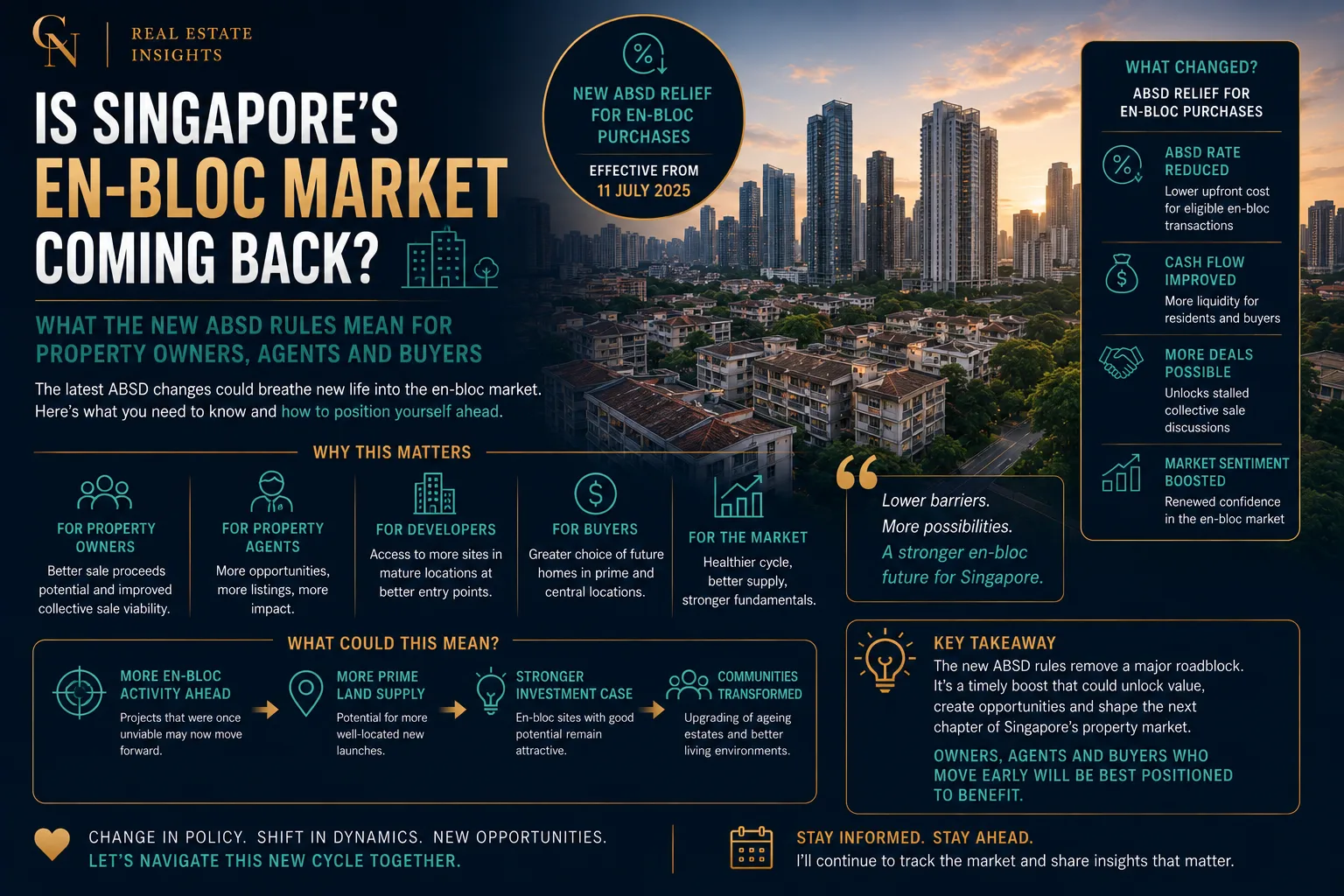
Singapore has adjusted ABSD rules for large en-bloc redevelopments, offering developers extended timelines. This change aims to reduce risk for mega projects, potentially making more large, aging condos viable for collective sale.
For many years, the words “en bloc” created excitement among owners of older private properties.
Those who remember the 2017–2018 collective-sale cycle will remember the stories.
Older condominiums suddenly became worth significantly more because developers weren't simply buying the apartments.
They were buying the land underneath them.
Then the market changed.
Developer ABSD increased, development risks grew, construction costs rose, and large collective-sale sites became increasingly difficult for developers to justify.
Fast forward to July 2026.
The Government has now made an important adjustment to the Additional Buyer’s Stamp Duty (ABSD) remission timelines for developers undertaking large-scale en-bloc redevelopment projects.
On the surface, this sounds like a technical policy change.
I think it could be much more significant.
It doesn't mean another en-bloc boom is definitely coming.
But it removes one of the biggest risks developers face when considering very large collective-sale sites.
And that could change the conversation for owners of ageing condominiums across Singapore.
What Exactly Has Changed?
Developers purchasing residential land are subject to developer ABSD. The existing regime includes a 5% non-remittable component and 35% upfront remittable component, with conditions attached to the remission.
One of the biggest conditions is time.
Developers need to complete the development and sell the residential units within the prescribed period to qualify for remission.
That creates a problem when the site is very large.
Imagine acquiring an old condominium that can be redeveloped into 1,500 new homes.
The developer needs to acquire the site, obtain approvals, design the project, demolish the existing development, construct the new project—and eventually sell a huge number of homes.
Every additional unit increases execution and sales risk.
The Government has now recognised this.
For qualifying en-bloc sites acquired from 29 July 2026, projects capable of yielding 700 to 1,399 residential units can receive an additional year, giving developers up to six years for the relevant completion and sale timelines.
For qualifying mega sites yielding at least 1,400 units, the extension can reach two years, bringing the timeline to as long as seven years, subject to the stipulated conditions. For mega developments, this includes selling at least 50% of the residential units by the end of the sixth year.
That extra time may sound small.
From a developer's perspective, it can be extremely valuable.
Why Was This Change Necessary?
The simple answer is risk.
One of the reasons developers became reluctant to buy large en-bloc sites was not necessarily because the land was unattractive.
The problem was what happened after they bought it.
The larger the redevelopment, the more units they eventually had to sell within the ABSD remission timeframe.
Historically, this has mattered tremendously.
Back in 2018, smaller collective-sale sites were viewed as more attractive partly because developers had greater confidence that they could sell the resulting units within the required five-year period. Larger sites carried substantially greater risk.
So this latest change addresses a genuine commercial problem.
The Government isn't removing developer ABSD.
It isn't giving developers unlimited time.
It is simply recognising that redeveloping 1,500 homes isn't the same exercise as redeveloping 150 homes.
To me, that is a sensible recalibration.
Does This Mean Another En-Bloc Boom Is Coming?
This is where I would be careful.
No—not automatically.
Giving developers more time improves the feasibility of some sites.
But developers still have to make the numbers work.
They will still ask:
What is the reserve price?
What is the land rate after development charges?
How much can I build?
What will construction cost?
How much competing supply is coming?
What selling price will I need to achieve?
And most importantly:
Can I make a reasonable profit after taking all that risk?
If the owners want $2 billion but the site only makes commercial sense at $1.6 billion, another two years isn't going to solve the problem.
Price expectations between sellers and developers will still determine whether transactions happen.
But We Have Seen This Movie Before
The best comparison is the 2017–2018 en-bloc cycle.
Developer demand for land became extremely strong.
In 2017 alone, ERA Research notes that 28 collective-sale deals worth about $8.7 billion were completed, followed by another 38 deals totalling around $10.8 billion in 2018.
Then the July 2018 cooling measures changed the economics dramatically.
Developer ABSD increased and a non-remittable component was introduced.
The reaction was almost immediate.
More than 30 collective-sale tenders failed to secure buyers during 2018, and the collective-sale cycle effectively came to an end.
That history tells us something very important.
En-bloc markets are extremely sensitive to developer risk.
Increase the risk and developers disappear.
Reduce the risk and previously unattractive sites can become interesting again.
That's why I think the July 2026 announcement deserves attention.
What Does This Mean for Existing Property Owners?
This is probably where most people will get excited.
If you own an ageing condominium sitting on a large piece of land, does this mean your chances of an en bloc have suddenly increased?
Potentially.
But don't start packing yet.
The biggest beneficiaries are likely to be developments where the underlying land already makes sense for redevelopment.
For example, an older development may have:
A large land parcel.
Underutilised plot ratio.
Attractive freehold or long-lease tenure.
Strong MRT connectivity.
A desirable residential location.
Potential to substantially increase the number of homes.
A reserve price developers can realistically support.
The new ABSD timeline makes such sites more interesting because developers now have greater runway to redevelop and sell the resulting project.
But an unattractive site doesn't suddenly become attractive simply because of an ABSD extension.
Good land is still good land.
The policy simply makes certain large parcels easier to digest.
Sellers Need to Be Realistic About Reserve Prices
This is probably the biggest lesson I would give owners.
Don't confuse an improvement in policy with a blank cheque from developers.
During every en-bloc cycle, the same problem eventually appears.
Owners read about another condominium achieving an enormous collective-sale price.
Expectations rise.
Reserve prices increase.
Developers run their numbers.
And the gap becomes too wide.
The tender fails.
If we do see a revival in collective sales, successful sites will still be those where owners' expectations and developers' feasibility calculations meet.
The highest reserve price isn't necessarily the best reserve price.
A $2 billion asking price that attracts zero bids is worth nothing.
What Does This Mean for Property Agents?
I think this creates a very interesting opportunity.
And you don't have to become an en-bloc specialist to participate.
Whenever collective-sale activity increases, it creates conversations long before an actual sale happens.
Owners start asking:
Should I sell my unit now or wait for en bloc?
How much could my property be worth collectively?
What happens if the en bloc succeeds?
Where should I move afterwards?
Should I buy before receiving my proceeds?
These are not merely en-bloc questions.
They are Asset Progression questions.
And this is where good agents can add tremendous value.
A Successful En Bloc Creates Hundreds of Property Decisions
Think about what happens when a 1,000-unit condominium successfully sells collectively.
We don't just have one transaction.
We potentially have 1,000 households needing another home.
Some will buy another condominium.
Some will upgrade to landed.
Some will buy new launches.
Some older owners may right-size into HDB.
Some may purchase smaller freehold apartments.
Others may decide to rent temporarily while deciding what to do next.
Every household has different financial circumstances and different timelines.
That creates an enormous advisory opportunity for agents.
The agent who establishes the relationship before the en bloc happens may eventually be the one helping the family make its next move.
Agents Should Start Studying Older Developments Now
I wouldn't tell agents to start knocking on every old condominium tomorrow saying:
"Your condo can en bloc!"
That's irresponsible.
Instead, learn how to identify the ingredients developers actually value.
Understand:
Plot ratio.
Land tenure.
Existing versus allowable GFA.
Development baseline.
Site configuration.
Planning restrictions.
Development charges.
Reserve price.
Replacement cost.
Surrounding new-launch prices.
This allows agents to have intelligent conversations instead of simply selling hope.
That's where professionalism matters.
What Does This Mean for Property Buyers?
This part is often overlooked.
An en-bloc revival doesn't only affect existing owners.
It affects future buyers too.
When a developer purchases an ageing development collectively, something important happens.
Old housing stock disappears.
New housing stock eventually replaces it.
But the replacement units are usually launched at significantly higher prices because the developer needs to recover:
land acquisition + development charges + construction + financing + marketing + ABSD + profit.
That creates a new pricing benchmark for the neighbourhood.
Older Resale Condos Could Become More Interesting
This is where buyers need to think carefully.
Imagine an older freehold condominium transacting at $1,800 psf.
A nearby site is sold en bloc.
Several years later, the replacement project launches at $3,000 psf.
Suddenly the surrounding resale market looks very different.
The older $1,800–$2,000 psf developments may start looking relatively affordable.
That doesn't mean they automatically jump to $3,000 psf.
They are older products with different facilities and remaining useful life.
But the price gap creates comparison.
And property prices are heavily influenced by comparison.
This is the same replacement-cost principle I frequently discuss when analysing GLS sites.
Could Buyers Buy Older Condos Hoping for En Bloc?
This is where I would strongly caution buyers.
Never buy a property solely because you think it will en bloc.
Collective sales are complicated.
Owners must agree.
Reserve prices must be realistic.
Developers must want the land.
Planning conditions must work.
Market conditions must cooperate.
And even developments that look like excellent candidates can attempt collective sales repeatedly without succeeding.
If the en bloc never happens, you still need to be comfortable owning the property.
My rule is simple:
Buy a good property first. Treat en bloc potential as a bonus.
Never reverse that order.
Could This Push Land Prices Higher?
Potentially.
If large collective-sale sites become more feasible, developers have another source of land beyond the Government Land Sales programme.
Competition for genuinely attractive sites could therefore improve.
But I don't expect developers to suddenly bid recklessly.
If anything, recent land tenders have shown that developers remain highly disciplined about margins.
The more likely outcome is selective interest.
Strong sites will attract attention.
Marginal sites will continue struggling.
And unrealistic reserve prices will continue producing failed tenders.
That's actually healthy.
The Bigger Story Is Urban Rejuvenation
There is another reason I think this policy matters.
Singapore has many private developments built decades ago.
Some sit on very large land parcels.
Some were designed at much lower densities than today's planning rules allow.
Others are increasingly expensive to maintain.
Collective redevelopment allows these sites to be rejuvenated.
The Government has explicitly said the revised timelines are intended to facilitate large-scale transformation, intensification and rejuvenation of older developments.
So this isn't simply about helping developers make more money or owners achieve an en-bloc windfall.
It's also about recycling scarce land.
In land-scarce Singapore, that becomes increasingly important as our housing stock ages.
My View
I think we should pay close attention to the en-bloc market over the next few years.
The Government hasn't removed the safeguards.
Developer ABSD remains substantial.
Developers still carry significant risk.
Owners still need to agree.
And the economics still need to work.
But one important obstacle has been reduced.
For very large sites, developers now have more time.
And in development, time is money—and risk.
Reduce that risk sufficiently and some sites that previously looked too difficult may become worth revisiting.
For sellers, this potentially creates another pathway to unlock the value of ageing properties.
For agents, it creates opportunities far beyond participating in the collective sale itself. Every en bloc potentially creates hundreds of families needing advice on what to do next.
For buyers, it means watching how redevelopment gradually changes the price benchmarks of mature private residential estates.
Will we see another 2017-style en-bloc fever?
I think it's far too early to say.
And perhaps that's not even what the Government wants.
What I see instead is a more measured attempt to make the redevelopment of Singapore's large ageing private estates commercially possible again.
That may not create an overnight boom.
But over the next five to ten years, it could quietly reshape some of our oldest private residential neighbourhoods.
And that makes this policy change much more important than the technical ABSD announcement initially suggests.
Want the tailored version for your portfolio?
Every article here generalises. A 20-minute conversation makes it specific to your numbers.
What changed to the developer ABSD rules in July 2026?
Has developer ABSD been removed for en-bloc sites?
Does this mean Singapore will have another en-bloc boom?
Which condos could benefit most from the new rules?
Should I buy an old condo because it has en-bloc potential?
Should I sell my older condo now or wait for en bloc?
What happens to owners after a successful en bloc?
How can property agents benefit from an en-bloc revival?
Could en-bloc sales increase surrounding property prices?
What happened during Singapore's last major en-bloc cycle?
What is the biggest takeaway from the new en-bloc policy?

Written by
Christopher Ng (CEA R014394H)
Singapore Property & Asset Progression Strategist with ERA Realty Network. A NUS Real Estate graduate, Christopher has advised homeowners, investors and property owners since 2004.