
A Random Mandarin SMS, a Bus Advertisement and a $3 Million Property
A chance encounter from a bus advertisement led to a $3 million exclusive property listing, revealing crucial lessons about marketing, client trust, and the blending of online and offline strategies.
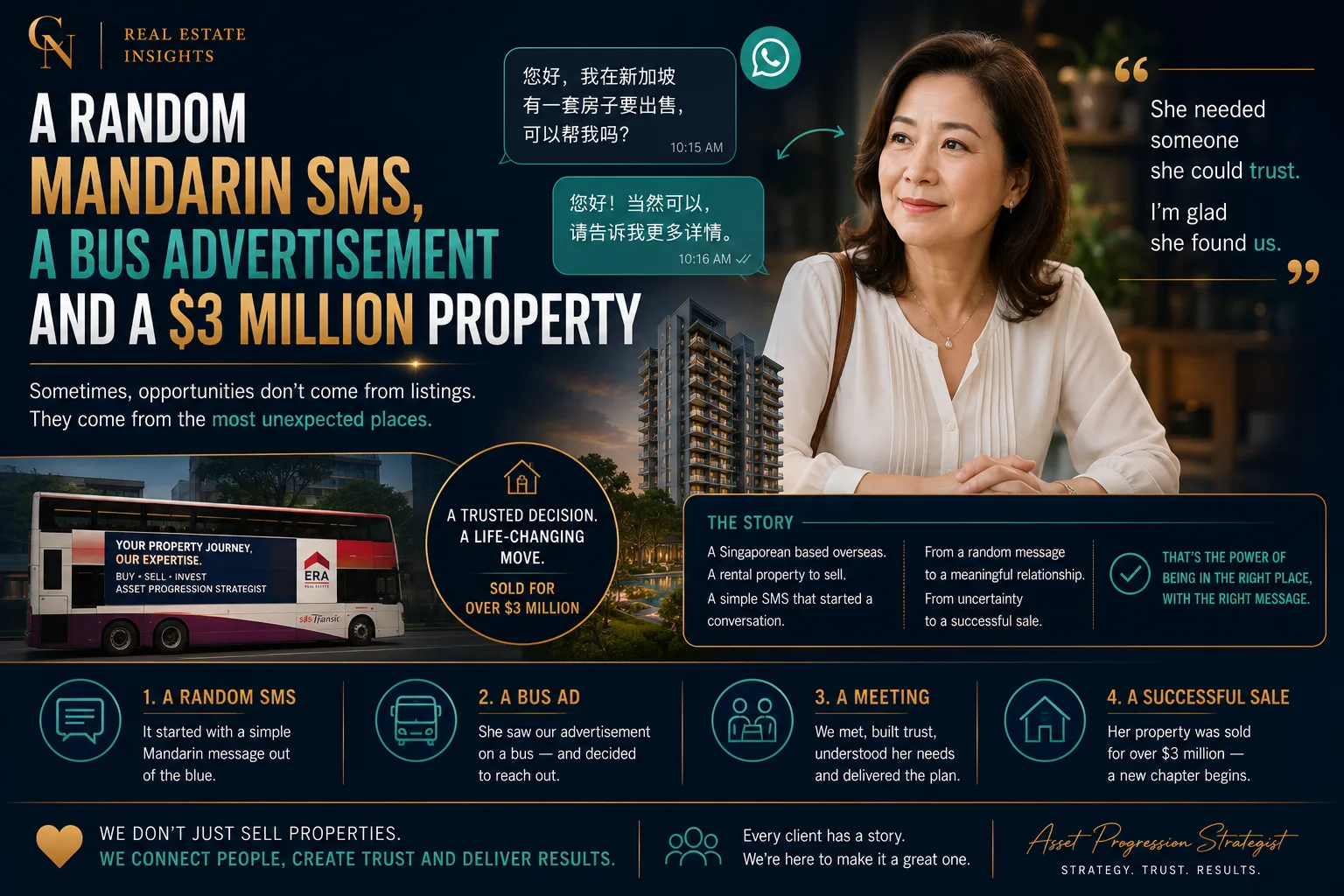
I received a random SMS in Mandarin last week.
It roughly translated to:
“Hi, I have a unit for sale at xxx. Can you help me?”
Now, if you had sent me this message 10 years ago, I would probably have been delighted.
Owner wants to sell property. Of course can help!
But this is 2026.
We live in an era of scam calls, suspicious WhatsApp messages, fake property enquiries and increasingly sophisticated attempts to get you to click on something you shouldn't.
So instead of excitement, my first reaction was:
Is this real?
There was no introduction. No referral. Just a random Mandarin message from someone I had never spoken to before.
Part of me was suspicious.
But I decided to reply politely anyway.
And I am very glad I did.
Because one hour later, this lady was sitting across from me in my Toa Payoh office.
Two hours after that, she walked out as a happy seller.
And I walked away with an exclusive appointment to market her 3-bedroom condominium, valued at around $3 million.
The entire experience reminded me of three very simple lessons about real estate, marketing and conversion.
But first, let me tell you what happened.
"I'm A Singaporean Living Overseas"
I replied to her message and offered to help, while asking for a little more information.
She explained that she is a Singaporean currently based overseas.
She owns a 3-bedroom condominium in Singapore which is presently tenanted, and she needed someone who could help her manage the tenancy here and eventually sell the property when the lease ends in December 2026.
The conversation went back and forth for a while.
Everything sounded plausible.
But I was still cautious.
There is only so much you can establish over SMS.
So rather than continuing endlessly through messages, I suggested something simple:
Why don't we meet face to face before we go any further?
She agreed.
Then she told me she could come to my office in Toa Payoh within the hour.
Okay.
Let's see.
And Exactly One Hour Later, She Appeared
She really came.
And her story turned out to be completely genuine.
She was born in China but had worked and lived in Singapore for about 35 years.
She subsequently married a German and moved to Germany around five years ago.
Her Singapore condominium had since been rented out.
The problem was that managing a property from thousands of kilometres away was becoming troublesome.
Tenancy matters.
Property maintenance.
Communication.
Eventually selling the property.
These things can already be inconvenient when you are living in Singapore.
Try doing them from Germany.
The agent who had previously assisted her with the rental had also decided to retire. Unfortunately, she felt there wasn't proper closure or continuity after that.
So now she needed someone here whom she could trust to take over.
That explained why she contacted an agent.
But I was still curious about something else.
"How Did You Find Me?"
I assumed she had found me through Google.
Maybe she had read one of my property articles.
Perhaps someone had referred me.
Maybe she had seen one of my social media posts.
Her answer surprised me.
She saw me at a bus stop.
More accurately, she saw my advertisement on a bus.
She told me she looked at the advertisement and — I am quoting her here — thought I looked:
"Pleasant to her eye."
I'll take that compliment anytime. 😂
But here's the important part.
She didn't immediately contact me just because she saw my face on a bus.
She remembered my name.
Then she Googled me.
She found my website.
She went through my online presence.
And only after doing her own research did she decide:
Okay, I'll contact this guy.
That sequence really caught my attention.
Because it perfectly illustrates how I think property marketing works today.
The Bus Advertisement Didn't Win Me The Listing
This is an important distinction.
The bus advertisement got my attention.
Or rather, it got her attention.
But attention alone wasn't enough.
She saw the advertisement.
Then she searched my name online.
My website gave her something else to evaluate.
Who is this person?
What does he do?
Does he know his stuff?
What does he write about?
What kind of clients does he work with?
What are his views on the property market?
Can I trust him with a property worth around $3 million while I am living halfway across the world?
That is why I still believe traditional marketing has a role today.
Bus advertisements.
Flyers.
Signboards.
Newspaper advertisements.
Direct mailers.
They are not necessarily "old-fashioned" simply because we have Facebook, Instagram, TikTok and Google.
But I think their role has changed.
Offline marketing creates discovery. Online content creates validation.
One without the other may not be enough anymore.
This Also Brought Me Back Six Years
There is another funny coincidence.
In my previous Christopher Client Story about Mr David, I shared how we first met him through a flyer.
We had embarked on a geographical farming campaign targeting five EC developments around where we were staying.
He saw our marketing, called us, and that eventually developed into a client relationship lasting six years.
Yesterday?
A lady saw my face on a bus advertisement.
She Googled me.
Read about me.
Sent me a random Mandarin SMS.
And an hour later, we were sitting together discussing her property.
Different era.
Different marketing medium.
But the principle hasn't really changed.
You need to be visible before someone can choose you.
The difference today is that being visible is only the first step.
We Spent Two Hours Going Through Her Situation
Once she arrived at the office, I didn't immediately start talking about how I was going to market her condominium.
We spent about two hours going through her situation properly.
Why does she want to sell?
What does she intend to do with the proceeds?
What is happening with the existing tenancy?
When does the lease expire?
What is the estimated market value?
What are her options?
What does selling now versus later mean?
What does she need from an agent while she remains based overseas?
In other words, we went through the same Asset Progression consultation I would normally conduct with my clients.
Because getting someone to sit opposite you is not the end of the sales process.
It is the beginning.
Marketing Gets You The Conversation. Knowledge Gets You The Client.
This was probably my biggest takeaway from yesterday.
As property agents, we spend a lot of time talking about leads.
How many leads did the advertisement generate?
How much did each lead cost?
Which portal works?
Should I run Facebook ads?
Should I do TikTok?
Should I distribute flyers?
Should I advertise on buses?
All useful questions.
But sometimes I think we become too obsessed with lead generation and not enough with what happens after the lead appears.
Imagine yesterday's sequence:
Bus ad → Google search → Website → SMS → Meeting → Consultation → Exclusive appointment.
Every stage had a different job.
The bus advertisement created awareness.
Google allowed her to investigate me.
My website and content helped establish credibility.
My response to her message opened the conversation.
The face-to-face meeting created human connection.
And finally, the consultation had to demonstrate that I actually knew how to help her.
You can spend thousands of dollars generating attention.
But eventually someone sits across the table and asks:
"So what should I do?"
At that point, the advertisement cannot answer for you.
Your knowledge has to.
Lesson #1: Don't Judge The Lead Too Quickly
I nearly dismissed the message mentally before the conversation even started.
Random number.
Mandarin message.
Overseas owner.
In today's environment, those ingredients naturally make us cautious.
And we should be cautious.
But cautious doesn't have to mean dismissive.
I replied politely.
I didn't click on suspicious links.
I didn't provide sensitive information.
I simply continued the conversation until I could establish whether there was a genuine person behind it.
There was.
And she turned out to be a serious property owner with a genuine need.
Every contact deserves a chance to become a conversation.
Not every conversation becomes an appointment.
Not every appointment becomes a client.
But if we judge the first message too quickly, we may never find out.
Lesson #2: Traditional Marketing Still Works — But It Cannot Stand Alone
This incident was a very good reminder for me.
A bus advertisement generated a $3 million property lead.
So yes, traditional marketing still works.
But I don't think the lesson is:
"Go and buy bus advertisements."
The more interesting lesson is how offline and online marketing now work together.
She saw me offline.
Then immediately verified me online.
This is how many consumers behave today.
They see your name somewhere.
Then they Google you.
And what happens next depends on what they find.
If someone searches your name, what appears?
A half-completed profile?
An old property listing?
A social media account you haven't updated for three years?
Or a substantial body of content that demonstrates who you are, how you think and what you know?
This is one reason I have invested so much effort into writing and building up my website.
Sometimes we don't know who is reading.
Most readers will never contact us.
But every article adds another little piece to our digital footprint.
Then one day, someone sees your face on a bus...
and Googles you.
Suddenly all that content has a job to do.
Lesson #3: Good Marketing Gets You The Right To A Conversation
This may be the most important lesson of all.
Marketing doesn't close property appointments.
Marketing earns you the opportunity to try.
That's it.
A beautiful advertisement may get the phone to ring.
A strong social media presence may get someone to WhatsApp you.
A searchable website may convince someone to arrange a meeting.
But once you're sitting opposite a homeowner discussing a multimillion-dollar asset, none of those things can substitute for knowledge.
You need to understand:
Property.
Financing.
Tenancy.
Timelines.
Market positioning.
Buyer behaviour.
Exit strategies.
And most importantly, you need to understand the person sitting opposite you.
Yesterday, the bus advertisement got me noticed.
My website helped me get researched.
But the two-hour consultation was what ultimately mattered.
A Random SMS Became An Exclusive Appointment
By the end of our meeting, we had gone from:
"Hi, I have a unit for sale at Potong Pasir. Can you help me?"
to a proper understanding of her situation and what needed to happen next.
She walked out happy.
And she entrusted me with the exclusive appointment to market her 3-bedroom condominium, worth approximately $3 million.
All from a message I initially wondered might be a scam.
Funny how this business works sometimes.
My Take: Marketing Is An Ecosystem Now
Yesterday's experience reinforced something I have increasingly believed.
There is no longer a clean separation between "traditional marketing" and "digital marketing".
Consumers don't behave that way.
They move between both worlds.
See you on a bus.
Search you on Google.
Read your website.
Check your credentials.
Send you a message.
Meet you in person.
And then decide whether they trust you.
The best marketing strategy therefore isn't simply being everywhere.
It is making sure that when someone moves from one touchpoint to another, the story remains consistent.
The advertisement gets their attention.
The online presence answers their questions.
And when they finally meet you, your knowledge validates everything they have seen.
That's the full journey.
Yesterday, mine started with a random Mandarin SMS.
And ended with a handshake, a happy seller and a new exclusive listing.
Never judge a lead too quickly.
Never underestimate traditional marketing.
And never confuse getting attention with earning trust.
Marketing may get you through the door.
What you know — and how well you understand the person sitting across from you — determines what happens after that.
Want the tailored version for your portfolio?
Every article here generalises. A 20-minute conversation makes it specific to your numbers.
Does traditional property marketing like bus ads and flyers still work in Singapore?
Why is an agent's Google presence important?
Can property agents still generate leads from geographical farming?
Should property agents respond to suspicious-looking enquiries?
Why did this overseas owner want to sell her Singapore property?
When is the existing tenancy expected to end?
What is the estimated value of the property?
What is the biggest marketing lesson from this story?
Is having a strong personal brand enough to win property listings?
What did this experience teach me as a property agent?

Written by
Christopher Ng (CEA R014394H)
Singapore Property & Asset Progression Strategist with ERA Realty Network. A NUS Real Estate graduate, Christopher has advised homeowners, investors and property owners since 2004.