
The Ultimate Guide to Buying Landed Property in Singapore (2026): Everything Buyers Need to Know Before Buying
Buying landed property in Singapore is a significant step in asset progression, offering unique benefits and challenges compared to condos. This guide explores everything from types of landed homes and land quality to financing and exit str
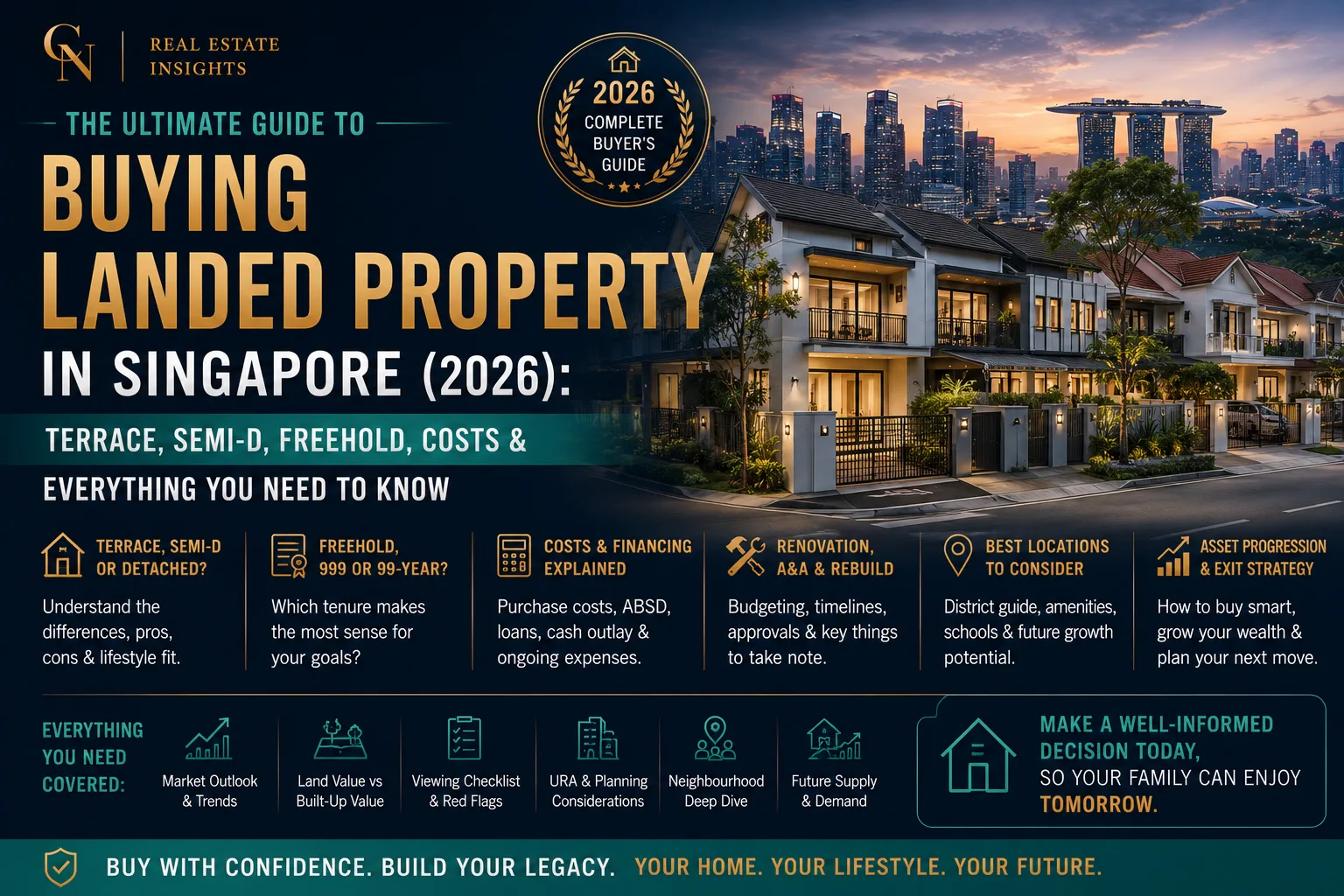
For many Singaporeans, landed property remains the ultimate property aspiration.
You may start with a BTO.
Upgrade to a condominium.
Move to a bigger or better condominium.
And somewhere along that Asset Progression journey, the question eventually comes:
"Can I afford landed?"
I am seeing this more and more among my clients today.
Many are not first-time property buyers. They have already owned an HDB or condominium. Their careers have progressed, their existing properties have appreciated, their children are growing up, and their financial positions are stronger.
Suddenly, something that looked impossible 10 years ago starts looking possible.
A piece of land to call their own.
But buying landed property in Singapore is very different from buying an HDB or condominium.
With a condominium, two units in the same stack can be relatively straightforward to compare.
With landed?
Two houses sitting beside each other can have completely different values.
One may have a regular rectangular plot.
The other may taper badly towards the rear.
One may be move-in ready.
The other may need $1 million or more of work.
One may have excellent frontage.
The other may have land that is technically large but difficult to utilise.
One may be freehold.
The other 99-year leasehold.
And sometimes, after considering everything, the leasehold house may actually be the better buy.
This guide is therefore not simply about:
"How much does landed property cost in Singapore?"
I want to answer the questions I actually discuss with landed buyers:
Should I buy terrace, semi-detached or detached?
Is freehold always better?
How should I value land versus the house sitting on it?
How much renovation should I budget?
Should I renovate, A&A or reconstruct?
How important are plot width and shape?
What should I look for during viewing?
Which landed neighbourhood should I buy?
How much cash do I need?
What happens to ABSD if I already own another property?
Should I buy an old house cheaply and rebuild?
What is my eventual exit strategy?
And most importantly: Does buying landed actually fit into my family's Asset Progression plan?
This is my attempt to put all of that into one comprehensive Singapore landed-property guide.
Why Does Landed Property Still Have Such Strong Appeal in Singapore?
Singapore has plenty of condominiums.
We can build more.
We can build them taller.
We can reclaim land and create new housing estates.
But landed housing is different.
There is a physical limitation to how much low-density landed housing Singapore can accommodate.
URA safeguards designated landed housing areas and applies specific planning controls to preserve their low-rise character.
That creates an interesting scarcity.
And scarcity is only one part of the attraction.
For many families, landed living represents something emotional too.
Space.
Privacy.
Your own front door.
No upstairs neighbour.
A garden.
More parking.
Space for three generations.
The ability to configure a home around the family instead of configuring the family around the apartment.
And eventually:
Legacy.
For some Singaporeans, owning landed property represents a form of self-actualisation.
It is the house they imagined buying after 20 or 30 years of working.
That emotional demand matters.
Because landed property isn't simply competing against other properties.
Sometimes it is competing against a lifelong aspiration.
I believe landed property will always have its appeal in Singapore.
The important question is whether the particular landed property you are considering is worth buying.
Those are two very different things.
My Own Asset Progression Journey Into Landed Property
I don't look at Asset Progression as a theory.
I have gone through it myself.
My property journey did not begin with landed.
In 2018, Jasmine and I bought a brand-new Executive Condominium.
That was where we started.
As our careers and finances progressed, our property strategy changed with us.
In 2023, we decoupled. Jasmine continued holding the EC, while I made the jump directly into an intermediate terrace house.
I bought the terrace for approximately $3.75 million.
Today, I estimate its value at around $5.5 million.
That increase in value is now helping to create the possibility of our next move.
We are currently looking at the next rung:
A semi-detached home around the $8 million range.
So when clients sit opposite me and ask:
"Christopher, does it make sense for me to move from condo to landed?"
I understand the conversation from both sides of the table.
I have advised clients through it.
And I am going through the same progression myself.
But here's something important.
I didn't start with an $8 million semi-detached house.
My property position was built progressively.
And that is how many Singaporean families eventually reach landed property.
Asset Progression: How Singaporeans Can Eventually Reach Landed Property
The journey may look something like this:
BTO → Condominium → Better/Larger Condominium → Terrace → Semi-Detached
It doesn't have to follow this exact sequence.
Some people jump stages.
Others stay in one property for 15 years.
Some right-size along the way.
And everyone's income, family situation and risk tolerance are different.
But the principle is important.
Your existing property can become part of the capital base for your next property.
Imagine a young couple begins with a BTO.
They eventually sell after MOP and use the accumulated CPF, savings and capital appreciation to purchase their first private condominium.
Over time, incomes rise.
Savings increase.
The condo appreciates.
They move again—perhaps into a larger unit or a better-positioned project.
Another property cycle passes.
Eventually, the equity accumulated across those moves can make the landed conversation possible.
This is why I often tell clients:
Don't only ask whether today's property is a good home. Ask what options it gives you tomorrow.
The objective isn't to keep moving unnecessarily.
Transaction costs are real.
Stamp duties are real.
Renovation costs are real.
Interest is real.
But a well-planned property journey can progressively increase both your housing quality and your financial options.
Landed Is Increasingly Becoming The Next Conversation With My Clients
I have noticed something interesting in recent years.
More of my clients are asking about landed.
Often they have already done well in private property.
They are not necessarily investors trying to maximise rental yield.
They are families asking:
"What's next?"
Their children are older.
They need more bedrooms.
Parents may eventually stay with them.
They want a study.
A helper's room.
Two cars.
More storage.
A proper dining area.
Maybe a garden.
At some point, buying a 1,800 or 2,000 sqft condominium at a very high PSF starts creating another question:
If I am already spending this much, should I just buy land?
That is where the landed conversation begins.
But before you jump in, understand what you are buying.
Part 1: What Counts as Landed Property in Singapore?
At a basic level, the main landed housing types most buyers encounter are:
Terrace House
Terrace houses share party walls with neighbouring houses and typically form a row of at least three homes.
Within terraces, you will commonly encounter:
Intermediate terrace — attached on both sides.
Corner terrace — located at the end of the row with additional side land.
For prevailing URA planning controls, a Terrace Type I intermediate plot generally has a minimum plot size of 150 sqm and minimum width of 6m, while a Type I corner terrace/semi-detached plot generally requires 200 sqm and 8m width. Different rules apply to Terrace Type II housing.
For many buyers entering the landed market, an intermediate terrace is the natural starting point.
Semi-Detached House
A semi-detached—or semi-D—is essentially one of a pair of houses attached along one side.
You get more openness than an intermediate terrace because one side is detached.
That side setback can transform the living experience.
More windows.
More light.
Better ventilation.
Potentially more garden.
More flexibility in planning.
Under prevailing URA controls, a side-to-side semi-detached plot generally requires at least 200 sqm of net plot area and 8m width.
Detached House
A detached house—or bungalow—does not share a wall with neighbouring houses.
URA's prevailing controls generally prescribe a minimum 400 sqm plot and 10m width for detached housing, subject to the relevant planning requirements.
This gives substantially greater privacy and flexibility.
But naturally, land quantum rises significantly.
Good Class Bungalow
GCBs form a specialised market of their own.
URA lists 39 Good Class Bungalow Areas, and GCB planning controls include substantially larger minimum plot requirements.
I won't go deeply into GCBs here because I think buyers shopping for $4 million terraces and $8 million semi-Ds are solving a different problem from buyers shopping in the GCB market.
This guide is primarily about the mainstream landed journey.
Terrace vs Semi-D vs Detached: Which Should You Buy?
Don't automatically assume:
Detached > Semi-D > Terrace.
As property types, yes, there is a hierarchy.
As individual purchases?
Not necessarily.
I would rather buy an excellent semi-D than a problematic detached house.
And I would rather buy a good terrace in the right location at the right price than stretch excessively for a semi-D simply to say:
"I own semi-D."
Ask what the additional money actually buys you.
For example, moving from terrace to semi-D may give you:
Side access
More windows
Better natural light
Greater privacy
Larger land
More redevelopment flexibility
Better parking
Potentially a stronger future buyer profile
If those benefits matter to your family, pay for them.
If they don't?
Perhaps your money is better deployed elsewhere.
Property type should solve a need, not satisfy an ego.
Part 2: Land Size Is Not The Same As Built-Up Area
This sounds basic, but it causes tremendous confusion.
When an advertisement says:
Land: 3,000 sqft
Built-up: 4,500 sqft
those numbers describe very different things.
Land area
This is essentially the area of the plot.
Built-up area
This refers broadly to the floor area constructed across the house's different levels, although buyers should verify how an advertised built-up figure has been calculated.
A 2,500 sqft plot could potentially have a house with substantially more than 2,500 sqft of total floor space because the building extends across multiple levels.
Conversely, you could buy 5,000 sqft of land with an old single- or two-storey house providing relatively little usable internal space.
This creates one of the most important landed-property questions:
Am I paying for the land or am I paying for the building?
Part 3: In Landed Property, Land Quality Matters
Two plots can both be 4,000 sqft.
That doesn't make them equally valuable.
This is where landed valuation becomes much more interesting than condominium valuation.
I look at things such as:
Frontage
Width
Depth
Plot shape
Orientation
Road level
Slope
Road reserve
Drainage reserve
Setbacks
Neighbouring structures
Access
Parking
Redevelopment possibilities
URA specifically states that plot size and width are assessed on net dimensions, excluding land required to be set aside for matters such as Drainage Reserve or Road Reserve.
That is why the number printed on a land title doesn't always tell you everything you need to know about development potential.
Regular Plot vs Irregular Plot
Generally, a rectangular plot is easier to work with.
A triangular or severely tapered plot may technically contain a lot of land but provide less efficient usable space.
URA does allow some flexibility for irregular plots under specific circumstances. For example, an irregular semi-D plot may have a slight width deficiency considered where the average width remains at least 8m, the narrowest point is at least 4m, and other requirements are met.
But from a buyer's perspective, the bigger question is:
What can I actually do with this land?
Never pay purely according to headline land PSF.
Part 4: Freehold, 999-Year or 99-Year Landed?
This is probably one of the most emotional landed-property debates in Singapore.
Many buyers tell me:
"If I buy landed, must buy freehold."
I understand.
Landed property and legacy often go together.
If you're spending millions buying land, the natural thought is:
"I want to leave this to my children."
Freehold is therefore attractive.
There is no fixed lease expiry.
The land can potentially remain within the family across generations.
And in a land-scarce country, that has obvious appeal.
But I don't believe:
Freehold = automatically good investment.
Nor:
99-year = automatically bad investment.
Imagine your budget is $4 million.
Option A gives you an old freehold terrace in a compromised location requiring $800,000 of work.
Option B gives you a much better 99-year landed home, with over 80 years remaining, in a location your family loves and in move-in condition.
Which is better?
There isn't a universal answer.
It depends on what you're optimising.
If your priority is multi-generational wealth preservation:
Freehold deserves substantial weight.
If your priority is the next 20–30 years of family living:
A well-selected leasehold landed property may deserve consideration.
This is exactly the dilemma I recently encountered with one of my clients.
Legacy matters. But so does enjoying the property while your children are still living with you.
Part 5: Strata Landed vs Conventional Landed
There is another category buyers should understand.
Strata landed.
URA describes strata landed developments as landed housing units within a common development site, generally sharing communal facilities and a single vehicular access point. They can take bungalow, semi-detached or terrace forms.
This can provide an interesting middle ground.
You may get:
Landed-style living
Security
Shared facilities
Sometimes a swimming pool or gym
Less responsibility for certain common areas
But don't assume strata landed is equivalent to owning your own conventional land parcel.
The ownership structure and redevelopment considerations are different.
And most importantly:
Check the internal space.
I recently brought a client from a large condominium to view several strata-landed developments.
On paper, it was:
Condo → Landed = Upgrade.
But after viewing?
He felt several homes had less useful internal space than his existing condo.
Technically an upgrade.
Practically a downgrade.
Again:
Buy the home, not the label.
Part 6: Location Still Matters — Even For Landed
Some buyers become so obsessed with buying land that they say:
"Anywhere also can, as long as freehold."
I would be careful.
Landed scarcity doesn't mean every landed location performs equally.
Singapore has very different landed enclaves.
You have established areas around:
Bukit Timah
Holland
Thomson
Serangoon Gardens
Seletar
Upper Thomson
Upper East Coast
Siglap
Frankel
Opera Estate
Kovan
Hougang
MacPherson/Paya Lebar
Clementi/Sunset
Upper Changi and the East
Each has different characteristics.
Ask:
Who is the future buyer?
Where are the schools?
How easy is the commute?
How wide are the roads?
Is parking a nightmare?
How established is the landed character?
What is being redeveloped nearby?
How easy will it be to sell a $6 million or $8 million home here in ten years?
URA also safeguards designated landed housing areas, meaning planning context matters alongside today's streetscape.
I will eventually write a separate detailed comparison of Singapore's major landed enclaves because this topic deserves its own guide.
Part 7: Old House vs Move-In Condition
This is one of the biggest mistakes I see landed buyers make.
They compare purchase prices instead of all-in costs.
House A:
$5.5 million
House B:
$6.3 million
House A looks $800,000 cheaper.
Easy choice?
Not necessarily.
What if House A requires $1 million of works?
What if you need temporary accommodation for 18 months?
Architect?
Engineer?
Approvals?
Financing during construction?
Unexpected structural issues?
Suddenly the "cheap" house may become the expensive house.
My framework is:
All-In Landed Cost
**Purchase price
BSD
ABSD if applicable
legal/financing costs
renovation/A&A/reconstruction
temporary accommodation
financing during works
contingency
= Actual cost of owning the house you want**
Only then compare alternatives.
Part 8: Renovation vs A&A vs Reconstruction
These terms are often used interchangeably in casual conversation.
They shouldn't be.
Simple renovation is very different from structural A&A.
And A&A is different from reconstruction.
URA sets specific criteria for works to qualify as Additions & Alterations. Among them, proposed additional GFA generally must not exceed 50% of approved GFA; replacement of external walls and structural changes are also subject to 50% thresholds. Proposals exceeding the relevant criteria are treated as reconstruction.
This matters tremendously when buying an old house.
You may walk in thinking:
"I'll just renovate."
Then your architect looks at what you want and tells you:
"This isn't renovation anymore."
The budget changes.
The timeline changes.
Approval requirements change.
And potentially your entire buying decision changes.
This is why, for older landed homes, I strongly recommend involving the appropriate architect, engineer or qualified professional before committing where redevelopment potential is central to the purchase.
Don't buy first and discover the limitations later.
Part 9: URA Envelope Control — You Cannot Simply Build Whatever You Want
Owning the land doesn't mean you can build anything you like.
Landed housing is subject to planning controls.
URA's envelope-control framework defines the permissible building envelope based on matters such as allowable storeys, height and setbacks. For designated landed areas, the applicable two- or three-storey control—or another prescribed control—must be observed.
Under current guidelines, the overall envelope can reach up to 12m for designated two-storey landed housing and 15.5m for three-storey landed housing, subject to applicable controls and technical constraints.
Other considerations can include:
Front setback
Side setback
Rear setback
Road buffer
Site coverage for relevant housing forms
Building height
Basement
Attic
Technical height restrictions
Conservation requirements
This is why two identical-sized plots can have different redevelopment outcomes.
When buying a landed property for reconstruction, you're not simply buying what exists.
You're buying what the site potentially allows you to create.
That potential has value.
Part 10: How Much Cash Do You Need To Buy Landed Property?
This is where dreams meet spreadsheets.
A landed buyer needs to account for much more than the down payment.
There is:
Down payment
Buyer’s Stamp Duty
Potential ABSD
Legal costs
Valuation
Renovation/A&A/reconstruction
Furniture
Temporary accommodation
Emergency reserve
Monthly mortgage
Property tax
Maintenance
And landed maintenance can be very different from condo living.
When the roof leaks?
Your roof.
Gate breaks?
Your gate.
Drainage issue?
Your problem.
External painting?
Your bill.
There is no MCST collecting maintenance every month to deal with common property.
I therefore don't like seeing buyers deploy every available dollar into the purchase price.
A landed home without sufficient liquidity can become a very stressful asset.
Part 11: BSD and ABSD Can Be Huge At Landed Quantums
At these prices, stamp duty is not a footnote.
It is a major cost.
For residential properties acquired today, Buyer's Stamp Duty is calculated progressively, with the top marginal residential BSD rate at 6% for the portion above $3 million.
ABSD can be even more significant.
As at 2026, a Singapore Citizen pays no ABSD on the first residential property, but the prevailing ABSD rate is 20% on a second residential property and 30% on the third and subsequent residential property. Different rates apply to PRs, foreigners and entities.
At landed-property prices, ownership structuring therefore matters enormously.
For example, 20% ABSD on an $8 million acquisition is:
$1.6 million.
That's not a rounding error.
That's another property.
This is why Asset Progression planning should begin before you exercise the OTP.
For married couples upgrading from another residential property, applicable ABSD remission provisions may also be relevant depending on ownership structure and whether the conditions are satisfied. Get proper tax/legal advice for your specific situation rather than structuring a multimillion-dollar transaction based on hearsay.
Part 12: Remember Seller's Stamp Duty Too
Exit planning has become even more important.
For residential properties acquired on or after 4 July 2025, the SSD holding period is four years, with rates of 16%, 12%, 8% and 4% depending on when the property is sold within that four-year period.
That reinforces something I already believe about landed:
Don't buy landed with a short-term mindset.
Transaction costs are high.
Renovation costs can be huge.
Buyer pools become smaller as quantum rises.
This is generally not the segment where I would want to buy today and hope to flip next year.
Think longer.
Part 13: Can Foreigners Buy Landed Property in Singapore?
This is another area where landed differs from condominiums.
Under the Residential Property Act, a foreign person generally requires approval to purchase landed residential property in Singapore, including terrace houses, semi-detached houses and bungalows. Applications are assessed by the Singapore Land Authority on a case-by-case basis.
Foreign buyers should therefore check eligibility before assuming they can purchase a landed home simply because they can afford one.
Part 14: My Landed Viewing Checklist
When I walk a landed property with a buyer, I don't only look at the marble flooring and kitchen cabinets.
Those can be changed.
I want to understand the asset underneath.
Here are some of the things I look at:
Land size — what are we actually buying?
Plot width/frontage — is it generous or narrow?
Plot shape — rectangular, tapered, triangular, irregular?
Road reserve/drainage reserve — does headline land differ from usable net land?
Road width — can cars pass comfortably?
Parking — one car? Two? Three?
Road level versus house level — any drainage/flooding considerations?
Orientation — where is the afternoon sun?
Neighbouring buildings — privacy and future redevelopment?
Existing structure — how much is worth retaining?
Roof condition
Signs of water ingress
Structural cracks
Electrical/plumbing age
Internal staircase position
Bedroom sizes
Helper/granny room arrangement
Kitchen and wet-area functionality
URA redevelopment potential
Exit buyer
That last one is very important.
Before buying, think about who will buy from you.
Part 15: Don't Be Distracted By Renovation
A beautiful landed house can make buyers emotional.
Designer kitchen.
Swimming pool.
Imported marble.
Fancy lift.
Beautiful landscaping.
All wonderful.
But remember:
Renovation depreciates. Land doesn't behave the same way.
If you pay a $2 million premium because you love someone's renovation, ask yourself how much of that premium the next buyer will still recognise ten years later.
Conversely, don't automatically dismiss an ugly old house.
Sometimes underneath the 1980s tiles and strange wallpaper sits an excellent rectangular freehold plot in a highly desirable street.
You need to separate:
the house you see
from
the asset you are buying.
Part 16: When Should You Buy An Old House And Rebuild?
I like old landed houses when three things align:
Good land + right price + redevelopment potential.
An old house can be an opportunity because the seller may largely be pricing the property based on land.
You then create value by improving what sits on it.
But rebuilding is not free money.
You need:
Time
Cash
Professional advice
Construction expertise
Patience
Contingency
And perhaps most importantly:
You need to enjoy the process—or at least tolerate it.
Some people love building their dream home.
Others will be miserable for two years.
Know yourself.
Part 17: How Should You Value A Landed Property?
There is no single magic formula.
Land PSF is useful.
Comparable transactions are useful.
But neither tells the whole story.
My mental framework looks something like:
1. Underlying land value
What are comparable plots nearby transacting at?
2. Land quality
Width, shape, frontage, road, orientation and redevelopment usefulness.
3. Tenure
Freehold, 999-year or remaining lease.
4. Building value
Is the house effectively worthless, partially useful or genuinely valuable?
5. Renovation/rebuild liability
How much must I spend after completion?
6. Location premium
School, MRT, accessibility, enclave quality and neighbourhood demand.
7. Future buyer pool
Who wants this house after me?
Then ask:
What is my all-in cost versus the alternatives?
That gives a much more useful answer than simply:
"The neighbour sold at $2,000 psf land, so this should also be $2,000."
Part 18: Exit Strategy — The Part Buyers Forget
Every property has an exit.
Even your dream home.
Maybe not tomorrow.
Maybe not in ten years.
But eventually.
So before buying, ask:
Who is my future buyer?
A $4 million terrace has one buyer pool.
An $8 million semi-D has another.
A $15 million detached house has another.
As quantum increases, affordability naturally narrows the market.
That doesn't make expensive landed bad.
But it makes entry price increasingly important.
I would also think about:
Remaining lease at exit
Condition at exit
Redevelopment potential
Future surrounding supply
Accessibility
School demand
Neighbourhood desirability
Plot usability
And one question I love asking:
If this house looks exactly the same ten years from now, will somebody still want the land?
If the answer is yes, that tells me something.
Part 19: Don't Stretch From Condo To Landed Just Because You Can
This may sound strange coming from someone who loves landed property.
But I don't think everyone should buy landed.
You may qualify for the loan.
That doesn't mean you should take it.
Imagine upgrading from a $3 million condo to a $6 million landed house.
You have doubled the property quantum.
But what else changed?
Higher mortgage.
Higher stamp duty.
Higher maintenance.
Possibly substantial renovation.
More cash tied up.
Potentially less liquidity.
Maybe longer commute.
Perhaps no condo facilities.
The move needs to improve your overall life or financial position sufficiently to justify those compromises.
Asset Progression is not Asset Maximisation.
The objective isn't to own the most expensive property the bank allows you to buy.
The objective is to build assets while still being able to sleep comfortably at night.
Part 20: A Landed Home Can Be Both Lifestyle And Asset Progression
This is ultimately why I find landed property fascinating.
It sits at the intersection of two things.
Lifestyle
Space.
Privacy.
Family.
Legacy.
Enjoyment.
Asset
Scarce land.
Redevelopment potential.
Long-term demand.
Capital preservation.
Asset progression.
The best landed purchase often gives you both.
And this is what many of my clients are now trying to achieve.
They have already accumulated wealth through HDBs and condominiums.
They are no longer asking only:
"Which property will appreciate the fastest?"
They are asking:
"Can I move my family into something we will enjoy for the next 15 or 20 years without compromising our financial future?"
That is a much better question.
My Own Next Step: From Terrace To Semi-Detached
This is also the question I am asking myself today.
I entered landed through an intermediate terrace at around $3.75 million.
Today, with its estimated value around $5.5 million, the upside gives us more options.
We are now exploring semi-detached homes around $8 million.
But just because we can consider $8 million doesn't automatically mean we should buy.
I am evaluating exactly the same things I tell clients to evaluate.
What does the extra $2–3 million actually give us?
More land?
More built-up?
Better location?
Better family living?
Stronger long-term scarcity?
Better exit?
And after accounting for the mortgage and opportunity cost:
Does the move genuinely improve our position?
If yes, we move.
If not, there is nothing wrong with staying.
That is Asset Progression.
The Biggest Mistake: Starting With "What Landed Can I Afford?"
I would start somewhere else.
Ask:
What am I trying to achieve?
Then:
What can I comfortably afford?
Then:
Which landed property best delivers that objective?
Not the other way around.
Because if you start with:
"I have $5 million. Show me landed."
you will see a lot of houses.
Some freehold.
Some leasehold.
Some beautiful.
Some terrible.
Some enormous but badly shaped.
Some tiny but brilliantly located.
And very quickly you become confused.
Instead establish your hierarchy.
For example:
Family space
2. Location
3. Financial comfort
4. Land quality
5. Tenure
6. Condition
Another buyer may say:
Freehold
2. Land size
3. Redevelopment potential
4. Location
5. Condition
Both can be correct.
Because they are solving different problems.
My 10 Rules Before Buying Landed Property in Singapore
If I had to reduce this entire guide to ten rules, they would be:
Buy according to your family's priorities, not the property hierarchy.
Understand the land before falling in love with the house.
Compare all-in cost, not asking price.
Don't assume freehold automatically makes a property superior.
Check redevelopment potential before paying for redevelopment potential.
Keep enough cash after completion.
Treat renovation, A&A and reconstruction as different decisions.
Think about your exit buyer before becoming today's buyer.
Don't stretch merely because the bank says you can.
Make sure the property moves your family forward—not merely your address.
Where I Think Singapore Landed Property Goes From Here
I remain constructive about landed property over the long term.
Not because I believe every landed house will automatically make money.
It won't.
Not because "Singapore has no land".
That explanation is far too simplistic.
My conviction comes from something more fundamental.
There remains a limited amount of low-density residential land in Singapore.
At the same time, household wealth and housing aspirations continue evolving.
As successful HDB owners move into private housing...
as condominium owners accumulate equity...
and as families reach the stage where lifestyle becomes as important as pure investment return...
landed becomes the next aspiration for some of them.
I am already seeing this among my own clients.
But scarcity does not excuse poor selection.
The next phase of Singapore's landed market, in my view, will increasingly reward buyers who understand the difference between:
land and building,
headline size and usable land,
freehold and good value,
renovation and redevelopment,
and most importantly,
buying landed versus buying the right landed property.
Final Thoughts: Landed Will Always Have Its Appeal
I've been in real estate long enough to see property preferences change.
New launches become fashionable.
Districts transform.
MRT lines appear.
Housing policies change.
But landed property retains a particular place in the Singaporean imagination.
Maybe it is scarcity.
Maybe it is privacy.
Maybe it is the dream of owning land.
Maybe it is the idea of leaving something tangible to our children.
Or maybe after years of living in apartments, some of us simply want to open our front door, walk onto our own little piece of Singapore and say:
"This is ours."
Whatever the reason, I believe landed will always have its appeal.
But landed property is too expensive to buy based on emotion alone.
Understand the numbers.
Understand the land.
Understand the planning rules.
Understand the house.
Understand your exit.
And above everything else:
Understand why you are buying it.
My own journey went from a new EC in 2018, to restructuring our property ownership in 2023, to buying an intermediate terrace at $3.75 million.
Today, that terrace is worth approximately $5.5 million, and we're exploring whether the next step into an approximately $8 million semi-detached home makes sense for us.
That journey didn't happen in one leap.
It happened progressively.
And for many families I meet today, their path to landed may similarly have started years earlier with something as ordinary as a BTO.
BTO → Condo → Better Condo → Terrace → Semi-D.
There is no requirement to reach the final arrow.
There isn't even a final arrow.
The point of Asset Progression isn't to keep buying increasingly expensive homes.
It is to ensure that as your family, career and resources progress, your property decisions progress with you.
Sometimes that journey eventually leads to landed.
And if it does?
Buy the right one.
Want the tailored version for your portfolio?
Every article here generalises. A 20-minute conversation makes it specific to your numbers.
Is landed property a good investment in Singapore in 2026?
How much money do I need to buy landed property in Singapore?
Should I buy a terrace or semi-detached house?
Is a corner terrace better than an intermediate terrace?
Is freehold landed always better than 99-year landed?
What is the difference between land size and built-up area?
What is A&A for landed property?
Should I buy an old landed house and rebuild it?
What should I check before buying an old landed house?
How important is plot shape?
Can foreigners buy landed property in Singapore?
Do Singapore Citizens pay ABSD when buying landed property?
Is there Seller's Stamp Duty when I sell landed property?
Is landed property suitable for Asset Progression?
Can someone realistically progress from BTO to landed property?
What is the most important thing to know before buying landed property?

Written by
Christopher Ng (CEA R014394H)
Singapore Property & Asset Progression Strategist with ERA Realty Network. A NUS Real Estate graduate, Christopher has advised homeowners, investors and property owners since 2004.