
201 Million-Dollar HDB Flats Sold in August — Did Removing the 15-Month Wait-Out Period Just Change the Market?
August saw a record 201 million-dollar HDB flats sold, sparking debate on the market impact of removing the 15-month wait-out period for private property owners. This surge primarily affects larger, premium HDB types, creating a two-speed m
I am actually overseas with my kids on a family holiday as I am writing this.
I had absolutely no intention of sitting down to write another property article today.
Then this piece of news came out.
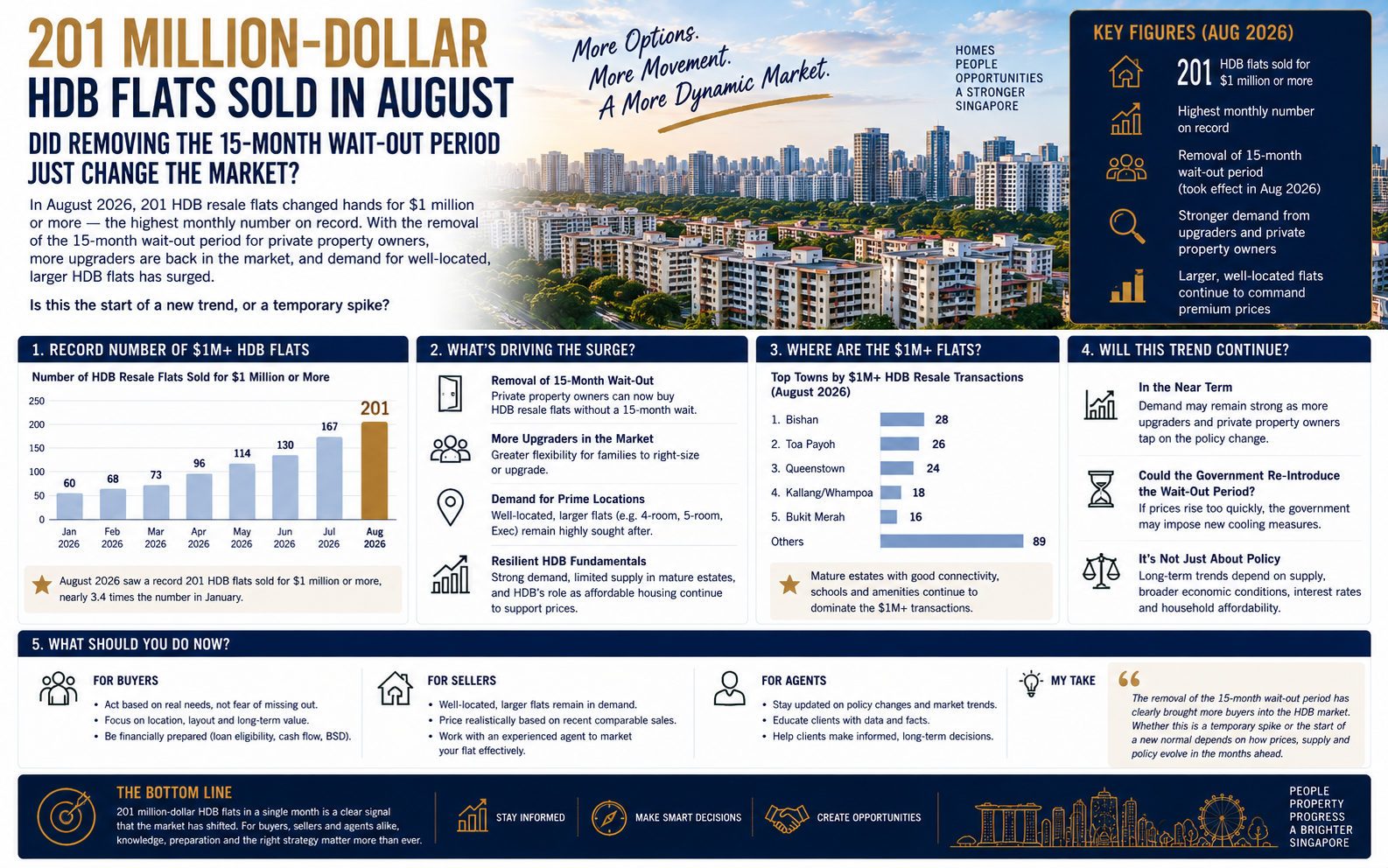
201 HDB flats were sold for $1 million or more in August 2026.
That is a new monthly record.
More importantly, it is the first time Singapore has crossed 200 million-dollar HDB transactions in a single month.
The previous record was 188 in June, followed by 187 in July.
August?
201.
And the timing immediately caught my attention.
Because on 28 July 2026, the Government removed the 15-month wait-out period for private-property owners buying a non-subsidised HDB resale flat.
When the announcement was made, I wrote about what I thought would happen next.
More importantly, we were already seeing something happen on the ground.
The National Day weekend that followed was crazy for some of our larger HDB listings.
My Executive Maisonette at Shunfu received approximately:
30 enquiries.
19 viewings.
In one weekend.
Another 5-room DBSS listing which had attracted viewings for months but no serious offers suddenly received offers.
At that time, my view was that removing the 15-month wait-out period would not necessarily send the entire HDB market sharply upwards.
Instead, I thought the effect would be concentrated.
Specifically:
5-room flats.
Executive Apartments.
Executive Maisonettes.
DBSS flats.
Large, well-located HDB homes.
And premium flats that appeal to private-property owners who are right-sizing.
Barely more than a month later, we now have our first interesting set of numbers.
So naturally, even though I am supposed to be on holiday with the kids…
I had to write about this.
First: What Actually Happened In August?
According to 99.co-SRX flash estimates, 201 HDB flats changed hands for at least $1 million in August 2026.
That was:
7.5% higher than July’s 187 transactions
and higher than the previous monthly record of:
188 in June.
Million-dollar transactions accounted for approximately 8% of the 2,524 HDB resale transactions in August.
Toa Payoh recorded the most, with:
32 million-dollar transactions.
Queenstown followed with:
26.
Bukit Merah recorded:
21.
And the most expensive transaction for the month?
A 5-room flat at Tiong Bahru View on Boon Tiong Road changed hands for:
$1,688,888.
But there is another number I think is even more important.
Overall HDB resale prices increased by only:
0.1% in August.
And compared with August 2025, overall resale prices were actually around 0.5% lower.
That sounds contradictory.
Record number of million-dollar flats…
but the overall market barely moved?
Actually, it isn’t contradictory at all.
It supports something I have been talking about for some time:
We may increasingly be looking at two different HDB markets.
The Headline Isn’t “HDB Prices Are Exploding Again”
This distinction is very important.
When people see:
201 MILLION-DOLLAR HDB FLATS
the immediate reaction may be:
“Wah, HDB prices are going crazy again.”
I don’t think that is what the data is telling us.
Remember:
201 million-dollar transactions represent about 8% of August’s resale market.
That also means:
92% of HDB resale transactions were below $1 million.
At the same time, overall resale prices barely changed.
So we should not confuse:
more premium transactions
with:
the entire HDB market becoming expensive.
These are two very different things.
This Was Actually My Hypothesis When The 15-Month Rule Was Removed
When the Government removed the 15-month wait-out period, I wrote that I expected the biggest immediate beneficiary to be the larger HDB resale segment.
Why?
Think about the typical private-property owner who wants to right-size.
Perhaps the children have grown up.
Maybe the mortgage is no longer worth carrying.
Maybe retirement is approaching.
Maybe they simply want to unlock capital.
They sell a private property for:
$2 million,
$2.5 million,
$3 million,
or more.
After paying off the outstanding loan, they may be sitting on substantial cash and CPF proceeds.
Their objective is not necessarily:
“Find me the cheapest HDB.”
They may be asking:
Can I still have space?
Can I stay somewhere central?
Can I be near my children?
Can I have a nice view?
Can I get something unique?
Can I avoid a huge renovation?
And most importantly:
Can I buy something that doesn’t feel like a massive lifestyle downgrade?
That is why I expected demand to flow disproportionately towards:
5-room flats,
Executive Apartments,
Executive Maisonettes,
DBSS,
jumbo flats,
newer flats,
high-floor units,
and premium locations.
The latest numbers don’t prove that hypothesis conclusively yet.
But they certainly aren’t contradicting it.
Our Shunfu EM Was A Very Real Example
This is where statistics become much more meaningful to me.
Because we actually experienced this shift ourselves.
I was marketing an Executive Maisonette in Shunfu.
It is a large 146 sqm home near Marymount MRT and within 1km of Catholic High School.
Before the policy change, there was interest.
But immediately after the removal of the 15-month wait-out period, enquiries accelerated dramatically.
Over the National Day weekend alone:
30 enquiries.
19 viewings.
Eventually, we secured a buyer at:
$1,388,000.
And the interesting part?
The transaction involved approximately:
$108,000 Cash Over Valuation.
That was not an easy deal.
Getting an offer is one thing.
Convincing a buyer that there is still value even when the COV is $108,000 is another.
We had to explain:
the scarcity of Executive Maisonettes,
the size of the home,
the location,
the surrounding alternatives,
the schools,
the MRT,
and what it would cost to replicate that amount of space elsewhere.
Eventually, the buyer exercised.
That experience made me even more convinced that something had changed in the buyer pool.
What Changed Wasn’t The Flat
This is the important point.
My Shunfu EM didn’t suddenly become:
bigger,
closer to the MRT,
younger,
or more beautifully renovated
on 28 July.
The buyer pool changed.
Before the policy removal, a private-property owner below 55 who wanted to sell and right-size into that EM generally faced a 15-month wait before becoming eligible.
That is a huge inconvenience.
Sell your home.
Find somewhere temporary to live.
Move.
Wait 15 months.
Buy HDB.
Renovate.
Move again.
For many families, that is enough friction to abandon the idea altogether.
Remove the 15 months?
Suddenly the same EM becomes accessible to a completely different group of buyers.
And some of those buyers are:
cash-rich private-property sellers.
That matters.
But We Need To Be Careful With August’s Numbers
This is where I want to be very clear.
The 15-month wait-out period was removed on 28 July.
August’s transaction statistics are based on registered transactions.
Some of the deals recorded in August would have been negotiated before the policy changed.
So it would be intellectually dishonest to say:
“Government removed the rule and immediately 201 million-dollar flats were sold because of it.”
We cannot establish that from one month’s numbers.
In fact, the previous record of 188 million-dollar transactions happened in June — before the rule was removed.
So premium HDB transactions were already increasing.
What the policy change may have done is add another source of demand to an already active premium segment.
That is why I think:
September, October and the rest of 2026 will be much more revealing.
The Original Reason For The 15-Month Rule Matters
To understand what happens next, we need to remember why the Government introduced it.
The 15-month wait-out period was introduced in September 2022, when the HDB resale market was rising rapidly.
It was specifically intended to moderate demand from private-property owners entering the HDB resale market.
The effect on larger flats was noticeable.
According to data cited by Huttons, transactions of 5-room resale flats fell from:
6,951 in 2022
to:
5,966 in 2025.
Executive and multi-generation flat transactions fell from:
1,946
to:
1,539
over the same period.
When the Government removed the restriction in July 2026, the environment was very different.
HDB resale prices had already declined for two consecutive quarters.
More flats were coming onto the market.
About 13,500 flats are expected to reach MOP in 2026, compared with around 8,000 in 2025.
So the Government’s assessment was effectively:
the market can now absorb these buyers again.
Could The Government Bring Back The 15-Month Wait-Out Period?
This is probably the question many people will ask now.
My answer:
Possible? Yes.
Imminent because 201 flats crossed $1 million? I don’t think we can conclude that.
The Government has repeatedly demonstrated that Singapore’s property policies are dynamic.
Measures can be:
introduced,
tightened,
relaxed,
or removed
depending on market conditions.
The 15-month rule itself proves that.
But I don’t think policymakers will look at one headline number and immediately reverse course.
They will probably look at the broader market.
Questions such as:
Are overall HDB resale prices accelerating again?
Are transaction volumes surging?
Are COVs increasing significantly?
Are former private-property owners crowding out ordinary HDB buyers?
Are larger HDB flats experiencing abnormal price growth?
Are million-dollar transactions spreading rapidly into more towns and ordinary flat types?
Is the policy undermining affordability?
Those are much more important than simply:
“Did we cross 200 million-dollar transactions?”
What Would Make Me Start Worrying About Another Intervention?
If over the next few months we see:
200 becoming 230…
then:
250…
then:
300 million-dollar transactions…
while overall HDB resale prices begin accelerating again…
then I think the conversation changes.
Especially if we see strong price increases spreading beyond:
premium locations,
rare flat types,
high-floor units,
DBSS,
Executive Apartments,
and Executive Maisonettes.
The key word is:
broad-based.
A $1.5 million rare flat in Tiong Bahru is one thing.
Ordinary flats across Singapore suddenly repricing sharply upwards is another.
Policy intervention becomes much more likely when the second starts happening.
I Actually Think We Could See A “Two-Speed” HDB Market
This is my working hypothesis now.
Instead of the entire HDB market rising together, we may see:
Market 1: Ordinary HDB
3-room.
Typical 4-room.
Older flats.
Less convenient locations.
Large competing supply.
These may experience relatively moderate price movements.
And then:
Market 2: Premium HDB
Newer 5-room.
Executive Apartments.
Executive Maisonettes.
DBSS.
Jumbo flats.
High-floor units.
Central locations.
Rare layouts.
Flats near MRTs and popular schools.
These may attract a completely different buyer.
And removing the 15-month restriction potentially increases that second group’s purchasing power.
A $1 Million HDB Isn’t Necessarily Expensive
This will probably upset some people.
But I think we need to stop evaluating HDB purely through the emotional threshold of:
”$1 million.”
One million dollars sounds enormous.
And yes, public housing affordability remains extremely important.
But property value is ultimately relative.
Imagine someone sells a 1,200 sq ft private condo for:
$2.5 million.
They can buy:
a 1,500+ sq ft Executive Maisonette
for:
$1.3 million–$1.5 million.
They unlock perhaps:
$1 million of capital
while retaining a large family home.
From that person’s perspective, the HDB may represent value, not extravagance.
That doesn’t mean every $1 million HDB is worth buying.
Far from it.
But:
Price and value are not the same thing.
This Is What Right-Sizing Is Supposed To Achieve
And this brings us back to Asset Progression.
Progression does not always mean:
HDB → Condo → Landed.
Sometimes progression means:
Private → HDB + $1 million cash.
If someone is approaching retirement and can move from a $2.5 million private property into a $1.3 million HDB while maintaining the lifestyle they want, what have they achieved?
Lower mortgage.
Lower financial commitment.
More retirement capital.
Possibly more space.
And potentially more flexibility.
That can be an extremely successful property move.
The direction of the arrow matters less than the outcome.
So Will Million-Dollar HDB Transactions Continue Increasing?
My view is:
Probably yes — but not necessarily because the whole HDB market is going up.
There are several structural reasons.
First, Singapore incomes and property values have increased substantially over time.
Second, there is a finite supply of rare flat types such as Executive Maisonettes.
Third, newer HDB flats in excellent locations increasingly offer attributes buyers are prepared to pay for.
Fourth, private-property right-sizers are now back in the buyer pool.
And fifth, the psychological meaning of “$1 million HDB” is changing.
Five years ago, every million-dollar transaction was news.
Today, we had 201 in one month.
Eventually, the more useful questions will be:
What flat?
Where?
How large?
How old?
What floor?
What remaining lease?
What alternatives were available at the same price?
Those questions tell us far more than the $1 million label.
What Should HDB Sellers Do Now?
If you own a:
5-room,
EA,
EM,
DBSS,
jumbo,
or other premium HDB,
I think this is a very interesting period.
Your potential buyer pool has widened.
But please don’t read:
“201 million-dollar flats”
and immediately add $200,000 to your asking price.
The market is still extremely price-sensitive.
A record transaction somewhere else does not automatically become your valuation.
Instead:
Understand who your likely buyer is.
If your home appeals to a private-property right-sizer, market accordingly.
Talk about:
space,
convenience,
lifestyle,
accessibility,
schools,
layout,
and the financial benefit versus retaining a private property.
You are not merely selling:
an HDB flat.
You may be selling:
a right-sizing solution.
That is a very different conversation.
What Should Buyers Do?
Do not panic.
The fact that 201 people bought million-dollar HDBs does not mean you need to rush out tomorrow.
Remember:
92% of August HDB resale transactions were still below $1 million.
There are plenty of options.
But if you are targeting a genuinely rare property:
Executive Maisonette,
Executive Apartment,
premium DBSS,
very high floor,
rare location,
large flat near MRT,
then understand that your competition may have changed.
You may now be competing against buyers who have just sold private property and have substantial cash proceeds.
That does not mean:
pay whatever the seller wants.
It means:
understand scarcity before negotiating.
Sometimes walking away is correct.
Sometimes paying $50,000 more for something genuinely irreplaceable is correct.
The job is knowing the difference.
What Should Agents Do?
This is where I think the opportunity is biggest.
Don’t simply forward your clients the article saying:
“HDB market very hot now!”
That adds no value.
Instead, understand why the market is changing.
If you are representing sellers:
identify whether the flat appeals to private-property right-sizers.
If you are representing buyers:
compare the premium against realistic alternatives.
If you have private-property owners in your database:
call them.
Some of them may have wanted to right-size for years but rejected the idea because of the 15-month wait.
Their situation has changed.
And don’t start the conversation with:
“Want to sell your condo?”
Start with:
“Now that the 15-month wait is gone, have you reconsidered what your retirement housing plan could look like?”
That is a much more meaningful conversation.
What Am I Watching Next?
Three things.
September And October Million-Dollar Transactions
These months should increasingly reflect buyers who began searching after the policy change.
If the numbers continue climbing, we have stronger evidence that the demand shift is real.
5-Room, EA And EM Prices
This is more important to me than the headline million-dollar count.
If larger-flat prices begin materially outperforming the rest of the market, that would support the right-sizer hypothesis.
COV
This could become very important.
My Shunfu EM ultimately transacted at $108,000 above valuation.
If large COVs become more common in premium HDB transactions, policymakers will certainly pay attention.
Because that’s when increased purchasing power starts translating into price expectations.
One Month Later: Was My Original Hypothesis Right?
Too early to declare victory.
But so far?
The direction looks right.
When I wrote immediately after the 15-month rule was removed, I said I expected demand to return particularly strongly for larger and more premium HDB homes.
Then we experienced it ourselves:
30 enquiries.
19 viewings.
One National Day weekend.
And eventually a $1.388 million Shunfu EM sale with $108,000 COV.
Now August has produced:
201 million-dollar HDB transactions.
But I want to emphasise this again.
Correlation is not causation.
Some August transactions predate the policy change.
Premium HDB activity was already strong before 28 July.
So I am not prepared to say:
“The 15-month removal caused this record.”
Not yet.
What I am prepared to say is:
the first evidence after the policy change is consistent with what we were already observing on the ground.
And that makes the next few months extremely interesting.
My Take
I am sitting overseas with my kids while writing this.
I should probably be thinking about where we are going for dinner instead of HDB transaction data.
But this is exactly why I enjoy property.
Policies change.
Buyer behaviour changes.
Markets react.
And sometimes we get to watch a hypothesis play out in real time.
The removal of the 15-month wait-out period looked like a small policy adjustment to some people.
I never thought it was small.
Because it reopened the HDB resale market to a very specific group of buyers:
private-property owners with substantial equity who want to right-size.
These buyers are unlikely to spread their demand evenly across every HDB flat.
They are likely to concentrate on homes that preserve the lifestyle they are leaving behind.
That is why I continue to watch:
5-room flats.
DBSS.
Executive Apartments.
Executive Maisonettes.
Rare layouts.
Premium locations.
And after August’s 201 million-dollar transactions?
I am watching them even more closely.
Will the Government eventually bring back the 15-month wait-out?
Maybe.
Singapore property policy has never been static.
But I don’t think 201 million-dollar flats alone will trigger it.
The bigger question is what happens next.
If the premium segment strengthens while the overall HDB market remains stable, policymakers may be comfortable allowing the market to absorb the demand.
If premium demand starts pulling the entire resale market upwards again?
Then I would not be surprised to see another policy response.
September and October will tell us much more.
For now, the experiment has begun.
And the first set of numbers is certainly worth watching.
Want the tailored version for your portfolio?
Every article here generalises. A 20-minute conversation makes it specific to your numbers.
How many million-dollar HDB flats were sold in August 2026?
Was this caused by the removal of the 15-month wait-out period?
What was the 15-month wait-out period?
Why did the Government remove it?
Are all HDB prices rising because of the change?
Which HDB flats could benefit most?
Why would former private-property owners pay more for HDB flats?
Will there be more million-dollar HDB flats?
Could the Government reinstate the 15-month wait-out period?
Does a million-dollar HDB automatically mean it is overpriced?
Should HDB sellers raise their asking prices now?
What should private-property owners considering right-sizing do?
What should agents do now?

Written by
Christopher Ng (CEA R014394H)
Singapore Property & Asset Progression Strategist with ERA Realty Network. A NUS Real Estate graduate, Christopher has advised homeowners, investors and property owners since 2004.