
How Much Is a Landed Property Really Worth? My Framework for Valuing Landed Homes in Singapore
Valuing Singapore landed property is complex, unlike condos. It involves assessing the land, the building, and future potential, not just land PSF. This article presents a framework to understand what a landed home is truly worth.
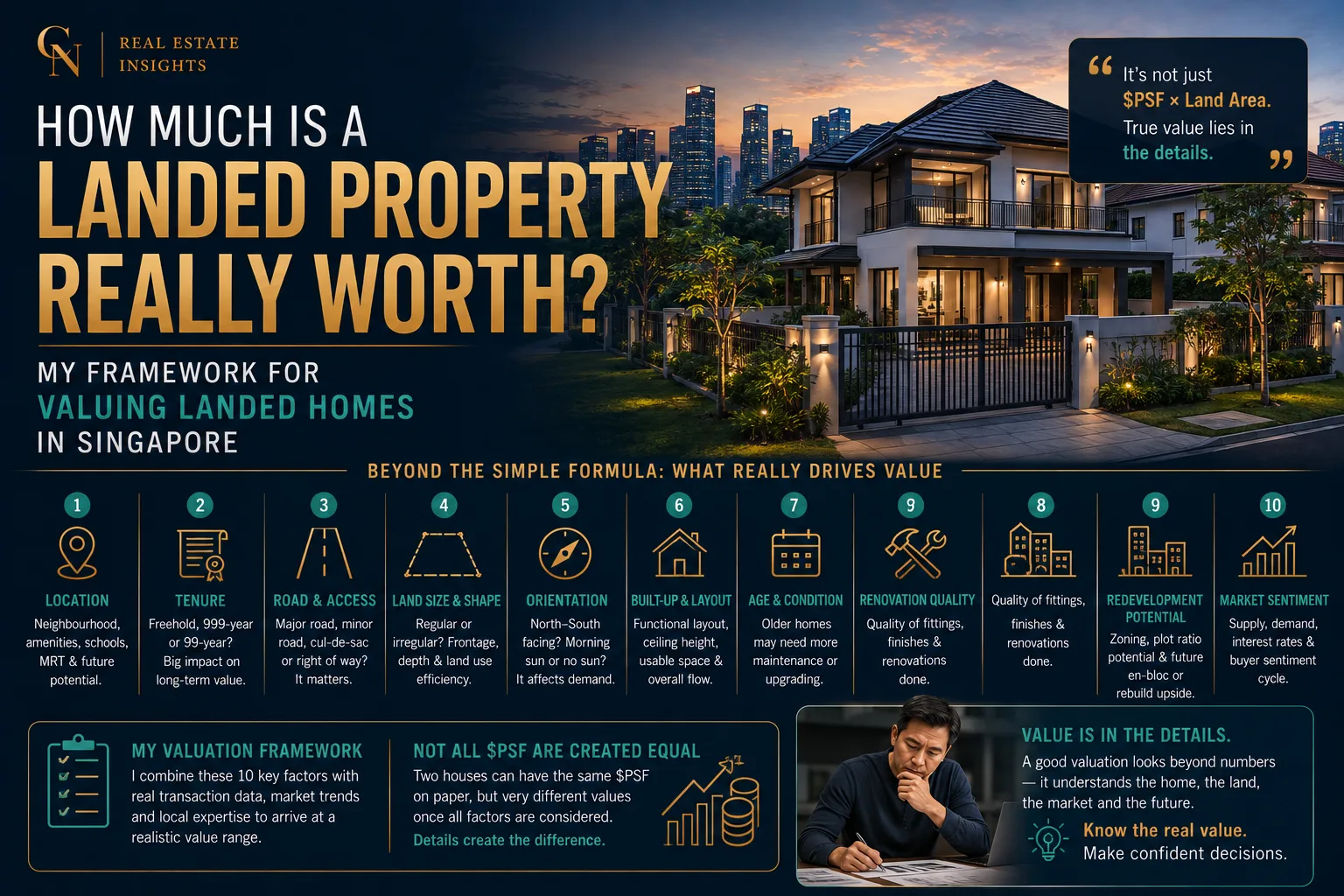
One of the most common questions I get when viewing landed property is:
“Christopher, what is the fair value?”
And very often, the next sentence is:
"The neighbour sold for $2,000 psf land, so this house should also be around $2,000 psf, right?"
I wish landed valuation were that simple.
It isn't.
In fact, this is probably one of the biggest differences between buying a condominium and buying landed property in Singapore.
With a condo, comparables are usually easier.
Same development.
Same unit type.
Similar floor.
Similar facing.
Similar size.
From there, we can establish a fairly sensible range.
Landed property is completely different.
Two houses sitting next to each other can have:
the same land size,
the same tenure,
the same postal code,
and still deserve very different prices.
Why?
Because with landed property, you're not buying one thing.
You're buying at least three things at the same time:
the land, the building and the future potential of the site.
And each of those has to be valued differently.
That is why I don't believe:
Land area × average land PSF = landed property value
is enough.
It's a useful starting point.
But it is only the starting point.
A Real Example: Same Street, Completely Different PSF
Let's look at a real 2026 example from Tai Yuan Heights.
Recent recorded semi-detached transactions included:
35 Tai Yuan Heights — about 6,245 sq ft of land, sold for approximately $7.388 million, or around $1,183 psf on land
8A Tai Yuan Heights — about 2,387 sq ft of land, sold for approximately $6.78 million, or around $2,840 psf on land
Another 3,451 sq ft semi-D transacted at about $5.735 million, or roughly $1,662 psf
A 3,456 sq ft transaction went for about $5.4 million, or about $1,562 psf
Same street.
Same landed neighbourhood.
Yet the PSF range is enormous.
If landed valuation were simply:
“What did the last house sell for per square foot?”
how do we explain this?
The answer is that land PSF alone does not tell you what is sitting on the land, how usable the plot is, what condition the house is in or what development potential the buyer is paying for.
This is why I always tell buyers:
Don't compare PSF first. Compare the asset first.
Then use PSF to help explain the difference.
My Landed Valuation Framework
When I value a landed property, I mentally break it into several components.
Not every factor has equal importance in every transaction.
But together, they help me understand whether the asking price is cheap, expensive or simply misunderstood.
1. Location: The First Layer of Value
Let's start with the obvious.
A 3,000 sq ft semi-D in Bukit Timah is not comparable with a 3,000 sq ft semi-D in another part of Singapore simply because the land size is identical.
Even within the same district, micro-location matters.
I look at:
landed enclave
proximity to MRT
road accessibility
schools
amenities
traffic conditions
distance to employment centres
surrounding housing profile
prestige and perception
future planning changes
And within a landed estate itself, some streets are more desirable than others.
A quiet internal street can command a premium over a road exposed to heavy traffic.
A house walking distance to the heart of Serangoon Gardens may trade differently from one at the fringe.
Location establishes the broad value range.
Everything else moves the property within that range.
2. Tenure: Freehold, 999-Year or 99-Year
Singapore buyers place a substantial premium on freehold landed property.
Understandably so.
For many families, landed isn't merely a home.
It is also about:
legacy.
They want something that can eventually pass to their children.
So when I compare two similar houses, freehold or 999-year tenure generally deserves a premium over a shorter leasehold property.
But again, I don't analyse tenure in isolation.
A terrible freehold house in a compromised location isn't automatically worth more than an excellent long-lease landed home somewhere much better.
Ask:
What premium am I paying for tenure, and what am I sacrificing to get it?
3. Land Size: Important, But Bigger Isn't Always Better
Naturally, larger land generally means more value.
But here's where landed gets interesting.
Imagine:
House A
4,000 sq ft rectangular plot.
House B
4,500 sq ft plot.
At first glance, House B sounds better.
But suppose House B tapers sharply towards the rear.
Or 400 sq ft sits in an awkward triangular portion.
Or part of the site is affected by a road reserve.
Suddenly, the additional 500 sq ft may not be as valuable as it looks.
URA itself assesses landed plot size and width based on net dimensions, excluding land that must be set aside for matters such as road or drainage reserves.
That is why I prefer thinking about:
usable land
rather than merely:
headline land area.
4. Plot Width and Frontage
This is one of the most underestimated landed factors.
A wider plot can transform what you can build.
For current URA planning controls, a side-to-side semi-detached house generally requires at least 200 sqm of plot area and 8m width, while a detached house generally requires at least 400 sqm and 10m width.
Why does frontage matter so much?
Because width affects:
driveway design
parking
entrance
facade
room configuration
natural lighting
internal circulation
future redevelopment
Two 4,000 sq ft plots could therefore have very different redevelopment value.
A broad, regular site may allow an architect to create an excellent family home.
A narrow site might force a long corridor-like configuration.
Same land area.
Very different land quality.
5. Plot Shape
This goes together with frontage.
The ideal plot for most buyers is relatively regular.
Rectangular.
Straight boundaries.
Good frontage.
Sensible depth.
Irregular land can still be valuable.
URA even provides some flexibility for irregular plots where average widths comply with minimum requirements, although the narrowest point and other planning controls still matter.
But from a buyer's perspective, every awkward corner can potentially affect:
buildability
room layout
garden usability
pool position
car porch
future resale appeal
This is why I would never automatically pay the same PSF for two plots simply because they're on the same road.
6. Road and Access
A landed house doesn't exist independently from the road in front of it.
I pay attention to:
road width
traffic
whether two cars can pass comfortably
parking congestion
cul-de-sac versus through-road
road category
turning space
slope
visibility when exiting the property
This sounds mundane until you live there.
Imagine paying $7 million for a beautiful landed house, then discovering that every evening your street is packed with parked cars and reversing out is a daily battle.
That affects liveability.
And liveability eventually affects value.
Road category can also affect planning setbacks. URA's prevailing controls prescribe different road buffers and setbacks depending on road classification.
Again:
the road can affect the land.
7. Orientation
Landed buyers often focus heavily on facing.
East.
West.
North.
South.
I wouldn't pay an arbitrary premium purely based on compass direction.
But orientation matters because it affects:
afternoon sun
room temperature
natural light
outdoor usability
facade design
future construction possibilities
A west-facing property isn't automatically bad.
Good architecture can mitigate heat.
But if you're comparing two otherwise similar homes, orientation can influence buyer preference and resale liquidity.
8. Building Age
Now we move from land to the building.
This is where many landed comparables break down.
Suppose two neighbouring 4,000 sq ft semi-D houses both sell around $7 million.
House A was reconstructed three years ago.
House B was built 35 years ago.
Those are not equivalent transactions.
In House A, part of the purchase price represents a modern building.
In House B, the buyer may effectively be purchasing land and treating the existing house as having limited value.
This distinction is critical.
9. Built-Up Area
For owner-occupiers, built-up area can matter tremendously.
Consider two semi-Ds:
Property A
Land: 4,000 sq ft
Built-up: 3,500 sq ft
Property B
Land: 4,000 sq ft
Built-up: 7,000 sq ft
If Property B is well designed and in good condition, buyers may pay substantially more because they avoid the time and cost required to create that additional space.
But built-up isn't automatically valuable either.
A badly designed 7,000 sq ft house can feel worse than an intelligently planned 5,000 sq ft house.
Again:
quantity and quality are different things.
10. Condition
I normally classify landed houses mentally into four broad categories.
Land value / rebuild condition
The buyer is really purchasing the plot.
Major A&A required
The existing structure has usefulness, but substantial works are needed.
Renovation required
Structure and layout are fundamentally workable.
Move-in / recently rebuilt
The building itself carries meaningful value.
This categorisation makes valuation much easier.
Because if I know I have to spend another $1 million after buying, I shouldn't compare the house directly against a move-in property without adjusting for that future cost.
11. Renovation Quality
This is where buyer emotion enters.
A beautifully renovated property commands a premium.
And it should.
The buyer receives:
immediate occupation
no construction risk
no two-year wait
no rental accommodation during works
less decision fatigue
But there is an important distinction between:
expensive renovation
and
valuable renovation.
A seller may have spent $1.5 million.
That does not mean the next buyer values it at $1.5 million.
Perhaps the buyer dislikes the design.
Perhaps the materials are already ten years old.
Perhaps the kitchen has to be replaced anyway.
The value of renovation is what the market recognises, not what the seller spent.
12. Redevelopment Potential
Sometimes the most valuable part of a landed house is something you cannot see.
What could be built there next.
That means looking at:
landed housing designation
permissible storeys
building envelope
site dimensions
setbacks
surrounding housing form
whether subdivision is possible
whether the existing structure can be retained
A&A versus reconstruction possibilities
Under current URA rules, for example, A&A generally requires proposed additional GFA, external-wall replacement and structural changes to remain within prescribed 50% thresholds; works beyond the applicable criteria are treated as reconstruction.
So if redevelopment potential is a key part of the purchase thesis, get a qualified architect or appropriate professional to assess it.
Do not pay for assumed potential.
Verify the potential.
Why Land PSF Can Be Very Misleading
Let's return to the Tai Yuan Heights example.
One 2026 semi-D on about 6,245 sq ft transacted at $7.388 million, around $1,183 psf land.
Another much smaller plot of approximately 2,387 sq ft transacted at $6.78 million, around $2,840 psf land.
If PSF alone determined value, the second buyer looks crazy.
But that conclusion would be irresponsible without understanding:
building age
condition
built-up
plot characteristics
reconstruction history
exact micro-location
redevelopment potential
In fact, this spread itself demonstrates the point.
When a house has meaningful building value, the apparent land PSF can become very high.
When a very large plot has an older or less valuable structure, its headline land PSF can look very low.
Neither number alone tells you whether the transaction was cheap or expensive.
My Favourite Question: “What Am I Really Paying For?”
When I evaluate landed property, I like to ask:
How much am I paying for the land?
Then:
How much am I paying for the building?
Then:
How much am I paying for convenience?
Then:
How much am I paying for future potential?
This helps unpack the asking price.
Suppose a seller asks $7.5 million.
Maybe:
$6 million is effectively underlying land value.
$700,000 represents building value.
$300,000 reflects location premium.
$500,000 reflects exceptional condition and convenience.
That doesn't need to be mathematically exact.
It's a way of thinking.
It stops you from treating one number as though it tells the entire story.
A Composite Client Case: House A vs House B
Let me give you an example based on the type of situation I regularly encounter.
The addresses below are fictional, but the price range and valuation issues are deliberately based on real 2025–2026 landed-market transactions in the Serangoon Gardens/Tai Yuan area, where semi-D caveats have ranged from roughly $5 million to $9 million depending on land size and property characteristics.
My client — let's call him Mr Lim — had a budget of around $7 million.
We shortlisted two freehold semi-detached houses.
House A — 18 Example Gardens
Asking price: $6.5 million
Land: 4,200 sq ft
Built-up: 3,600 sq ft
Age: Approximately 35 years
Condition: Original
Plot: Slightly irregular, tapering towards the rear
Frontage: Average
Road: Quiet but narrow
Immediate works required: Significant
Estimated renovation/A&A budget: $800,000–$1 million
At first glance, House A looked attractive.
$6.5 million.
4,200 sq ft.
That's around:
$1,548 psf on land.
Many buyers would immediately say:
"Cheap!"
But let's keep going.
House B — 27 Sample Heights
Asking price: $7 million
Land: 3,850 sq ft
Built-up: 6,200 sq ft
Age: Rebuilt approximately five years ago
Condition: Very good
Plot: Regular rectangular
Frontage: Wider
Road: Good access
Immediate works required: Minimal
Estimated renovation: $150,000
Land PSF?
Around:
$1,818 psf.
So House B is:
$500,000 more expensive
sitting on 350 sq ft less land
and has a land PSF around $270 higher
If you stopped there:
House A wins.
But I wouldn't stop there.
Now Let's Calculate The Real Cost
House A
Purchase: $6.50m
Works: $0.90m
Indicative all-in before financing/transaction costs: $7.40m
And perhaps the family needs to rent for a year or more during construction.
There is also:
construction risk,
professional fees,
possible cost overruns,
and time.
House B
Purchase: $7.00m
Works: $0.15m
Indicative all-in: $7.15m
Move in almost immediately.
Now which one is cheaper?
Suddenly, the "$6.5 million house" costs $250,000 more to achieve the family's required living standard.
And House B provides:
larger built-up
wider frontage
more regular land
newer construction
no major construction headache
So although House B has the higher asking price and higher land PSF...
House B may actually offer better value.
That's the difference between:
cheaper purchase price
and
cheaper ownership outcome.
But What If Mr Lim Wants To Rebuild His Dream House?
Then the answer changes again.
Suppose Mr Lim doesn't care about the existing building.
He wants to demolish everything and create a bespoke home.
Now House B's expensive new construction may have limited value to him.
He's paying for a building he intends to destroy.
House A could suddenly become more attractive because its older structure has already been largely discounted.
This is why valuation is buyer-specific too.
The same house can represent different value to:
an owner-occupier,
a rebuilder,
a developer,
and
an investor.
What Would I Offer?
Let's take our fictional House A and House B.
If Mr Lim tells me:
"Christopher, I want to move in within three months and I absolutely don't want construction."
I may recommend House B even at $7 million.
But if he tells me:
"I want a 9,000 sq ft dream home and I'm prepared to rebuild anyway."
Then House A becomes much more interesting — assuming professional due diligence confirms the site can accommodate what he wants.
That's why I don't like clients asking:
“Which house is cheaper?”
My response is:
“Cheaper for what objective?”
The Comparable Transaction Trap
Another common problem happens when sellers say:
"Number 10 sold for $7.2 million, so mine must be worth $7.2 million."
Perhaps.
But what was Number 10?
Was it:
newly rebuilt?
larger frontage?
corner plot?
better road?
regular land?
more built-up?
better orientation?
better condition?
The comparable transaction is evidence.
It isn't the answer.
The job is to adjust the evidence to reflect the subject property.
This is why landed valuation requires judgement.
And why two people looking at the same caveat data can come to different conclusions.
Bigger Land Can Sometimes Trade At Lower PSF
This is another pattern landed buyers should understand.
Large land plots frequently have lower land PSF than smaller plots.
Why?
Because absolute quantum matters.
A buyer paying $2,500 psf for 2,500 sq ft spends:
$6.25 million.
Put the same PSF on 6,000 sq ft:
$15 million.
The buyer pool changes completely.
So don't conclude that a 6,000 sq ft plot at $1,500 psf is automatically undervalued compared with a 2,500 sq ft property nearby at $2,500 psf.
The total cheque matters.
Landed PSF is not linear.
The House Can Sometimes Be Worth Millions
There is another extreme.
Suppose a seller recently reconstructed a semi-D.
Beautiful modern architecture.
Lift.
Pool.
Four ensuite bedrooms.
Excellent materials.
7,000 sq ft built-up.
You cannot compare it against an original 1970s house purely on land PSF.
Rebuilding that home today could cost a very substantial amount of money and several years of effort.
A buyer willing to pay for convenience will recognise some of that value.
Not necessarily every dollar the owner spent.
But certainly more than zero.
Conversely, Some Houses Have Negative Building Value
Yes — negative.
Suppose the existing house is so poor that the buyer must demolish it.
The building now creates:
demolition cost
disposal cost
time
inconvenience
The structure isn't adding value.
It's adding liability.
In that situation, the correct question may be:
What is the site worth as vacant land, less what it costs me to clear and redevelop it?
Again, this is why beautifully renovated versus original landed homes cannot be compared lazily.
My Practical Landed Valuation Checklist
Before deciding what I think a landed property is worth, I want answers to these questions:
Land
What is the land area?
Is it gross or affected by road/drainage reserve?
What is the frontage?
Is the plot regular?
Is it sloping?
Is the plot deep or awkwardly shaped?
Location
Which landed enclave?
Which street?
Main road or internal?
MRT?
Schools?
Amenities?
Future planning?
Tenure
Freehold?
999-year?
Remaining lease?
Building
Built-up?
Age?
Condition?
Layout?
Renovation quality?
Structural usefulness?
Redevelopment
What can potentially be built?
How many storeys?
What setbacks apply?
Is A&A feasible?
Is reconstruction necessary?
Could the plot be subdivided or housing form changed, where planning rules allow?
Money
Asking price?
Comparable transactions?
Renovation liability?
Rebuild cost?
Temporary rental?
Financing?
All-in acquisition cost?
Exit
Who buys this property from me later?
What will the lease look like then?
Will the building still have value?
Will the land remain desirable?
Only after that do I become comfortable answering:
“What is this landed property worth?”
So How Much Is A Landed Property Really Worth?
My answer is:
It is worth what a rational buyer should pay after adjusting comparable land transactions for the specific qualities of the land, building and redevelopment potential.
That sounds less satisfying than quoting one PSF number.
But it is far closer to reality.
A landed home is not a commodity.
Every plot is different.
Every house is different.
Every road is different.
And every buyer is solving a different problem.
This is exactly why I enjoy landed property.
There is a lot more thinking involved.
My View
If there is one thing I hope landed buyers take away from this article, it is this:
Stop asking only, “What is the land PSF?”
Instead ask:
“What am I getting for every dollar I am paying?”
A $6.5 million landed home can be more expensive than a $7 million home.
A 4,500 sq ft plot can be worse than a 4,000 sq ft plot.
A freehold house can be inferior to a leasehold house.
A newly rebuilt property can be better value at a higher PSF than an original house that needs another million dollars.
And a cheap-looking old property can be an outstanding purchase if the underlying land and redevelopment potential are strong.
That is why valuing landed property requires more than multiplying two numbers.
You need to understand:
land value,
building value,
location value,
redevelopment value,
and ultimately,
value to the person buying it.
Once you understand those layers, the asking price becomes much easier to judge.
Because the most important question isn't:
“Is this landed property expensive?”
It is:
“Expensive compared with what I'm actually getting?”
That is the framework I use.
And in a market where landed homes can differ by millions of dollars even on the same street, I think that distinction matters more than ever.
Want the tailored version for your portfolio?
Every article here generalises. A 20-minute conversation makes it specific to your numbers.
How do you value a landed property in Singapore?
Why can two landed homes on the same street have very different PSF?
Is lower land PSF always better?
Is a bigger landed plot always more valuable?
Why is frontage important in landed property?
Does a road reserve affect landed value?
How much value should I give a newly rebuilt landed house?
Can an old landed house have zero building value?
What is more important: land size or built-up area?
How do I compare an original-condition house with a renovated one?
What is the difference between A&A and reconstruction?
Should I engage an architect before buying landed property?
Is freehold landed always worth more than leasehold?
What is the biggest mistake buyers make when valuing landed property?
House A costs $6.5 million and House B costs $7 million. Which is cheaper?
What is the most important question when buying landed property?

Written by
Christopher Ng (CEA R014394H)
Singapore Property & Asset Progression Strategist with ERA Realty Network. A NUS Real Estate graduate, Christopher has advised homeowners, investors and property owners since 2004.