
Amberwood at Holland: Is This Quiet District 10 Launch Actually a Hidden Opportunity?
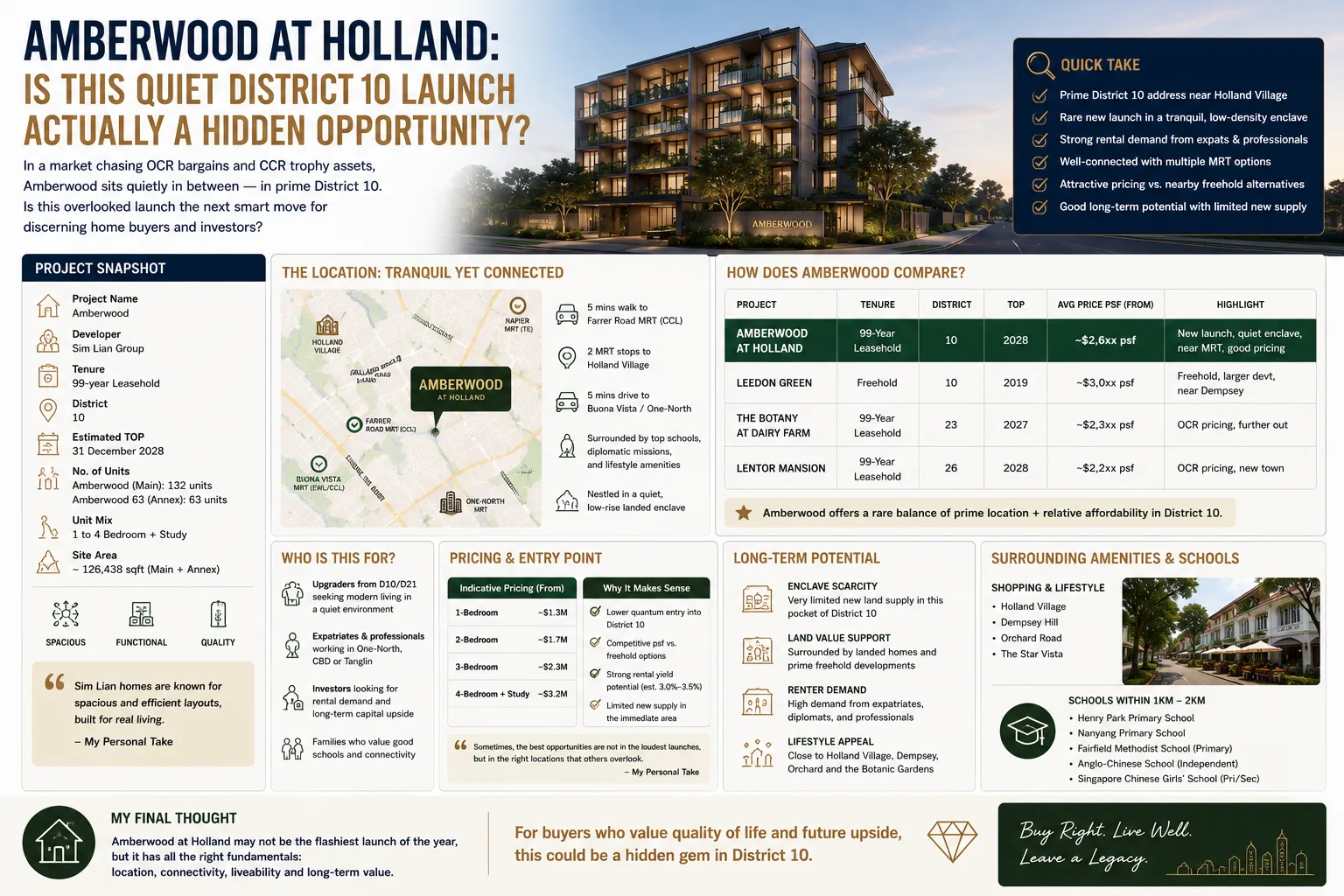
Amberwood at Holland is a 212-unit low-rise District 10 development by Sim Lian, offering spacious 3- to 5-bedroom family homes. This project sits in the emerging Holland Plain precinct, positioning it as a first-mover in a transforming area
Every now and then, a new launch comes along that does not immediately scream for attention.
It isn't sitting on top of an MRT station.
It isn't a 1,000-unit mega development.
It isn't surrounded by shopping malls.
And it isn't in a location that needs much introduction.
Amberwood at Holland may be one of those projects.
Sim Lian's upcoming 212-unit development at Holland Link sits within District 10, beside established landed and Good Class Bungalow neighbourhoods, and importantly, within the emerging Holland Plain precinct.
Official pricing has yet to be released as I write this, so I am not going to pretend that Amberwood is automatically a good buy.
At the end of the day, price determines opportunity.
But having studied the site, the land bids, what is happening around Bukit Timah and Turf City, and where Holland fits into this transformation, I think Amberwood deserves a closer look.
Because its biggest selling point may not be what Holland is today.
It could be what this entire belt becomes over the next 10 to 20 years.
First, A Personal Connection With This Part Of Singapore
I don't stay around Holland or Bukit Timah today.
But this part of Singapore was very much part of my formative years.
I went from Henry Park Primary School to St Joseph's Institution and subsequently National Junior College.
For many years, the bus routes I took revolved around Holland, Sixth Avenue, Bukit Timah and Dunearn.
So this is an area I remember very differently from how I analyse it today as a property agent.
Back then, it was simply a very nice neighbourhood.
Quiet.
Green.
Low-density.
Beautiful landed homes.
Bukit Timah Road.
Holland Village.
Sixth Avenue.
I certainly wasn't sitting on the bus analysing PSF and land values!
As I grew older and entered real estate, I began to understand something else:
This is also where a significant amount of Singapore's wealth lives.
Look around Holland, Leedon, Ford Avenue, Coronation, Bin Tong, King Albert Park and the surrounding GCB areas.
This isn't a neighbourhood that suddenly became desirable because a developer built a condominium here.
The address was already desirable.
That distinction matters to me.
What Exactly Is Amberwood at Holland?
Sim Lian's Amberwood at Holland is an upcoming 99-year leasehold condominium by Sim Lian at Holland Link.
The confirmed development comprises only 212 residences, spread across 11 low-rise blocks of four and six storeys.
Interestingly, there are no one- or two-bedroom apartments.
The project is entirely made up of:
3-bedroom homes
4-bedroom homes
5-bedroom homes
Sim Lian describes Amberwood as a collection of spacious family homes, with direct access to Holland Green Linear Park and the future Community Plain. Methodist Girls' School is also within 1km.
That unit mix already tells us something about the intended positioning.
This isn't being designed primarily as a shoebox investor project.
It is a family project.
And personally, I think that fits the neighbourhood.
Sim Lian As Developer: Something I Like About Their Products
Sim Lian may not always generate the same branding hype as some of the developers behind ultra-luxury CCR developments.
But there is something I have generally appreciated about their residential products:
their layouts tend to be functional.
For owner-occupiers, this matters.
Sometimes we become too obsessed with PSF and forget that people actually need to live inside the property.
Can I fit a proper dining table?
Is the living room wide enough?
Are the bedrooms usable?
Is there sufficient storage?
Does the kitchen work?
Can a family with three children actually live here comfortably?
Amberwood's decision to offer only 3- to 5-bedroom apartments is therefore something I find interesting.
A boutique, low-rise District 10 development designed around families could differentiate itself from many newer developments where efficiency sometimes simply means squeezing more bedrooms into less space.
Of course, I will reserve final judgement until we assess the actual floor plans and prices.
But conceptually?
I like the direction.
The First Big Number: Sim Lian Paid $1,432 PSF PPR For The Land
This is where the investment discussion becomes interesting.
Sim Lian won the Holland Link GLS site in August 2025 for approximately:
$368.37 million
or about:
$1,432 psf ppr.
Five developers competed for the site.
More interestingly, Sim Lian's winning bid was approximately 22% higher than the second-highest bidder.
At the time, you could interpret that two ways.
One:
Sim Lian overpaid.
Or two:
Sim Lian saw something in Holland Plain that the other developers valued much more conservatively.
We now have another piece of evidence.
Sim Lian Then Bought The Next Holland Plain Site
In May 2026, the next Holland Plain GLS parcel was awarded.
Guess who bought it?
Sim Lian again.
This time, they were the only bidder.
And they paid:
$1,491 psf ppr.
That's higher than Amberwood's $1,432 psf ppr land rate.
This is important.
Because Sim Lian didn't merely make one aggressive bet on Holland.
They effectively doubled down on the precinct.
Amberwood's site:
$1,432 psf ppr
Next Holland Plain site:
$1,491 psf ppr
That gives Amberwood something I always like to examine when evaluating new launches:
replacement land cost.
The next piece of land has already been sold at a higher rate.
That does not guarantee Amberwood buyers will make money.
But it creates an interesting pricing reference for the next development.
And This Is Where Amberwood's First-Mover Story Begins
Amberwood isn't simply another Holland condo.
It is effectively the first major new development within the emerging Holland Plain residential precinct.
That matters.
Because today, when you visit the area, you are not yet seeing the final product.
You are buying while the neighbourhood is still at the beginning of its transformation.
Over time, Holland Plain is expected to become a new low-density residential precinct integrated with greenery and future community spaces.
So the investment question becomes:
Would I rather buy after the entire neighbourhood is established — or buy the first project before everything around it is completed?
There are risks to being first.
But there can also be advantages.
Amberwood's Low Density Is Quite Special
The Holland Link site has a relatively low plot ratio of 1.4, and Amberwood will rise only four to six storeys.
Compare that with many modern new launches where maximising land efficiency means:
high-rise towers,
hundreds or thousands of units,
and increasingly compact apartments.
Amberwood is almost the opposite.
212 units.
Low-rise.
Large family-oriented unit types.
Green surroundings.
District 10.
That creates a rather different product.
And I suspect its strongest buyers may not necessarily be pure investors calculating rental yield to the last decimal point.
It may appeal much more to families who say:
“I want to stay in Bukit Timah/Holland, but I don't necessarily want to stay in a landed house.”
That can be a very powerful buyer pool.
But There Is One Obvious Weakness
Let's address it immediately.
Amberwood isn't an MRT-doorstep project.
The Holland Link site was previously noted by market analysts as being relatively far from an MRT station and having limited immediate amenities compared with more established locations.
If your investment thesis is:
“Must be 3 minutes walk to MRT,”
Amberwood probably isn't your project.
But this is where I think buyers need to understand the target market.
Look at the surrounding neighbourhood.
This is a predominantly affluent, low-density part of Singapore.
Car ownership is common.
Families may prioritise:
schools,
space,
privacy,
greenery,
address,
and neighbourhood quality
above being directly beside an MRT station.
That doesn't eliminate the transport weakness.
But it changes how heavily I would penalise it.
The School Story Is Very Strong
Amberwood is within 1km of Methodist Girls' School, according to the developer.
For family-oriented projects, that matters.
And this whole Bukit Timah-Holland belt contains one of Singapore's strongest concentrations of established schools.
This is also where my personal history with the area comes back.
Henry Park.
MGS.
Nanyang.
Hwa Chong.
National Junior College.
The Bukit Timah education belt has been one of the enduring reasons families want to live here.
Schools can change policies.
Admission rules can change.
So I would never buy a property purely because of one school.
But when an entire neighbourhood has a longstanding education ecosystem, that is much harder to replicate elsewhere.
Now Zoom Out: The Bigger Bukit Timah Transformation
This is where I think Amberwood becomes much more interesting.
Don't analyse Amberwood as one isolated site.
Zoom out.
Look at what is happening around:
Holland Plain
Bukit Timah
Turf City
Sixth Avenue
and eventually the wider Bukit Timah-Dunearn corridor.
The biggest transformation is clearly the former Bukit Timah Turf City.
URA plans approximately:
15,000 to 20,000 new homes
there over the next 20 to 30 years.
For the first time in almost 40 years, public housing will also return to Bukit Timah.
This isn't a small infill development.
It is effectively the creation of a new major residential neighbourhood inside one of Singapore's most established prime districts.
Turf City Is Not Just About Adding Houses
This is important.
Whenever people hear:
15,000–20,000 homes
the immediate reaction is:
“Wah. So much supply. Bad for existing properties?”
I don't think it is that simple.
The development also brings the infrastructure needed to support those homes.
URA's plans include potential:
retail,
F&B,
parks,
sports facilities,
schools,
healthcare,
senior facilities,
a bus interchange,
walking and cycling connections,
and road improvements.
URA is studying improvements including the widening of Eng Neo Avenue, Dunearn Road and Bukit Timah Road.
The upcoming Turf City MRT station on the Cross Island Line is expected around 2032.
So the transformation isn't simply:
more apartments.
It is:
more apartments + more connectivity + more amenities + more people + more activity.
For established neighbourhoods around it, that can be significant.
The Bukit Timah Of The Future May Be Quite Different
For decades, much of Bukit Timah's appeal has been built around:
prestige,
schools,
landed housing,
greenery,
private clubs,
and low-density living.
But certain stretches can feel surprisingly quiet.
Sometimes even inconvenient without a car.
Turf City changes the equation.
A much larger residential population creates economic justification for:
better retail,
more F&B,
more transport,
more services,
more community infrastructure.
That can make the wider Bukit Timah area considerably more liveable.
And existing private homeowners benefit from those amenities without necessarily living inside the higher-density precinct itself.
Where Does Holland Fit Into All This?
This is where I think the story gets overlooked.
Holland isn't disappearing.
If anything, it could become the established premium residential anchor beside all this new development.
You have:
Holland Village,
One Holland Village,
the GCB neighbourhoods,
Leedon,
Holland Road,
Holland Plain,
Sixth Avenue,
and then the future Turf City transformation.
Amberwood sits somewhere between these worlds.
It isn't Holland Village.
It isn't Turf City.
It isn't landed.
It isn't GCB.
It is a low-rise condominium sitting beside established landed wealth and a new precinct that is only beginning to emerge.
That positioning could become quite attractive.
What About Nearby Property Prices?
This is where Amberwood's eventual launch price becomes critical.
Official prices have not been released by Sim Lian as at 1 September 2026.
Market estimates circulating currently broadly place expectations around the high-$2,000s to low-$3,000s psf, but these remain estimates rather than developer-confirmed pricing.
So I would not make a buying recommendation yet.
But we can examine the surrounding market.
For example, freehold Hyll on Holland has recently recorded transactions around the high-$2,000 psf range, including a July 2026 transaction at approximately $2,891 psf.
Nearby freehold Leedon Green has seen recent transactions spanning the mid-$2,000s to above $3,000 psf depending on unit type and transaction.
And newer prime projects elsewhere are increasingly entering the $3,000 psf conversation.
This is why Amberwood's pricing cannot be analysed simply as:
“$3,000 psf for leasehold? Expensive.”
We need to compare:
new versus resale,
leasehold versus freehold,
unit efficiency,
absolute quantum,
land replacement cost,
and
future precinct transformation.
My Price Framework For Amberwood
This is how I would personally look at it.
If Sim Lian prices Amberwood aggressively enough to create a meaningful gap against comparable new prime launches, I become interested.
If pricing gets pushed too close to established freehold alternatives nearby, then buyers need to ask:
Why shouldn't I simply buy the freehold resale?
That's the real debate.
Amberwood needs to compensate buyers for its 99-year tenure and current transport/amenity limitations through some combination of:
better entry price,
better layout,
better quantum,
newness,
and
future transformation potential.
If it does that?
Then we have an interesting project.
If not?
District 10 gives buyers plenty of alternatives.
Is Amberwood An Investment Property?
Yes — but I wouldn't approach it like a typical investor project.
If your strategy is:
buy smallest unit,
lowest quantum,
rent immediately,
maximise yield,
sell quickly...
Amberwood wouldn't be my obvious first choice.
There aren't even 1- or 2-bedroom apartments.
I see the investment story differently.
Family demand.
Think about the future buyer.
Family with children.
Wants District 10.
Values MGS proximity.
Likes greenery.
Wants three or four bedrooms.
Doesn't want an old condo.
Doesn't want to maintain landed property.
Comfortable with driving.
Likes boutique developments.
That buyer may be prepared to pay for the product.
And because Amberwood has only 212 units, the project doesn't need thousands of buyers to create liquidity.
Which Units Would Interest Me?
Without the final pricing matrix, I would not select a stack yet.
But conceptually, I would pay particular attention to the 3- and 4-bedroom configurations.
Why?
The 3-bedroom should provide the broadest quantum accessibility.
The 4-bedroom may hit a sweet spot for families genuinely moving into the neighbourhood.
The 5-bedroom could be excellent for owner-occupation, but once quantum rises substantially, the alternative universe expands.
At $4 million-plus, buyers start comparing:
larger resale condos,
freehold developments,
older luxury projects,
and sometimes even landed options depending on location.
So for larger units, absolute quantum matters more than PSF.
The Collective-Sale / Redevelopment Angle Around Holland
There is another longer-term dynamic worth watching.
Holland and Bukit Timah contain a significant stock of:
older freehold condominiums,
older apartments,
low-density developments,
and ageing landed homes.
As surrounding land values rise and new infrastructure arrives, redevelopment pressure naturally increases.
That does not mean every old condo is suddenly an en-bloc candidate.
Collective sales depend on:
reserve price,
development baseline,
plot ratio,
lease/tenure,
developer appetite,
construction costs,
and planning constraints.
But rising replacement land costs matter.
Sim Lian's first Holland site:
$1,432 psf ppr.
Their next:
$1,491 psf ppr.
As new land establishes higher benchmarks, owners of older developments will inevitably reassess what their land might be worth.
Over a 10- to 20-year horizon, I would expect redevelopment to gradually refresh portions of this corridor.
That can change the character of the neighbourhood substantially.
But Could All This New Supply Hurt Amberwood?
Absolutely.
This is the biggest investment risk I would monitor.
Amberwood may have first-mover advantage.
But first mover also means:
more projects are coming after you.
The second Holland Plain site alone is expected to yield around 280 homes and has already been awarded to Sim Lian at the higher $1,491 psf ppr land rate.
More residential sites are expected across the broader precinct.
Then Turf City adds thousands more homes over time.
So buyers cannot simply say:
“District 10 means scarce, therefore sure make money.”
That is too simplistic.
The real question is:
Will future launches establish higher prices than your entry price?
If Amberwood launches at a sensible first-mover price and future land/replacement costs rise, subsequent launches can potentially create price support.
But if buyers pay tomorrow's price today?
Then much of that future upside has already been captured by the developer.
Risk No. 2: 99-Year Leasehold In A Freehold-Dominated Area
This cannot be ignored.
There are plenty of freehold options in District 10.
Amberwood is 99-year leasehold.
For a five-year investor, lease decay is largely irrelevant.
For someone thinking:
“I want to keep this for my children for 40 years,”
the discussion changes.
Buyers need to compare the premium required for nearby freehold alternatives.
This links back to my earlier landed-property discussion about freehold versus 99-year leasehold.
Tenure matters.
But tenure should never be analysed in isolation from:
entry price,
location,
product,
age,
layout,
and holding period.
Risk No. 3: Buying The Transformation Too Early
Transformation stories are powerful marketing tools.
Sometimes too powerful.
Turf City will take decades to fully develop.
The entire estate is expected to be progressively developed over approximately 20 to 30 years.
So please don't buy Amberwood and expect:
“Turf City transformation means next year +20%.”
That's not how I would approach it.
The transformation is a long-duration support story.
Your property must still work today.
Risk No. 4: Construction Around The Precinct
Being early means enjoying the future.
It can also mean living through its construction.
Future sites around Holland Plain will be developed.
Roads and infrastructure will change.
There will be construction activity.
Anyone buying for immediate peaceful retirement should understand what is planned around their chosen stack.
This is where studying the Master Plan becomes important.
Don't only study your swimming pool view.
Study what can eventually be built beyond your boundary.
So Who Should Seriously Consider Amberwood?
I think Amberwood makes the most sense for several types of buyers.
Families Already Familiar With Bukit Timah / Holland
Perhaps parents live nearby.
Children attend schools nearby.
Their social and family ecosystem is already here.
HDB Or Condo Upgraders With Stronger Budgets
Particularly those who want a prime District 10 address without moving into an ageing development.
Landed Right-Sizers
This one is interesting.
A couple selling a $6 million–$10 million landed property may not want another huge house.
But they may still want:
space,
quiet,
greenery,
privacy,
and the same neighbourhood.
A large Amberwood unit could potentially fit that buyer very well.
Long-Term Investors
People willing to hold through the Holland Plain and Turf City transformation rather than expecting immediate speculative gains.
School-Motivated Families
Particularly those who value the established Bukit Timah education belt.
Who Might Amberwood NOT Be For?
I would be more cautious if you:
need immediate MRT convenience,
want maximum rental yield,
want a tiny investment unit,
strongly insist on freehold,
expect a three-year speculative flip,
or dislike living near future construction.
There are other projects better suited to those requirements.
The Hidden Opportunity: First-Mover Versus Future Replacement Cost
This is ultimately what interests me most.
Amberwood sits on land acquired at:
$1,432 psf ppr.
The next Sim Lian site:
$1,491 psf ppr.
And the neighbourhood is only beginning its transformation.
So Amberwood potentially gets:
earlier land cost + first-mover entry + future neighbourhood improvement.
That combination can be powerful.
But only if the developer leaves enough on the table for buyers.
Which brings me back to the most important point:
Entry price.
A great location bought too expensively can still produce mediocre returns.
An imperfect location bought at the right price can be an excellent investment.
My Personal Take On Amberwood
There is something about this project that I quite like.
Maybe part of it is nostalgia.
This entire Holland-Bukit Timah corridor was part of my growing-up years.
From Henry Park to SJI to NJC, I spent countless hours moving through these roads.
It always felt like a nice neighbourhood.
Only when I became older did I appreciate what that really meant.
The greenery.
The schools.
The landed enclaves.
The GCBs.
The privacy.
The proximity to town.
And the concentration of wealth that has quietly existed here for generations.
Today, I look at the same neighbourhood through very different eyes.
I see:
Holland Plain beginning.
Turf City transforming.
Cross Island Line coming.
New homes arriving.
Amenities improving.
Land replacement costs moving upwards.
And sitting quietly at the beginning of all this is a 212-unit Sim Lian development.
That interests me.
Is Amberwood A Hidden Gem?
Potentially.
I deliberately won't call it one yet.
Because I haven't seen the final price.
If Amberwood launches at a sensible premium that recognises:
its District 10 location,
low-density character,
family layouts,
MGS proximity,
and future transformation,
while still leaving a meaningful gap against competing freehold and future new-launch options...
then yes.
I think Amberwood could become one of the more interesting quiet launches of 2026.
Not because everybody is talking about it.
Perhaps precisely because they aren't.
The projects that make the most noise are not always the ones that ultimately create the best outcome.
Sometimes the more interesting question is:
Where is the neighbourhood going — and am I entering before or after everybody can already see it?
For Amberwood, I think that is the question worth asking.
Want the tailored version for your portfolio?
Every article here generalises. A 20-minute conversation makes it specific to your numbers.
What is Amberwood at Holland?
Who is the developer of Amberwood?
How much did Sim Lian pay for the Amberwood land?
How many developers bid for the site?
What is particularly interesting about the next Holland Plain GLS site?
What is Amberwood's expected launch price?
Is Amberwood freehold?
Is Amberwood within 1km of Methodist Girls' School?
Is Amberwood near an MRT station?
What is happening at Bukit Timah Turf City?
When is Turf City MRT expected?
Will Turf City's huge housing supply hurt Amberwood?
Is Amberwood good for investment?
Which unit type would you look at?
Should I buy Amberwood or a nearby freehold resale condo?
Could older Holland and Bukit Timah condos benefit from collective-sale potential?
What is Amberwood's biggest advantage?
What is Amberwood's biggest risk?
So is Amberwood at Holland worth buying?

Written by
Christopher Ng (CEA R014394H)
Singapore Property & Asset Progression Strategist with ERA Realty Network. A NUS Real Estate graduate, Christopher has advised homeowners, investors and property owners since 2004.