
Thomson Reserve Doesn't Have One Market: Why Its 1,268-Unit Mix Could Determine Which Buyers Win
Thomson Reserve's 1,268 units cater to vastly different buyer profiles and price points, from quantum-focused investors to lifestyle upgraders. Understanding these distinct markets within the development is crucial for making smart purchasi
I've written quite a bit about Thomson Reserve.
READ ALSO: Thomson Reserve Review (2026): Anticipated Singapore Launch?
We've looked at its land cost.
We've studied its floor plans.
READ ALSO: Thomson Reserve Floor Plans Revealed: Which Layouts Stand Out?
We've examined which unit types may make more sense from an investor's perspective.
READ ALSO: Thomson Reserve: Best Units for Investors & Resale Value
And most recently, I stress-tested the investment case itself — looking at what I agree with, what I would be more cautious about, and why a good project can still become a bad investment if we enter at the wrong price.
READ ALSO: Thomson Reserve Investment Analysis 2026: Does the Bull Case Really Stack Up?
So for this article, I don't want to repeat any of that.
Instead, I want to ask a different question.
Who exactly is Thomson Reserve being built for?
Because after studying the latest information, I'm increasingly convinced that describing Thomson Reserve simply as a 1,268-unit mega development misses something important.
Thomson Reserve isn't really one property market.
I think there are several different property markets sitting inside the same development.
And understanding which one you are buying into could eventually matter more than the project's average PSF.
First, Look At How Thomson Reserve Has Been Designed
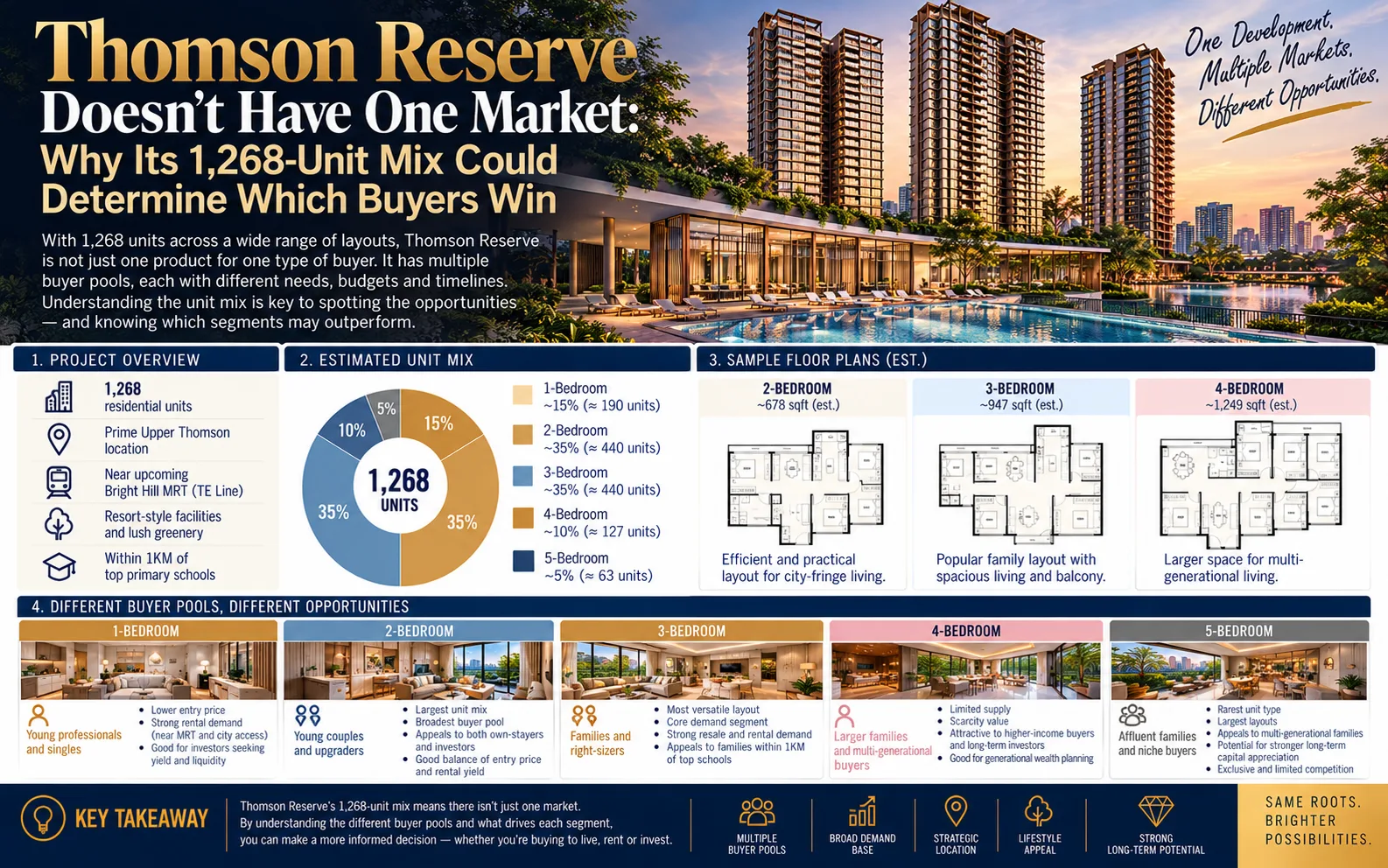
Thomson Reserve will have 1,268 homes across six residential towers on the former Thomson View site.
There are four 21-storey towers forming the Classic Collection and two 30-storey towers forming the Luxury Collection. The development spans about 51,567 sqm and offers homes ranging from two bedrooms to five-bedroom suites.
The current published unit mix broadly breaks down like this:
Segment | Units | Share |
|---|---|---|
2BR and 3BR variants | 1,066 | 84% |
4BR and 5BR variants | 202 | 16% |
Total | 1,268 | 100% |
Within those categories are multiple variations:
2 Bedroom
2 Bedroom Premium
2 Bedroom Premium + Study
3 Bedroom
3 Bedroom Premium
3 Bedroom Premium + Study
4 Bedroom
4 Bedroom Premium
4 Bedroom Premium + Study
5 Bedroom Suite
And selected larger Luxury Collection units come with private lifts.
At first glance, this just looks like a developer offering buyers plenty of choices.
But I think there is something more interesting going on.
I See Three Different Thomson Reserves
Forget the marketing names for a moment.
From a buyer-demand perspective, I think Thomson Reserve can be divided into three broad markets.
Market 1: The Quantum Buyers
These are predominantly the smaller two-bedroom buyers.
Their first question probably isn't:
“What is the PSF?”
It is:
“How much do I need to write the cheque for?”
That distinction matters.
Someone buying a compact two-bedroom investment unit may have a budget of around $1.7 million to $2 million.
They may be comparing Thomson Reserve against other new-launch two-bedders across Singapore.
Their priorities could include:
MRT,
rentability,
future resale liquidity,
monthly mortgage,
total quantum,
and how efficiently the floor plan uses every square foot.
They may like Upper Thomson.
But they don't necessarily need Upper Thomson.
If another project gives them a compelling alternative at $200,000 less, they can move.
That makes this part of Thomson Reserve potentially the most price-sensitive.
Market 2: The Family Buyers
Then we move into the three-bedroom and some four-bedroom units.
Now the conversation changes.
These buyers aren't necessarily trying to find the lowest possible quantum.
They're asking:
“Can my family actually live here?”
Bedroom sizes start mattering.
Storage matters.
Kitchen matters.
Study space matters.
Schools matter.
Parents living nearby matter.
Daily commute matters.
And suddenly Ai Tong School, Upper Thomson MRT, Thomson Plaza and the established neighbourhood become much more relevant.
This buyer may already own an HDB or condo nearby.
They aren't necessarily choosing between:
Thomson Reserve and a condo in Tampines.
They may be choosing between:
staying in Bishan/Thomson
or
leaving an area their family already knows and loves.
That's a very different buyer psychology.
Market 3: The Lifestyle And Right-Sizing Buyers
Then we reach the largest units.
Four-bedroom Premium.
Four-bedroom Premium + Study.
Five-bedroom Suite.
Private lifts enter the picture.
Larger floor plates.
Better specifications.
Potentially stronger views.
And considerably larger purchase quantums.
Now we're almost talking about a different product.
A buyer looking at a five-bedroom private-lift residence isn't necessarily comparing it against the smallest units downstairs.
Their alternatives could be:
a large resale condominium,
a premium Bishan condo,
a boutique freehold development,
a smaller landed property,
or simply staying in their existing landed home.
And there is one buyer segment I think could become particularly interesting:
landed right-sizers.
I've been meeting more of these clients recently.
They may own a $5 million, $6 million or $8 million landed home.
They aren't necessarily short of space.
What they're increasingly short of is the desire to maintain that space.
Roof.
Garden.
External walls.
Waterproofing.
Pest control.
Stairs.
Security.
General maintenance.
But here's the important thing.
They don't necessarily want to downgrade their lifestyle just because they're right-sizing their property.
A large private-lift condominium near greenery, food, MRT and established amenities can therefore make sense.
Especially if they've spent 20 or 30 years living around Thomson, Bishan or Ang Mo Kio.
That's why I think the upper end of Thomson Reserve needs to be analysed almost separately.
This Changes How We Should Think About PSF
We're going to hear a lot about Thomson Reserve's average launch PSF.
$2,6xx?
$2,7xx?
$2,8xx?
Maybe higher?
But I'm increasingly wondering:
Does Thomson Reserve even have one meaningful PSF?
Imagine two buyers.
Buyer A purchases a compact two-bedroom at $1.8 million.
Buyer B purchases a private-lift five-bedroom at more than $4 million.
Technically, they're buying the same project.
But economically?
They're participating in very different markets.
Buyer A's future purchaser might be:
an investor,
a young couple,
a single professional,
or a first-time private-property buyer.
Buyer B's future purchaser might be:
a wealthy family,
a condo upgrader,
a landed right-sizer,
or someone specifically seeking a large luxury home in Upper Thomson.
So why should we assume both units should trade at the same PSF?
They shouldn't.
The Developer Doesn't Necessarily Need Every Unit To Perform The Same Job
This is where the project becomes even more interesting.
A mega development needs volume.
1,268 units is a lot of inventory.
So the smaller homes can potentially perform one important function:
create accessibility.
They allow Thomson Reserve to advertise a much more approachable “From $X million” headline.
That brings people into the showflat.
It generates transactions.
It establishes momentum.
And momentum matters enormously in a mega launch.
But the larger units can perform a different function.
They establish aspiration.
Private lift.
Large format.
Premium finishes.
Views.
Space.
These buyers may be less sensitive to a $50 or $100 psf difference if the actual product is sufficiently differentiated.
So rather than pricing every home using:
one project PSF × floor area
I wouldn't be surprised if the developer creates quite deliberate price ladders between the different collections and unit categories.
This Is Where Things Get Interesting For Buyers
Whenever developers create price ladders, anomalies can appear.
And anomalies are exactly what I look for.
Suppose a three-bedroom Premium costs only $120,000 more than a smaller three-bedroom.
Maybe the larger unit becomes much better value.
Or perhaps a four-bedroom costs only modestly more than a three-bedroom Premium + Study.
Suddenly the upgrade becomes attractive.
Conversely, imagine a private-lift Premium unit carries an enormous premium over the standard four-bedroom.
Then we have to ask:
Will the future resale buyer pay me back for that premium?
This is why I don't want to decide what to buy based purely on floor plans.
We need the actual price ladder.
Look At The Upgrade Gaps, Not Just The PSF
This is one of the most useful things buyers can do once the price list comes out.
Don't only compare:
$2,650 psf vs $2,720 psf.
Compare:
2BR → 2BR Premium
How much more?
What additional utility do I receive?
2BR Premium → 2BR + Study
How much does that study actually cost me?
3BR → 3BR Premium
Is the additional space worth the quantum jump?
3BR Premium → 4BR
Could this become the sweet spot?
4BR → private-lift 4BR Premium
Am I paying for genuinely scarce attributes or merely better finishes?
4BR Premium → 5BR Suite
Does the larger home create an entirely different future buyer pool?
This tells us much more than average PSF.
Sometimes The Best Unit Isn't The Cheapest Unit
This is another misconception I frequently see.
Investors naturally gravitate towards the smallest quantum.
The logic is understandable:
“Cheaper means easier to sell.”
Sometimes.
But not always.
Imagine there are hundreds of broadly similar smaller units.
When you sell five years later, perhaps 15 owners are listing at the same time.
Your buyer has plenty of choice.
They negotiate.
Then imagine there are relatively few genuinely large private-lift homes.
The buyer pool is smaller.
But so is the supply.
Which one performs better?
We can't answer that simply by saying:
“Buy the cheapest unit.”
Instead, I want to know:
Supply of my unit type ÷ future demand for my unit type.
That is the relationship that matters.
Mega Developments Have A Strange Advantage — And Disadvantage
I've discussed this previously, but this new way of looking at the project adds another dimension.
Large projects tend to enjoy:
strong branding,
large facilities,
high transaction volume,
more comparable transactions,
greater awareness,
and generally better resale liquidity.
But the disadvantage is:
internal competition.
Your biggest competitor at resale may not be another condo.
It could be your neighbour.
If ten similar units are listed simultaneously, buyers have negotiating power.
That's why choosing the right sub-market inside Thomson Reserve matters.
Not just choosing Thomson Reserve.
The Classic Collection And Luxury Collection Could Eventually Behave Differently
This is something I think we should watch closely.
The Classic Collection comprises four 21-storey towers, while the Luxury Collection comprises two 30-storey towers. Published project information indicates differences in finishes, with the larger premium Luxury Collection homes including private-lift formats.
Over time, buyers may start recognising them differently.
We've seen this happen in other large developments.
Certain blocks.
Certain stacks.
Certain views.
Certain layouts.
Certain collections.
They establish their own resale premium.
So five years after TOP, buyers may not simply search:
“Thomson Reserve.”
They could eventually ask:
“Classic or Luxury?”
That differentiation could become important.
And This Is Why The Showflat Matters More Than Usual
Four show units are currently expected:
2 Bedroom Premium + Study — 732 sq ft
3 Bedroom Premium — 1,055 sq ft
4 Bedroom Premium — 1,367 sq ft
5 Bedroom Suite — 1,808 sq ft.
Notice something?
They're showing buyers the progression.
Not simply four random floor plans.
From a compact home all the way to a large private-lift residence.
When I eventually walk the showflat, that's one thing I'll be looking at carefully:
Does the perceived quality increase enough as the quantum increases?
Because if it does, the premium collection may justify a very different pricing structure.
If it doesn't?
Then some buyers may be better off staying lower in the hierarchy.
That's an article for another day.
There Is Also A Very Important Asset Progression Story Here
This is the part that interests me personally.
Property progression isn't always:
HDB → condo → bigger condo → landed.
Life doesn't move in a perfectly straight line.
A young couple may start with a two-bedroom.
Children arrive.
They move to a three-bedroom.
Income rises.
They upgrade again.
Eventually they may buy landed.
Then 20 years later?
They may sell the landed house and move back into a large condominium.
So theoretically, Thomson Reserve could serve people at very different stages of their property journey.
The 2BR buyer could be at the beginning.
The 3BR buyer could be a young family progressing upward.
The 4BR buyer could be an established upgrader.
And the 5BR buyer could actually be someone coming back down from landed.
Same development.
Completely different life stages.
That's quite unusual.
And from an investment perspective, it potentially gives the development a very broad ecosystem of buyers.
But Broad Demand Doesn't Mean Every Unit Is A Good Buy
This is where I want to remain disciplined.
Thomson Reserve can be an excellent project.
And still contain units I wouldn't buy.
That's not contradictory.
A certain stack could be overpriced.
A premium between two layouts could be too large.
A lower-floor unit could be priced too closely to a much better-facing higher-floor unit.
A private-lift unit could command too much of a premium.
Or the developer could price the smallest units aggressively because they know investors naturally gravitate towards them.
We don't know yet.
Which is precisely why I don't want to make the final call before seeing:
the actual price chart.
My Launch-Day Question Has Changed
Earlier in my Thomson Reserve analysis, the big question was:
What will Thomson Reserve launch at?
I don't think that's the most useful question anymore.
My question now is:
Where has the developer created the best relative value within Thomson Reserve itself?
That's different.
Because perhaps $2,800 psf is expensive for one unit type but perfectly reasonable for another.
Perhaps the best buy isn't the cheapest PSF.
Perhaps it isn't the cheapest quantum either.
Perhaps the opportunity sits at the point where:
the upgrade gap is small
but
the improvement in product is large.
That's what I'll be looking for.
Final Thoughts: Don't Buy Thomson Reserve. Buy The Right Thomson Reserve.
That probably sums up my current thinking.
Thomson Reserve has:
1,268 homes.
Ten broad layout types.
Two collections.
Six towers.
Multiple views.
Different specifications.
Different floor plates.
And potentially very different buyer pools.
So asking:
“Is Thomson Reserve a good buy?”
may be too broad a question.
Instead ask:
Which Thomson Reserve am I buying?
Am I buying into the investor/quantum market?
The family/upgrader market?
Or the premium lifestyle/right-sizer market?
Then ask:
How much competition will I have when I eventually sell?
Who is likely to buy this unit from me?
What alternatives will that buyer have?
And finally:
Am I paying the correct premium today for the attributes that buyer will value tomorrow?
Those questions matter far more to me than whether the project launches at an average:
$2,6xx,
$2,7xx,
or $2,8xx psf.
Because there may not actually be one Thomson Reserve price.
There may be several different property markets inside the same development.
And when the official price chart arrives, our job isn't simply to decide whether Thomson Reserve is cheap or expensive.
It's to find:
where the developer has left value on the table.
That's where I want to buy.
Want the tailored version for your portfolio?
Every article here generalises. A 20-minute conversation makes it specific to your numbers.
How many units are there at Thomson Reserve?
What unit types are available?
Are most Thomson Reserve units small apartments?
Is the cheapest Thomson Reserve unit likely to be the best investment?
Should I choose Classic Collection or Luxury Collection?
Why could the larger units be interesting?
What should I look for when the price list is released?
When is Thomson Reserve launching?

Written by
Christopher Ng (CEA R014394H)
Singapore Property & Asset Progression Strategist with ERA Realty Network. A NUS Real Estate graduate, Christopher has advised homeowners, investors and property owners since 2004.