
The 20 Things I Check Before Buying a Landed House in Singapore — A Landed Buyer’s Viewing Checklist
Buying a landed house in Singapore is complex due to each property's unique characteristics. This guide outlines a comprehensive checklist, from budget and location to specific structural details, to help you make an informed decision.
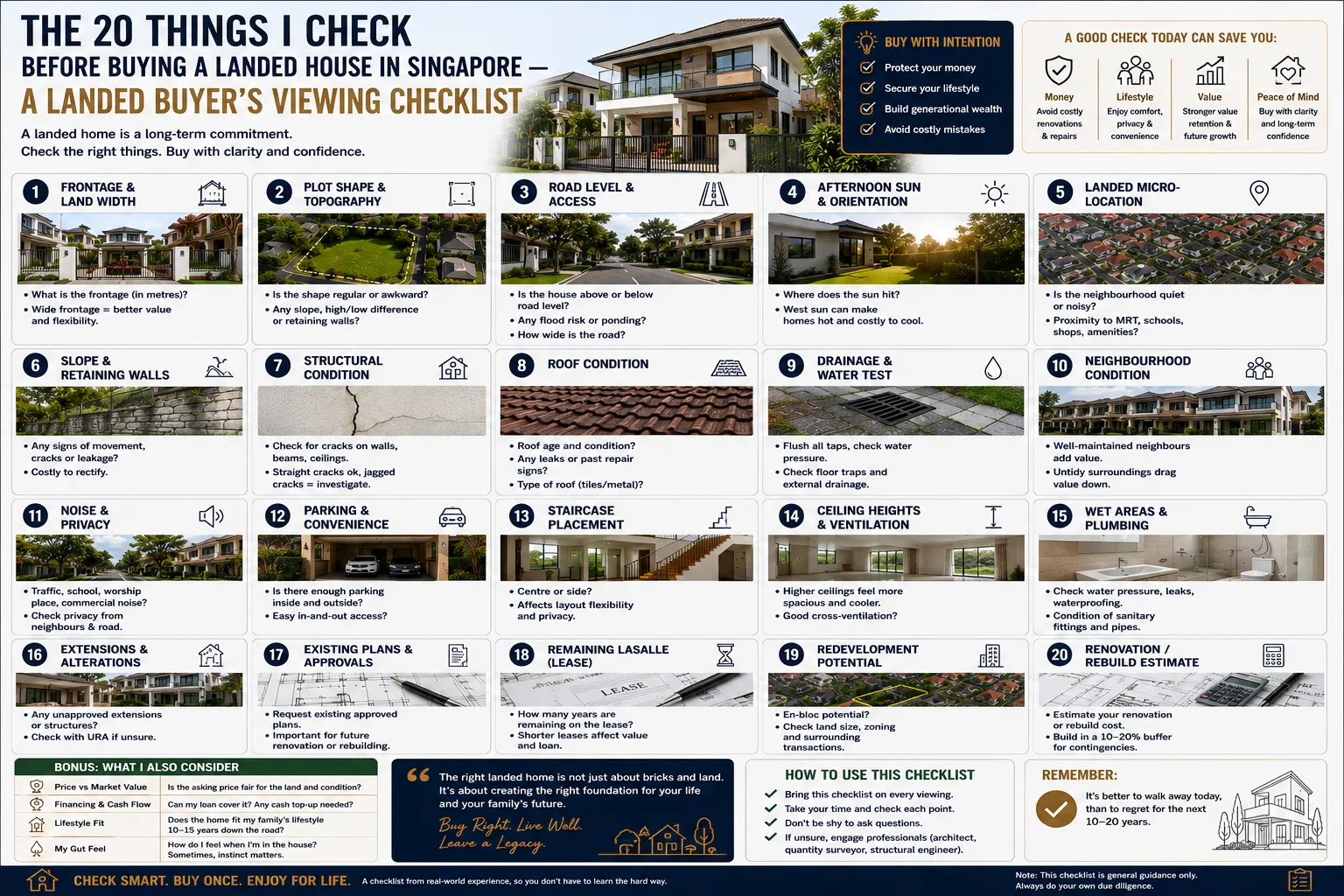
Buying landed property is very different from buying a condo.
With a condo, many of the big questions are already standardised.
You can compare:
same development,
same stack,
same floor range,
same unit type,
same tenure.
With landed, almost every house is its own case.
Two houses beside each other can have completely different:
land shape,
frontage,
road level,
building condition,
renovation liability,
redevelopment potential,
and ultimately value.
That is why when I walk a landed house with buyers, I am rarely looking only at whether the kitchen is beautiful or whether the master bedroom is big.
I am trying to understand:
What exactly are we buying?
And having gone through the landed-search process for my own family as well, I realised something else.
I don't actually begin with the house.
My own decision sequence starts much earlier.
For me, it is:
Budget
2. Location
3. Value between price and address
4. Feng shui
5. My own feeling when I enter the property
6. Then the technical details
And I think that sequence says something important.
A landed home is both:
an asset
and
a place your family may spend the next 10, 20 or 30 years living in.
So numbers matter.
But numbers are not the entire decision.
Before The Viewing: My First Filter Is Always Budget
I know this sounds obvious.
But landed buyers are very good at suffering from budget creep.
You start with:
$5 million.
Then you see something at $5.5 million.
Very nice.
Then the agent says:
"Actually another $300,000 can get semi-D."
Now you're looking at $5.8 million.
Then:
"Since already $5.8 million, this $6.3 million one is much newer..."
Before long, your $5 million landed search has become a $6.5 million landed search.
So before I start seriously evaluating a house, I want to know:
What is my comfortable all-in budget?
Not only purchase price.
I include:
BSD,
possible ABSD,
renovation,
A&A or rebuilding,
interest,
temporary accommodation,
and how much liquidity I want to retain after purchase.
That is my real budget.
A $5 million old house requiring $1.5 million of works is not really a $5 million decision.
I have written about this previously in my All-In Landed Cost framework.
That number should be established first.
My Second Filter: Location
Then comes location.
Personally, I don't want to buy landed merely because:
"This area cheap."
Nor do I want to buy a prestigious address merely because:
"This is District 10."
There must be a sensible relationship between:
Price and address.
If I am paying substantially more for one location, I want to understand what that premium gives me.
Schools?
MRT?
Centrality?
Future buyer pool?
Neighbourhood quality?
Land scarcity?
Lifestyle?
For my own search, I am constantly asking:
Does this address justify this price?
Because if the answer is no, bigger land alone doesn't excite me enough.
And if the answer is yes?
I may accept a slightly smaller property because the underlying location is stronger.
That is valuation at the neighbourhood level before we even enter the house.
Then Comes Feng Shui
This is personal to me.
I believe strongly that feng shui matters to the occupants of a landed home, so it forms an important part of my own decision-making.
I don't treat feng shui as a substitute for financial analysis or planning due diligence.
A bad property does not suddenly become a good investment because somebody says the feng shui is excellent.
But equally, if I am spending millions on a home that I may stay in for many years, I want to feel comfortable with how the home sits, faces and flows.
For me, that can include:
orientation,
approach to the house,
door position,
internal flow,
surroundings,
and the overall relationship between the building and its environment.
Some buyers care deeply about this.
Others don't.
There is no right or wrong answer.
But if feng shui matters to you, check it before you fall in love with the property, not after exercising the OTP.
And Then There Is Something Less Scientific: Vibes
This one is hard to put into a spreadsheet.
Sometimes I enter a house and immediately feel:
Nice.
Sometimes I don't.
Perhaps it is:
light.
Air.
Neighbourhood.
Ceiling height.
Proportions.
Garden.
The way the road approaches the house.
Or some combination of everything.
I don't think buyers should make a multimillion-dollar decision purely on vibes.
But I also don't dismiss them.
If I am buying a family home for the next 20 years and every time I walk in I feel uncomfortable...
why am I trying so hard to convince myself?
Likewise, occasionally an objectively imperfect house simply feels right.
Then the job is to determine whether the numbers and technical issues support that feeling.
Emotion should start the question. Due diligence should answer it.
Only Then Do I Start My Landed Viewing Checklist
Once a property passes the broad filters of:
budget, location, value, feng shui and personal fit,
I go deeper.
These are the 20 things I pay attention to.
1. Frontage
One of the first things I look at is:
How wide is this plot?
Because frontage affects almost everything.
Parking.
Facade.
Room layouts.
Natural light.
Redevelopment potential.
A 4,000 sq ft plot with generous frontage can be much more valuable than another 4,000 sq ft plot that is extremely narrow and deep.
This is why I don't evaluate landed property based on land area alone.
I want:
land area + width + shape.
2. Plot Shape
Regular rectangular land is generally easier to work with.
The more the plot becomes:
triangular,
trapezoidal,
or sharply tapered,
the more carefully I look.
It doesn't mean irregular land is bad.
Sometimes it creates interesting architecture.
But it can affect:
room efficiency,
setbacks,
parking,
garden usability,
and rebuilding potential.
As I discussed in my article on why two 4,000 sq ft landed plots can be worth very different amounts, not every square foot has equal usefulness.
3. Road Level Versus House Level
I always look at where the house sits relative to the road.
Is the house:
higher?
level?
lower?
A house substantially below road level raises questions for me.
Drainage.
Surface runoff.
Potential water ingress.
Future redevelopment works.
Conversely, a house dramatically above road level may require:
steps,
retaining structures,
slope management,
and potentially more expensive access solutions.
The level difference matters.
4. Afternoon Sun And Orientation
Where does the western sun hit?
Which bedrooms get it?
Living room?
Rear garden?
Master bedroom?
West-facing does not automatically mean bad.
Architecture can mitigate heat.
But I want to know what I am dealing with.
A hot wall on the wrong side of a house can significantly affect comfort, especially in a landed home with large exposed surfaces.
5. Slope
A flat plot is generally easier and cheaper to build on.
A sloping plot can be wonderful.
Views.
Interesting architecture.
Split levels.
Basements.
But slope may also mean:
retaining structures,
earthworks,
drainage,
more complicated construction.
Again, it is not:
good versus bad.
It is:
What does this slope cost me and what does it give me?
6. Retaining Walls
If the property has a substantial retaining wall, I pay attention.
Especially where:
the neighbouring plot sits significantly higher,
or
your land is supporting another level difference.
I want to know:
How old is it?
Any visible movement?
Any cracks?
Drainage behind it?
If significant structural concerns exist, this is where the engineer should enter the conversation.
7. Cracks
Not every crack means structural failure.
Older landed homes naturally develop cracks.
But I look at:
where they occur,
how wide they are,
whether they repeat,
and whether there are signs of movement.
A cosmetic plaster crack is one thing.
Large diagonal cracks near structural elements deserve more attention.
Again, agents should identify concerns.
Qualified professionals should diagnose them.
8. Roof Condition
Roof issues can become very expensive.
I look for:
water stains,
discolouration,
ceiling damage,
signs of past leaks,
old roof tiles,
gutters,
roof drainage.
If the house is already due for major reconstruction, maybe the roof condition doesn't matter much.
If the buyer intends to simply renovate and move in?
Very important.
9. Drainage
This is something condo buyers rarely think about.
Landed homeowners should.
Where does water go during heavy rain?
Are drains properly sized?
Any ponding?
Does the backyard slope correctly?
Any areas where water clearly accumulates?
In Singapore's climate, drainage deserves respect.
I would rather discover the problem while viewing than during the first thunderstorm after completion.
10. Neighbouring Houses
I don't only view the property.
I view the neighbours.
Have they rebuilt?
Are their houses much higher?
Could they rebuild soon?
Will their future house overlook your garden?
Any retaining-wall issues?
Any very old properties likely to undergo construction?
This matters because you may spend two years rebuilding your dream home, only for the neighbour to begin another two-year rebuild the month after you move in.
That is part of landed living.
11. Road Noise
Stand still.
Stop talking.
Listen.
Traffic.
Bus route?
Expressway hum?
School?
Temple?
Restaurant?
Industrial activity?
Aircraft?
I have seen beautiful houses where buyers are so excited by the interiors that they don't notice the constant road noise until the second viewing.
Go back at different times.
Morning.
Evening.
Weekend.
Night.
12. Parking
How many cars can actually fit?
Not theoretically.
Actually.
One?
Two side by side?
Two in tandem?
Can the gates open properly?
Can you reverse easily?
What happens when visitors arrive?
What does street parking look like at 8pm?
Many landed buyers own two cars.
Some eventually have children driving too.
Parking is therefore not a small issue.
13. Staircase Placement
This is one of the first internal things I look at.
Because moving a staircase can transform a renovation into a much more complicated structural project.
A good staircase position can help:
circulation,
space efficiency,
natural light,
family separation between floors.
A terrible staircase can waste huge areas.
If I am buying an old house for renovation rather than reconstruction, staircase position matters enormously.
14. Ceiling Height
You can renovate almost everything.
But low ceilings are harder to fix.
I like spaces that feel generous.
Especially landed living and dining areas.
Ceiling height also affects:
natural light,
air circulation,
sense of space.
A 4,000 sq ft house with poor proportions can feel much worse than a thoughtfully designed 3,500 sq ft home.
15. Wet Areas
Bathrooms.
Kitchen.
Yard.
Balconies.
Roof terrace.
These are the areas where waterproofing failures typically reveal themselves.
Look for:
mould,
stains,
peeling paint,
musty smells,
swollen carpentry,
silicone repairs,
patchwork.
Sometimes a beautifully renovated bathroom hides a very old waterproofing system underneath.
Surface beauty isn't everything.
16. Existing Extensions
Older landed houses can accumulate extensions over decades.
Covered yards.
Rear extensions.
Enclosed balconies.
Extra rooms.
Roof additions.
Before assuming:
“Great, already built so much.”
I want to know:
Was it approved?
This becomes particularly important if the buyer later wants to A&A or reconstruct.
The physical house and approved house may not always be identical.
17. Approved Plans
If I become serious about the property, I want to understand what has officially been approved.
Especially when redevelopment forms part of my buying thesis.
This helps answer:
What can be retained?
What was legitimately built?
What changes have already happened?
What might need rectification?
Never buy redevelopment potential entirely from an advertisement.
18. Remaining Lease
For leasehold landed, this becomes a major strategic question.
80+ years remaining?
Different conversation.
60 years?
Need more thought.
40 years?
Very different buyer and financing implications.
This links directly to the Mr David Client Story I recently shared.
David initially insisted on freehold because he wanted to build a legacy for his children.
But after viewing several compromised freehold options, we opened the search to 99-year landed homes with long remaining leases.
That changed the entire property pool.
The lesson from David's journey was not:
“Leasehold is better.”
It was:
“Know what tenure is costing you.”
If a long-lease landed home gives dramatically better space, condition and family enjoyment for the same budget, it deserves to be analysed properly rather than rejected automatically.
19. Redevelopment Possibilities
If the existing house is old, I immediately ask:
What could this land become?
Renovation?
A&A?
Reconstruction?
Full rebuild?
2-storey zone?
3-storey zone?
Attic?
Basement?
Setbacks?
Road reserve?
Plot width?
This is where my recent articles on URA envelope control, A&A versus reconstruction, and land shape/frontage all connect.
If I'm paying a premium for potential, I want the potential checked.
20. Realistic Renovation Or Rebuild Cost
This is the final technical filter—and often the one that changes the deal.
Buyers see:
House A: $5.5m
House B: $6.5m
House A seems much cheaper.
But House A requires:
$1.5m rebuild,
temporary rental,
professional costs,
financing during works,
18 months of construction.
House B?
$200k renovation and move in.
The $5.5 million house may actually cost more.
This is why I calculate:
All-In Landed Cost
not simply purchase price.
And Then I Go Back To Comparable Transactions
After inspecting all 20 factors, I finally return to the price.
What did nearby land transact at?
But I don't simply say:
Neighbour sold at $2,000 psf.
Therefore:
This house = $2,000 psf.
I adjust.
Better frontage?
Add value.
Irregular plot?
Discount.
New building?
Add building value.
Road reserve?
Investigate and adjust.
Busy road?
Different buyer pool.
Original condition?
Renovation liability.
This is why landed valuation is so much more interesting than just multiplying:
land size × PSF.
Comparable transactions give me evidence.
They do not give me the final answer.
My Own Buying Hierarchy
If you ask me personally how I would rank my own landed purchase considerations, it is probably:
1. Budget
Can I comfortably own it?
2. Location
Do I want to live here, and is the address worth what I am paying?
3. Value
Am I getting enough property relative to the price?
4. Feng Shui
Does the home work for me and my family from that perspective?
5. Personal Feel
Do I genuinely like being there?
6. Land Quality
Width, frontage, shape, road.
7. House Condition
Retain, renovate, A&A or rebuild?
8. Future Potential
What can I create?
9. Exit
Who buys from me later?
That is my real thought process.
Not:
“This one 5,000 sqft, buy.”
Sometimes A House Passes Every Checklist And I Still Don't Want It
And this is where property remains personal.
Great location.
Good land.
Fair price.
Technically sound.
But every time I enter, something doesn't feel right.
Would I automatically reject it?
Not necessarily.
But I would listen to that reaction.
Because I am not buying an industrial warehouse.
I am buying the place where my family may wake up every morning.
There is a value to wanting to go home.
And Sometimes A House Looks Terrible But I Become Very Interested
Ugly facade.
Old tiles.
1970s bathrooms.
Terrible curtains.
Seller hasn't renovated in decades.
But underneath that?
Beautiful rectangular land.
Wide frontage.
Quiet street.
Good feng shui from my perspective.
Right location.
Great price.
Now I'm interested.
Because cosmetic ugliness is solvable.
Bad land is much harder.
This is why I encourage landed buyers to see beyond decoration.
The Checklist Changes Depending On What You Intend To Do
If you're buying move-in condition, I care more about:
roof,
wet areas,
M&E,
condition,
layout.
If you're buying to A&A, I care heavily about:
existing structure,
staircase,
approved plans,
structural usefulness.
If you're buying to rebuild, I care much more about:
land,
frontage,
shape,
road,
setbacks,
planning envelope.
The same house can therefore be a bad purchase for one buyer and an excellent purchase for another.
The Mr David Lesson Applies Here Too
David's search is a good example of why landed buying cannot be reduced to one filter.
Initially:
Freehold landed only.
Then we viewed the reality.
Some freehold homes gave him the tenure he wanted but compromised:
space,
condition,
or family enjoyment.
The conversation changed from:
“Which freehold landed should I buy?”
to:
“What do I actually want my next home to achieve?”
That is a much better question.
And I think the same principle applies to this checklist.
The 20 items are not there to produce a score out of 100.
They are there to help you understand:
Where are you willing to compromise?
No Landed House Is Perfect
This is important.
Especially for resale landed.
Every house has something.
Small frontage.
West sun.
Old roof.
Busy road.
Strange staircase.
Leasehold.
Irregular plot.
Needs $500,000 renovation.
Too far from MRT.
The objective is not to find:
the perfect landed house.
You may never buy.
The objective is:
Find the property whose weaknesses you can accept at a price that compensates you for them.
That is a much more realistic buying mindset.
The Three Things I Would Never Compromise Too Much On
Personally?
Location
You can rebuild the house.
You cannot move the land.
Financial Comfort
The dream home becomes a nightmare if every month is stressful.
How I Feel About The Property
This includes my personal feng shui considerations and overall feel.
If I'm going to stay there for many years, I want to enjoy coming home.
Everything else?
Potentially negotiable if the price is right.
A Simple Example
Suppose I have two houses.
House A
$6.5m
Beautifully rebuilt
Average location
Narrow plot
Doesn't feel right to me
House B
$6.0m
Original condition
Excellent location
Regular wide plot
Good road
Feels right
Needs $800k work
All-in House B:
Approximately $6.8m before other costs.
Technically more expensive.
Which do I choose?
I may still buy House B.
Because once renovation is complete, I own:
the location and land I actually wanted.
That is the type of decision PSF alone cannot make for you.
What I Tell Buyers Before We Enter The House
I increasingly try to establish priorities before viewings.
Give me your top five.
Maybe:
Within $6m
2. Within 15 minutes of parents
3. Minimum 3,500 sq ft land
4. Freehold
5. Move-in condition
Great.
Then I ask:
Which one can move?
Perhaps freehold becomes negotiable.
Perhaps land size.
Perhaps condition.
Because once we know your hierarchy, every viewing becomes much more productive.
Without priorities, every house simply becomes:
"This one nice."
"That one also nice."
No decision.
My Landed Viewing Checklist — Quick Version
If you're viewing landed this weekend, screenshot this:
Before Viewing
□ Comfortable all-in budget
□ Location makes sense
□ Price versus address makes sense
□ Tenure acceptable
□ Feng shui requirements considered
Outside
□ Frontage
□ Plot shape
□ Road level
□ Slope
□ Road noise
□ Parking
□ Neighbouring houses
□ Afternoon sun/orientation
□ Drainage
□ Retaining walls
Inside
□ Cracks
□ Roof/leak signs
□ Ceiling height
□ Staircase placement
□ Wet areas
□ Room sizes/layout
□ M&E condition
□ Extensions
Due Diligence
□ Approved plans
□ Road/drainage reserve
□ URA landed zoning/storey control
□ A&A/rebuild possibilities
□ Remaining lease
□ Preliminary architect/QP opinion where needed
□ Renovation/rebuild estimate
□ Comparable transactions
□ All-in landed cost
□ Future buyer/exit strategy
That's the checklist I would keep beside me.
My Final Take
When I bought and when I search for my own landed homes, I realised that I don't actually begin with:
“How many square feet?”
I begin with:
Can I comfortably afford this?
Do I want this location?
Does the price make sense for the address?
Does the feng shui work for me?
Do I like how I feel when I enter?
Only then does the technical analysis begin.
I don't think that makes the decision less rational.
I think it makes it more complete.
Because landed property is unusual.
It can be:
one of your family's biggest financial assets,
one of your biggest expenses,
your children's childhood home,
your retirement home,
and perhaps eventually something you leave behind.
You therefore have to analyse it with both:
your calculator
and
your instincts.
The calculator tells you whether the property makes sense.
The checklist tells you what you're actually buying.
And your own priorities tell you whether it is right for you.
That is ultimately how I approach landed property.
Not:
“Is this house good?”
But:
“Is this the right house, on the right land, in the right location, at the right price, for this particular family?”
That is the question worth answering.
Want the tailored version for your portfolio?
Every article here generalises. A 20-minute conversation makes it specific to your numbers.
What should I check first when viewing a landed house in Singapore?
Is land size the most important factor when buying landed?
How important is frontage?
Should I worry about cracks in a landed house?
What should I look for in the roof?
Why is staircase position important?
Should I check approved plans before buying landed?
Should I engage an architect before buying landed?
How much should I budget for landed renovation?
Why should I calculate all-in landed cost?
Does remaining lease matter for landed property?
Should I always buy freehold landed?
How important is feng shui when buying landed?
Should I trust my feeling about a house?
Should I visit a landed property more than once?
What is the most important thing to remember when buying landed?

Written by
Christopher Ng (CEA R014394H)
Singapore Property & Asset Progression Strategist with ERA Realty Network. A NUS Real Estate graduate, Christopher has advised homeowners, investors and property owners since 2004.