
Singapore Has Reached 6.21 Million People. What Does This Mean for Property Prices — And the 2027 New Launch Boom?
Singapore's population reached 6.21 million, but what does this growth mean for property prices amid a rising housing supply? This article explores how population, household formation, and planned new launches in 2027 will shape the market.
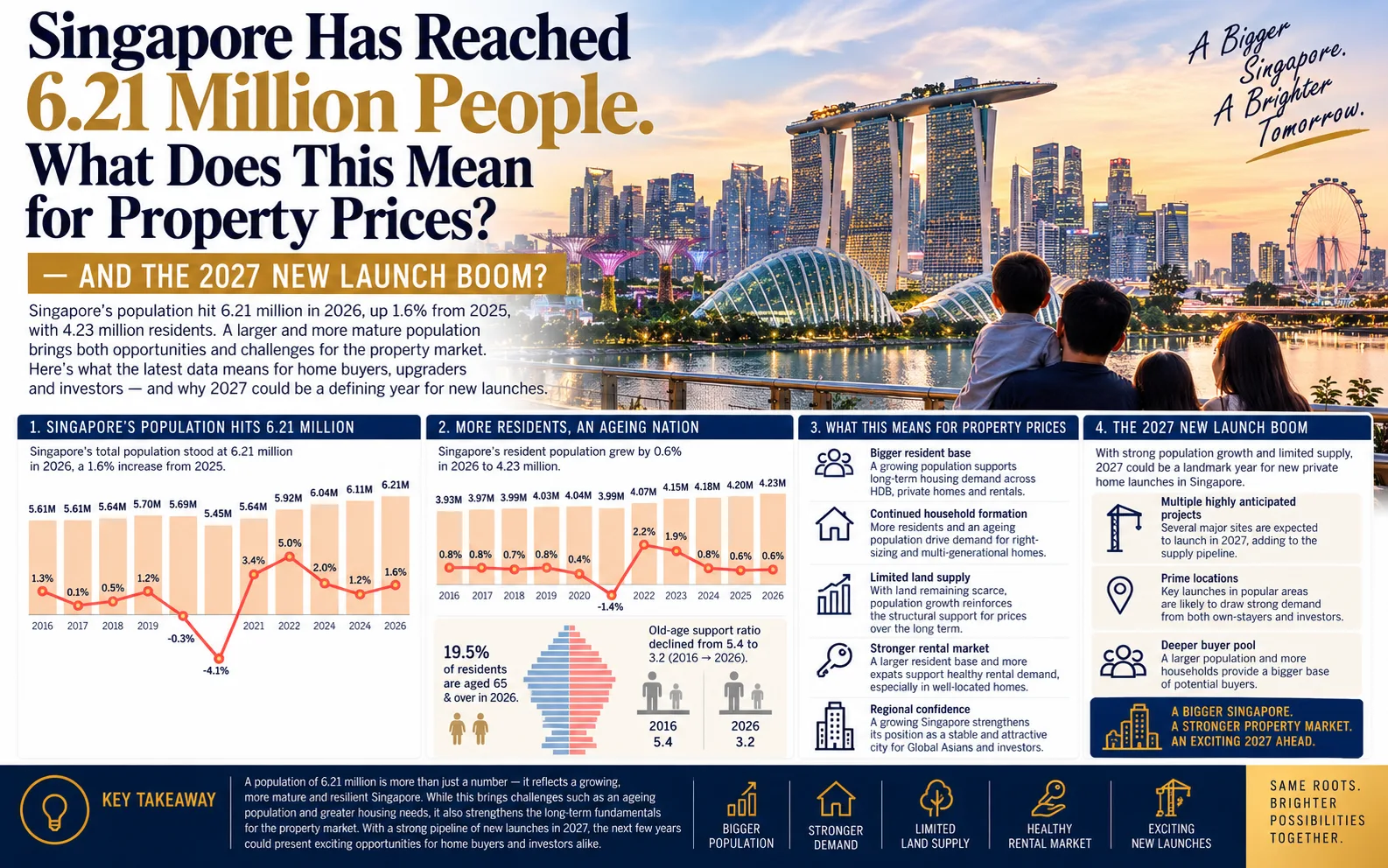
Singapore's population has reached another milestone.
According to the latest 2026 population figures, our total population now stands at:
6.21 million.
That's up 1.6% from 2025.
The breakdown is equally interesting:
3.68 million Singapore citizens
550,000 Permanent Residents
1.98 million non-residents
Total resident population: 4.23 million
At first glance, this looks like another demographic statistic.
But if you're a property buyer, investor, developer or agent, I think this number deserves considerably more attention.
Because Singapore is simultaneously entering another major housing-supply cycle.
We have a substantial pipeline of private homes coming.
2027 is shaping up to have a bumper crop of new launches.
And the Government has deliberately increased GLS supply.
So the question isn't simply:
“Singapore's population is growing. Does that mean property prices will rise?”
That's far too simplistic.
The more interesting question is:
Can Singapore's growing population continue absorbing the housing supply we're creating — and what happens to prices if it can?
To answer that, we need to go back 13 years.
Remember The Famous 6.9 Million Number?
Anyone who followed Singapore politics or property in 2013 will probably remember:
6.9 million.
It became one of the most discussed numbers from the 2013 Population White Paper.
But there's an important misconception that still exists today.
The Government did not say:
Singapore's population will be 6.9 million by 2030.
The 2013 planning range was 6.5 million to 6.9 million.
And 6.9 million represented the high end used for long-term infrastructure planning.
The Government explicitly explained at the time that it was not deciding that Singapore would reach 6.9 million in 2030. The purpose was to make sure infrastructure wasn't underbuilt if population eventually approached the upper end of the planning range.
That distinction matters.
Because today, in 2026, the Government's position is actually that Singapore is expected to remain significantly below 6.9 million by 2030.
However — and this is the interesting part —
6.9 million remains relevant as a planning parameter for the 2030s.
So the number hasn't disappeared.
The timeline has shifted.
From 5.31 Million To 6.21 Million
Singapore's population in 2012, just before the White Paper, was around 5.31 million.
Today:
6.21 million.
That's roughly 900,000 more people.
And look at just the last few years.
2021: 5.45m
2022: 5.64m
2023: 5.92m
2024: 6.04m
2025: 6.11m
2026: 6.21m
The post-pandemic rebound obviously affects part of this trend.
So I wouldn't simply draw a straight line from 6.21m and extrapolate it forever.
But the bigger picture is hard to ignore.
Singapore continues to need to plan for:
more people,
more households,
more workers,
more infrastructure,
and ultimately:
more places for people to live.
Then There Is The Even More Controversial Number: 10 Million
The late Dr Liu Thai Ker, Singapore's former chief planner and often described as one of the key architects of modern Singapore's urban planning, took an even longer-term view.
He argued that Singapore should think beyond 2030.
His point was essentially:
The world doesn't end in 2030.
He suggested that Singapore should consider planning much further ahead — potentially towards a population of 10 million over the very long term.
Again, context is extremely important.
10 million is NOT Singapore's population target.
The Government has explicitly stated that it has not proposed, planned or targeted Singapore to reach 10 million.
Dr Liu's argument was about long-term planning capacity.
His thinking was that planners shouldn't ask:
“How many people do we have today?”
They should ask:
“How many people might Singapore eventually need to accommodate, and what infrastructure should we reserve today so future generations still have options?”
As someone who spends a lot of time thinking about property, I find that distinction fascinating.
Because that's actually how Singapore plans land.
Housing Supply Doesn't Just Appear
This is something I constantly explain when discussing the Singapore property market.
Housing supply isn't random.
Government controls a major part of the upstream land pipeline through:
Government Land Sales.
Land is released.
Developers bid.
Projects are planned.
Units eventually launch.
Construction begins.
Several years later, those homes are completed.
The process can take years.
Which means today's GLS decision is partly a decision about:
Singapore's housing requirements several years from now.
And that brings us to the current supply numbers.
Singapore Is Actually Releasing A Lot Of Private Housing Land
If population growth alone determined property prices, Singapore could simply restrict land indefinitely and prices would rise.
That's obviously neither sustainable nor desirable.
Instead, Government has been increasing supply.
URA announced 4,745 private residential units under the 2H2026 Confirmed List.
Combined with 1H2026:
9,320 units will come from the 2026 GLS Confirmed List.
That's more than 50% above the average annual Confirmed List supply over the preceding 10 years.
And the broader private residential pipeline?
Approximately:
60,600 homes, including ECs.
Around 25,900 are expected to complete by 2028, with another approximately 34,700 from 2029 onwards.
That is substantial.
So anyone saying:
“Singapore doesn't have enough property, therefore prices can only go up”
is oversimplifying the market.
We are building.
A lot.
And 2027 Is Where This Gets Really Interesting
Many GLS sites sold during 2025 and 2026 will progressively turn into launches.
That means 2027 could become one of the most interesting new-launch years we've seen in quite some time.
And readers of my blog will already recognise several of the names entering this cycle.
Chuan Grove.
Future Upper Thomson/Sin Ming supply.
New Upper Changi Road.
Holland and Bukit Timah supply.
The growing Greater Southern Waterfront pipeline.
And multiple other GLS projects progressively moving from:
land sale → planning → launch.
This creates something buyers haven't enjoyed consistently over the last few years:
choice.
Which is why I've previously written that Singapore may increasingly be entering a:
property picker's market.
A market where not every launch automatically wins.
So Should Developers Be Worried About 2027?
Here's where population becomes important.
A lot of people see:
many launches = oversupply.
But that's only half the equation.
Supply means very little without looking at:
absorption.
This is a concept I've discussed repeatedly when teaching our ZHA Explained market framework.
The relationship is roughly:
Population
↓
Household formation
↓
Housing demand
↓
Land supply
↓
New launches
↓
Sales / absorption
↓
Completions
↓
Next housing cycle
The market doesn't become oversupplied simply because 10,000 homes are launched.
It becomes oversupplied when:
new supply persistently exceeds the market's ability to absorb it.
That's a completely different question.
And Historically, Singapore Has Been Absorbing Supply
This is why I don't like looking at launch numbers alone.
For example, the historical data I've used in our ZHA Explained analysis showed:
2024
6,647 units launched
6,469 units sold
And in 1H2025:
4,659 launched
4,587 sold.
That's very strong absorption.
It doesn't mean that ratio will continue forever.
And it certainly doesn't mean every individual project will sell.
But it illustrates something important.
Singapore can absorb significant housing supply when underlying household demand remains healthy.
That is why the 6.21 million population number matters.
But There's Another Important Distinction: Residents vs Non-Residents
Here's where I would challenge the simplistic population argument again.
Of Singapore's 6.21 million population:
4.23 million are residents.
Approximately:
1.98 million are non-residents.
That matters because not every additional person creates the same type of housing demand.
A Singapore citizen forming a household and buying a first home is different from:
a PR buying private property,
an expatriate renting,
a construction worker living in purpose-built accommodation,
or a student renting a room.
So:
Population growth does not translate one-for-one into home purchases.
But different population groups affect different parts of the housing market.
Citizens and PRs influence:
owner-occupation demand,
household formation,
HDB demand,
private upgrading,
and resale demand.
Non-residents can significantly influence:
rental demand.
And that matters to investors too.
The More Important Number May Eventually Be Households
This is something I think property investors should start paying more attention to.
Imagine Singapore's population remains exactly the same.
But average household size falls.
You would still need:
more homes.
Why?
Because six million people living at four people per household require fewer homes than six million people living at three people per household.
Singapore is also ageing.
According to the latest figures:
19.5% of residents are now aged 65 and above.
The old-age support ratio has fallen from:
5.4 working-age residents per senior in 2016
to:
3.2 in 2026.
That has property implications.
Older households may right-size.
Children form their own households.
Parents remain in their existing homes.
Singles live independently.
Divorce creates separate households.
Young couples establish homes.
So housing demand isn't determined only by:
population.
It is determined by:
population × household formation × housing preferences × affordability.
That is a much better framework.
This Is Why Singapore's Housing Supply Is So Carefully Managed
Look at the language URA itself uses.
The Government says it will continue to:
monitor economic and property-market conditions and calibrate GLS supply to keep the property market stable and sustainable.
That word —
calibrate
matters.
The Government isn't deciding today that Singapore needs exactly X condos forever.
It can adjust.
If demand remains resilient?
More land can be released.
If demand weakens substantially?
Future land supply can be moderated.
Reserve List sites provide another buffer because developers can trigger them when market demand justifies doing so.
So Singapore's housing market has an unusual characteristic:
supply responds to demand — but with a long planning lag.
And population planning helps Government anticipate that demand before homes are actually needed.
Does Population Growth Therefore Guarantee Property Prices Will Rise?
No.
And this is probably the most important sentence in this article.
Population growth supports housing demand.
It does not guarantee property appreciation.
Prices are determined by the interaction of:
population,
household formation,
income growth,
interest rates,
credit availability,
TDSR,
ABSD,
land supply,
construction costs,
developer pricing,
resale inventory,
rental yields,
and buyer sentiment.
A growing population can coexist with stagnant property prices if supply expands faster.
Likewise, prices can rise slowly even when population growth moderates if housing supply remains constrained.
Think of it simply as:
Demand versus supply.
Not:
Population equals price.
Then What Does 6.21 Million Mean For The 2027 Launches?
This is where I become cautiously constructive.
2027 will likely give buyers considerably more choice.
That means developers can't simply assume:
“Launch it and they will come.”
Projects will increasingly compete on:
location,
MRT proximity,
schools,
layout,
quantum,
land cost,
product quality,
and — most importantly —
price.
That's good for buyers.
And this is where projects such as Thomson Reserve and Chuan Grove become interesting to analyse.
Not because Singapore has 6.21 million people and therefore everything will sell.
But because in a high-supply environment:
good projects should increasingly separate themselves from mediocre ones.
That is exactly what a picker's market looks like.
What Happens If Singapore Eventually Approaches 6.9 Million?
Let's forget the exact year for a moment.
Singapore today:
6.21 million.
The long-standing planning parameter:
6.9 million.
Difference:
approximately:
690,000 people.
That's roughly another 11% from today's population.
They will not all buy private condominiums.
Obviously.
But they need somewhere to live.
They need:
transport,
workplaces,
schools,
hospitals,
shops,
recreation,
and infrastructure.
That is why the property story is much bigger than:
“More people means condo prices go up.”
The real story is:
Singapore has to continually create the urban capacity to accommodate more households without allowing housing shortages to become structurally destabilising.
That's what GLS is partly doing.
That's what BTO supply is doing.
That's what redevelopment is doing.
And that's also why we're now talking about extraordinary long-term projects such as:
Long Island,
future Pulau Tekong reclamation,
Greater Southern Waterfront,
Turf City,
Jurong Lake District,
Paya Lebar Air Base,
and new land creation.
READ ALSO: Singapore's Next Chapter: Long Island, Tekong & Western Island
And What About 10 Million?
I wouldn't invest based on it.
It's not Government policy.
It's not a population target.
And there is no announced timeline to reach it.
But I think Liu Thai Ker's underlying planning philosophy is still worth understanding.
Don't plan a city merely for:
what exists today.
Plan for:
what future generations may require.
Property investors can borrow the same philosophy.
Don't simply ask:
“Is there demand for this project today?”
Ask:
“Who could need this property 5, 10 or 15 years from now?”
That is a much more powerful question.
My Take: The 6.21 Million Number Makes Me More Comfortable With Supply — Not More Bullish On Every Property
This is probably where my conclusion differs from the usual property commentary.
I'm not looking at 6.21 million and saying:
“Property prices are going up!”
Instead, I'm saying:
Singapore's growing population gives me greater comfort that there is an underlying demand base capable of absorbing substantial housing supply — provided supply continues to be calibrated and homes remain affordable enough for households to form.
That's different.
And it matters heading into 2027.
Because we are going to see many projects.
Some will perform exceptionally.
Some will sell steadily.
Some may struggle.
And I suspect the gap between good and mediocre projects will become more obvious.
Population growth may support the market.
It doesn't automatically rescue the wrong property bought at the wrong price.
Population Gives Us Demand. Planning Controls Supply. Price Decides Who Wins.
That's perhaps the simplest way I can summarise the whole article.
Singapore's population has reached:
6.21 million.
We have come a long way since the 2013 debate around 6.9 million.
Interestingly, instead of rushing towards that number, Singapore has taken longer than originally contemplated — and the Government now expects us to remain significantly below 6.9 million in 2030.
But we're still growing.
Meanwhile, Government is releasing substantial housing supply.
And 2027 could bring buyers one of the widest selections of new launches in years.
To me, these aren't contradictory stories.
They are part of the same story.
Population creates housing demand.
Planning anticipates that demand.
GLS calibrates future supply.
Developers turn land into homes.
Buyers absorb those homes.
And then the cycle starts again.
The question for investors isn't whether Singapore will have more people.
It's:
Will the property I'm buying capture its fair share of that future demand?
That's why location matters.
That's why MRT matters.
That's why schools matter.
That's why employment nodes matter.
That's why unit mix matters.
That's why surrounding supply matters.
And above everything else:
that's why entry price matters.
2027 may bring us a bumper crop of launches.
Personally, I welcome it.
Because more supply doesn't necessarily destroy the property market.
Sometimes it simply forces us to become:
better pickers.
And I think that's exactly where the Singapore property market is heading.
Read Also: Singapore Property: Are We Entering a Picker's Market?
Want the tailored version for your portfolio?
Every article here generalises. A 20-minute conversation makes it specific to your numbers.
Did the 2013 Population White Paper say Singapore would reach 6.9 million by 2030?
Will Singapore reach 6.9 million by 2030?
Is Singapore planning for a population of 10 million?
Singapore already has 6.21 million people. Does that mean property prices will rise?
Isn't Singapore facing too much housing supply?
Why is 2027 important for property buyers?
Will every 2027 new launch do well because population is growing?
What should investors watch instead of population alone?

Written by
Christopher Ng (CEA R014394H)
Singapore Property & Asset Progression Strategist with ERA Realty Network. A NUS Real Estate graduate, Christopher has advised homeowners, investors and property owners since 2004.