
Where Should I Buy Landed Property in Singapore? A Buyer’s Guide to the Major Landed Enclaves
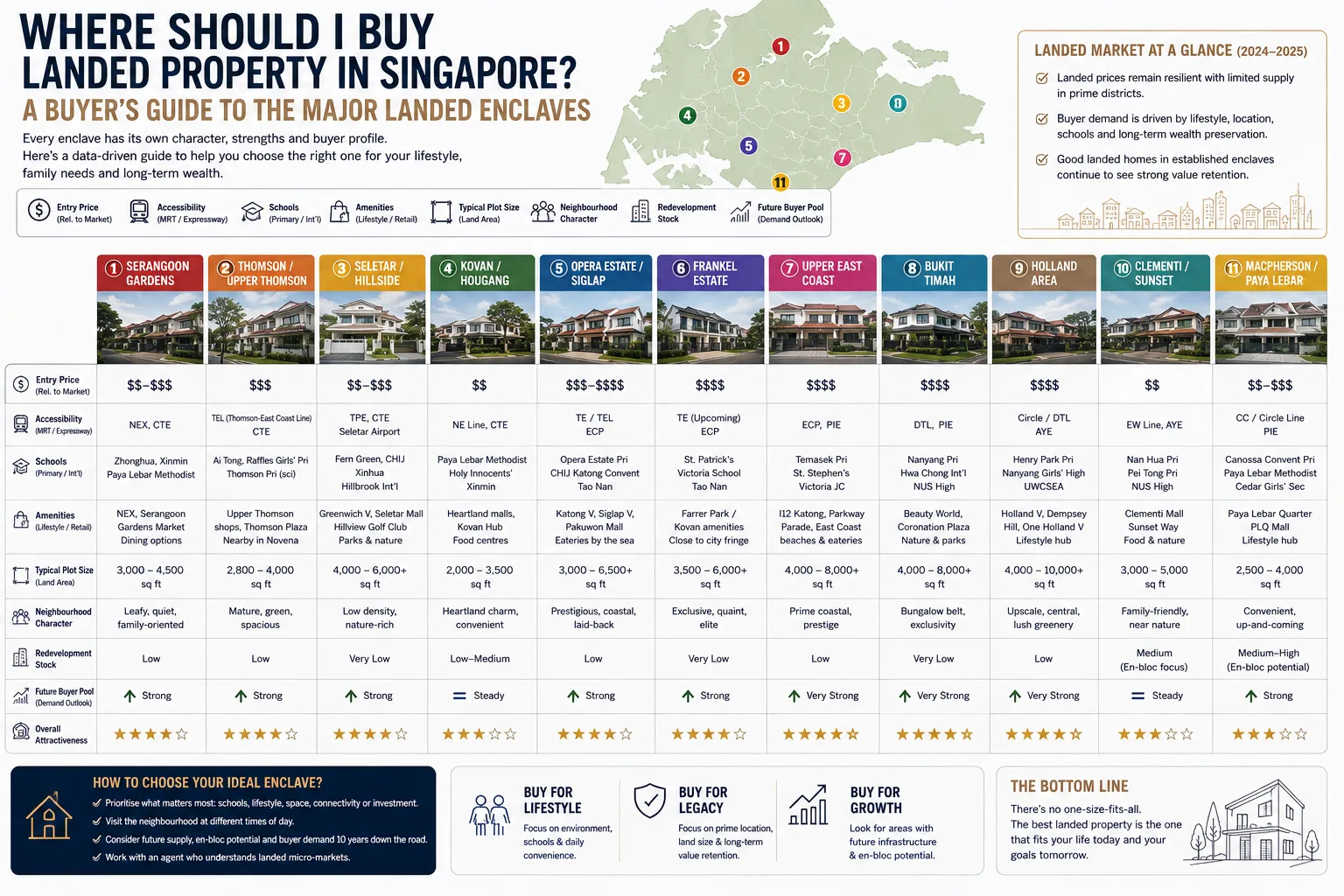
Choosing landed property in Singapore is complex, with many distinct markets beyond simple metrics. This guide helps buyers assess enclaves based on entry price, accessibility, schools, amenities, plot sizes, and future buyer potential, ali
Once a buyer decides:
“I want landed.”
The next question is usually:
“Where should I buy?”
And this is where things become much more complicated.
Singapore does not have one landed market.
We have many different landed markets.
A terrace in Serangoon Gardens attracts a different buyer from a terrace in Watten.
A semi-D in Seletar Hills offers a very different proposition from one in Frankel.
A large house in Sunset Way may give you tremendous land, while a smaller house in Holland may cost considerably more because of location and future buyer depth.
So I don't think the right way to choose a landed enclave is simply:
District 10 good. OCR cheaper. Freehold best.
That is much too simplistic.
Instead, when I help buyers shortlist landed areas, I look at several things together:
Entry price. Accessibility. Schools. Amenities. Plot sizes. Neighbourhood character. Redevelopment opportunities. And most importantly, who is likely to buy this property from me in the future.
That last point matters.
Because the best landed enclave isn't necessarily the most prestigious one.
It is the one that best fits your budget, family and Asset Progression stage.
URA itself safeguards designated landed housing areas across Singapore, with different housing forms and site-specific planning controls; some streets are additionally governed by Street Block Plans. That preservation of low-rise housing is part of what makes established landed enclaves structurally different from ordinary residential areas.
So let's go around Singapore.
First, My 2026 Landed-Enclave Scorecard
This is my buyer's scorecard, not an official ranking.
For Entry Price, 5 means relatively easier to enter and 1 means expensive.
For the other categories, 5 means stronger in that particular area.
Landed enclave | Entry Price | Accessibility | Schools | Amenities | Plot Choice/Size | Redevelopment Stock | Future Buyer Pool |
|---|---|---|---|---|---|---|---|
Serangoon Gardens | 4 | 4 | 4 | 5 | 4 | 5 | 5 |
Thomson / Upper Thomson | 4 | 5 | 5 | 4 | 4 | 4 | 5 |
Seletar / Seletar Hills | 5 | 3 | 3 | 3 | 5 | 5 | 4 |
Kovan / Hougang | 4 | 4 | 4 | 4 | 4 | 5 | 4 |
Opera Estate / Siglap | 3 | 4 | 4 | 5 | 3 | 5 | 5 |
Frankel | 1 | 4 | 4 | 5 | 5 | 4 | 5 |
Upper East Coast | 3 | 4 | 4 | 5 | 4 | 4 | 5 |
Bukit Timah / Watten | 1 | 5 | 5 | 5 | 4 | 4 | 5 |
Holland / Greenleaf / Mt Sinai | 1 | 5 | 5 | 5 | 4 | 4 | 5 |
Clementi / Sunset | 2 | 4 | 5 | 4 | 5 | 5 | 5 |
MacPherson / Paya Lebar | 3 | 5 | 3 | 5 | 4 | 5 | 4 |
Do not use this table to say:
“Area A got 31 points, therefore must buy.”
That's not the intention.
The point is to understand what you are paying for in each enclave.
1. Serangoon Gardens: Perhaps The Best All-Rounder
If someone asked me:
“Christopher, which landed estate gives me the most balanced combination of lifestyle, recognisability, family demand and entry price?”
Serangoon Gardens would be very high on my list.
It has something many landed estates struggle to create:
identity.
When someone says:
“I stay Serangoon Gardens.”
Everybody roughly knows what that means.
Chomp Chomp.
Serangoon Garden Market.
Restaurants.
Cafes.
Low-rise streets.
A mature neighbourhood with its own centre.
That matters.
A landed estate with a strong neighbourhood identity can have a broader buyer pool than an equally good collection of houses without one.
Recent Serangoon Garden Way transactions illustrate the range. In 2026, recorded sales included roughly 2,146–2,685 sq ft plots changing hands from about $5.5 million to $6.48 million, while a larger roughly 4,198 sq ft plot transacted at $6.3 million. This huge variation also reminds us that condition and building value can distort land PSF considerably.
What I Like
Serangoon Gardens works extremely well for families.
It is established without feeling excessively exclusive.
There are terraces, corner terraces, semi-Ds and detached homes.
And critically for someone who enjoys the idea of buying an old house and creating value, there is plenty of older stock.
That gives buyers opportunities to:
buy land-value houses,
renovate,
A&A,
or rebuild.
What I Don't Like
Traffic into and out of parts of the estate can be irritating.
Not every street enjoys easy MRT access.
And today, the better houses are no longer what I would describe as cheap landed property.
The market understands Serangoon Gardens already.
Who I Think Should Buy Here
The condo upgrader who wants his first long-term landed family home.
For Asset Progression, I particularly like it because the future buyer pool is broad.
You could buy a terrace today and eventually have:
another condo upgrader,
a terrace upgrader,
or an existing landed owner
interested in buying from you later.
My take: Probably one of Singapore's strongest all-round landed enclaves.
2. Thomson and Upper Thomson: Centrality Without Bukit Timah Pricing
I have a natural appreciation for the Thomson landed belt because it occupies an interesting geographical position.
It feels suburban.
Yet it isn't particularly far from town.
And the Thomson-East Coast Line has made the accessibility proposition considerably stronger.
Upper Thomson, Springleaf and nearby landed pockets now have access to TEL stations such as Upper Thomson and Springleaf. Broad 2026 D26 landed data points to a median around $4.69 million across recent landed transactions, materially below the headline numbers seen in D10 or D11.
That creates a very interesting proposition:
central-ish landed without always paying central-region landed pricing.
What I Like
You have nature.
You have food.
You have established schools.
You have access towards Bishan, Novena, town and the north.
And the landed stock is varied enough for different budgets.
There are also many older properties where rebuilding becomes relevant.
The Important Distinction
Don't treat:
Thomson,
Upper Thomson,
Springleaf,
and every estate along the corridor
as one market.
They are not.
Some locations have dramatically better accessibility.
Some roads are extremely good.
Others are compromised.
Some plots are freehold.
Some landed pockets involve leasehold stock.
Micro-location matters tremendously.
Who I Think Should Buy Here
Families wanting a compromise between:
centrality + space + value.
For someone whose alternative is a much smaller house in Bukit Timah, Thomson can make a lot of sense.
My take: One of the areas I would watch closely for family-focused landed Asset Progression.
3. Seletar and Seletar Hills: Where Your Money Buys More Land
If your priority is:
“I want more land for my money.”
Seletar deserves serious attention.
This is one of the first areas I would explore with a buyer who tells me:
"Location can compromise a little. I want space."
Recent 2026 transactions within the broader Seletar Hills estate show exactly how varied the opportunity is. Terrace transactions included roughly 2,160–2,556 sq ft plots around $3.91 million to $4.97 million, while semi-D transactions spanning roughly 3,000–5,000 sq ft ranged from around $5 million into the $8 million range depending on the street, tenure, condition and building.
Some individual freehold streets are considerably more expensive; Seletar Hills Drive recorded a recent terrace around $4.5 million and semi-D around $8.3 million.
What I Like
Land.
Lots of it relative to more central locations.
Wider roads in selected areas.
Bigger gardens.
More substantial semi-D and detached possibilities.
And plenty of redevelopment stock.
For someone who wants to buy an original house and create a dream home, this is interesting.
What You Give Up
Centrality.
For some households, that's irrelevant.
For someone working in Marina Bay five days a week and sending children to schools on the other side of Singapore?
It may matter considerably.
This is why a bigger landed house is not always the better house for your life.
Who I Think Should Buy Here
Buyers prioritising:
land size, family space and long holding periods.
It is also one of the areas where a buyer priced out of semi-D in central Singapore may still be able to make the semi-D dream work.
My take: One of the best places to exchange location premium for actual land.
4. Kovan and Hougang: The Practical Landed Market
Kovan and Hougang don't always get spoken about with the same glamour as Bukit Timah, Holland or Frankel.
That may be exactly why buyers should look.
I view this as a very practical landed market.
You have established landed streets.
Food.
Heartland amenities.
MRT access in parts of the estate.
Schools.
And relatively broad buyer affordability compared with the prime landed districts.
Richards Avenue gives a good example of how diverse individual assets can be. 2026 sales ranged from about $4.15 million on a 4,628 sq ft plot to above $8 million for a smaller but clearly different product; other transactions on smaller plots exceeded $5 million. This is another reminder that in landed, building condition and tenure can make headline land PSF almost meaningless without context.
What I Like
The future buyer pool is practical.
A lot of Singaporean families can understand the proposition.
You're not necessarily depending on an ultra-high-net-worth buyer to take you out.
There is also plenty of older stock.
That is good for buyers who understand redevelopment economics.
The Weakness
The streets vary dramatically.
Some are excellent quiet landed pockets.
Some feel more mixed.
Some sit very close to commercial activity.
Again:
micro-location, micro-location, micro-location.
Who Should Buy
A buyer who says:
“I don't need prestige. I want a proper landed house in a convenient area at a sensible quantum.”
I like that buyer.
Because he is usually buying for the right reasons.
5. Opera Estate and Siglap: The East Coast Lifestyle Play
Opera Estate is one of the landed markets I find fascinating because the plot sizes are often not huge.
Yet the buyer demand can be extremely strong.
Why?
Lifestyle and location.
You're near:
Siglap.
East Coast.
Established schools.
Food.
Parks.
And now significantly improved transport connectivity across the east.
The latest recorded Opera Estate sale in August 2026 included a roughly 1,700 sq ft Jalan Bangsawan property at $5.71 million, while a late-July Jalan Bintang Tiga sale of about 1,741 sq ft went for $4.12 million. Jalan Bangsawan's broader transaction database shows a median around $4.37 million and substantial rebuilding activity.
This is not cheap land.
Buyers are paying for location and lifestyle, not merely square footage.
What I Like
The neighbourhood has tremendous character.
And because the plots include many relatively compact terraces, there is still a ladder within the landed market.
A condo upgrader may enter through an intermediate terrace without requiring the $8 million–$12 million budget associated with large prime semi-Ds.
What I Would Watch
At high land PSF, I become very sensitive to:
plot width,
road,
condition,
and how much usable house I can create.
Paying a premium location PSF for a compromised plot can hurt.
Who Should Buy
East-side families who already know:
“This is where I want to live.”
For them, the neighbourhood premium may be worth paying.
My take: A strong lifestyle enclave with an excellent future owner-occupier pool.
6. Frankel: Established East-Side Prestige
Move towards Frankel and the conversation changes.
The plots generally become more substantial.
The price quantum rises.
The streets feel different.
Recent Frankel Avenue transactions demonstrate how serious the numbers have become. A roughly 6,387 sq ft property changed hands at $14.5 million in May 2026, while a roughly 9,225 sq ft property sold at $14 million in July. A smaller roughly 4,172 sq ft transaction in 2025 was above $10 million.
Across D15 more broadly, recent landed data shows a strong and deep market, but Frankel itself sits towards the more premium end of that district.
What I Like
Strong identity.
Good land.
Established wealth.
Easy access towards East Coast and town.
And a future buyer pool that understands what Frankel is.
What I Don't Like
Entry quantum.
You can sometimes buy considerably more land elsewhere for the same cheque.
So the question becomes:
Do you want more land or this address?
Neither answer is wrong.
Who Should Buy
Someone already financially comfortable in the landed market.
I see Frankel less as an entry-level landed play and more as a:
terrace → larger landed
or
semi-D → better semi-D
Asset Progression destination.
7. Upper East Coast: The Middle Ground Of The East
Upper East Coast is interesting because it sits between different East Coast identities.
You're not necessarily paying peak Frankel numbers.
But you're still tapping into the east-side lifestyle, schools, amenities and improved TEL connectivity.
The broader District 16 landed market recorded a recent 12-month median around $4.85 million, compared with about $5.8 million in D15.
Obviously, district medians hide enormous property differences.
But directionally, it demonstrates the proposition.
What I Like
It offers East Coast buyers another price point.
Some estates also have good plot sizes and genuine redevelopment opportunities.
What I Would Watch
Road quality.
Some homes can be affected by heavier traffic.
Others sit in beautiful internal streets.
Don't buy “Upper East Coast” from the postal code.
Buy the actual street.
Who Should Buy
The family that wants East Coast living but is flexible enough to move slightly farther from the most expensive core enclaves.
8. Bukit Timah and Watten: The School-and-Scarcity Premium
Now we reach a very different market.
Bukit Timah.
Watten.
Sixth Avenue.
The established landed pockets around D10/D11.
This is where landed property becomes expensive for reasons beyond the house itself.
Location.
Schools.
Centrality.
Prestige.
Established landed planning.
Future wealth buyer pool.
2026 Watten transactions illustrate the premium clearly. Semi-D transactions around 4,000 sq ft reached roughly $11.1 million to $12 million, while terraces around 1,800–2,200 sq ft sold roughly between $6.2 million and $6.65 million.
Watten Rise alone recorded a roughly $3,232 psf land median over its recent 12-month sample.
What Are You Paying For?
Not just the land.
You are paying for scarcity within scarcity.
Landed is scarce.
Central landed beside Singapore's established education and wealth belts is scarcer again.
What I Like
The future buyer pool.
If you own a good plot here, there will almost always be wealthy families who understand the proposition.
That doesn't mean they will pay any price.
But the address requires less explanation.
What I Don't Like
The entry price means mistakes are extremely expensive.
Overpay by 5% on a $4 million property?
$200,000.
On $12 million?
$600,000.
So land quality and valuation discipline become even more important.
Who Should Buy
The buyer whose finances already comfortably support prime landed.
I would not stretch excessively just to say:
“Bukit Timah.”
My take: Outstanding long-term owner-occupier depth, but you pay heavily for it upfront.
9. Holland, Greenleaf and Mount Sinai: Prime Without Always Feeling Urban
Holland is another market where location and lifestyle blend extremely well.
You have access to:
Holland Village,
one-north,
Orchard,
Bukit Timah,
and the education belt.
Yet many of the landed streets remain surprisingly quiet.
A 2026 analysis of 158 freehold and 999-year landed sales around Greenleaf, King's and Mount Sinai found terrace land PSF around a median $2,840 psf across its analysed sample.
That tells you immediately:
This is not an entry-price story.
What I Like
The buyer pool is exceptional.
Professionals.
Business owners.
Senior executives.
Families upgrading from premium condominiums.
Existing landed owners.
And the surrounding amenities and employment nodes make the area work for both lifestyle and asset preservation.
The Trade-Off
You often pay a large price for relatively modest land.
If all you want is:
maximum square feet, look elsewhere.
If you want:
prime location + landed scarcity, Holland becomes very interesting.
Who Should Buy
The buyer whose priority hierarchy begins:
Location first. Land second.
10. Clementi and Sunset: One Of The Most Interesting Large-Plot Markets
Sunset is a very different landed proposition.
Some of the land parcels are substantial.
The neighbourhood feels green and secluded.
Yet you're still connected towards:
Clementi,
Bukit Timah,
Holland,
one-north,
and the west-side education/employment ecosystem.
But the pricing has moved significantly.
Recent Sunset Way caveats include roughly 3,200 sq ft properties transacting around $8.12 million and $8.55 million in late 2025, while much larger 7,783–8,427 sq ft properties sold around $12 million to $13.08 million.
The fact that larger plots can show much lower land PSF than smaller plots is another great illustration of the quantum effect in landed valuation.
What I Like
Land.
Greenery.
Family feel.
Schools.
Proximity to Clementi and education nodes.
And importantly:
redevelopment stock.
There remain older houses where a sophisticated landed buyer can see the potential to create a much more valuable finished home.
What I Don't Like
Not every pocket is transport-convenient without a car.
And today, Sunset is hardly undiscovered.
The premium has risen substantially.
Who Should Buy
Families wanting a long-term substantial home rather than the smallest possible prestigious address.
My take: Particularly attractive for buyers who understand rebuilding and intend to stay a long time.
11. MacPherson and Paya Lebar: The Under-Appreciated Centrality Play
This is one area I think buyers sometimes dismiss too quickly.
MacPherson.
Certain Paya Lebar and Geylang-fringe landed streets.
They don't carry the romantic branding of:
Holland,
Siglap,
or Serangoon Gardens.
But look at the map.
They are incredibly central.
You have access towards:
CBD,
Paya Lebar,
Serangoon,
Potong Pasir,
major expressways,
and multiple MRT corridors.
Jalan Anggerek provides one illustration. Two recent sales produced a 12-month median around $6.2 million and $1,741 psf land; the street also has extensive recorded redevelopment activity, with many properties having rebuild permissions in the broader dataset.
What I Like
Centrality.
And older stock.
This can be fertile ground for the buyer who says:
“I don't care whether the neighbourhood sounds glamorous. Show me value.”
What I Don't Like
Neighbourhood character can vary sharply from one street to another.
Some roads feel wonderfully residential.
Others sit close to denser urban activity.
This is probably one of the areas where I would drive every street rather than judging from PropertyGuru photos.
Who Should Buy
Value-conscious families who want central access and are prepared to look beyond the famous landed enclaves.
So Which Landed Enclave Is “Best”?
This is exactly the wrong question.
The better question is:
Which landed enclave is best for my current Asset Progression stage?
Because the answer changes dramatically with budget.
If My Budget Is Around $4 Million
I would start by exploring:
Seletar, Upper Thomson/Springleaf, selected Kovan/Hougang pockets and the more accessible terrace segments of established estates.
My objective would be:
Buy the best underlying landed asset rather than force the most prestigious postcode.
At this level, I care enormously about:
land shape,
remaining lease if applicable,
condition,
all-in renovation cost,
and the future buyer pool.
I don't need District 10.
I need a property that moves the family forward.
Around $5 Million To $6 Million
Now I think the choices become fascinating.
Serangoon Gardens.
Kovan.
Upper Thomson.
Seletar semi-D possibilities.
Selected East Coast terraces.
MacPherson/Paya Lebar.
Perhaps larger leasehold landed choices elsewhere.
This may be the sweet spot for serious first-time landed buyers.
The quantum is high enough to unlock quality.
But you're not yet forced into prime-district premiums.
Around $7 Million To $8 Million
Now I start asking:
Should I buy a fantastic semi-D in a value enclave or a smaller terrace in a prime enclave?
This is where priorities become critical.
$8 million might buy:
more land elsewhere,
or
less land in a coveted neighbourhood.
Neither is automatically smarter.
This is the same argument I made in my terrace vs corner terrace vs semi-D vs detached article:
Don't buy the highest property label your money can technically reach.
Buy the best asset.
$10 Million And Above
At this point the world opens considerably.
Prime semi-Ds.
Detached homes outside GCB areas.
Larger East Coast estates.
Bukit Timah.
Holland.
Substantial redevelopment plays.
But buyer discipline becomes even more important.
Because the cheque sizes become enormous.
The broad 2026 data highlights just how large the regional divide is: recent district medians were about $9.85 million in D10 and $10.94 million in D11, versus roughly $4.6 million in D28, $4.69 million in D26 and $5.16 million in D19.
You need to decide whether the extra millions are buying:
better land, better location, better scarcity — or simply a more prestigious name.
The Best Landed Area For Schools
If schooling is your overriding concern, my strongest clusters would generally be:
Bukit Timah / Watten, Holland and the Thomson-Bishan belt, followed by selected Clementi/Sunset and established family enclaves elsewhere.
But I would never buy a landed property simply because someone says:
“Near good schools.”
Verify the actual school-distance calculation and admissions rules relevant to your family.
A landed house five streets away can fall on the wrong side of an important distance boundary.
At multimillion-dollar prices:
check, don't assume.
The Best Landed Area For Food And Lifestyle
My personal winners?
Serangoon Gardens and the East Coast belt.
It is difficult to beat having an actual neighbourhood centre nearby.
The ability to walk or make a very short drive for:
breakfast,
coffee,
dinner,
groceries,
and community amenities
makes landed living feel far less isolated.
Holland obviously performs strongly here too—but at a very different entry price.
The Best Landed Area For More Land
I would look harder at:
Seletar/Seletar Hills, selected Upper Thomson/Springleaf areas, Sunset/Clementi and other outer landed pockets.
But remember the lesson from my land-quality article:
More land isn't automatically better land.
I would rather buy:
4,000 sq ft regular,
wide frontage,
good road
than:
5,000 sq ft badly tapered beside heavy traffic
at the wrong premium.
The Best Areas For Rebuilding Opportunities
This is where older estates become interesting.
Serangoon Gardens.
Kovan/Hougang.
Seletar.
Opera Estate.
MacPherson.
Sunset.
These areas contain significant older landed stock.
For someone who understands:
land valuation,
A&A,
reconstruction,
URA envelope controls,
and construction economics,
that isn't a weakness.
It can be an opportunity.
An old house can mean:
the seller is largely selling you the land.
If you know what to do with that land, you may be able to create value.
But Don't Assume Old House Means Cheap
This is important.
Sometimes owners say:
“Original condition, selling land value.”
Then ask the same price as the rebuilt house down the road.
No.
If I must spend another $1.5 million–$2 million after completion, that needs to appear somewhere in my valuation.
This is where my All-In Landed Cost framework applies.
Purchase price is only the beginning.
The Future Buyer Pool May Matter More Than Today's Discount
Suppose House A saves you $500,000.
But the location has a narrow buyer pool.
House B costs $500,000 more but sits in an established enclave every Singaporean landed buyer understands.
Twenty years later, which is easier to sell?
Possibly House B.
This doesn't mean:
always buy famous areas.
But it means I assign real value to:
buyer depth.
For landed property, particularly once quantum crosses $6 million, $8 million or $10 million, buyer depth matters enormously.
Why Established Landed Enclaves Continue To Appeal
Singapore can build more condominiums.
We can release more GLS land.
We can intensify housing.
But safeguarded landed areas are deliberately maintained as low-rise housing environments. URA's latest guidance continues to direct landed housing forms through its Designated Landed Housing Area Plan and specific planning controls.
That is one reason I remain constructive on good landed property over the long term.
Not every landed house.
Good landed property.
In good enclaves.
On good land.
Bought at a sensible price.
My Personal Shortlist By Buyer Type
If you tell me:
“I want the best all-round family estate.”
I would look very hard at Serangoon Gardens.
If you tell me:
“Give me centrality but I don't want Bukit Timah prices.”
I would explore Thomson/Upper Thomson and selected MacPherson/Paya Lebar pockets.
If you tell me:
“Give me as much land as possible.”
Let's explore Seletar and some of the larger northern/western landed enclaves.
If you say:
“East Coast lifestyle is non-negotiable.”
We go through Opera Estate, Siglap, Upper East Coast and Frankel, depending on budget.
If you say:
“Schools and prime-location preservation matter more than entry price.”
Then we're talking Bukit Timah, Watten and Holland.
And if you say:
“I want land, greenery and I'm prepared to rebuild my long-term home.”
I find Sunset/Clementi particularly interesting.
There is no single winner.
There are different winners for different buyers.
Asset Progression: Your Landed Location May Change As You Progress
This is another concept I think buyers should understand.
Your first landed home doesn't necessarily have to be your final landed home.
Perhaps your journey becomes:
BTO → Condo → Terrace in Seletar → Semi-D in Serangoon Gardens → Larger semi-D in Bukit Timah.
Or perhaps:
BTO → Condo → Terrace in Kovan
and you live there happily for the next 30 years.
Both are successful outcomes.
The point of Asset Progression is not to eventually arrive at District 10.
The point is to create more choices over time.
Your first landed purchase should therefore do two jobs:
It needs to serve your family today.
And ideally, preserve enough asset quality that it gives you options tomorrow.
Don't Buy A Landed Area Because Someone Says It Is “Up And Coming”
I am much less interested in this phrase for landed property than for condos.
Why?
Landed ownership tends to be long term.
I want fundamentals.
Road.
Schools.
Accessibility.
Amenities.
Plot quality.
Neighbourhood.
Buyer pool.
Planning.
Those are much harder to manufacture through marketing.
A good landed estate doesn't need a glossy launch brochure.
Often it has been proving itself for 40 years already.
Drive The Estate At Night
This is one very practical thing I recommend.
Do not assess a landed neighbourhood only during your Sunday afternoon viewing.
Come back:
weekday morning.
weekday evening.
night.
Rainy day if possible.
Why?
Parking changes.
Traffic changes.
Schools create congestion.
Restaurants create cars.
Neighbours park on the road.
Some streets become surprisingly noisy.
Some become wonderfully peaceful.
You're buying more than the house.
You're buying the street.
Walk The Neighbourhood Too
This is something condo buyers do less often.
Landed should be experienced at ground level.
Walk.
Where is the nearest food?
Bus?
MRT?
Park?
Groceries?
Can your teenager move around independently?
Would your elderly parent be comfortable?
Sometimes an amazing house becomes very car-dependent.
Nothing wrong with that.
But know what you're buying.
My Final View: There Is No “Best Landed District”
If you forced me to choose the most prestigious?
Different answer.
Most affordable?
Different answer.
Best schools?
Different answer.
Most land?
Different answer.
Best lifestyle?
Different again.
That is why I would never begin a landed search by asking:
“Which district should I buy?”
I would begin with:
“What does your family need this landed property to do?”
Then establish:
your budget,
location requirements,
schools,
work,
parents,
land size,
property type,
renovation appetite,
legacy objectives,
and holding period.
Only then do we shortlist estates.
Because the best landed property in Singapore isn't necessarily in the best-known enclave.
It is the one where:
location, land, house, price and your family's life line up.
And increasingly, as more Singaporean families progress from HDBs to condos and from condos into landed property, I think this distinction will become more important.
The landed market isn't one ladder.
It is a map.
Serangoon Gardens offers one path.
Thomson another.
Seletar another.
East Coast another.
Bukit Timah and Holland another.
The trick isn't to find the most expensive place on that map.
It is to find the place where your money buys the strongest combination of life today and options tomorrow.
That, to me, is where you should buy landed property.
Want the tailored version for your portfolio?
Every article here generalises. A 20-minute conversation makes it specific to your numbers.
Which area is best for buying landed property in Singapore?
Where is entry-level landed property more affordable in 2026?
Is Serangoon Gardens good for landed property?
Is Seletar Hills good value?
Is Bukit Timah landed worth paying more for?
Is East Coast landed property good for families?
Is Sunset Way good for landed property?
Which landed areas are good for rebuilding?
Should I choose location or bigger land?
Is a D10 landed home automatically better than an OCR landed home?
Where should a first-time landed buyer start?
What is the most important factor when choosing a landed enclave?
How does location fit into Asset Progression?
What is the biggest mistake when choosing where to buy landed?
Written by
Christopher Ng (CEA R014394H)
Singapore Property & Asset Progression Strategist with ERA Realty Network. A NUS Real Estate graduate, Christopher has advised homeowners, investors and property owners since 2004.