
Thomson Reserve Has 1,268 Units — But Which Unit Type Should An Investor Actually Buy?
Discover which Thomson Reserve unit types offer the best investment opportunities. This analysis explores the unit mix, potential resale competition, and strategic considerations for investors.
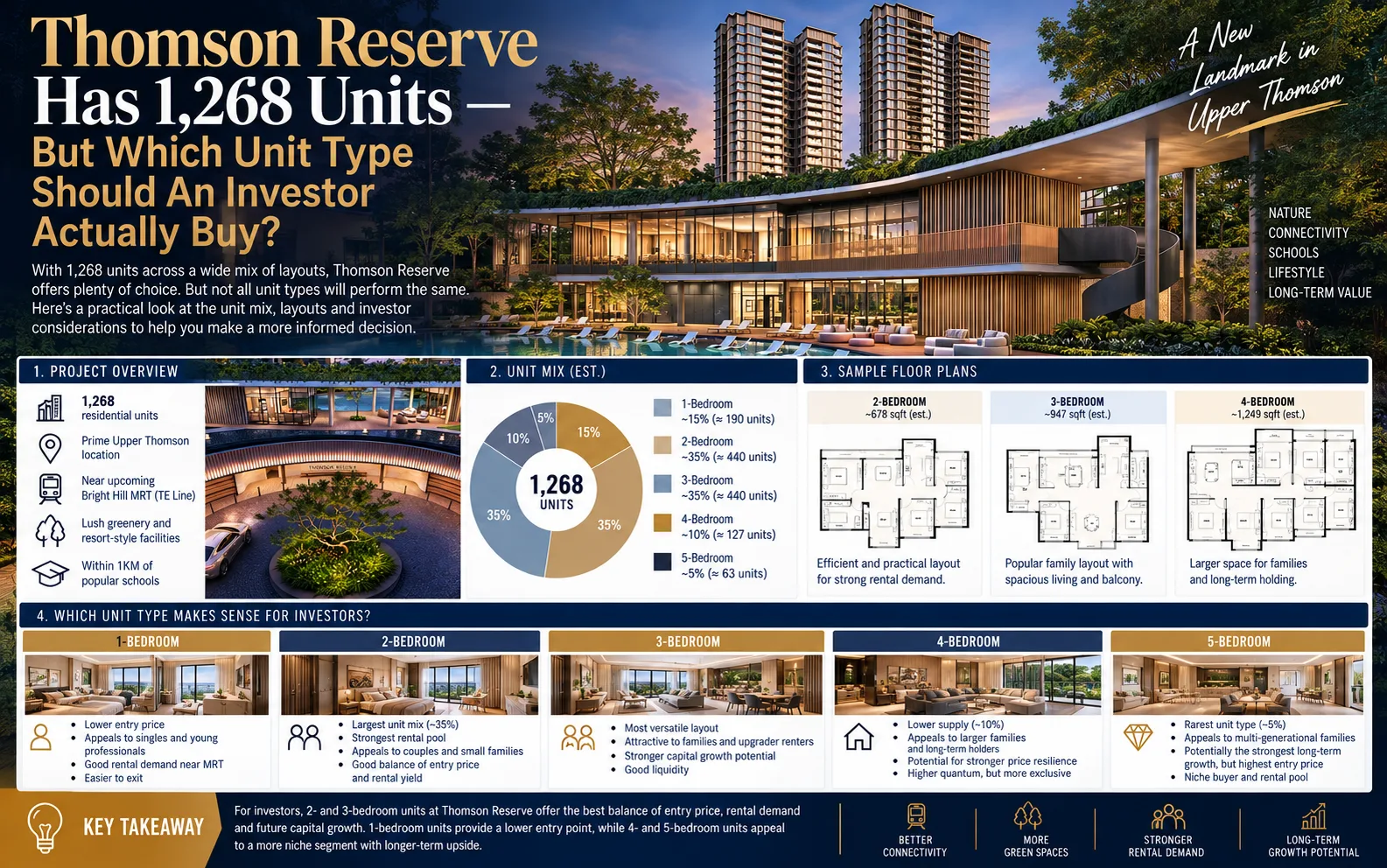
I recently wrote about the newly released Thomson Reserve floor plans.
But after studying the unit mix more carefully, something else caught my attention.
And for an investor, I think it may actually be more important than whether you prefer one floor plan over another.
Thomson Reserve has 1,268 units.
But those 1,268 units are not evenly distributed.
The project is heavily concentrated in certain unit types.
And that creates a question I don't think buyers ask often enough:
When I eventually sell my unit, who am I competing against?
Because buying a property is only half the investment.
Eventually, someone else has to want to buy it from you.
And at Thomson Reserve, the unit mix gives us some clues about where that future competition could be.
First, Let's Look At The Actual Unit Mix
Based on the latest released information, this is how Thomson Reserve is structured:
Unit Type | Size | Units | % of Project |
|---|---|---|---|
2 Bedroom | 592 sf | 100 | 7.9% |
2 Bedroom Premium | 678 sf | 416 | 32.8% |
2 Bedroom Premium + Study | 732–775 sf | 200 | 15.8% |
All 2BR | 716 | 56.5% | |
3 Bedroom | 947 sf | 120 | 9.5% |
3 Bedroom Premium | 1,055 sf | 170 | 13.4% |
3 Bedroom Premium + Study | 1,152 sf | 60 | 4.7% |
All 3BR | 350 | 27.6% | |
4 Bedroom | 1,238 sf | 90 | 7.1% |
4 Bedroom Premium — Private Lift | 1,367 sf | 56 | 4.4% |
4 Bedroom Premium + Study — Private Lift | 1,485 sf | 28 | 2.2% |
5 Bedroom Suite — Private Lift | 1,808 sf | 28 | 2.2% |
The project materials themselves contain a very extensive range of B-, BP-, BPS-, C-, CP-, CPS-, D-, DP-, DPS- and E-series floor plans, rather than just one generic layout per bedroom category.
And when you look at the numbers this way, the investment story becomes much clearer.
More Than Half Of Thomson Reserve Is 2-Bedroom
716 out of 1,268 units.
That is the first number I would remember.
Approximately:
56.5% of Thomson Reserve is 2-bedroom.
Why would the developer do this?
It makes commercial sense.
Smaller apartments produce lower absolute entry quantum.
They are accessible to more buyers.
They generally have a larger tenant pool.
And with Upper Thomson MRT at the doorstep, smaller units naturally fit the investment proposition.
So does that mean the 2-bedroom is automatically the best investment?
I don't think it is that simple.
In fact, this is where things get interesting.
The Investor's Paradox: The Easiest Unit To Buy May Also Be The Most Competitive Unit To Sell
Imagine Thomson Reserve five or six years after completion.
You own a 678 sq ft 2-Bedroom Premium.
You decide to sell.
But perhaps another 15 owners are also selling.
Remember:
there are 416 of these units alone.
Your buyer enters PropertyGuru.
Same development.
Same tenure.
Same age.
Same MRT.
Same facilities.
Same general layout.
Suddenly your buyer can compare:
Stack A.
Stack B.
Floor 12.
Floor 18.
Pool view.
Greenery view.
Renovated.
Unrenovated.
$1.95 million.
$2.02 million.
$2.08 million.
That creates internal price competition.
This is something investors sometimes forget when buying mega developments.
Liquidity is good.
But too much identical supply can reduce your pricing power.
So Is The 592 Sq Ft 2-Bedroom Better?
There are only:
100 units.
Immediately, that's more interesting from a scarcity perspective.
And because it is only 592 sq ft, it should theoretically carry the project's lowest absolute quantum.
That gives it a strong advantage.
Imagine Thomson Reserve is trading at $2,700 psf one day.
A 592 sq ft apartment is roughly:
$1.60 million.
A 1,055 sq ft 3-bedroom at the same PSF is:
$2.85 million.
The first buyer pool is obviously much larger.
For a rental-yield-focused investor, therefore, I would study the smallest 2-bedroom very carefully.
But there is a catch.
It's a compact home.
Your future buyer pool may lean more towards:
investors,
singles,
couples,
or smaller households.
That means its investment thesis depends heavily on:
quantum.
If the developer prices the smallest units at an enormous PSF premium simply because they have low quantum, I become less interested.
The 678 Sq Ft 2-Bedroom Premium Is Probably The Project's Commodity Unit
I don't mean "commodity" negatively.
It simply means there are many of them.
416 units.
That's almost:
one-third of the entire development.
It has a very practical advantage over the 592 sq ft unit: two bathrooms.
For tenants, couples and small families, that makes it significantly more usable.
But from an investment perspective, I would be extremely price-sensitive here.
Because you are buying into Thomson Reserve's largest individual unit category.
If I buy one, I want something differentiating my unit.
Higher floor.
Better view.
Better orientation.
Good stack.
Or importantly:
a very good entry price.
I would not pay a large premium merely to secure "a 2BR Premium".
There will be 415 others.
The 2-Bedroom Premium + Study Is More Interesting
Now we move to roughly:
732–775 sq ft
and only:
200 units.
This introduces something investors should think about:
buyer-pool expansion.
A normal 2-bedroom mainly competes within the 2-bedroom market.
Add a genuinely usable study and suddenly the apartment could potentially appeal to:
a couple working from home,
a young couple with one child,
someone wanting a nursery,
a buyer needing a study,
or someone who doesn't quite have the budget for a 3-bedroom.
This is what I call a:
bridge product.
And bridge products can be interesting because they sit between two buyer segments.
But there is one important condition.
The price gap to the 3-bedroom cannot become too small.
If the 2BR+Study costs $1.95m while the 947 sq ft 3BR costs $2.10m?
I'd seriously question why I wouldn't simply buy the three-bedroom.
Which leads us to what I think is the most interesting part of Thomson Reserve.
The 3-Bedroom Market
There are:
350 three-bedroom units.
That's only 27.6% of Thomson Reserve.
Already, the supply-demand equation looks different.
But even within the 350 units, there are three very different products.
120 standard 3BR.
170 Premium.
Only 60 Premium + Study.
And this is where my investor brain starts becoming more interested.
Why I Think The 947 Sq Ft 3-Bedroom Could Be A Dark Horse
The standard 3-bedroom is around:
947 sq ft.
Only 120 units.
This gives you a full three-bedroom apartment while keeping quantum relatively controlled.
And more importantly, the future resale buyer is very different from the 2-bedroom buyer.
Your potential buyer pool includes:
HDB upgraders,
young families,
existing 2BR owners,
investors,
families buying for school considerations,
and existing condo owners wanting another bedroom.
That is a very deep resale market.
This is why investors shouldn't automatically say:
“Investment means buy the smallest unit.”
Sometimes:
the best investment is the smallest unit that enters the next buyer category.
And at Thomson Reserve, that could potentially be the standard 3-bedroom.
Then We Have The 1,055 Sq Ft 3-Bedroom Premium
There are:
170 units.
I like the layout from an owner-occupation perspective.
Proper kitchen.
Yard.
Household shelter.
WC.
More family functionality.
But an investor must ask:
How much more am I paying over the 947 sq ft 3BR?
Because the difference is approximately:
108 sq ft.
At $2,500 psf, that's theoretically around:
$270,000 of additional area.
Would a future buyer pay $270,000 more?
Maybe.
Because the buyer isn't only getting additional floor area.
They're getting a more complete family home.
But if the developer prices the Premium too far away from the standard 3BR, I would rather own the cheaper three-bedroom.
The 3-Bedroom Premium + Study May Be The Most Interesting Supply Number In The Whole Project
There are only:
60 units.
That's:
4.7% of Thomson Reserve.
Approximately 1,152 sq ft.
Three bedrooms.
Study.
Yard.
Household shelter.
WC.
Proper kitchen.
It sits in a fascinating position.
It's bigger than a normal three-bedroom.
But it doesn't require the financial jump into a four-bedroom.
Again:
bridge product.
And unlike the 2BR+Study, this bridge leads into a much wealthier buyer pool.
A future buyer comparing:
1,152 sq ft 3BR+Study
versus
1,238 sq ft 4BR
may actually prefer the former if the study and layout meet their needs and the quantum is meaningfully lower.
For capital appreciation rather than maximum rental yield, this is one category I would watch very closely.
Now Look At What Happens Above 1,200 Sq Ft
This is where Thomson Reserve's supply suddenly collapses.
There are only:
202 four- and five-bedroom homes.
That's:
15.9% of the development.
And only 112 residences have private lifts.
This creates a very different investment proposition.
You sacrifice rental yield.
Your absolute quantum rises.
Your buyer pool becomes smaller.
But:
your internal competition falls dramatically.
This is essentially the opposite of the 2-bedroom proposition.
The 1,238 Sq Ft 4-Bedroom Could Be Another Interesting Bridge
There are 90.
That's just:
7.1% of Thomson Reserve.
It doesn't have the private-lift positioning of the Premium units.
But that may actually be its strength.
You get four bedrooms without paying for the full luxury proposition.
Who might eventually buy this?
HDB upgraders.
Families with three children.
Multi-generational households.
Existing 3BR owners.
Families who need a helper's room.
And people who simply want more space.
This could become the project's:
entry-level family upgrade unit.
And that's potentially a very powerful resale position.
The Private-Lift Units Are A Completely Different Investment
Then you have:
56 × 4BR Premium at 1,367 sq ft.
28 × 4BR Premium + Study at 1,485 sq ft.
28 × 5BR Suite at 1,808 sq ft.
Just:
112 private-lift residences.
These shouldn't really be analysed using the same investment logic as the 592 sq ft 2-bedroom.
The buyer is different.
The rental market is different.
The resale market is different.
And even the emotional reason for buying is different.
Here you're selling:
privacy,
space,
prestige,
views,
family lifestyle,
and scarcity.
A landed right-sizer doesn't necessarily care whether his gross rental yield is 2.8% or 3.1%.
He may care much more about whether:
his dining table fits,
his children can visit,
there is a private lift,
and his master bedroom feels like a proper master bedroom.
That is a different market.
So Which Unit Would I Buy As An Investor?
I wouldn't answer this by picking one bedroom type.
I'd first decide what investment game I'm playing.
There are three.
Income investor: I want low quantum, strong tenant pool and rental efficiency. The 592 sq ft 2BR becomes interesting.
Liquidity investor: I want the broadest future buyer pool. The 947 sq ft 3BR becomes very interesting.
Scarcity investor: I want something relatively difficult to replicate within Thomson Reserve. Then I start studying the 3BR Premium + Study, 4BR and selected private-lift units.
That is a much better way of looking at Thomson Reserve than:
“Which one has the lowest PSF?”
Now The Important Question: What Is A Good Entry Price?
This is where I want to be disciplined.
Thomson Reserve's official prices have not yet been released.
So I'm going to establish my numbers before seeing the developer's price chart.
That prevents us from reverse-engineering an argument after launch.
The site was acquired at an effective land rate presented in the sales materials at about $1,178 psf ppr. The same project materials contrast this with Lorong Puntong at $1,612 psf ppr and New Upper Changi Road at $1,537 psf ppr.
That land-cost advantage is real.
But I don't think buyers should hand all of that advantage back to the developer through the selling price.
For me, the interesting zone is broadly:
$2,400–$2,550 psf.
Below that, certain units could become extremely compelling.
Around $2,600 psf, I become selective.
Once we start approaching $2,700 psf across ordinary stacks, the investment case changes substantially.
Because cheap land only matters to me if some of the land advantage reaches the buyer.
My Thomson Reserve Entry Framework
These aren't predictions of launch prices.
They are the numbers where I would start getting interested versus where I would seriously consider walking away, assuming an ordinary mid-floor unit without an exceptional view.
Unit | Size | Attractive Quantum | My Walk-Away Zone* |
|---|---|---|---|
2BR | 592 sf | ≤ ~$1.50m | > ~$1.60m |
2BR Premium | 678 sf | ≤ ~$1.68m | > ~$1.82m |
2BR + Study | 732 sf | ≤ ~$1.80m | > ~$1.95m |
3BR | 947 sf | ≤ ~$2.30m | > ~$2.50m |
3BR Premium | 1,055 sf | ≤ ~$2.52m | > ~$2.75m |
3BR + Study | 1,152 sf | ≤ ~$2.70m | > ~$2.95m |
4BR | 1,238 sf | ≤ ~$2.90m | > ~$3.20m |
*Not a valuation and not an official price forecast. “Walk away” means I would stop viewing the project as an obvious investment entry and compare alternatives, not that a unit above this number is automatically overpriced. Exceptional high-floor, nature-facing or Luxury Collection units deserve separate analysis.
This is important.
I don't want to set one magic:
“Thomson Reserve must be below $2,500 psf.”
That's too simplistic.
A fantastic high-floor greenery-facing unit at $2,600 psf could make more sense than a compromised unit at $2,450 psf.
Good property investing isn't about buying the cheapest PSF.
It is about buying the most defensible combination of product, price and future demand.
There Is One More Number I Would Calculate On Booking Day
And this may actually be my favourite way of choosing between unit types.
I call it:
The Upgrade Gap.
Suppose launch day gives us:
2BR Premium — $1.68m
2BR+Study — $1.82m
3BR — $2.18m
3BR Premium — $2.48m
3BR+Study — $2.68m
Don't analyse each unit independently.
Ask:
What do I get for the next $140,000?
Then:
What do I get for the next $360,000?
Then:
What do I get for another $300,000?
Because sometimes the best value isn't the cheapest apartment.
It is the point where:
a relatively small increase in quantum buys access to a much larger future buyer pool.
That is what I will be looking for at Thomson Reserve.
The Most Dangerous Unit May Actually Be The One Just Below The Next Category
Imagine a 2BR+Study costs:
$1.95m.
And the cheapest 3BR costs:
$2.08m.
That's only:
$130,000 difference.
For an owner-occupier who can afford both, which one do you think is easier to sell eventually?
Probably the genuine three-bedroom.
The reverse can also happen.
If the 3BR Premium costs $2.70m but a 4BR starts at $2.82m?
Suddenly I would study the four-bedroom instead.
This is why looking at each floor plan independently misses half the investment analysis.
Every unit at Thomson Reserve competes against the unit immediately above and below it.
That relationship matters.
The Unit Mix Creates A Pricing Ladder
This is perhaps my biggest insight after studying Thomson Reserve.
The project isn't simply:
2BR → 3BR → 4BR → 5BR.
It is:
2BR
→ 2BR Premium
→ 2BR Premium + Study
→ 3BR
→ 3BR Premium
→ 3BR Premium + Study
→ 4BR
→ 4BR Premium
→ 4BR Premium + Study
→ 5BR Suite.
That's a ten-rung pricing ladder.
The developer's job is to convince you to climb one more rung.
The investor's job is to identify:
where the biggest jump in utility occurs for the smallest jump in price.
That unit may be the value buy.
And This Is Why I Don't Yet Have A “Best Thomson Reserve Unit”
Not until I see the actual price chart.
The floor plans tell me:
what I like.
The unit mix tells me:
what is scarce.
The site plan tells me:
which stacks I prefer.
But the price chart tells me:
what I would actually buy.
And those are not necessarily the same thing.
If the developer makes the 592 sq ft 2BR exceptionally attractive?
I'll look there.
If the 947 sq ft 3BR carries only a reasonable premium over the larger 2BRs?
That may become far more interesting.
If the 3BR Premium + Study is priced close to the 4BR?
I'll move up.
And if everything I like crosses my walk-away numbers?
I walk.
There is no property in Singapore that you must buy.
Especially heading into 2027, when buyers will have more launches to choose from.
And one of the projects I will be watching particularly closely after Thomson Reserve is Chuan Grove, expected in Q1 2027.
So my approach to Thomson Reserve will be very simple:
Don't ask which unit is cheapest.
Ask:
Which unit gives me the strongest future buyer pool relative to the amount I am paying today?
For me, that is the real investment question.
And once the official price chart comes out, I intend to test every Thomson Reserve unit type against exactly that question.
FAQs
Want the tailored version for your portfolio?
Every article here generalises. A 20-minute conversation makes it specific to your numbers.
Is a 2-bedroom the best investment at Thomson Reserve?
Which Thomson Reserve unit type interests me most for capital appreciation?
Why could the 3-bedroom be attractive?
What is a good entry PSF for Thomson Reserve?
What is my walk-away price?
Should investors buy the cheapest Thomson Reserve unit?

Written by
Christopher Ng (CEA R014394H)
Singapore Property & Asset Progression Strategist with ERA Realty Network. A NUS Real Estate graduate, Christopher has advised homeowners, investors and property owners since 2004.