
What Are Good Class Bungalows (GCBs) in Singapore — And Why Is Everyone So Fascinated With Them?
Good Class Bungalows (GCBs) represent Singapore's most exclusive landed property, defined by strict criteria beyond just size. They are highly sought after for their scarcity, privacy, prime locations, and role as wealth preservation assets
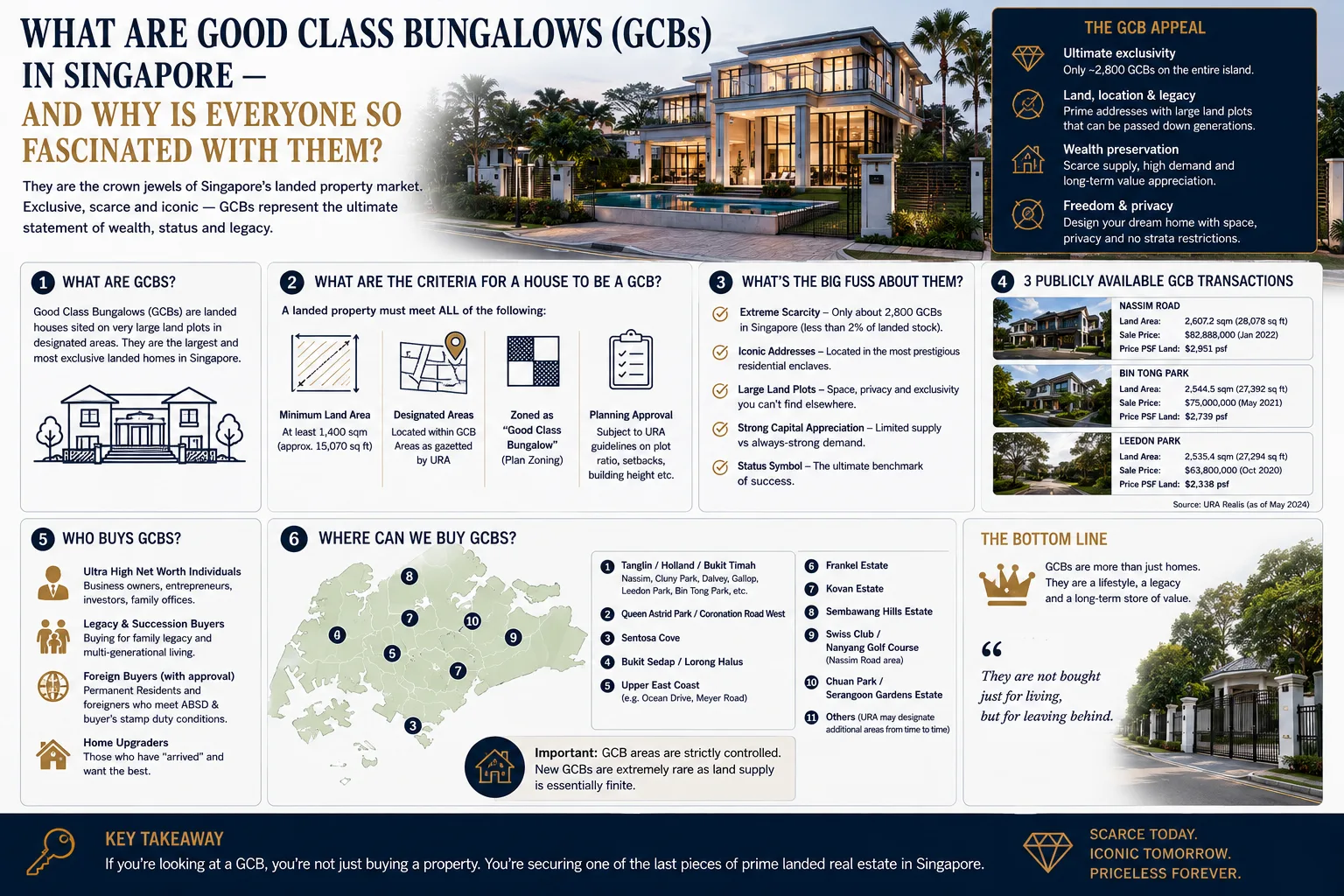
If landed property is often seen as the top of Singapore's property ladder, then Good Class Bungalows — or GCBs — sit in a category of their own.
A terrace is landed.
A semi-detached house is landed.
A detached bungalow is landed.
But not every bungalow is a Good Class Bungalow.
And once you enter the GCB market, the numbers become very different too.
$20 million.
$40 million.
$60 million.
And occasionally, more than $100 million for a single home.
In December 2025, for example, a GCB along Peirce Road reportedly changed hands for $148 million.
So naturally, people ask:
What exactly makes a house a GCB?
Why are wealthy Singaporeans prepared to pay so much for them?
Who can actually buy one?
And if you have the money, where do you even find them?
Let me break it down from a landed-property buyer's perspective.
First: What Exactly Is A GCB?
GCB stands for:
Good Class Bungalow
It is essentially the most exclusive category of landed residential property in Singapore.
But here's the important part:
A very expensive bungalow is not automatically a GCB.
A 20,000 sq ft detached house in the wrong location is still not technically a GCB.
To qualify, the property has to sit within one of Singapore's officially designated Good Class Bungalow Areas, or GCBAs, and meet the relevant planning requirements.
URA currently recognises 39 Good Class Bungalow Areas in Singapore.
That limited geography is the starting point of the scarcity.
What Are The Criteria For A Good Class Bungalow?
For a standard GCB plot under today's prevailing planning controls, there are several key requirements.
1. It Must Be Within A Designated Good Class Bungalow Area
This is probably the most important criterion.
You cannot buy a giant detached house anywhere in Singapore and decide to call it a GCB.
The land must be within one of URA's designated GCB Areas.
URA's current list contains 39 GCBAs.
2. Minimum Land Size: 1,400 sqm
That is approximately:
15,070 sq ft
This is one of the reasons GCBs feel so different from ordinary landed homes.
For comparison, the prevailing minimum plot size for an ordinary detached house outside a GCB Area is only 400 sqm, or roughly 4,306 sq ft.
A normal GCB therefore requires more than three times that minimum land area.
There are some existing deficient or conserved plots where specific concessions can apply, so you may occasionally encounter recognised GCB properties below 15,070 sq ft. But for new standard GCB plots, 1,400 sqm is the prevailing benchmark.
3. Minimum Width: 18.5 metres
URA also stipulates a minimum plot width of:
18.5m
and minimum depth of:
30m
for standard GCB plots.
This is important.
As I have discussed throughout my landed-property series, land area alone doesn't determine land quality.
A huge but narrow plot is not the same as a broad, regular GCB site.
4. The House Must Be Detached
A GCB is fundamentally a bungalow — a detached landed house.
No party walls.
Your house is separated from adjoining homes.
5. More Open Land Must Be Preserved Around The House
GCB planning deliberately preserves the spacious and green character of these estates.
Current URA controls allow a maximum 35% sub-control and 45% overall site coverage within GCB Areas. Ordinary bungalows outside GCB Areas have higher limits of 40% and 50% respectively.
GCBs also have wider side and rear setbacks than ordinary detached homes:
Front: generally 7.5m for applicable Category 3–5 roads
Side: 3m
Rear: 3m
This is deliberate.
A GCB isn't supposed to become a giant building squeezed right to its boundaries.
The greenery and sense of openness are part of the planning concept.
So A GCB Is Not Simply “A Big House”
That distinction is important.
A GCB is really a combination of:
location + land size + width + planning controls + scarcity.
You can build a spectacular $30 million detached house outside a GCB Area.
It may even sit on more than 15,000 sq ft.
But technically, it still isn't a GCB.
Likewise, simply owning 15,000 sq ft inside a landed estate doesn't automatically make the house one.
Location within the GCBA is fundamental.
What's The Big Fuss About GCBs?
This is where the story becomes more interesting.
Why would someone pay $50 million for a house when $15 million can already buy a very nice detached home elsewhere?
There are several reasons.
1. Scarcity Within Scarcity
Singapore landed housing is already scarce.
GCB land is scarcer again.
There are only 39 designated GCB Areas.
And unlike condominiums, you cannot simply release another GLS site and build 500 new GCBs vertically.
The whole point of a GCB Area is its low-density character.
That makes the supply structurally constrained.
And when household wealth continues expanding at the top end, finite supply becomes very powerful.
2. You Are Buying A Huge Piece Of Singapore
Think about what 15,000 sq ft means in Singapore.
That is around:
1,400 sqm of land.
In many parts of Singapore, that same amount of land could accommodate multiple landed homes.
Yet one family occupies it.
And many GCBs are far larger than the minimum.
20,000 sq ft.
30,000 sq ft.
50,000 sq ft.
In the Peirce Road case reported in 2025?
More than 80,000 sq ft.
That is an extraordinary amount of private residential land in a city-state.
3. Privacy
This is one benefit that money sometimes struggles to buy even in luxury condominiums.
You can own a 10,000 sq ft penthouse.
But you're still in a building.
GCB living can offer:
large setbacks,
landscaping,
private driveways,
gardens,
pools,
large distances from neighbours,
and substantially greater seclusion.
For certain ultra-high-net-worth families, privacy is itself a luxury product.
4. GCB Areas Tend To Be In Highly Desirable Locations
Look at the names.
Nassim Road.
Cluny Hill.
Gallop Road.
Dalvey Estate.
Leedon Park.
Holland.
Binjai.
Queen Astrid Park.
These are not remote large-land areas.
Many sit within some of Singapore's most established central residential belts.
So buyers are getting:
huge land + central Singapore + low density.
That combination is extremely difficult to replicate.
5. GCBs Have Become Wealth-Preservation Assets
A buyer spending $40 million or $60 million is normally operating at a very different financial level from someone stretching into their first terrace.
For many GCB buyers, the home is not their only asset.
They may already own:
businesses,
equities,
commercial real estate,
family-office assets,
overseas properties,
and substantial cash portfolios.
A GCB can therefore become one part of a diversified family balance sheet.
And because the supply is restricted, it is often viewed as a form of long-term capital preservation.
6. Legacy Becomes Much More Powerful At This Level
I recently wrote about my client Mr David, who initially wanted freehold landed because he hoped to leave something meaningful to his children.
That same concept exists at the GCB level — only magnified considerably.
Imagine acquiring 20,000 or 30,000 sq ft of prime freehold Singapore land.
Your children may eventually inherit it.
Perhaps subdivide it where planning rules permit.
Perhaps rebuild.
Perhaps continue living there.
The physical land itself becomes part of the family's intergenerational wealth.
At this end of the market, legacy isn't simply emotional. It can become a major capital-planning consideration.
Not All GCBs Are Equal Either
This is important.
Just like my articles on ordinary landed property, I would never say:
“GCB is GCB. Just compare PSF.”
Absolutely not.
Within the GCB market, I still look at:
plot shape,
frontage,
road,
slope,
orientation,
house condition,
architecture,
age,
redevelopment potential,
micro-location,
and land size.
A beautiful regular 20,000 sq ft plot close to the Botanic Gardens is a different asset from an awkward 20,000 sq ft site elsewhere.
And building value can dramatically distort land PSF.
A newly rebuilt architectural GCB can trade at a much higher apparent land PSF than an old house that a buyer intends to demolish.
We saw that in 2025.
EdgeProp noted that new-build GCBs were commanding especially strong premiums, with recently completed homes achieving materially higher land rates than older land-value properties.
Again:
Land PSF is evidence. It is not the entire valuation.
Three Publicly Reported GCB Cases
Rather than talking only in theory, let's look at three transactions that have been publicly reported.
These are useful because they show just how different GCB buyers and properties can be.
Case 1: Peirce Road — $148 Million
This was probably the headline GCB transaction of 2025.
A freehold GCB site along Peirce Road reportedly changed hands in December 2025 for:
$148 million
Land:
80,448 sq ft
Price:
approximately $1,840 psf land
The reported buyer was property developer Victor Soh Choon Lai of Pinnacle Assets Group. The plot's enormous size and regular configuration reportedly created potential for subdivision into multiple GCB plots, subject of course to approvals and applicable planning rules.
This case demonstrates something important:
At GCB level, sometimes the buyer isn't only buying:
the existing house.
He may be buying:
the strategic value of the land.
An 80,000 sq ft GCB site is almost a development proposition of its own.
Case 2: Second Avenue — $53 Million
In September 2025, a GCB at Second Avenue reportedly sold for:
$53 million
Land:
approximately 19,998 sq ft
Land rate:
about $2,652 psf
The reported buyer was Gallant Tang, group CEO of SingHaiyi, who was 29 at the time. The house reportedly had around 16,661 sq ft of built-up area and had been completed in 2013.
This case is interesting because it challenges the traditional image of GCB buyers being only elderly tycoons.
The buyer profile is getting younger.
Entrepreneurs and next-generation business families are entering the segment earlier.
Case 3: Joan Road — $58 Million
Another fascinating deal involved a property at Joan Road in the Caldecott Hill Estate.
It reportedly changed hands for:
$58 million
Land:
approximately 39,276 sq ft
Land rate:
around $1,477 psf
The reported buyers were the two sons of the founders of Koufu Group, aged 25 and 30 at the time.
The property comprised a pair of bungalows on a very substantial freehold site.
Again, look at the buyer profile.
Young.
Second-generation family wealth.
Long investment horizon.
And an enormous land parcel.
This is why I think the GCB market increasingly sits at the intersection of:
housing + wealth management + family succession.
These Three Transactions Also Show Why PSF Alone Doesn't Work
Look at the three examples:
Peirce Road: ~$1,840 psf
Second Avenue: ~$2,652 psf
Joan Road: ~$1,477 psf
Does that mean Joan Road was "cheap" and Second Avenue "expensive"?
Not so fast.
The houses differed.
Land sizes differed dramatically.
Condition differed.
Built-up differed.
Redevelopment potential differed.
Absolute quantum differed.
At this level especially, the quantum effect is huge.
It is much easier for the market to absorb:
$50 million
than:
$150 million.
So gigantic sites can trade at much lower land PSF despite requiring vastly larger absolute cheques.
Exactly the same landed-valuation principles I have discussed elsewhere still apply.
Just add another zero.
Who Actually Buys GCBs?
Historically, you might imagine:
bankers,
property developers,
industrialists,
old family wealth.
Those buyers still exist.
But today's GCB buyer pool is more diverse.
EdgeProp's review of the 2025 market described buyers coming from sectors including:
technology, finance, property, F&B, commodities and entrepreneurship, with a noticeably younger cohort participating in recent transactions.
I would broadly divide GCB buyers into several groups.
Business Founders
People who have created significant wealth through operating businesses.
At this level, the house often represents a relatively manageable percentage of their overall net worth.
Next-Generation Family Wealth
This is becoming more visible.
Children of successful business families acquiring GCBs themselves.
The 2025 Second Avenue and Joan Road transactions are good examples.
Finance And Investment Professionals
Fund founders.
Private-equity principals.
Family-office executives.
Investment managers.
These buyers understand scarce assets and capital allocation.
Technology Entrepreneurs
The rise of Singapore's tech and family-office ecosystem has created new sources of wealth.
Recent publicly reported GCB transactions have included buyers from technology and cloud-services businesses.
Property Developers
This is another very interesting buyer group.
An old GCB on excellent land can be a redevelopment opportunity.
Buy.
Demolish.
Build exceptional architecture.
Then either occupy or eventually sell.
At the top end, the quality of the completed house can add enormous value.
Can A Foreigner Buy A GCB?
This is where GCBs become even more exclusive.
For ordinary landed residential property, non-Singapore citizens generally need approval from SLA's Land Dealings Approval Unit.
SLA says applicants are assessed case by case, and the general criteria include having been a Singapore PR for at least five years and making an exceptional economic contribution to Singapore.
But GCBs face an even higher bar.
SLA's current FAQ states that PRs are generally limited to restricted residential properties not exceeding 15,000 sq ft and not situated within a Good Class Bungalow Area.
Applicants wishing to acquire properties beyond those limits, including within GCBAs, are subject to much more stringent qualifying criteria, including exceptional economic contribution.
So practically, the GCB buyer pool is overwhelmingly Singapore-citizen-led, with exceptional approval cases treated very differently.
That restriction further limits the buyer pool — but also contributes to the exclusivity.
Where Can We Buy GCBs?
You cannot simply choose any landed estate.
URA officially lists 39 Good Class Bungalow Areas.
They are:
Belmont Park
Bin Tong Park
Binjai Park
Brizay Park
Bukit Sedap
Bukit Tunggal
Caldecott Hill Estate
Camden Park
Chatsworth Park
Chee Hoon Avenue
Chestnut Avenue
Cluny Hill
Cluny Park
Cornwall Gardens
Dalvey Estate
Eng Neo Avenue
Ewart Park
First/Third Avenue
Ford Avenue
Fourth/Sixth Avenue
Gallop Road/Woollerton Park
Garlick Avenue
Holland Park
Holland Rise
Kilburn Estate
King Albert Park
Leedon Park
Maryland Estate
Nassim Road
Oei Tiong Ham Park
Queen Astrid Park
Raffles Park
Rebecca Park
Ridout Park
Swiss Club Road
Victoria Park
White House Park
Windsor Park
plus the remaining designated areas shown on URA's current GCBA list and map.
The precise boundary matters.
This is important.
A house can sit on a street that sounds like it is in a GCB area but fall outside the official GCBA boundary.
So just as I tell ordinary landed buyers:
Check the planning map. Don't buy the marketing description.
URA SPACE's Designated Landed Housing Area Plan is the place to verify the location.
Which GCB Areas Are The Most Prestigious?
This becomes subjective.
But if you asked which names have particularly strong recognition, I would certainly include:
Nassim Road
Cluny Hill / Cluny Park
Gallop Road / Woollerton Park
Dalvey Estate
Leedon Park
Queen Astrid Park
Chatsworth Park
Ridout / Holland
Different buyers value different things.
Nassim and Cluny benefit tremendously from proximity to Orchard and the Singapore Botanic Gardens.
Holland and Leedon have their own prestige.
Bukit Timah GCBAs appeal strongly to families already rooted in that part of Singapore.
Caldecott offers a different central residential proposition.
Again:
There isn't one GCB market.
Even within the 39 areas, there are micro-markets.
But Where Do You Actually Find A GCB For Sale?
This is another interesting part of the market.
Don't expect the GCB market to behave like a condo new launch.
Some properties appear on portals.
Some are marketed by specialist landed agents.
Some sell through tenders.
Some go to auction.
But many of the most significant deals are:
off-market.
EdgeProp estimated that in 2025, beyond the publicly caveated GCB transactions, another group of off-market deals had also been concluded. Some were subject to confidentiality and therefore not easily visible in public transaction databases.
That tells you something about this market.
At $40 million or $80 million, sellers often value:
privacy,
discretion,
and qualified introductions.
This is a relationship-driven market.
Sometimes the house you want is not advertised at all.
Why Would Someone Sell A GCB?
This is also fascinating.
If GCBs are so scarce, why sell?
Same reasons families sell any major asset.
Estate planning.
Generational transition.
Children have moved overseas.
Right-sizing.
Portfolio restructuring.
Divorce.
Liquidity.
Or simply:
The next generation does not want the house.
Some of the most interesting GCBs that came to market in 2024–2025 were long-held family homes occupied for several decades before the next generation chose to sell.
That is the other side of legacy.
You may intend to leave the property to your children.
But one day your children decide whether they actually want to keep it.
Is A GCB Automatically A Good Investment?
No.
I would apply exactly the same philosophy I use throughout my landed-property series.
Scarcity does not excuse a bad purchase.
You can still:
overpay,
buy compromised land,
buy poor frontage,
buy the wrong road,
overvalue an old building,
underestimate rebuilding costs,
or overbuild the land.
At $50 million, mistakes become extremely expensive.
Even a:
5% valuation error
on $50 million is:
$2.5 million.
So GCB buyers need even more—not less—discipline.
Old GCB Versus Newly Rebuilt GCB
This deserves its own future article.
But broadly, the same principle from my Old Landed House vs Newly Rebuilt article applies.
An old GCB may essentially be:
prime land + demolition liability.
A newly rebuilt GCB may include millions of dollars of architectural, structural and interior value.
A recently built home with:
large basement,
lift,
pool,
exceptional architecture,
premium materials,
and 20,000+ sq ft of built-up
cannot sensibly be compared with a 40-year-old bungalow purely on land PSF.
This is partly why some newer GCBs have achieved very high land rates.
In 2025, a newly built GCB on Chee Hoon Avenue reportedly sold for $55 million, or around $3,955 psf land, while another Dalvey Road property reportedly achieved above $4,000 psf.
The building matters.
GCBs Are Also An Architecture Story
This is another reason I find the segment fascinating.
At this level, buyers can commission some of Singapore's best architects.
The home may include:
large gardens,
courtyards,
basements,
entertainment spaces,
multiple kitchens,
staff quarters,
gyms,
wine rooms,
libraries,
and large swimming pools.
But because URA restricts site coverage within GCB Areas, the architectural challenge isn't simply:
build as much as possible.
The house still needs to respect the low-density, green character of the estate.
That creates some remarkable homes.
The Real Luxury Is Probably Not The House
This is my personal perspective.
It is easy to look at a $60 million GCB and think the luxury is:
marble,
pool,
lift,
designer furniture.
Those things can be bought anywhere.
The real luxury may actually be:
space.
15,000 sq ft of private land.
20,000 sq ft.
30,000 sq ft.
In central Singapore.
Surrounded by greenery.
With substantial distance between you and your neighbours.
In one of the densest and most valuable cities in Asia.
That is very difficult to reproduce.
From Asset Progression To Wealth Preservation
In my normal work with clients, Asset Progression might look something like:
BTO → Condo → Better Condo → Terrace → Semi-D.
GCB buyers are already well past the stage where property progression is primarily about moving up another rung.
At this level, the conversation changes.
It becomes:
wealth preservation,
family legacy,
capital allocation,
privacy,
and
lifestyle.
The property can still appreciate.
Of course.
But if someone has a $100 million or $500 million net worth, buying a $40 million GCB may have a very different strategic purpose from a family stretching from a $2 million condo into a $4 million terrace.
Same property market.
Completely different financial problem.
My Take: Why GCBs Will Always Fascinate Singapore
I think Good Class Bungalows sit at the extreme end of something very Singaporean.
We live in a small country.
Land is scarce.
Most of us grow up in apartments.
So the idea that one family can own:
15,000, 20,000 or even 80,000 sq ft of private freehold land
in central Singapore is naturally extraordinary.
Then add:
only 39 designated areas,
strict planning rules,
limited buyer eligibility,
wealthy families competing for the best plots,
and very little new supply.
You can understand why the GCB market behaves differently.
But I would still apply the same rule I have repeated throughout this landed series:
Don't buy the label. Buy the asset.
Even at GCB level.
Understand:
the land,
the frontage,
the shape,
the road,
the building,
the development potential,
the buyer pool,
and the price.
Because not every bungalow is a GCB.
And not every GCB is equally good.
The best ones combine something almost impossible to replicate in Singapore:
a huge piece of excellent land, in the right location, held for the long term.
That is what makes the GCB market so special.
Want the tailored version for your portfolio?
Every article here generalises. A 20-minute conversation makes it specific to your numbers.
What does GCB mean in Singapore?
How big must a Good Class Bungalow plot be?
Is every 15,000 sq ft bungalow a GCB?
How many Good Class Bungalow Areas are there in Singapore?
What is the maximum site coverage for a GCB?
What are the setbacks for a GCB?
Can a Singapore PR buy a GCB?
Can a foreigner buy a GCB?
How much does a GCB cost in Singapore?
Who buys GCBs?
Why are GCBs so expensive?
Where are the most famous GCB areas?
Are all GCB transactions publicly visible?
Are newly rebuilt GCBs worth more?
Is buying a GCB good Asset Progression?
What is the biggest mistake when buying a GCB?
Written by
Christopher Ng (CEA R014394H)
Singapore Property & Asset Progression Strategist with ERA Realty Network. A NUS Real Estate graduate, Christopher has advised homeowners, investors and property owners since 2004.