
How Much Does It Cost to Rebuild a Landed House in Singapore? A 2026 Cost Guide
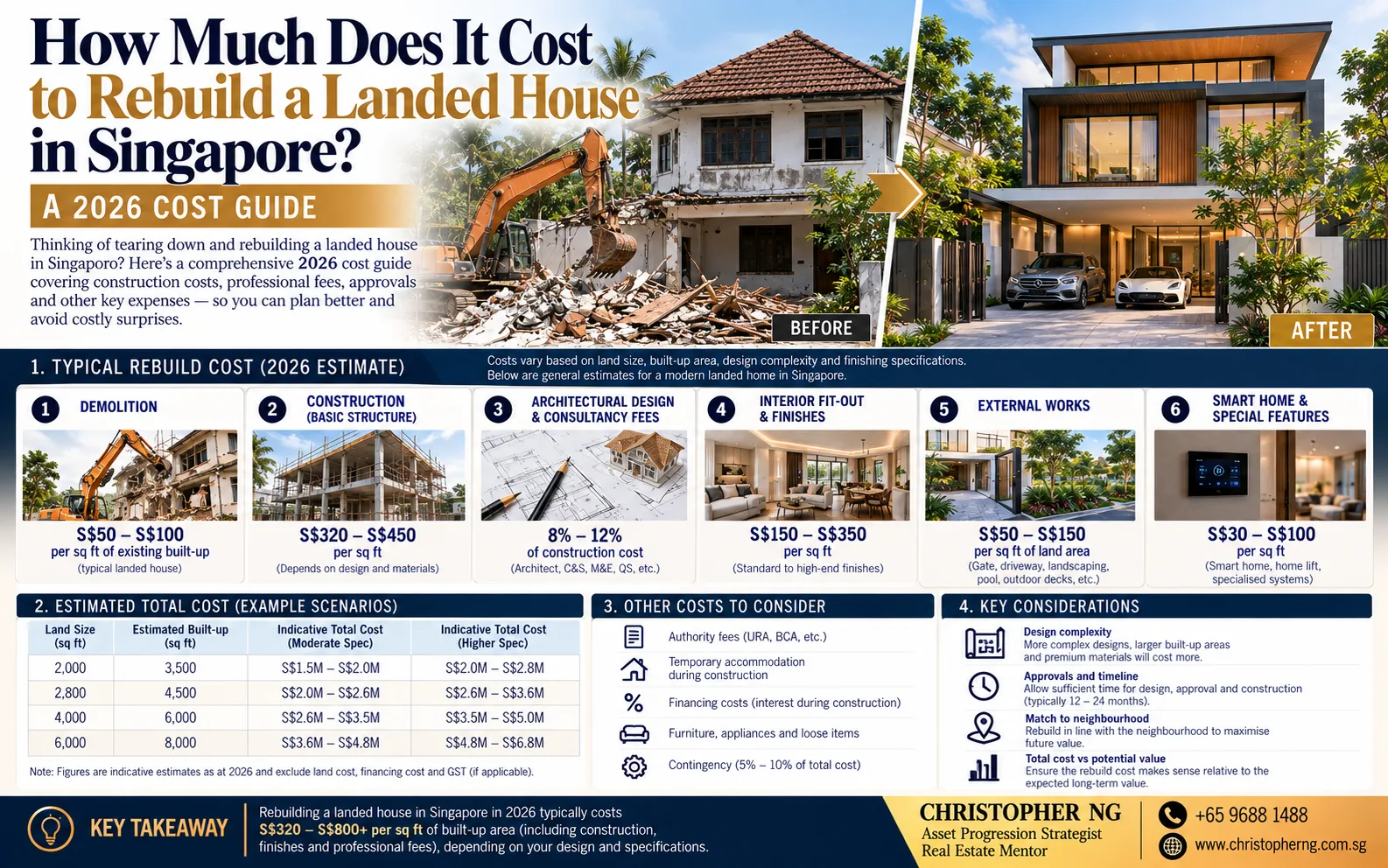
Rebuilding a landed house in Singapore involves far more than just the purchase price. Understand the true all-in cost, including demolition, consultants, and contingency, to make informed property decisions.
You find an old landed house on a good plot.
The location is right.
The frontage is decent.
The land shape works.
And compared with the beautifully rebuilt house three streets away, the asking price looks surprisingly attractive.
Then you walk inside.
The house is 30 or 40 years old.
The layout doesn't work.
The electrical system is dated.
There may be water seepage.
The rooms are too small.
And you start thinking:
“Maybe I should just tear everything down and rebuild.”
That's when the property calculation changes completely.
Because if you're buying an old landed house with the intention of rebuilding it, the purchase price isn't really the price of your future home.
It is only the price of getting into the property.
The real question is:
How much will I have spent by the time I'm actually living in the house I want?
And that number can be very different.
So, How Much Does It Cost to Rebuild a Landed House in Singapore in 2026?
Everyone wants a simple number.
Something like:
“Chris, just tell me. $300 psf? $400 psf? $500 psf?”
The problem is that there isn't one universal rebuilding rate.
As a broad planning reference, published Singapore landed-property guides in 2026 are citing full-rebuild construction costs around S$400–S$600+ per sq ft of built-up area, depending heavily on specification, site conditions and contractor. But that's a market guide—not an official rate, and definitely not a quotation.
And more importantly:
Construction PSF is not your total rebuild budget.
A S$2 million contractor number does not necessarily mean your project costs S$2 million.
You may still have:
demolition,
architect,
engineers,
authority submissions,
soil investigation,
surveying,
external works,
pool,
lift,
landscaping,
contingency,
financing,
rent while rebuilding,
and other items sitting outside that headline number.
That's why when I'm analysing an old landed property, I use a much broader equation.
The Real Landed Rebuild Cost Formula
For a buyer, I would think about it like this:
PURCHASE PRICE
BUYER'S STAMP DUTY
ABSD, IF APPLICABLE
LEGAL & ACQUISITION COSTS
DEMOLITION
MAIN CONSTRUCTION
ARCHITECT & CONSULTANTS
AUTHORITY / SUBMISSION COSTS
STRUCTURAL & M&E WORKS
FINISHES
EXTERNAL WORKS
POOL / LIFT / SPECIAL FEATURES
CONTINGENCY
FINANCING & HOLDING COSTS
TEMPORARY ACCOMMODATION
=
TRUE ALL-IN COST OF YOUR FINISHED LANDED HOME
That's the number I care about.
Because once I know that number, I can ask:
“What else could I buy for the same money?”
“My Builder Says S$400 PSF.” What Does That Actually Include?
This is one of the first questions I would ask.
Because S$400 psf from Builder A may not mean the same thing as S$400 psf from Builder B.
Does it include:
structure?
foundation?
roof?
windows?
waterproofing?
electrical?
plumbing?
air-conditioning?
flooring?
sanitary fittings?
kitchen?
carpentry?
boundary walls?
gate?
driveway?
landscaping?
pool?
lift?
professional fees?
demolition?
GST?
And what level of specifications have been assumed?
A lower PSF with many exclusions can eventually cost more than a higher but more comprehensive quotation.
So when comparing rebuilding quotations:
Compare scope against scope — not PSF against PSF.
Before Costing Anything: Is It A&A or Reconstruction?
This distinction matters.
Under URA's current rules, for works to qualify as Additions & Alterations, among the criteria are:
additional GFA should not exceed 50% of the approved existing GFA;
external walls removed and replaced should not exceed 50% of approved external walls; and
structural changes to the existing building should not exceed 50%.
Certain changes can also cause the works to be treated as reconstruction even if those thresholds aren't exceeded—for example, increasing the storey height or changing the landed housing form.
So don't simply assume:
“I retain one wall, therefore this is A&A.”
It doesn't work like that.
If the distinction affects whether you buy the property, get an architect or appropriate Qualified Person to assess it before committing.
I've covered this separately in my article:
A&A vs Reconstruction vs Rebuilding a Landed House in Singapore: What Buyers Must Know Before They Buy.
How Much House Can You Actually Build?
This is another mistake I see.
Buyer sees 4,000 sq ft of land and starts calculating:
“If I build 7,000 sq ft × $450 psf…”
Wait.
First establish whether you can actually build what you're imagining.
URA's landed housing rules use an allowable building envelope based on factors including landed housing type, storey-height control and setbacks. The applicable controls can materially affect what can be created on a particular plot.
So the sequence should be:
LAND
↓
WHAT CAN I BUILD?
↓
HOW MUCH BUILT-UP?
↓
WHAT SPECIFICATION?
↓
THEN CALCULATE COST
Not the other way around.
What Actually Goes Into the Cost of Rebuilding?
I would divide the project into seven main buckets.
1. Demolition & Site Preparation
Before you build the new house, the old one has to come down.
Depending on the property, this can include demolition, disposal, site clearing, temporary works, hoarding and protection to adjoining properties.
Access matters.
Neighbouring structures matter.
Existing construction matters.
Don't treat demolition as a rounding error.
2. Structure & Building Shell
This is the actual house:
foundations,
piling where required,
columns,
beams,
floor slabs,
stairs,
roof,
external walls,
façade,
windows,
waterproofing.
Ground conditions and structural complexity can materially affect the budget.
Two houses with exactly the same built-up area can cost very different amounts to construct.
3. Mechanical & Electrical Works
These aren't particularly exciting when you're looking at beautiful renders.
But they matter enormously after you move in.
Electrical.
Plumbing.
Drainage.
Air-conditioning.
Ventilation.
Lighting infrastructure.
Data and networking.
Smart-home provisions.
Solar provisions.
Pool systems where applicable.
These are areas where I would be very careful about cutting costs purely to achieve a lower construction PSF.
4. Internal Finishes
Now we get to what everybody sees.
Flooring.
Tiles.
Stone.
Bathrooms.
Sanitary fittings.
Kitchen.
Carpentry.
Doors.
Wardrobes.
Lighting.
Paint.
The range here can be enormous.
You can have two structurally similar houses where one owner spends hundreds of thousands more simply because of material and finishing choices.
5. Architects, Engineers & Consultants
Your contractor isn't the only professional involved.
Depending on the project, you may require architectural, structural engineering, M&E, surveying, soil investigation, quantity surveying and other specialist services.
If these aren't included in your construction quote, they need their own budget.
6. Pool, Lift, Landscaping & External Works
This is where:
“Since we're already rebuilding…”
can become a very expensive sentence.
Swimming pool.
Home lift.
Landscaping.
Automatic gate.
Driveway.
Decking.
Outdoor kitchen.
Solar.
EV charger.
Water features.
Basement.
Gym.
Entertainment room.
Individually, each may sound manageable.
Collectively, they can materially change the project cost.
7. Contingency, Interest & Temporary Accommodation
This is probably one of the most underestimated buckets.
You may have:
variation orders,
unexpected site conditions,
changes in specifications,
additional works,
interest during construction,
property-related holding costs,
rent while rebuilding,
storage,
moving costs,
and delays.
If your entire project only works financially when nothing goes wrong:
Your budget is too tight.
Three Illustrative Rebuild Scenarios
Let's put some numbers around this.
These are illustrative feasibility examples, not contractor quotations.
I'm deliberately using different construction assumptions to show how scale and specification can affect the numbers.
Scenario 1: Rebuilding an Intermediate Terrace
Suppose you buy an older inter-terrace for:
S$5.0 million
After preliminary feasibility, you are considering approximately:
4,000 sq ft built-up
Let's use an illustrative main construction allowance of:
S$400 psf
Main construction:
4,000 × S$400 = S$1.60 million
Then let's allow:
Demolition/site works: S$50,000
Architect/consultants/submissions: S$180,000
External/additional works: S$120,000
Contingency: S$200,000
Financing/holding/temporary accommodation: S$200,000
Approximate project allowance: S$2.35 million
Now add acquisition cost.
At the current residential BSD rates, BSD on a S$5 million property is approximately:
S$239,600
So before legal fees and any applicable ABSD:
S$5.00m purchase
+ S$2.35m project
+ S$0.240m BSD
≈ S$7.59 million all-in basis
And now my question is no longer:
“Is S$5 million cheap for this terrace?”
It's:
“Would I rather spend approximately S$7.6 million creating this house, or buy another landed property around S$7.6 million?”
That's a much better question.
Scenario 2: Rebuilding a Semi-Detached House
Now imagine an older semi-D.
Purchase price:
S$7.0 million
Proposed built-up:
6,000 sq ft
Illustrative main construction:
S$500 psf
Main construction:
6,000 × S$500 = S$3.00 million
Then:
Demolition/site works: S$60,000
Architect/consultants/submissions: S$280,000
Pool/lift/external works: S$350,000
Contingency: S$370,000
Financing/holding/temporary accommodation: S$250,000
Approximate project allowance: S$4.31 million
Current BSD on a S$7 million residential property is approximately:
S$359,600
So before legal fees and any applicable ABSD:
S$7.00m purchase
+ S$4.31m project
+ S$0.360m BSD
≈ S$11.67 million all-in basis
Again:
Don't compare the S$7 million old semi-D against another S$7 million semi-D.
Compare your approximately S$11.7 million finished outcome against what S$11.7 million can buy.
Scenario 3: Rebuilding a Detached House
Purchase:
S$9.0 million
Proposed built-up:
8,000 sq ft
Illustrative main construction:
S$600 psf
Main construction:
8,000 × S$600 = S$4.80 million
Then:
Demolition/site works: S$80,000
Architect/consultants/submissions: S$450,000
Pool/landscaping/special works: S$600,000
Contingency: S$600,000
Financing/holding/temporary accommodation: S$350,000
Approximate project allowance: S$6.88 million
BSD on a S$9 million residential property is approximately:
S$479,600
Therefore:
S$9.00m purchase
+ S$6.88m project
+ S$0.480m BSD
≈ S$16.36 million all-in basis
Suddenly the apparently “cheap old bungalow” looks very different.
Because the relevant comparison isn't another old bungalow.
It's:
What completed landed home can approximately S$16.4 million buy me?
The Numbers Side by Side
Property | Purchase | Illustrative Project | BSD | Approx. Total* |
|---|---|---|---|---|
Inter-Terrace | S$5.00m | S$2.35m | S$239.6k | S$7.59m |
Semi-D | S$7.00m | S$4.31m | S$359.6k | S$11.67m |
Detached | S$9.00m | S$6.88m | S$479.6k | S$16.36m |
*Illustrative feasibility examples only. Before legal fees and any applicable ABSD. Actual costs may vary materially.
This is why I don't like evaluating an old landed house purely on its asking price or land PSF.
Don't Forget Stamp Duty
At landed-property prices, transaction costs matter.
Under current IRAS rules, residential BSD is calculated on the higher of purchase price or market value. The current top marginal rate is 6% on the portion above S$3 million.
ABSD depends on the buyer's profile and property count.
As at 2026, a Singapore Citizen buying a first residential property has no ABSD; a Singapore Citizen buying a second residential property is generally subject to 20% ABSD, with different rates applying to PRs, foreigners and other profiles.
On a S$7 million house, 20% is:
S$1.4 million.
That's not a footnote.
So before somebody tells me:
“Chris, I have S$2 million for rebuilding.”
I first want to know:
“What is your ownership position when you buy?”
The S$5m + S$2m vs S$6.6m + S$300k Question
This is one of my favourite ways to explain the decision.
House A
Old landed house: S$5.0m
Rebuild: S$2.0m
Total before transaction costs:
S$7.0m
House B
Better existing landed house: S$6.6m
Renovation: S$300k
Total:
S$6.9m
Which is cheaper?
Technically, House B.
Which is better?
We still don't know.
House A may give you:
better land,
better frontage,
better orientation,
a completely new structure,
modern M&E,
and a house designed exactly around your family.
House B may give you:
immediate occupation,
far less construction risk,
lower temporary housing costs,
less financing during construction,
and perhaps two years of your life back.
This is why the question shouldn't be:
“Which property has the lower asking price?”
It should be:
“Which finished outcome gives me better value?”
The Existing House Can Actually Have Negative Value to You
This sounds strange until you think about it.
Two properties sit on comparable land.
House A has a modern, usable home.
House B has a 40-year-old structure you're going to demolish immediately.
Should the existing buildings have the same value to you?
Obviously not.
House B's structure may provide zero utility.
Worse, you need to spend money removing it.
So from your perspective:
The existing house can effectively become a liability.
That's why I don't value landed properties purely by multiplying land area by neighbouring land PSF.
The building matters too.
The “Rebuild Discount”
Here's another concept I use when analysing these properties.
Suppose a completed rebuilt home is worth:
S$8 million.
You estimate that rebuilding the old property will cost:
S$2 million.
Does that automatically mean the old house is worth S$6 million?
I wouldn't look at it that way.
Because you're also taking:
construction risk,
time risk,
financing risk,
temporary housing costs,
coordination risk,
and valuation risk.
You are doing the work.
So I would want some form of:
REBUILD DISCOUNT
The exact amount isn't fixed.
But I don't want to pay a price where the only reward for spending two years managing a rebuild is ending up at exactly the same total cost as buying a completed house.
Cost Does Not Equal Value
Suppose you spend S$200,000 on imported stone.
Does your property automatically become worth another S$200,000?
No.
You build an elaborate basement.
The next buyer doesn't want one.
You install a massive swimming pool.
The next family wants a garden.
There's nothing wrong with spending on things you love.
This is your home.
But separate:
PERSONAL LIFESTYLE VALUE
from:
MARKET VALUE.
Not every construction dollar comes back as a valuation dollar.
Where I Would Be Careful About Saving Money
There are some things I'd be reluctant to compromise on purely to hit a lower PSF.
Structure.
Waterproofing.
Roof.
Drainage.
Electrical.
Plumbing.
Windows.
Heat management.
Air-conditioning planning.
Good spatial planning.
The expensive marble can be changed later.
Systemic water ingress is a much more painful problem.
Can Sourcing From China Reduce Rebuild Cost?
Potentially, yes.
I've written separately about this because more landed owners are considering direct sourcing.
Certain product categories can offer meaningful savings:
tiles,
stone,
lighting,
sanitary ware,
furniture,
carpentry,
wall finishes.
And on a large landed project, even a 20–30% product saving can become meaningful in absolute dollars.
But remember:
Products are not the entire construction cost.
You still require Singapore-side structure, wet works, engineering, electrical, plumbing, waterproofing, installation, approvals and coordination.
And my favourite question remains:
“When something goes wrong, who owns the problem?”
Direct sourcing can work very well.
But it doesn't magically turn a S$4 million construction project into a S$2 million project.
Basements Can Change Everything
One sentence can change the budget quickly:
“Since we're rebuilding, let's add a basement.”
Basements introduce additional excavation, structure, waterproofing, drainage, ventilation and engineering considerations.
Likewise:
a lift,
swimming pool,
large-span structure,
extensive glazing,
complex façade,
retaining works,
or complicated site levels
can materially alter the budget.
That's why two 6,000 sq ft houses can have completely different construction costs.
Don't Buy First and Ask the Architect Later
If the purchase only makes sense because you intend to rebuild:
Do the feasibility before buying.
Understand the:
landed housing type,
height control,
setbacks,
road reserve,
drainage issues,
site levels,
plot shape,
frontage,
existing structure,
and likely building envelope.
URA's current envelope-control regime defines the allowable envelope according to applicable landed-housing controls; it isn't simply a matter of multiplying land size by a plot ratio and assuming that's your buildable house.
If your entire valuation assumes you can create a 7,000 sq ft house:
Please establish that before paying for it.
My Framework for Valuing an Old Landed House That Needs Rebuilding
This is where the property side becomes important.
Instead of starting with:
“Neighbour sold at S$2,500 psf land, so this should also be S$2,500 psf.”
I prefer to work backwards.
MAXIMUM PRICE I SHOULD PAY
=
Expected finished property value
− rebuild cost
− stamp duties & acquisition costs
− financing & holding costs
− temporary accommodation
− construction risk allowance
− margin required for undertaking the project
This isn't a formal valuation formula.
It's a buyer's feasibility framework.
But it forces you to think about what you're ultimately buying.
Buy the Finished Outcome, Not the Old House
When I view an old landed property, I mentally fast-forward two or three years.
The old house is gone.
The construction is complete.
Your family has moved in.
Now ask:
How much did you really spend?
How much interest did you pay?
How much rent did you pay elsewhere?
What unexpected costs appeared?
What compromises did the plot impose?
And:
What is the completed property realistically worth?
Then work backwards.
That tells you far more about what the old property is worth to you today.
My Landed Rebuild Checklist
Before buying an old landed property with rebuilding in mind, I would want answers to these questions:
What can actually be built on this plot?
Is the intended work A&A or reconstruction?
What is the realistic built-up area?
What specification am I budgeting for?
What exactly does the contractor's PSF include?
What is excluded?
What professional fees sit outside the quote?
Are unusual structural/foundation works required?
Am I adding a basement?
Am I adding a lift or pool?
What contingency have I allowed?
Where will my family stay?
What will financing cost during construction?
What stamp duties apply?
What completed homes can I buy for the same total budget?
What will my finished property realistically be worth?
Only after that would I answer:
“How much should I offer?”
One Last Thing — I Went Through This Exercise Myself
This article isn't purely theoretical for me.
I own landed property, and I seriously explored the rebuilding route myself.
I met builders.
I spoke with architects.
I looked at what could potentially be built.
And I worked through what a major rebuild would actually cost.
That process reinforced something I've increasingly come to believe about landed property:
The construction question and the property question cannot be separated.
Knowing how much it costs to build is useful.
Knowing whether you should deploy that money into the building is an entirely different question.
What I eventually decided to do with my own home is a story for another article.
Because that deserves an article by itself.
Final Thoughts: A Cheap Old House Can Become a Very Expensive New House
A S$5 million old terrace isn't necessarily cheaper than a S$6.5 million completed terrace.
A S$7 million old semi-D isn't necessarily cheaper than a S$9 million move-in-condition semi-D.
And a detached house with an attractive land PSF isn't automatically a bargain.
The asking price is only:
Chapter One.
If you're rebuilding, calculate everything.
Purchase.
Stamp duty.
Demolition.
Construction.
Consultants.
Engineering.
Finishes.
External works.
Contingency.
Interest.
Rent.
Time.
Risk.
Then compare that number against what else your money can buy.
Because when I'm looking at an old landed house, I don't just want to know:
“What's the land PSF?”
I want to know:
“What can we actually build?”
“How much will it really cost?”
“What else can we buy?”
And finally:
“What will the completed property be worth?”
That's how I would decide whether an old landed house that needs rebuilding is actually a bargain.
Want the tailored version for your portfolio?
Every article here generalises. A 20-minute conversation makes it specific to your numbers.
How much does it cost to rebuild a landed house in Singapore in 2026?
How much would it cost to rebuild a terrace house?
How much would it cost to rebuild a semi-detached house?
How much would it cost to rebuild a detached house?
Is S$300 psf enough to rebuild a landed house?
Does rebuild cost include the architect?
Is A&A cheaper than rebuilding?
Is it cheaper to rebuild or buy a newly rebuilt landed house?
How much contingency should I allow?
Does a basement significantly increase rebuilding cost?
Can I save money sourcing materials from China?
Should I buy an old landed house and rebuild?

Written by
Christopher Ng (CEA R014394H)
Singapore Property & Asset Progression Strategist with ERA Realty Network. A NUS Real Estate graduate, Christopher has advised homeowners, investors and property owners since 2004.