
URA Rejected $984 PSF PPR. Now It Accepts $1,243 — What Has Changed at Marina South?
In 2024, URA rejected a $984 psf ppr bid for Marina Gardens Crescent. Two years later, it accepted EL Development's $1,243 psf ppr bid for a neighbouring site — still 11.3% below One Marina Gardens' land cost. Why the different outcomes? I examine what the GLS results reveal about developer confidence, Marina South's future, potential launch prices and the risks buyers should consider.
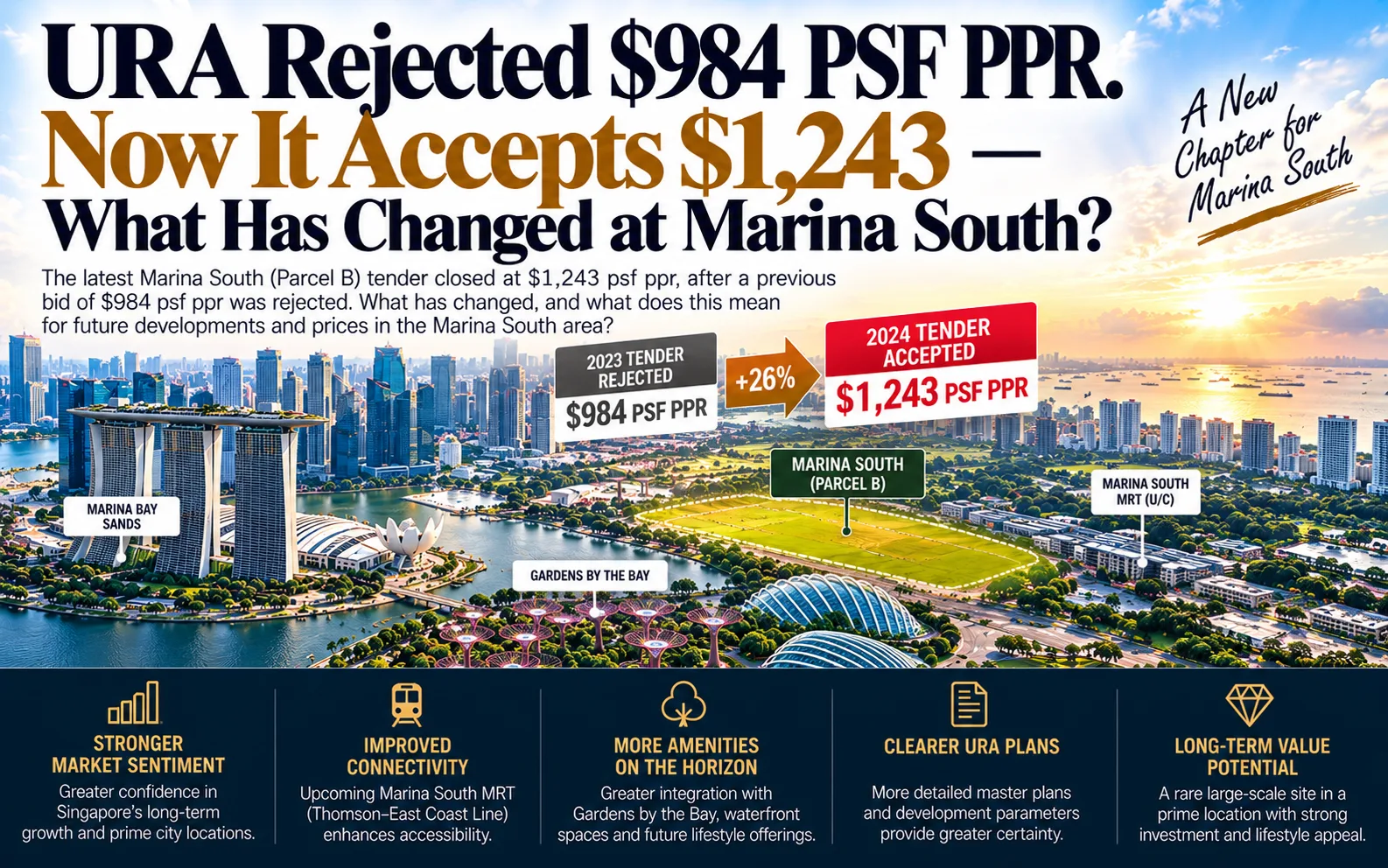
Three Marina South land tenders. Two sole bids. One rejection. And now, a rather interesting approval.
In February 2024, the Urban Redevelopment Authority (URA) rejected a $984 psf ppr bid for Marina Gardens Crescent because the offer was assessed to be too low.
Fast-forward to October 2026.
EL Development submitted the only bid for a neighbouring Marina Gardens Lane site at $1,243 psf ppr.
And this time, URA accepted it.
What makes this particularly interesting is that EL Development's land rate is still 11.3% lower than the $1,402 psf ppr paid for the neighbouring One Marina Gardens (OMG) site in 2023.
So we now have three very different outcomes within the same emerging Marina South precinct.
One developer paid a premium.
Another consortium tried to buy land at a substantial discount but was rejected.
And the latest developer has successfully secured land at a rate somewhere in between.
Has the government's position on Marina South changed? Has the market become more realistic? And should buyers of One Marina Gardens be concerned?
I think these are much more interesting questions than simply reporting that another GLS site has been sold.
Let's examine the numbers and what they may tell us about the next phase of Marina South.
1. EL Development Wins Marina Gardens Lane GLS for $450.1 Million
On 26 October 2026, URA officially awarded the Marina Gardens Lane site to EL Development.
The developer had submitted the sole bid when the tender closed on 15 October 2026.
Here are the key details.
Item | Marina Gardens Lane GLS |
|---|---|
Successful bidder | EL Development |
Tender price | $450.1 million |
Land rate | $1,243 psf ppr |
Number of bids | 1 |
Site area | 6,007.4 sqm |
Maximum gross floor area | 33,642 sqm |
Estimated residential yield | Approximately 390 units |
Tenure | 99 years |
Land use | Residential with commercial at first storey |
Award date | 26 October 2026 |
The site is located in District 1, near Marina South MRT station.
For a location with strong connectivity, proximity to Gardens by the Bay and an ambitious long-term master plan, one might have expected more competition.
Indeed, market expectations had generally pointed towards a higher winning land rate.
Instead, EL Development emerged as the only bidder.
A prime District 1 site, a relatively manageable development size, and only one developer willing to commit.
That tells us something about how developers currently view the risks and opportunities of Marina South.
2. One Marina Gardens vs EL Development: An 11.3% Land Cost Difference
Let's compare the neighbouring developments.
Comparison | One Marina Gardens | EL Development's future project |
|---|---|---|
Developer | Kingsford-led consortium | EL Development |
Land acquisition | 2023 | 2026 |
Land price | Approximately $1.035 billion | $450.1 million |
Land rate | $1,402 psf ppr | $1,243 psf ppr |
Number of bids | 4 | 1 |
Residential units | 937 | ~390 estimated |
Status | Launched in April 2025 | Land awarded October 2026 |
Selling price | Around $3,000 psf benchmark | Not announced |
The difference in land rate is $159 psf ppr, or approximately 11.3%.
And the newer land was acquired three years later.
That is an interesting result in a market where we often hear that replacement land costs are rising.
But there's an important distinction.
A cheaper land purchase doesn't automatically translate into cheaper apartments.
Land cost is only one component of a developer's total expenditure.
Construction, financing, professional fees, marketing, development specifications and profit margins all affect the final selling price.
The two sites also differ in scale and design possibilities.
Still, EL Development now has something valuable: a potentially more flexible cost position.
It can choose to compete on price, product quality or margins.
Whether that advantage eventually benefits buyers remains to be seen.
3. The More Important Comparison: URA's Rejected $984 PSF PPR Bid
This is where the story becomes especially interesting.
In January 2024, the Marina Gardens Crescent white site attracted just one bid.
A consortium involving GuocoLand, Hong Leong Group entities and TID Residential submitted an offer of approximately $770.5 million.
That worked out to $984 psf ppr.
On 8 February 2024, URA rejected the bid, stating that it had been assessed as too low.
The site was subsequently placed on the Reserve List.
Now compare that with EL Development's successful bid.
Site | Tender period | Land rate | Outcome |
|---|---|---|---|
Marina Gardens Lane — OMG | 2023 | $1,402 psf ppr | Awarded |
Marina Gardens Crescent | 2024 | $984 psf ppr | Rejected |
Marina Gardens Lane — EL Development | 2026 | $1,243 psf ppr | Awarded |
The latest accepted bid is approximately 26.3% higher than the rejected 2024 bid, yet still 11.3% below the earlier One Marina Gardens land rate.
So what changed?
I think there are three possible explanations.
Explanation 1: The Two Sole-Bid Sites Are Not Directly Comparable
This is the first point we need to establish.
The Marina Gardens Crescent site rejected in 2024 was a substantially larger white site.
It had approximately 72,741 sqm of permissible gross floor area and broader mixed-use development requirements.
EL Development's Marina Gardens Lane parcel has approximately 33,642 sqm of permissible gross floor area.
That's less than half the development scale.
A larger mixed-use project can involve greater capital commitment, more complicated development requirements and different commercial risks.
So we cannot simply compare the two land rates and conclude that URA has changed its minimum acceptable price.
URA assesses each site on its own characteristics and market circumstances.
The fact that $984 psf ppr was rejected for one site doesn't mean that $984 psf ppr would necessarily have been rejected for every Marina South parcel.
And the acceptance of $1,243 psf ppr doesn't establish a universal minimum land value for the precinct.
Explanation 2: EL Development's Bid May Have Been Considered Reasonable Under Current Conditions
URA's official award confirms the winning bidder and tender price.
However, it does not publicly disclose the valuation used to assess the site or explain the detailed reasoning behind its decision.
That limits what we can conclude.
What we do know is that URA accepted this particular offer despite it being the only bid and despite the land rate being below the neighbouring 2023 benchmark.
That establishes a new government-awarded transaction in Marina South.
And importantly, it demonstrates that a newer land parcel can be awarded at a lower rate than an earlier neighbouring site.
The government is not necessarily using One Marina Gardens' $1,402 psf ppr land cost as a floor for subsequent awards.
That's a useful observation for buyers.
But it isn't proof that URA has officially revised its valuation policy or expectations for Marina South.
Explanation 3: Could Development Momentum Be Becoming More Important?
This is my interpretation, rather than an official explanation from URA.
Marina South is intended to become a substantial mixed-use residential neighbourhood, with more than 10,000 homes envisioned over the longer term.
But a new precinct cannot develop through master plans alone.
Residents must move in.
Commercial amenities need customers.
Community facilities require an established population.
Public spaces need activity.
And developers must be willing to commit capital to bring those homes and amenities into existence.
In 2024, the Marina Gardens Crescent tender did not result in an award.
In 2026, the smaller Marina Gardens Lane site has been awarded despite limited developer interest.
Could there be a greater willingness to allow development to proceed at a realistic market-supported land rate, rather than wait for another bidder to reproduce 2023's pricing?
I think that is a plausible interpretation.
It would be consistent with the practical need to build momentum in a new residential precinct.
But we must be careful.
URA has not said that this was its reason for accepting EL Development's bid.
The award could also be explained by site-specific valuation differences.
What we can say with certainty is that the latest decision allows another residential development to move forward in Marina South.
And for an emerging neighbourhood, that matters.
4. What Can Buyers Infer From These Three Land Tenders?
I see three important lessons.
First, historical land costs are not permanent price floors.
One Marina Gardens' developer paid $1,402 psf ppr.
A neighbouring developer has now successfully acquired land at $1,243 psf ppr.
That doesn't make One Marina Gardens overpriced, but it challenges the assumption that future land purchases must always become more expensive.
Second, developer confidence is selective.
Both the 2024 Marina Gardens Crescent tender and the 2026 Marina Gardens Lane tender attracted only one bid.
Despite Marina South's long-term potential, developers appear cautious about committing capital to this evolving precinct.
That caution may reflect uncertainty around end-user demand, future supply, construction costs and the pace of neighbourhood development.
Third, a successful land award can be positive for the precinct while introducing competition for individual projects.
More homes can help Marina South develop a functioning residential community.
But more homes also mean additional choices for future buyers.
Those two effects can exist at the same time.
And that brings us to One Marina Gardens.
5. Should One Marina Gardens Buyers Be Worried?
One Marina Gardens launched in April 2025.
During its opening weekend, it sold 353 of its 937 units, or approximately 38%, at an average price of about $2,953 psf.
By October 2026, market commentary indicated that approximately 72% of its units had been sold, with 2026 transaction pricing around the $3,000 psf level.
That is meaningful evidence of buyer demand.
But it also shows that Marina South is not necessarily a market where every unit sells immediately.
Demand exists.
The question is how deep that demand is at different price points.
For existing OMG buyers, EL Development's acquisition presents both an opportunity and a risk.
The potential concern
If EL Development eventually launches at a materially lower selling price, prospective buyers may compare the two projects directly.
For example, if a future development offers a comparable apartment at $2,700 psf while OMG transactions are around $3,000 psf, that creates a visible price gap.
The differences in layouts, views, specifications and completion timing may justify some premium.
But buyers will naturally ask whether the additional cost is worthwhile.
That could affect pricing expectations for remaining developer inventory and, eventually, resale transactions.
The potential benefit
Additional residential development can also strengthen the precinct.
More residents may support more amenities, commercial activity and neighbourhood vibrancy.
And One Marina Gardens has an earlier development timeline than a project whose land was only awarded in October 2026.
For buyers who want to occupy or rent out a property sooner, that timing difference has value.
So I wouldn't say existing OMG owners should panic. But I would certainly monitor EL Development's future pricing.
6. How Cheap Could EL Development's New Condo Be?
This is probably the biggest question for prospective buyers.
With a land rate of $1,243 psf ppr, could EL Development launch at a substantially lower price than One Marina Gardens?
Market analysts have offered different estimates.
Knight Frank suggested a possible average launch price of approximately $2,700–$2,900 psf, depending on market conditions and product positioning.
Other estimates have been both lower and higher.
None of these figures is an official developer price.
Let's use a simple illustration, comparing different potential future launch prices against a $3,000 psf OMG benchmark.
Future launch price | Difference vs $3,000 psf | Difference for 1,000 sq ft |
|---|---|---|
$2,600 psf | -13.3% | -$400,000 |
$2,700 psf | -10.0% | -$300,000 |
$2,800 psf | -6.7% | -$200,000 |
$2,900 psf | -3.3% | -$100,000 |
$3,000 psf | 0% | $0 |
These are hypothetical scenarios, not price predictions. They assume equal floor area and do not adjust for differences in product quality, location within the precinct, floor or facing.
But they illustrate why the eventual pricing matters.
At $2,700 psf, the future project could present a substantial quantum difference.
At $2,900 psf, the gap narrows.
At $3,000 psf, buyers would need to compare the projects primarily on product merits and timing.
And here's another point.
EL Development is not obligated to pass its lower land cost on to buyers.
If the market supports higher selling prices, the developer may choose to preserve its margins.
So I wouldn't assume a lower land cost automatically creates a bargain.
The actual launch price will decide that.
7. Why Are Developers So Cautious About Marina South?
I think this is where buyers need to understand the difference between an established residential neighbourhood and a future residential neighbourhood.
Marina South has a compelling long-term vision.
It is close to the CBD, Gardens by the Bay and the Thomson-East Coast Line.
It is planned as a pedestrian-friendly district with housing, amenities and public spaces.
But some of the lifestyle benefits associated with the future precinct are still developing.
Compare this with mature locations such as Bishan, Upper Thomson or Serangoon.
Those neighbourhoods already have established residential populations, schools, retail amenities and resale transaction histories.
Developers can assess the existing buyer catchment more clearly.
At Marina South, part of the investment proposition depends on how the district will evolve.
Who will buy the homes?
How many purchasers will be owner-occupiers?
How much demand will come from investors?
How quickly will the precinct mature?
Will future housing supply compete for the same buyers?
These questions become particularly relevant when developers must commit hundreds of millions of dollars upfront.
And Singapore's property cooling measures, including the Additional Buyer's Stamp Duty payable by many investor and foreign-buyer groups, can constrain demand in traditionally investor-oriented locations.
Marina South may be an excellent long-term location, but that doesn't eliminate short-term development and absorption risks.
The latest tender suggests developers are taking those risks seriously.
Buyers should too.
8. Don't Forget the Existing Marina Bay Resale Market
One mistake I often see is buyers comparing only new launches with other new launches.
If you're considering a condominium at approximately $3,000 psf, you should also examine what the resale market offers.
Nearby developments such as The Sail @ Marina Bay, Marina One Residences and V on Shenton provide useful alternative benchmarks.
These projects differ considerably in age, lease balance, layouts, facilities and positioning.
Some resale units may offer more space for the same budget.
Others may have less efficient layouts or require renovation.
But that's precisely why the comparison is important.
Consider a buyer with a $3 million budget.
At $3,000 psf, that buys approximately 1,000 sq ft before stamp duties and other costs.
At $2,400 psf, the same budget theoretically buys 1,250 sq ft.
That's 250 sq ft of additional space.
Of course, the lower-PSF property may be older or have different attributes.
But buyers should ask themselves:
Am I paying for a better home, a newer home, or simply the promise of future appreciation?
Those are different propositions.
And the answer should influence how much premium you're willing to pay.
9. The Marina Gardens Crescent Site Remains a Wild Card
Remember the 2024 site that URA rejected?
It hasn't simply disappeared from the longer-term planning picture.
The Marina Gardens Crescent parcel was placed on the Reserve List following the unsuccessful tender.
Future development of this or other Marina South sites could add further residential and commercial supply.
That means buyers should not assume that today's relatively limited completed residential stock will remain limited indefinitely.
Marina South's long-term vision involves substantial new housing.
And while additional residents can strengthen the neighbourhood, additional supply can also create competition.
The success of Marina South as a district and the capital appreciation of every condominium within it are not necessarily the same thing.
This is a distinction I think investors should remember.
10. Six Things I Would Watch Before Buying EL Development's Future Launch
If I were evaluating the new project when it eventually launches, these would be my priorities.
1. The actual selling price
The most important question is whether EL Development's lower land cost translates into a competitive selling price.
I would compare it with actual OMG transactions, not just advertised prices.
2. The unit mix
Will the project focus on compact investment units or larger owner-occupier homes?
That will tell us which buyer segments the developer is targeting.
3. The floor plans
At Marina South price levels, every square foot matters.
I would pay close attention to layout efficiency, bedroom usability, kitchen arrangements and storage.
4. Views and future developments
A beautiful skyline or greenery view can be valuable.
But buyers need to examine surrounding parcels and future development possibilities before paying a significant premium for an apparently open view.
5. Maintenance fees and facilities
With approximately 390 estimated homes, the new project will be substantially smaller than One Marina Gardens.
A smaller development doesn't automatically mean lower maintenance fees.
The eventual facilities, management structure and cost allocation matter.
6. The resale and rental alternatives
I would compare the future launch with OMG and established Marina Bay condominiums.
For investors, rental yield and eventual resale liquidity deserve particular attention.
For owner-occupiers, the focus may be on lifestyle, layout and the timeline for the surrounding neighbourhood to mature.
11. My Interpretation: EL Development Has Bought Flexibility, Not a Guaranteed Winning Formula
I think EL Development's acquisition is interesting for several reasons.
The total land commitment of $450.1 million is much smaller than the billion-dollar land purchase behind One Marina Gardens.
The land rate is lower.
The site is more manageable in scale.
And the developer can study the actual sales performance of OMG when planning its own product and pricing strategy.
These are potential advantages.
But the single-bid result also reminds us that Marina South's future is not without uncertainty.
Developers are weighing the opportunity against the risks.
And I think that should influence how buyers approach the precinct.
If developers are careful about the price they pay for land, buyers should be equally careful about the price they pay for apartments.
Final Thoughts: URA's Decision May Be More Significant Than the Land Price Itself
The headline figure is $1,243 psf ppr.
But to me, the more interesting story is the sequence of events.
In 2023, Kingsford secured the One Marina Gardens site at $1,402 psf ppr.
In 2024, URA rejected a sole bid of $984 psf ppr for Marina Gardens Crescent.
And in 2026, URA accepted EL Development's sole bid at $1,243 psf ppr.
The sites are different, and we cannot infer URA's internal valuation or policy intentions from these outcomes alone.
But the latest award does establish something important.
A new Marina South development can proceed at a land rate below the benchmark set by One Marina Gardens.
That creates an interesting opportunity for EL Development.
It introduces a potential future competitor for OMG.
And it may help the wider Marina South precinct continue its transformation.
For buyers, however, I would separate two questions.
Will Marina South become a more attractive residential neighbourhood over time?
I believe the long-term planning vision gives it meaningful potential.
Will every Marina South condominium purchased today deliver attractive investment returns?
That depends heavily on the price paid, the unit selected, future competition and the pace of the precinct's development.
And that leads me to the one question I will be watching when EL Development eventually launches its project:
Will the developer pass its 11.3% land-cost advantage on to buyers — or keep that advantage for itself?
Because the answer could make a substantial difference to which Marina South condominium represents better value.
Christopher Ng
ERA Real Estate | Asset Progression Strategist
For property analysis and asset progression planning: WhatsApp 8868 2289.
Want the tailored version for your portfolio?
Every article here generalises. A 20-minute conversation makes it specific to your numbers.
Who won the Marina Gardens Lane GLS tender in October 2026?
Why did URA reject the Marina Gardens Crescent bid in 2024?
Why did URA accept EL Development's sole bid in 2026?
Is EL Development's land cheaper than One Marina Gardens?
Does cheaper land mean EL Development's new condo will be cheaper?
How much could EL Development's Marina Gardens Lane condo launch for?
Should One Marina Gardens buyers be worried?
Is Marina South a good property investment location?
Should I buy One Marina Gardens or wait for EL Development's project?

Written by
Christopher Ng (CEA R014394H)
Singapore Property & Asset Progression Strategist with ERA Realty Network. A NUS Real Estate graduate, Christopher has advised homeowners, investors and property owners since 2004.