
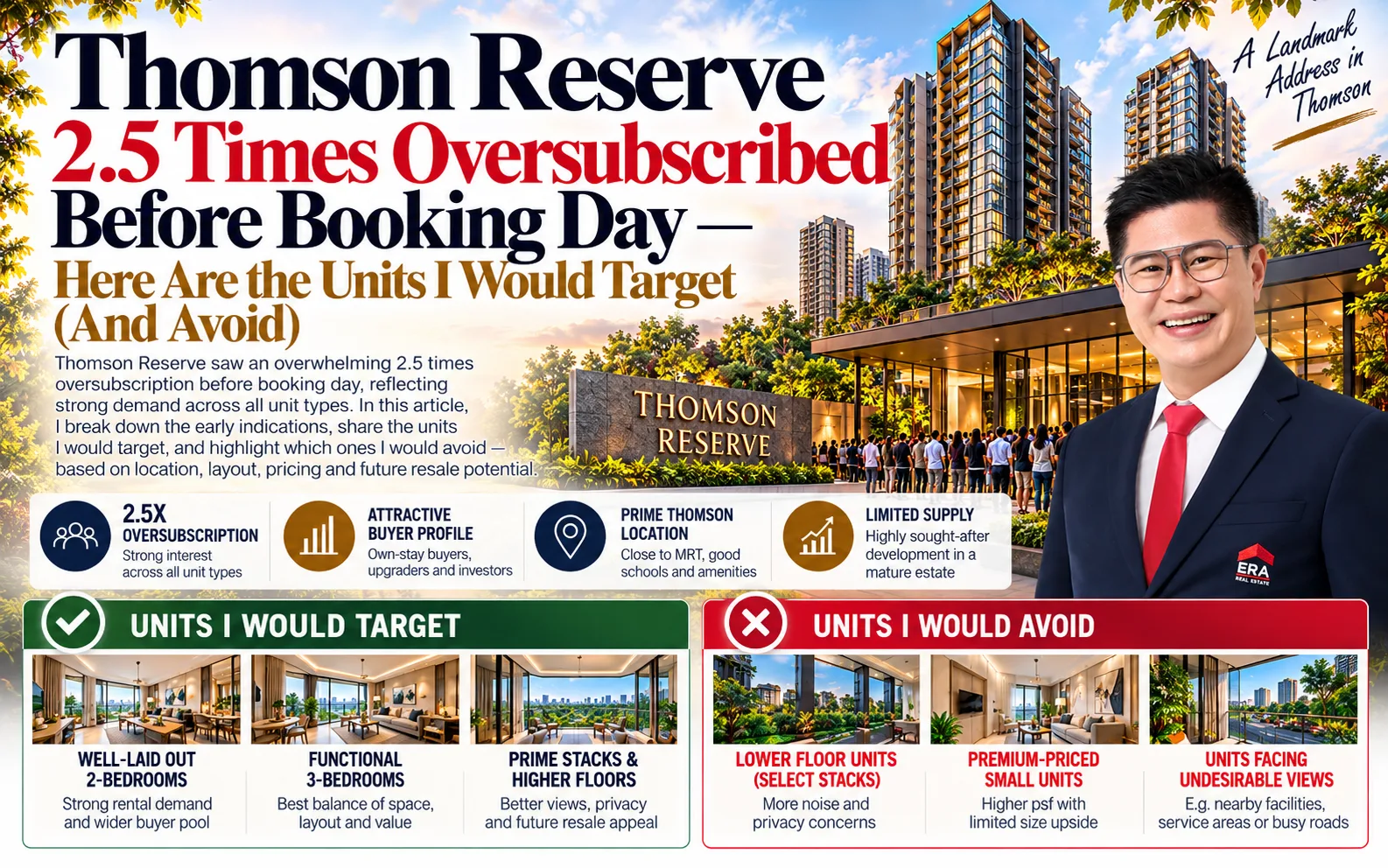
Thomson Reserve 2.5 Times Oversubscribed Before Booking Day — Here Are the Units I Would Target (And Avoid)
Thomson Reserve has attracted approximately 3,200 expressions of interest for just 1,268 units — more than 2.5 times subscribed before booking day. But strong demand doesn't make every unit a good buy. I examine the 2-bedroom and 3-bedroom configurations I would prioritise, the price premiums I would question, and why knowing when to walk away could be your smartest buying decision.
3,xxx cheques. 1,268 units. More than 2.5 times subscribed.
And booking day hasn't even arrived.
Thomson Reserve has just recorded one of the most striking expressions of buyer interest for a major Singapore condominium launch this year.
For a development of this size, attracting approximately 3,xxx expressions of interest is no small achievement.
To put that into perspective, Thomson Reserve is Singapore's largest new private residential launch of 2026.
The development attracted approximately 11,800 visitors during its opening preview weekend and more than 23,000 visitors in its first week.
Now, ahead of the official launch on 31 October 2026, the cheque collection has crossed the 3,200 mark.
And the question everyone is asking is:
Will Thomson Reserve sell out?
But I think buyers should be asking a much more important question.
If I get a chance to buy, which unit should I actually choose?
Because there's a danger when a launch becomes this popular.
Buyers stop asking whether a unit is worth buying.
They start asking whether they can secure anything.
And those are two very different things.
I've spent considerable time studying Thomson Reserve's pricing, floor plans, site planning and surrounding resale market.
With booking day approaching, here's how I would approach unit selection — including the configurations I would prioritise, the price gaps I would watch and the units I would be cautious about.
1. What Does 2.5 Times Oversubscribed Actually Mean?
Let's start with the numbers.
Thomson Reserve has 1,268 units.
Approximately 3,xxx cheques have been collected ahead of launch.
That works out to roughly 2.52 expressions of interest per available unit.
For a project this large, that is a significant response.
But here's something I want buyers to understand.
3,xxx cheques do not mean 3,xxx confirmed buyers.
Some prospective purchasers may change their minds.
Some may not obtain their preferred units.
Some may decide that the final selling prices are beyond their budget.
Others may have registered interest in multiple developments or may ultimately choose not to purchase.
The conversion rate matters.
For perspective, ParkTown Residence collected approximately 2,367 cheques before its launch and sold 1,041 units during its launch weekend.
Skye at Holland collected 2,151 cheques and sold 658 units.
These were both successful launches, but their cheque-to-sale conversion rates were very different.
At Thomson Reserve, a hypothetical 30% conversion of 3,xxx cheques would translate to 960 purchases, equivalent to about 76% of the project.
At 35%, it would be 1,120 purchases, or approximately 88%.
At 40%, there would be more potential purchases than available units.
These are mathematical scenarios, not sales forecasts.
But they illustrate why the market is watching Thomson Reserve so closely.
The demand is substantial. The actual sales conversion remains to be seen.
And the final pricing will be critical.
2. The Real Danger: Buying the Wrong Unit Because You're Afraid of Missing Out
Imagine this.
You've shortlisted a particular 3-bedroom stack.
You've worked out your financing.
You've decided that your ideal budget is $2.7 million.
Then booking day arrives.
Your preferred unit is taken.
Your second choice is gone.
Your third choice is available, but it costs $180,000 more than you expected.
What do you do?
This is where emotions can take over.
After weeks of anticipation, queuing, researching and discussing the project with your family, walking away can feel like a loss.
But it isn't.
Missing out on an overpriced unit is not the same as missing out on an opportunity.
When I guide buyers through a new launch, I prefer to establish three things before booking day:
The units we genuinely want.
The maximum price we are prepared to pay for each.
The point at which we will walk away.
And yes, the third one is important.
Because I would rather my client miss Thomson Reserve than purchase a unit that doesn't make financial sense.
3. My First Target: The 947 Sq Ft 3-Bedroom
Let's start with the published indicative prices.
Unit type | Size | Starting price | Starting PSF |
|---|---|---|---|
2-Bedroom | 592 sq ft | $1.544M | $2,608 |
2-Bedroom Premium | 678 sq ft | $1.772M | $2,613 |
2-Bedroom Premium + Study | 732 sq ft | $1.925M | $2,630 |
3-Bedroom | 947 sq ft | $2.503M | $2,642 |
3-Bedroom Premium | 1,055 sq ft | $2.777M | $2,633 |
4-Bedroom | 1,238 sq ft | $3.388M | $2,737 |
These are published indicative starting prices, not confirmed prices for every unit.
The configuration I would examine first is the 947 sq ft 3-bedroom, starting from $2.503 million.
Why?
Because it sits at an interesting intersection of price, functionality and future buyer demand.
A 3-bedroom unit appeals to a broader family market than a compact 2-bedroom.
It may suit HDB upgraders, younger families and existing private-property owners who want to remain in the Upper Thomson area.
And at a published starting PSF of $2,642, it doesn't carry a particularly large PSF premium over the smaller configurations.
There are only 120 units of this specific 947 sq ft type in the development.
That's less than 10% of the entire project.
For me, that makes it worth examining carefully.
But I wouldn't buy every 947 sq ft 3-bedroom.
I would want to see whether the bedrooms are genuinely usable, whether the living and dining areas work, and whether the unit's facing justifies its price.
My price discipline
The published entry is $2.503 million.
At approximately $2.65 million, the effective PSF is about $2,798.
At $2.75 million, it becomes approximately $2,904 psf.
Those are meaningful differences.
For a typical 947 sq ft unit, I would initially treat the $2.65 million to $2.75 million range as a comparison zone, not an automatic approval to purchase.
A higher floor or genuinely superior view may justify more.
An ordinary facing or less desirable position may not.
Without the final unit-by-unit price chart, I cannot responsibly identify a universal walk-away price for every stack.
But I would be particularly cautious about paying a substantial premium simply because the lower-priced units have sold out.
4. My Second Target: The 1,055 Sq Ft 3-Bedroom Premium
This is where the comparison becomes interesting.
The 3-bedroom Premium starts from $2.777 million.
That's $274,000 more than the entry 947 sq ft 3-bedroom.
But you receive another 108 sq ft.
The incremental price is approximately $2,537 psf.
That's actually below the published starting PSF of either configuration.
Now, that doesn't automatically make the Premium the better buy.
The starting units may be on different floors or have different facings.
But it suggests that the developer hasn't applied an aggressive PSF premium to the larger 3-bedroom at the entry level.
And for families, 108 sq ft can make a meaningful difference.
The Premium configuration also deserves attention for its family-oriented layout features, including the yard and helper's WC.
For someone buying a long-term family home, those details can matter more than a small PSF difference.
Where I would become cautious
Let's say the 947 sq ft unit you like costs $2.65 million.
And a comparable 1,055 sq ft Premium costs $2.90 million.
The difference is $250,000 for 108 sq ft.
That could be a reasonable upgrade if the extra space improves daily living.
But what if the Premium costs $3.15 million?
Now you're paying another $500,000.
That's a different conversation.
The question is no longer whether the Premium layout is better.
It probably offers more functionality.
The question becomes:
Is the improvement worth the additional half a million dollars?
That's why I would compare actual available units side by side rather than treating one bedroom type as universally superior.
5. The 2-Bedroom Premium May Be More Interesting Than the Cheapest 2-Bedroom
The headline entry price of Thomson Reserve is $1.544 million.
That buys a 592 sq ft 2-bedroom at the published starting price.
But I would also look closely at the 678 sq ft 2-bedroom Premium, starting from $1.772 million.
Why?
Because the extra 86 sq ft could make a meaningful difference in everyday functionality.
And the published starting PSF barely changes.
$2,608 psf for the smaller unit.
$2,613 psf for the Premium.
That's just $5 psf apart.
If the larger configuration offers a better living area, kitchen or bedroom arrangement, it may appeal to a wider group of future buyers and tenants.
There are 416 units of the 678 sq ft 2-bedroom Premium type.
That's nearly one-third of the entire development.
This creates both an opportunity and a risk.
The opportunity is that it may become a familiar and actively transacted unit type.
The risk is future competition.
When owners eventually sell or rent, there may be several comparable units within the same development.
So I would pay particular attention to:
Facing. Floor. Privacy. Price.
If two similar units differ by $100,000, I want to understand exactly what I'm receiving for that difference.
6. The Units I Would Be Most Careful With
Now let's talk about the other side.
Which units would I avoid?
I wouldn't blacklist an entire bedroom category.
That would be too simplistic.
But there are several situations where I would become cautious.
A. A High-Floor Unit With an Excessive Premium
Thomson Reserve occupies an elevated site with views towards surrounding greenery, landed estates, reservoirs and parts of the city skyline.
Some of those views could be genuinely attractive.
But not every high-floor premium is justified.
Suppose a higher-floor unit costs $200,000 more than a lower-floor unit with a similarly open outlook.
Would I pay it?
Not automatically.
I would examine the actual view difference, privacy, surrounding buildings and long-term resale appeal.
A higher floor is an attribute. It isn't a blank cheque.
B. A Premium Facing Where the Price Gap Becomes Too Large
Nature views are a major part of Thomson Reserve's appeal.
And I expect some buyers will place substantial value on reservoir and greenery-facing stacks.
I can understand that.
But even a beautiful view has a price.
If a premium-facing unit costs $300,000 more than another well-positioned unit with a pleasant open outlook, I would examine whether the difference is recoverable in future resale demand.
For an owner-occupier who genuinely loves the view, the premium may be worthwhile.
For an investor seeking efficient capital deployment, perhaps not.
The right answer depends on the buyer.
C. A Compact Unit Bought Only Because It's the Cheapest
I would be cautious about buying the 592 sq ft 2-bedroom simply because it carries the lowest quantum.
A compact layout may be perfectly suitable for some buyers.
But I would still examine bedroom dimensions, furniture placement, storage and how comfortably two people can live there.
A unit isn't automatically a bargain because it's the cheapest one on the price list.
D. A Unit Purchased Above Budget Because Everything Else Is Gone
This is the biggest red flag for me.
A buyer who planned to spend $2.6 million suddenly stretches to $2.9 million because of the booking-day atmosphere.
That additional $300,000 is real money.
It affects your financing, monthly repayments and future flexibility.
Don't let a strong launch crowd make your financial decisions for you.
7. Classic Collection or Luxury Collection?
Thomson Reserve comprises two distinct residential collections.
The Classic Collection has 740 units across four 21-storey towers.
The Luxury Collection has 528 units across two 30-storey towers.
The Luxury Collection offers enhanced specifications, including premium finishes and Miele appliances, while selected larger units feature private lifts.
This gives buyers another important decision.
Do you prioritise:
Efficient entry quantum and practical family space?
Or:
Higher specifications, exclusivity and premium positioning?
For a buyer focused primarily on value, I would first establish the price difference between comparable units in the two collections.
For someone buying a long-term home, the Luxury Collection may justify a premium.
But the premium must be measured.
Better finishes are attractive.
Yet finishes can eventually be renovated or replaced.
Location within the development, facing, layout and purchase price may have a more lasting effect on resale appeal.
I wouldn't pay a large premium for specifications alone.
8. The 4-Bedroom: Good Family Product, But Watch the Price Jump
The entry 4-bedroom is 1,238 sq ft, starting from $3.388 million.
That's approximately $2,737 psf.
The starting PSF is noticeably higher than the 3-bedroom categories.
For a family that genuinely needs four bedrooms, this may still be a sensible choice.
But I would be more demanding about the layout and position.
At $3.388 million, the buyer has many alternatives to consider.
Larger resale condominiums.
Other new launches.
Potentially different locations with larger floor areas.
I would also look at the 4-bedroom Premium configurations with private lifts, but only after understanding the actual price difference.
The private lift and enhanced specifications may be valuable to certain owner-occupiers.
They are not automatically worth any asking premium.
At this price level, I would buy for a genuine housing requirement, not simply because four-bedroom units appear scarce.
9. Why the Unit Mix Matters More Than Buyers Realise
Here's an important detail.
Of Thomson Reserve's 1,268 units:
716 are 2-bedroom configurations, approximately 56.5%.
350 are 3-bedroom configurations, approximately 27.6%.
174 are 4-bedroom configurations, approximately 13.7%.
28 are 5-bedroom suites, approximately 2.2%.
So approximately 84% of the development consists of 2- and 3-bedroom homes.
What does that mean?
The project has been designed to serve a substantial pool of buyers seeking compact and mid-sized homes.
But that also means there will be internal competition between similar units when the development eventually enters the resale and rental markets.
For me, this makes differentiation important.
A good layout.
A better-facing stack.
An efficient quantum.
A sensible floor premium.
These are the details that could help a unit stand out.
And that's why I would rather spend more time studying the actual unit chart than simply chasing the most popular bedroom type.
10. Could Thomson Reserve Sell 80% or More on Launch Weekend?
With approximately 3,xxx cheques collected, it is mathematically possible.
But I wouldn't declare the outcome before booking day.
The final sales performance depends on buyer conversion, actual prices, unit availability and whether purchasers can secure homes they genuinely want.
There is also a difference between strong demand for the development and strong demand for every single unit.
Some stacks may sell quickly.
Others may be less popular.
Some configurations may attract multiple competing buyers.
Others may remain available.
And that's normal.
I think the 2.5-times subscription rate tells us that Thomson Reserve has captured significant market attention.
It doesn't tell us that every unit will sell at any price.
Demand creates competition. Pricing determines whether that competition converts into transactions.
11. What Would I Do If I Were Buying Thomson Reserve This Weekend?
I would go into booking day with a disciplined plan.
First, I would shortlist the unit configurations that match my actual needs.
For a family buyer, that may mean comparing the 947 sq ft 3-bedroom with the 1,055 sq ft Premium.
For a smaller household, it may mean comparing the 592 sq ft and 678 sq ft 2-bedroom options.
Next, I would rank several stacks and floors.
Not just one.
Then I would establish a maximum acceptable price for each shortlisted unit.
And finally, I would compare those prices against the resale alternatives in Upper Thomson and Bishan.
This last step is important.
Because if the available Thomson Reserve units become significantly more expensive than expected, the resale market doesn't disappear.
You still have alternatives.
A good buyer knows what those alternatives are before walking into the sales gallery.
My pre-booking shortlist
Priority | What I would examine | My main condition |
|---|---|---|
1 | 947 sq ft 3BR | Efficient family layout at a sensible quantum |
2 | 1,055 sq ft 3BR Premium | Extra functionality without an excessive price gap |
3 | 678 sq ft 2BR Premium | Practical layout and competitive pricing against similar units |
4 | 592 sq ft 2BR | Only if the compact layout suits the buyer and entry price is compelling |
Selective | 1,238 sq ft 4BR | Genuine family need and strong value against resale alternatives |
Highly selective | Luxury Collection/private-lift homes | Premium justified by actual position, space and lifestyle benefits |
This is my configuration-level shortlist, not a verified ranking of specific stack numbers. Without the final unit-by-unit price chart, it would be misleading to declare individual stacks the best or worst buys.
12. The One Thing I Would Not Do: Chase the Last Available Unit
Let's imagine Thomson Reserve sells exceptionally well.
Your first choice is gone.
Your second choice is gone.
Even your third choice has been taken.
The sales gallery is buzzing.
People are congratulating one another.
The remaining inventory is shrinking.
And someone tells you:
"Just take this one. There won't be anything left."
That's the moment to remember why you wanted to buy property in the first place.
You're not buying a queue number.
You're not buying the excitement of a successful launch.
You're buying an asset that may represent several million dollars of your family's wealth.
And you'll potentially own it for many years.
The best booking-day decision may sometimes be to walk away.
That's not a failure.
That's discipline.
Final Thoughts: 3,xxx Cheques Are Impressive. But They Don't Change My Buying Rules.
Thomson Reserve has clearly attracted substantial buyer interest.
More than 2.5 times subscribed before launch.
Over 23,000 visitors during its first preview week.
And a strong response across a development with 1,268 units.
It's an impressive achievement.
I can understand the appeal.
Upper Thomson MRT.
Established schools.
Nature and greenery.
A large development with extensive facilities.
Two residential collections.
And published starting prices from $2,608 psf.
But here's my conclusion.
I like Thomson Reserve. That doesn't mean I like every Thomson Reserve unit.
The 947 sq ft 3-bedroom and 1,055 sq ft 3-bedroom Premium are the two configurations I would pay particularly close attention to.
The 678 sq ft 2-bedroom Premium also deserves a serious look.
For the larger and more exclusive configurations, I would be selective about the premium being charged.
And for every unit, I would compare price, layout, facing, floor and alternatives before making a commitment.
Because when a project is 2.5 times subscribed, getting a unit may feel like winning.
But in property investment, the real win isn't simply securing a unit.
It's securing the right unit at the right price.
And that is what I will be focusing on this booking weekend.
Christopher Ng
ERA Real Estate | Asset Progression Strategist
For Thomson Reserve unit selection and buying strategy: WhatsApp 8868 2289.
Want the tailored version for your portfolio?
Every article here generalises. A 20-minute conversation makes it specific to your numbers.
How many cheques has Thomson Reserve collected?
Does 2.5 times oversubscribed mean Thomson Reserve will sell out?
Which Thomson Reserve 3-bedroom should I consider?
What is the best Thomson Reserve stack?
Should I buy the cheapest Thomson Reserve unit?
When is Thomson Reserve booking day?
Is Thomson Reserve worth buying above $2,800 psf?
What happens if I don't get my preferred Thomson Reserve unit?

Written by
Christopher Ng (CEA R014394H)
Singapore Property & Asset Progression Strategist with ERA Realty Network. A NUS Real Estate graduate, Christopher has advised homeowners, investors and property owners since 2004.