
The Landed Property Upgrade Ladder: When Should You Move From Terrace → Semi-D → Detached?
Should every terrace owner eventually upgrade to a semi-D, and every semi-D owner aspire to a detached house? I don't think so. Here's my Landed Property Upgrade Ladder — and why progression should focus on improving the land, not simply the property label.
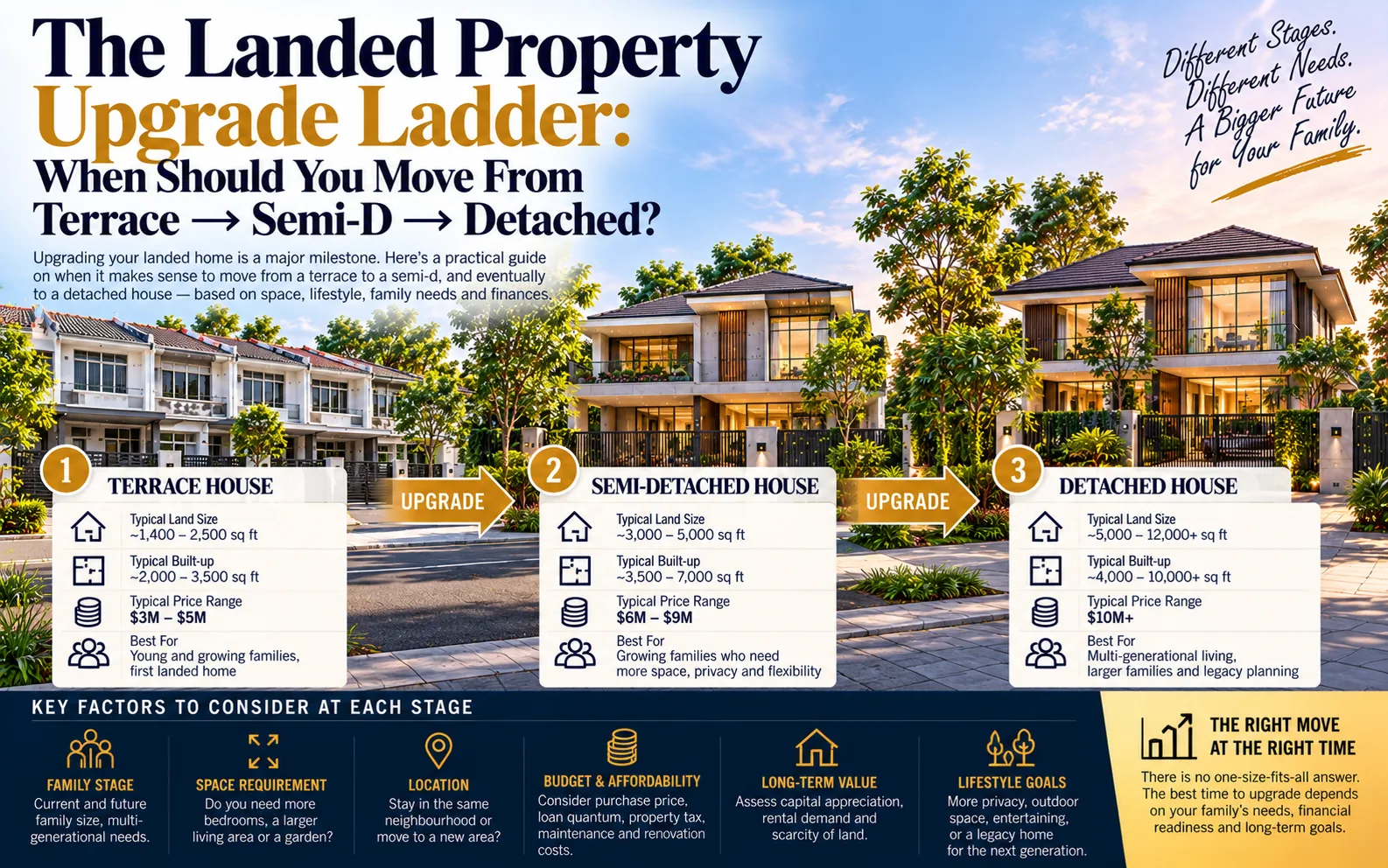
For years, we have talked about property progression in Singapore in a fairly predictable way.
HDB.
Then condo.
Then perhaps landed.
But once you already own landed property, what happens next?
Is there such a thing as landed property progression?
I think there is.
And after going through my own move from an inter-terrace to a semi-detached home, I've started looking at landed upgrading very differently.
Because once you're already staying in a landed house, the next upgrade isn't necessarily about getting:
a newer kitchen,
another bedroom,
more marble,
or another 1,000 sq ft of built-up area.
Sometimes the real upgrade is underneath the house.
The land.
And that leads me to what I call:
The Landed Property Upgrade Ladder
Terrace → Semi-D → Detached
But before anybody takes this as:
“Chris says everyone should keep upgrading until they own a bungalow.”
No.
That's not what I mean at all.
The objective isn't to reach the top of the ladder.
The objective is to identify:
Which rung gives your family the best combination of lifestyle, land and financial sense?
For some people, that's a terrace.
For others, a semi-D.
For a much smaller group, perhaps a detached house.
And sometimes the smartest decision is to stop climbing altogether.
First: Why Think of Landed Property as a Ladder?
Because each category can potentially improve something that is difficult to create through renovation alone.
Imagine you own an inter-terrace.
You can spend $1 million.
$2 million.
Perhaps even more.
You can create an incredible house.
You can add bedrooms.
Improve the layout.
Install a lift.
Create a beautiful kitchen.
Redo the façade.
But fundamentally, certain things don't change.
Your land remains the same size.
Your frontage remains largely the same.
You're still attached on both sides.
The relationship with your neighbours remains.
That's why I think landed progression should be viewed differently from renovation.
Renovation improves the building.
Landed progression can improve the underlying property.
That's an important distinction.
The Ladder Isn't Really Terrace → Semi-D → Detached
Those are merely labels.
The actual ladder looks more like this:
LAND AREA ↑
FRONTAGE ↑
DETACHMENT ↑
PRIVACY ↑
DESIGN FLEXIBILITY ↑
REDEVELOPMENT OPTIONALITY ↑
That's what you're potentially trying to improve.
And once I looked at it this way, my own landed decision became much clearer.
Level 1: Terrace — Often the Sweet Spot of Landed Ownership
I don't see terraces as the “bottom” of landed property.
Far from it.
For many families, I think a good terrace could actually be the sweet spot.
You get:
your own land,
your own roof,
no upstairs or downstairs neighbour,
potential parking within your property,
greater freedom over the home,
and potentially significantly more usable family space than a condo.
And importantly:
Your entry quantum can be considerably lower than the next landed category.
That's powerful.
A family doesn't necessarily need 5,000 or 7,000 sq ft of land to enjoy landed living.
Sometimes a well-designed terrace provides everything they actually need.
When Does a Terrace Make the Most Sense?
I would seriously consider staying at the terrace level if:
the location is excellent,
the land is regular,
the frontage is decent,
the house already accommodates the family,
the financial position remains comfortable,
and there is enough redevelopment potential for future needs.
Especially if upgrading requires another $2–3 million but doesn't materially improve your life.
This is where ego can become expensive.
If your terrace already gives your family everything it needs, there is no rule saying:
“Successful people must eventually buy a semi-D.”
Your home isn't a corporate title.
You don't need another promotion every three years.
When Do You Outgrow a Terrace?
This is where it became personal for me.
My terrace served my family well.
But my three children were growing.
They wanted their own rooms.
Our space requirements were changing.
And initially, I thought the solution was obvious:
Rebuild.
Spend around $2 million and create a substantially better house.
I explored it seriously.
I met builders.
I spoke with architects.
But eventually I realised something.
I wasn't only outgrowing the house.
I was beginning to want more from the land.
That's different.
If your problem is:
“My kitchen is old.”
Renovate.
If your problem is:
“My layout doesn't work.”
A&A or rebuilding may solve it.
But if your problem is:
“I want substantially more land, frontage, separation and privacy.”
Construction cannot solve all of that.
That's when the next rung starts becoming relevant.
Level 2: Semi-Detached — Where the Upgrade Becomes About Land
The jump from terrace to semi-D is interesting because superficially the difference seems almost silly.
One side is detached.
That's it.
So you're paying another $2 million, $3 million or more…
for air?
In a way:
Yes.
But that strip of air can change quite a lot.
It potentially creates:
more natural light,
more ventilation,
more windows,
greater privacy,
a stronger relationship between indoor and outdoor space,
and more flexibility in how the home is designed.
More importantly, the semi-D plots buyers consider are often materially larger than the terrace plots they are upgrading from.
So you're not simply buying:
A BETTER HOUSE.
You're potentially buying:
A DIFFERENT CLASS OF LAND.
That's why I eventually chose this route myself.
When Should You Upgrade From Terrace to Semi-D?
For me, there are five questions.
1. Is the land becoming the constraint?
This is the most important one.
If the problem can be solved by renovating or rebuilding your existing terrace, you may not need to move.
But if you're fundamentally constrained by:
land area,
frontage,
attachment,
privacy,
or outdoor space,
then upgrading may make more sense.
2. Does the semi-D genuinely improve the land?
Don't buy a semi-D just because the title says semi-detached.
Compare:
land size,
frontage,
shape,
road,
orientation,
levels,
privacy,
and redevelopment potential.
A poor semi-D doesn't automatically beat a great terrace.
3. Can you upgrade without becoming financially uncomfortable?
This matters enormously.
Suppose your terrace is worth $6 million and the semi-D costs $8 million.
The question isn't:
“Can the bank lend me the difference?”
It's:
“Does deploying another $2 million into my home improve my overall financial position or weaken it?”
Your home shouldn't consume every dollar you have simply because you can technically afford the mortgage.
4. Will your family actually use the difference?
If the additional land gives your children more space, improves privacy, accommodates ageing parents or creates a home you expect to stay in for 15 years, the lifestyle return may be substantial.
If you're buying 3,000 sq ft of additional land that nobody will meaningfully use?
That's a different calculation.
5. Does the upgrade improve long-term optionality?
Can the property serve you in different ways later?
Live in it as-is?
Renovate?
A&A?
Rebuild?
Reconfigure for multi-generational living?
The more options good land gives you, the more interesting the upgrade becomes.
Then Comes the Big Question: Semi-D → Detached
This is where the numbers can become very serious.
If you're already living in a good semi-D, what exactly are you trying to achieve by moving into a detached house?
Again, I wouldn't start with prestige.
I'd start with the land.
A detached property gives you separation from neighbouring houses on both sides, subject of course to the characteristics of the actual plot and development controls.
That can create a very different living environment.
Potentially:
more privacy,
more light,
more ventilation,
more landscaping,
greater visual separation,
and more architectural freedom.
But the capital jump can also be enormous.
So the hurdle for me becomes much higher.
When Does Moving From Semi-D to Detached Make Sense?
I would want the upgrade to solve a real problem.
Perhaps:
your family has become multi-generational,
you want substantially more land,
you need more parking,
privacy has become very important,
you want a genuinely different garden/outdoor lifestyle,
or you intend to build a long-term family home that may serve multiple generations.
If the upgrade is simply:
“Detached is the next level.”
I don't find that particularly convincing.
Because once you're already living in a comfortable semi-D, the marginal lifestyle benefit from spending another few million dollars needs to be examined carefully.
The Higher You Climb, the More Important Land Quality Becomes
This is one of the biggest lessons I've learnt from looking at landed homes.
At lower budgets, buyers may accept compromises.
At higher budgets, they become increasingly selective.
Imagine spending $10 million, $12 million or $15 million on a landed property.
Suddenly you're looking very carefully at:
frontage,
land shape,
road width,
traffic,
orientation,
neighbouring properties,
privacy,
site levels,
redevelopment potential,
and address.
Because at those price levels:
“It's a detached house” isn't enough.
The land itself needs to justify the money.
This is why I don't think the landed ladder is really about housing type.
It is increasingly about land quality.
The Hidden Ladder: Upgrade the Land, Not Just the Label
Let me show you another way to think about progression.
Stage 1
Average terrace → better terrace
Maybe you don't need a semi-D.
Perhaps your next upgrade is simply:
better street,
larger land,
wider frontage,
more regular plot,
better orientation.
That can be meaningful progression.
Stage 2
Excellent terrace → semi-D
Now you're adding detachment and potentially significantly more land.
Stage 3
Average semi-D → excellent semi-D
Again, you don't necessarily need to move category.
Perhaps you improve:
location,
land size,
frontage,
shape,
privacy.
Stage 4
Excellent semi-D → detached
Only when the detached house creates a genuinely different property outcome.
This is why:
The best upgrade isn't always upwards in property type.
Sometimes it is sideways into better land.
A $6m Terrace Can Beat an $8m Semi-D
I discussed this in my previous article, but it deserves repeating.
Imagine:
Property A — $6m Terrace
Excellent street.
Regular land.
Good frontage.
Move-in condition.
Good orientation.
Strong location.
Versus:
Property B — $8m Semi-D
Irregular land.
Poor frontage.
Busy road.
Old structure.
Needs $500,000 of work.
Less desirable location.
Which is the better property?
I may choose the terrace.
Now compare it with:
Property C — $8m Semi-D
Substantially larger regular plot.
Good frontage.
Quiet road.
Livable house.
Strong redevelopment potential.
Now the extra money becomes much easier to justify.
The label didn't change.
The quality of the land did.
And an Excellent Semi-D May Beat a Mediocre Detached House
Exactly the same logic applies one rung higher.
Imagine:
Excellent Semi-D
Wide frontage.
Regular plot.
Quiet street.
Excellent location.
Good orientation.
Well-designed home.
Versus:
Detached House
Larger land.
But awkward shape.
Busy road.
Poor orientation.
Significant rebuilding requirement.
And a price several million dollars higher.
Do I automatically buy the detached house?
No.
Why would I?
I'm not collecting landed-property categories like Pokémon.
The objective is to own the best property for the money, not the highest-status housing label your budget permits.
The Financial Ladder Matters Too
There's another ladder running alongside the property ladder.
And this one is equally important.
EQUITY
CASH FLOW
DEBT
LIQUIDITY
INVESTMENTS
RETIREMENT PLANNING
As your home gets more expensive, more of your net worth can become concentrated in one illiquid asset.
That may be completely acceptable for some families.
For others, it may not be.
So every time you move up the landed ladder, ask:
What happens to the rest of my balance sheet?
If upgrading from a $6 million terrace to an $8 million semi-D means:
selling investments,
emptying cash reserves,
maximising borrowing,
and significantly increasing monthly commitments,
then the lifestyle upgrade needs to be weighed against the financial concentration.
Asset Progression should improve your position.
It shouldn't simply make your house more expensive.
Don't Confuse Affordability With Suitability
This is something I tell buyers frequently.
The bank may say you can afford it.
That doesn't mean you should buy it.
You may technically qualify for the loan.
You may have enough cash for the downpayment.
But after buying:
How much liquidity remains?
What happens if income changes?
Can you still invest?
Can you still fund your children's needs?
Can you still retire comfortably?
Can you afford future rebuilding?
Do you still sleep well at night?
That's the difference between:
CAN BUY
and
SHOULD BUY.
So Where Should You Stop on the Landed Ladder?
This may be the most important part of the article.
You stop when the next rung no longer materially improves your life or your property position relative to the capital required.
For one family:
TERRACE IS ENOUGH.
For another:
SEMI-D IS THE SWEET SPOT.
For another:
DETACHED MAKES SENSE.
There is no trophy for reaching the top.
And there is definitely no trophy for reaching the top with no cash left.
The objective is not:
“Own the biggest house possible.”
It's:
Own the right landed property while keeping the rest of your financial life healthy.
My Own Progression
My own landed journey helped crystallise this framework for me.
When I bought my inter-terrace, it represented a meaningful step for my family.
And it served us well.
Then the children grew.
Our requirements changed.
Initially, I thought I would rebuild.
I was prepared to deploy around $2 million into creating a substantially better house.
But eventually I asked:
What if I used that capital to upgrade the underlying land instead?
That led me to sell the terrace and move into a semi-D.
Not because I needed to say:
“I upgraded to semi-D.”
But because the new property gave me more of the things I increasingly valued:
land,
space,
privacy,
flexibility,
and future options.
That's progression to me.
Will I Eventually Move From Semi-D to Detached?
Maybe.
Maybe not.
And I genuinely don't think that question needs answering today.
If one day my family's needs change…
if the right property appears…
if the financial position makes sense…
and if a detached home provides something meaningful that my semi-D cannot…
then I'll evaluate it.
But I wouldn't buy one simply because it's the next rung.
Because the older I get, the more I think property progression should become less about upgrading for the sake of upgrading.
It should become more intentional.
My Landed Property Upgrade Framework
If you're wondering whether to climb to the next rung, I would ask these seven questions.
1. What problem am I actually trying to solve?
Space?
Privacy?
Land?
Location?
Schools?
Multi-generational living?
Prestige isn't a good enough answer for me.
2. Can my current property solve the problem?
Could renovation, A&A or rebuilding achieve the outcome?
If yes, compare that option properly.
3. What permanent property attributes improve?
Land size?
Frontage?
Shape?
Detachment?
Location?
These matter more to me than finishes.
4. What does the upgrade really cost?
Include transaction costs, renovation, financing and opportunity cost.
5. What happens to my overall financial position?
Don't analyse your home in isolation.
6. Who will want this property after me?
Think about the eventual buyer pool.
7. Does the next rung genuinely improve my family's life?
If not:
Why climb?
The Real Landed Property Upgrade Ladder
So perhaps the ladder shouldn't be:
TERRACE
↓
SEMI-D
↓
DETACHED
Maybe it should be:
BETTER LAND
↓
BETTER OPTIONALITY
↓
BETTER FAMILY OUTCOME
↓
BETTER FINANCIAL POSITION
And sometimes achieving that means moving from terrace to semi-D.
Sometimes semi-D to detached.
Sometimes buying a better terrace.
Sometimes staying exactly where you are.
That's the difference between simply upgrading property and practising Asset Progression.
Final Thoughts: Don't Climb Just Because There's Another Rung
Singaporeans are very used to progression.
Upgrade the HDB.
Upgrade the condo.
Upgrade the car.
Upgrade the house.
There's always another level.
But landed property gets expensive very quickly.
And once you're talking about deploying another $2 million, $3 million or $5 million into your home, I think the question deserves more thought than:
“Can I afford the next category?”
Ask instead:
What exactly improves?
Does the land improve?
Does the frontage improve?
Does privacy improve?
Does your family's lifestyle improve?
Does redevelopment optionality improve?
Does your financial position remain healthy?
If yes, climb.
If not, staying where you are may actually be the smarter form of progression.
Because:
The goal isn't to reach the top of the landed ladder.
The goal is to stop at the rung that gives your family the best life without compromising everything else you're building.
And once you've understood that, there's an even more fundamental landed-property question to answer:
Should you buy the biggest house you can afford — or the best land you can afford?
That's where I'll go next.
Want the tailored version for your portfolio?
Every article here generalises. A 20-minute conversation makes it specific to your numbers.
What is the landed property upgrade ladder in Singapore?
When should I upgrade from a terrace to a semi-D?
When should I upgrade from a semi-D to a detached house?
Is a semi-D always better than a terrace?
Is a detached house always better than a semi-D?
Should I rebuild instead of upgrading my landed property?
What matters most when upgrading landed property?
How do I know when to stop upgrading?

Written by
Christopher Ng (CEA R014394H)
Singapore Property & Asset Progression Strategist with ERA Realty Network. A NUS Real Estate graduate, Christopher has advised homeowners, investors and property owners since 2004.