
Thomson Reserve Sold 90% at $2,900 PSF — But the Speed at Which Family Homes Disappeared Is the Real Story
Thomson Reserve sold over 90% at launch, with family-sized units selling out almost instantly. Here is an on-the-ground look at what drove demand and what this means for buyers eyeing upcoming new launches.
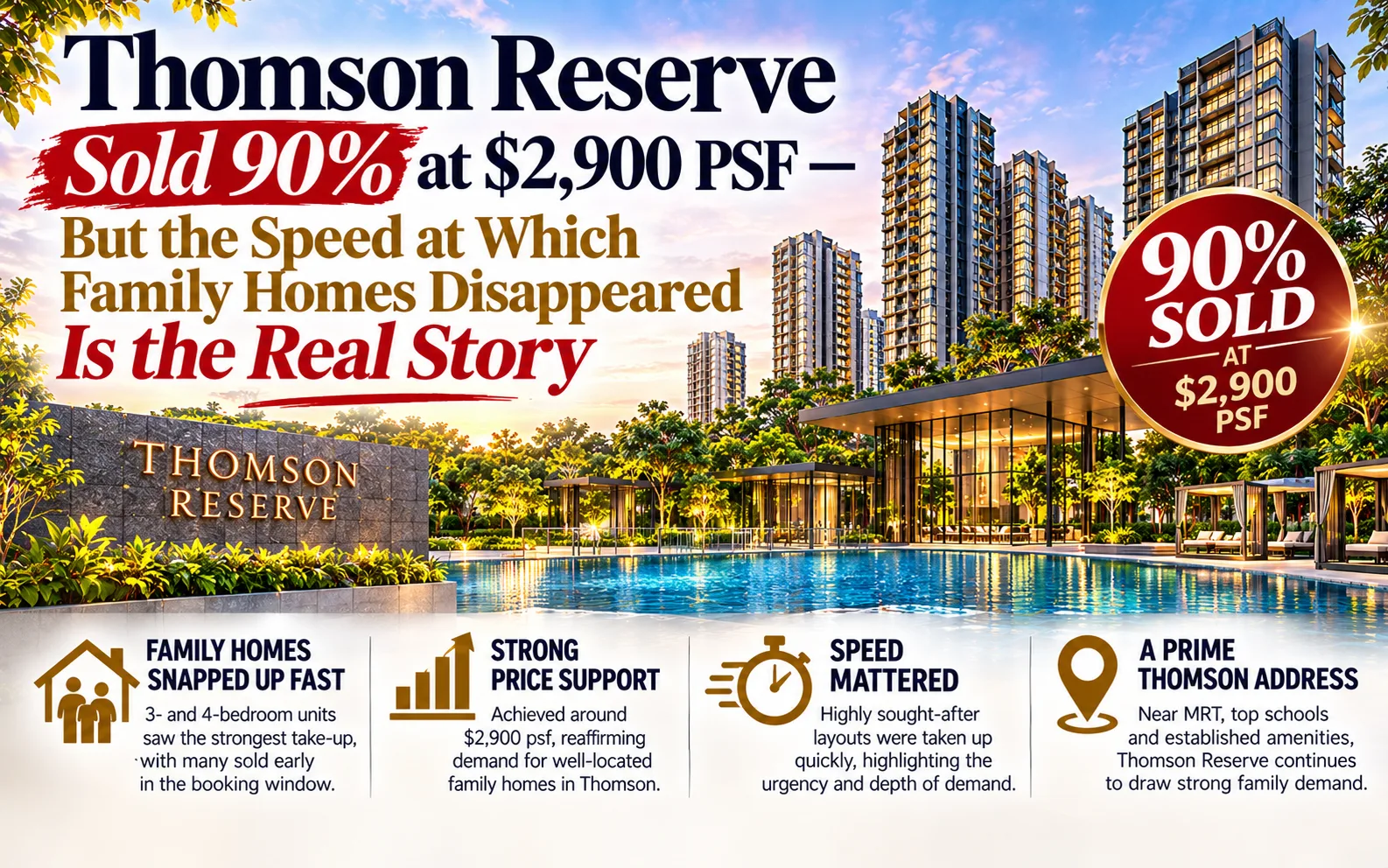
1,143 homes sold. 90.1% take-up. An average selling price of $2,900 psf.
And by the time queue numbers reached the 500-plus range, buyers hoping for larger family homes were already facing severely limited choices.
Thomson Reserve has delivered one of the most significant new launch performances of 2026.
Over its VIP booking exercise on 30 October and official launch on 31 October, the 1,268-unit development sold 1,143 homes.
For a project of this scale, that's an extraordinary result.
But having spent the entire booking day at ERA APAC Centre, I can tell you that the numbers only tell part of the story.
Behind every successful booking was a family making one of the biggest financial decisions of their lives. And behind every missed opportunity was another family going home disappointed.
That human side of the launch is something I won't forget.
1. Thirteen Hours at ERA APAC Centre: The Human Side of a Blockbuster Launch
I arrived at ERA APAC Centre at 8am on booking day.
My role was to serve as a PDI explainer, supporting the booking process and helping buyers understand the property details and information relevant to their purchases.
I remained there until the final booking at 9pm.
Thirteen hours. One booking day. And an incredible range of emotions.
There was a real sense of anticipation throughout the day.
For many buyers, this wasn't their first visit to Thomson Reserve.
They had already studied the floor plans, shortlisted their preferred stacks, calculated their finances and discussed their choices with their families.
Some had spent weeks preparing.
Now everything came down to their queue number and whether their preferred unit would still be available when their turn arrived.
What struck me most was the happiness of those who successfully secured their homes.
The excitement.
The smiles.
The visible relief when they knew the unit they had been hoping for was finally theirs.
For some, it was probably the culmination of months of planning their next chapter.
A larger home for their growing family.
A new neighbourhood.
A place where their children could grow up.
But the other side of the booking exercise was just as memorable.
I also saw the disappointment of buyers who didn't manage to secure a unit.
Some had waited patiently for their turn, only to discover that their preferred configurations were already fully taken.
Others had to watch their choices narrow as the queue progressed.
By the time queue numbers moved into the 500-plus range, the larger 3-bedroom to 5-bedroom configurations had been effectively exhausted.
And for a family who genuinely needs that additional bedroom, switching to a smaller apartment isn't always a reasonable compromise.
It's easy to look at a 90% take-up rate and celebrate the success of a development.
And commercially, it was certainly an outstanding achievement.
But spending thirteen hours there reminded me that every property launch has two stories.
The joy of those who got their dream home.
And the disappointment of those who didn't.
Both deserve to be acknowledged.
As a real estate professional, I've participated in many launches over the years.
But experiences like this reinforce something I strongly believe.
Our job isn't simply to help people secure a unit. It's to help them make the right property decision, even when that means accepting that the right unit is no longer available.
That was my biggest personal takeaway from Thomson Reserve's booking day.
2. The Numbers Behind the 90% Take-Up
Here are the headline launch figures.
Launch indicator | Result |
|---|---|
Total units | 1,268 |
Units sold | 1,143 |
Launch take-up | 90.1% |
Average selling price | $2,900 psf |
Units remaining at launch snapshot | 125 |
Expressions of interest | More than 3,300 |
Preview visitors | Approximately 32,000 |
Sales period | 30–31 October 2026 |
Thomson Reserve became the highest-volume new condominium launch of 2026.
Selling more than 1,100 homes over a launch weekend is a significant achievement.
And at an average selling price of $2,900 psf, it reflects substantial purchasing power.
But the average deserves closer examination.
3. The $2,900 PSF Average: What Does It Really Tell Us?
Before launch, Thomson Reserve's indicative starting prices began at approximately $2,608 psf.
A 592 sq ft 2-bedroom started from $1.544 million.
A 947 sq ft 3-bedroom started from $2.503 million.
And a 1,055 sq ft 3-bedroom Premium started from $2.777 million.
The eventual average selling price of $2,900 psf was approximately 11.2% above the lowest advertised entry PSF.
But that does not mean every buyer paid 11% more for the same apartment.
The average reflects the mix of units sold, including different floors, layouts, orientations and premium configurations.
Here's what $2,900 psf means across different unit sizes.
Unit size | Illustrative price at $2,900 psf |
|---|---|
947 sq ft | $2.746 million |
1,055 sq ft | $3.060 million |
1,152 sq ft | $3.341 million |
1,238 sq ft | $3.590 million |
1,485 sq ft | $4.307 million |
1,808 sq ft | $5.243 million |
These are illustrations using the project-wide average, not actual transacted prices for each configuration.
But they demonstrate the scale of financial commitments involved.
Buyers were prepared to spend approximately $2.5 million to more than $4 million on family-sized apartments.
Some larger suites commanded even higher prices.
Thomson Reserve wasn't simply successful because of an attractive entry price. It succeeded because buyers saw sufficient value in the overall proposition to commit substantial sums.
4. The Real Story: The Larger Units Disappeared First
This was the most striking part of the booking experience for me.
The final sales breakdown showed exceptionally strong demand for larger homes.
Configuration | Total units | Sold | Take-up |
|---|---|---|---|
3-bedroom | 350 | 350 | 100% |
4-bedroom | 174 | 174 | 100% |
5-bedroom | 28 | 26 | 92.9% |
2-bedroom + Study | 200 | 200 | 100% |
That's 550 of the 552 three- to five-bedroom homes sold during the launch period.
Approximately 99.6%.
The 4-bedroom and 5-bedroom categories were released during the VIP booking exercise on 30 October, so not all unit types were available at the same stage of booking.
But by the time I was watching queue numbers move into the 500-plus range, buyers hoping for larger homes were already facing very limited choices.
What I found interesting was that many buyers were not simply chasing the cheapest unit.
They were looking for the home that could accommodate their family.
And when those larger configurations were gone, a smaller two-bedroom apartment wasn't necessarily a suitable substitute.
A family looking for four bedrooms cannot solve its housing requirements simply by buying whatever remains available.
That is why I think the speed of the larger-unit take-up is more revealing than the overall 90% sales figure.
5. Why Did Family-Sized Homes Sell So Quickly?
I see five contributing factors.
Genuine demand for space
Singapore's housing market is often discussed through the lens of PSF and investment returns.
But for many families, the number of bedrooms and usability of the layout are more important.
A larger home provides flexibility for children, elderly parents, working from home and changing family requirements.
The sellout of Thomson Reserve's 3-bedroom and 4-bedroom units is consistent with strong demand for that flexibility.
The strength of Upper Thomson's established neighbourhood
Thomson Reserve benefits from a sheltered connection to Upper Thomson MRT, proximity to Thomson Plaza and access to an established residential environment.
Its location within 1 km of Ai Tong School is also relevant to eligible families, subject to address verification and school admission rules.
Buyers can assess much of the neighbourhood's utility today rather than relying entirely on future development plans.
Limited comparable new family homes
For buyers specifically seeking a new condominium in the Upper Thomson catchment, directly comparable alternatives may be limited.
That can create competition for preferred configurations.
Buyers willing to stretch for a longer-term home
A family already considering a $2.7 million purchase may assess whether an additional budget commitment provides a substantially better home for the next ten to fifteen years.
That doesn't mean everyone should stretch financially.
But where affordability permits, buyers may prioritise long-term suitability over the lowest possible entry price.
Concentrated demand during booking
More than 3,300 expressions of interest created a substantial pool of prospective purchasers.
The booking process brought that demand together within a short period.
For popular layouts, available inventory could disappear rapidly.
But the most important factor remains that buyers were financially prepared and willing to commit.
6. Why Were Smaller Two-Bedroom Units Left?
The contrast is revealing.
While all 3-bedroom and 4-bedroom units were sold, most of the remaining inventory consisted of two-bedroom apartments.
All 200 two-bedroom-plus-study units were also taken up.
This suggests that flexibility and usable space may have been important considerations.
A study can provide additional functionality for home working or other family needs, depending on the approved layout.
But we shouldn't assume that every remaining two-bedroom unit was undesirable.
Individual prices, floors and orientations could also have influenced buyer choices.
The broader lesson is that the lowest purchase quantum doesn't necessarily produce the strongest demand.
Buyers still evaluate whether a home meets their needs.
7. What Does This Mean for Chencharu?
Chencharu represents a different residential proposition.
The emerging Yishun neighbourhood is planned to include new housing, community facilities, green spaces and supporting amenities.
Its potential buyer catchment includes HDB upgraders and existing residents in Yishun, Khatib and surrounding northern estates.
Thomson Reserve's performance provides an encouraging signal about family-sized housing demand.
But Chencharu cannot simply copy Thomson Reserve's $2,900 psf benchmark.
Its location, land cost, neighbourhood maturity and buyer budgets differ.
I would watch how the developer positions its 3-bedroom and 4-bedroom units.
If the layouts are practical and the total purchase quantums are accessible to its target upgrader market, Chencharu could appeal to households looking for more space without leaving the north.
Thomson Reserve demonstrated demand for family homes. Chencharu will need to demonstrate value for its own family-buyer catchment.
8. What Does This Mean for One Chuan Grove?
I believe Thomson Reserve's results are particularly relevant to One Chuan Grove.
Lorong Chuan shares an important characteristic with Upper Thomson.
It is surrounded by established residential communities.
One Chuan Grove is expected to attract buyers from Serangoon, Bishan, Ang Mo Kio and neighbouring estates, including families who want to remain close to familiar schools, amenities and relatives.
Its planned facilities, including padel, pickleball, golf simulators and wellness amenities, may further strengthen its family-lifestyle positioning, subject to final approved plans.
But I don't think facilities alone will determine the project's success.
The more important questions will be its 3-bedroom and 4-bedroom layouts, total purchase quantums, unit mix and pricing relative to alternatives.
The lesson from Thomson Reserve
I would pay close attention to One Chuan Grove's larger configurations.
Thomson Reserve demonstrated that substantial demand can exist for family-sized apartments, even at high purchase quantums.
That may encourage buyers to prepare early for upcoming launches.
But it doesn't guarantee that One Chuan Grove will achieve the same sales velocity or pricing.
Its eventual success will depend on whether the developer delivers a product that resonates with its own buyer catchment.
One Chuan Grove doesn't need to reproduce Thomson Reserve's $2,900 psf average. It needs to make a convincing case for why its homes are worth their asking prices.
And for families comparing the two locations, the choice will involve more than PSF.
Transport connectivity, schools, neighbourhood familiarity, facilities, layout and total affordability will all matter.
9. Will Thomson Reserve's Success Push 2027 Launch Prices Higher?
Possibly.
Developers study major launch results.
A 90% take-up at $2,900 psf is a powerful demonstration of demand for a well-positioned project.
But I would caution against extrapolating that result across Singapore.
Different developments serve different buyer catchments.
Land costs differ.
Unit mixes differ.
And the amount of competing supply varies by location.
A buyer willing to pay $3 million for an Upper Thomson home may not be willing to pay $3 million for a different location.
Strong demand at one development is not proof that every future project can charge more.
In fact, with substantial new supply expected over the coming years, developers may need to compete harder on layout, specifications and value.
That could ultimately benefit buyers.
10. My Advice After Spending Thirteen Hours at the Booking Centre
The emotional highs and lows I witnessed reinforced several lessons.
Prepare your financing before booking day.
Understand your maximum comfortable budget.
Shortlist multiple acceptable units rather than pinning all your hopes on one stack.
Compare the project against resale alternatives.
And know when to walk away.
Because when a booking exercise becomes highly competitive, it is easy to confuse securing a unit with making a good purchase.
They are not the same thing.
A successful booking should be the beginning of a good housing decision, not simply the end of an anxious queue.
For those who secured their preferred Thomson Reserve homes, congratulations.
I could see how much those successful bookings meant to many buyers.
And for those who were disappointed, there will be other opportunities.
Chencharu, One Chuan Grove and other upcoming launches will offer additional choices, although their suitability and eventual pricing remain to be assessed.
Sometimes the right property decision is the one you make today.
And sometimes it's the decision to wait for a home that better meets your needs.
Final Thoughts: The Numbers Were Extraordinary. The People Made the Day Memorable.
Thomson Reserve's launch will be remembered for its commercial performance.
1,143 units sold.
90.1% take-up.
An average selling price of $2,900 psf.
And almost every 3-bedroom to 5-bedroom home taken up.
But for me, the memory of that day will be more personal.
From 8am to 9pm at ERA APAC Centre, I witnessed the excitement of families securing their new homes and the disappointment of others who had to leave without one.
Those experiences reminded me that behind every property transaction is a real household making a major life decision.
The numbers tell us about market demand.
The speed of the larger-unit sales tells us about the importance of family-sized homes.
And the emotions on booking day remind us why careful property advice matters.
As we look towards Chencharu and One Chuan Grove in 2027, I believe family-home demand will remain an important theme.
But successful projects will still need to justify their pricing.
Because ultimately, buyers aren't just purchasing square feet. They're choosing where the next chapter of their lives will unfold.
Christopher Ng
ERA Real Estate | Asset Progression Strategist
For property analysis and asset progression planning: WhatsApp 8868 2289.
Want the tailored version for your portfolio?
Every article here generalises. A 20-minute conversation makes it specific to your numbers.
How many units did Thomson Reserve sell during its launch?
What was Thomson Reserve's average selling price?
Were Thomson Reserve's larger units sold out?
Why did Thomson Reserve's larger apartments sell so quickly?
What does Thomson Reserve's success mean for One Chuan Grove?
Will Chencharu benefit from Thomson Reserve's strong launch results?
Should buyers prepare early for One Chuan Grove?

Written by
Christopher Ng (CEA R014394H)
Singapore Property & Asset Progression Strategist with ERA Realty Network. A NUS Real Estate graduate, Christopher has advised homeowners, investors and property owners since 2004.