
Singapore's 2027 New Launch Boom: Will Buyers Finally Have the Upper Hand?
Singapore is heading into 2027 with a substantial new condominium supply pipeline. With more than 32,000 private homes potentially available for sale over the next one to two years, will buyers finally gain the upper hand? I examine the 2026 launch results, Thomson Reserve, One Chuan Grove, upcoming western developments and why more supply may create better buying opportunities without necessarily bringing lower prices.
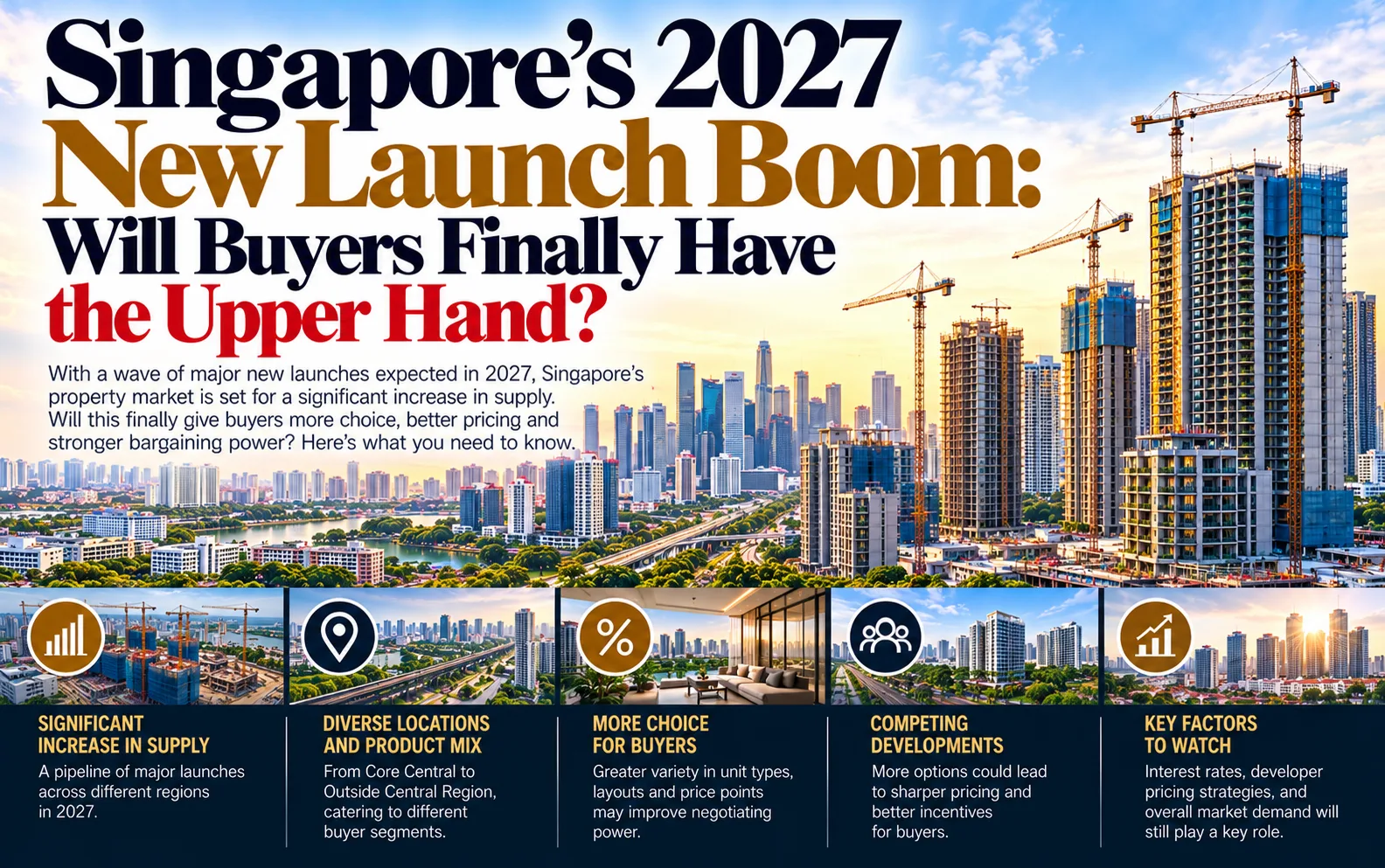
More than 32,000 private homes could become available for sale over the next one to two years.
And yet, Singapore property prices are still rising.
Something interesting is happening in our property market.
For the past few years, many new launch buyers have been conditioned to act quickly.
Register your interest early.
Prepare your financing.
Get your cheque ready.
Hope for a good queue number.
And when your preferred unit becomes available, make a decision before someone else takes it.
We've seen new launches attract thousands of visitors, multiple expressions of interest for each available unit, and buyers competing intensely for preferred stacks and layouts.
But as we approach 2027, I think the dynamics could begin to change.
Not necessarily because property prices are about to collapse.
Not because developers will suddenly start offering huge discounts.
And certainly not because Singapore has stopped being an attractive place to own property.
The change I am watching is something more subtle: buyers may finally have more alternatives.
And when buyers have more alternatives, developers must work harder to justify their prices.
Could 2027 become a buyers' market?
Or will the next wave of new launches simply push prices even higher?
Let's examine what the numbers tell us.
1. The Number That Changes the Conversation: 32,000 Homes
On 23 October 2026, URA released its third-quarter property market statistics.
One figure stood out to me.
More than 32,000 private residential units, including Executive Condominiums, could be made available for sale over the next one to two years.
The government also indicated that approximately 57,200 private residential units are expected to be completed over the coming years.
These are two different measures.
The 32,000 figure refers to potential homes available for sale, while the 57,200 figure concerns the broader future completion pipeline.
They should not be added together.
But both tell us something important.
Singapore is moving into a period of substantial private housing supply.
For the full year of 2026, the Government Land Sales Confirmed List alone provides land capable of yielding approximately 9,320 private homes.
That's more than 50% above the average annual Confirmed List supply over the preceding decade.
This isn't an accidental increase.
The government has been deliberately maintaining a strong land supply pipeline to meet housing demand and support market stability.
And I think the effects will become increasingly visible in 2027 and beyond.
But here's an important distinction.
32,000 potential homes for sale does not mean 32,000 condominiums will launch simultaneously in 2027.
Some will be launched earlier.
Some later.
Some sites have not even been tendered or awarded.
And developers control the timing and phasing of their sales launches, subject to regulatory requirements.
Still, the direction is clear.
Buyers are likely to see a wider range of projects entering the market.
And that could change how purchasing decisions are made.
2. Why Haven't Prices Fallen Despite Increasing Supply?
This is the obvious question.
If Singapore is preparing for so many new homes, why are prices still increasing?
According to URA, private residential property prices rose 1.4% in the third quarter of 2026.
That followed a 0.5% increase in the second quarter.
Over the first nine months of 2026, prices continued to register positive growth.
Interestingly, the price movement was not uniform.
Outside Central Region non-landed prices increased 2.2% in the third quarter.
Rest of Central Region non-landed prices rose a more modest 0.2%.
Core Central Region non-landed prices slipped 0.1%.
This tells us that Singapore isn't experiencing one single property market.
Different regions are responding differently to demand, affordability and available supply.
And there are several reasons why a larger pipeline doesn't automatically produce lower prices.
First, future supply takes time to reach the market.
Second, developers have already committed substantial amounts to land purchases.
Third, construction and financing costs affect their selling prices.
And fourth, buyers continue to place a premium on well-located projects with attractive layouts, transport connectivity and amenities.
More supply may slow price growth without causing an outright price decline.
That is an important difference.
3. What 2026 Has Already Taught Us About Buyer Demand
Before looking ahead to 2027, we should examine the signals from 2026.
The market has not been uniformly strong or weak.
Instead, we've seen buyers become increasingly selective.
According to ERA's analysis of URA's third-quarter statistics, developers sold 1,183 new private homes in 3Q 2026, compared with 2,141 in the preceding quarter.
That's a decline of approximately 44.7%.
But developers also launched fewer homes.
Only 1,140 units were launched in the third quarter, compared with 1,783 in the second quarter.
So lower transaction volume doesn't necessarily mean buyers have disappeared.
It partly reflects the smaller number of new homes being introduced.
CBRE reported that 5,334 new private homes had been sold during the first nine months of 2026, down 32.3% from the corresponding period in 2025.
The research house attributed the moderation partly to fewer new launches, higher price points and increasing buyer selectivity.
I think that's a useful observation.
Buyers are still willing to purchase. But they are becoming more demanding about what they receive for their money.
And this is where 2027 could become interesting.
If developers introduce substantially more homes while buyers remain selective, competition for the same buyer budgets could intensify.
4. Thomson Reserve: The Final Big Test of 2026
One of the most anticipated launches of 2026 is Thomson Reserve.
With 1,268 units, it is a major development in Upper Thomson.
Its indicative starting prices begin from $1.544 million for a 592 sq ft 2-bedroom, or approximately $2,608 psf.
The 947 sq ft 3-bedroom starts from $2.503 million.
And the 1,055 sq ft 3-bedroom Premium starts from $2.777 million.
Ahead of its 31 October booking exercise, the development reportedly attracted approximately 3,200 expressions of interest.
That's more than 2.5 times the number of available units.
For a project of this size, that is an impressive level of interest.
But I would distinguish expressions of interest from completed purchases.
The actual sales conversion and distribution of units sold will tell us much more.
Why is Thomson Reserve important to the 2027 outlook?
Because it gives us a real-world test of buyer appetite for family-sized homes in the $2.5 million to $3 million range.
If the 3-bedroom configurations perform strongly, that would reinforce the depth of demand for well-located family homes.
If some higher-priced stacks move more slowly, it may indicate that buyers are becoming more price-sensitive.
And if buyers who miss out on Thomson Reserve begin looking at other upcoming launches, that demand could carry forward into 2027.
The outcome of Thomson Reserve may tell us not just how popular Upper Thomson is, but how much buyers are prepared to pay for the right family home.
5. One Chuan Grove: Why 2027 Could Become a Competition for Family Buyers
Now let's move to Lorong Chuan.
One Chuan Grove is one of the developments I'm watching particularly closely.
It is expected to enter the market in 2027, subject to the developer's final launch schedule.
And I think it has the potential to appeal to a substantial upgrader catchment.
Lorong Chuan sits within an established residential environment.
It is served by the Circle Line.
It has access to surrounding mature estates such as Serangoon, Bishan and Ang Mo Kio.
And it is positioned within a wider network of private and public housing neighbourhoods.
That matters because new launch demand doesn't emerge from nowhere.
It often comes from households progressing through different stages of their housing journey.
HDB owners looking to upgrade.
Existing condominium owners seeking more space.
Families moving closer to schools or relatives.
And homeowners who want a different lifestyle without leaving their familiar residential catchment.
This is where I see One Chuan Grove's potential.
But here's the interesting part.
Its competition isn't limited to other projects in Lorong Chuan.
A family with a $2.5 million to $3 million budget may consider Thomson Reserve.
Or One Chuan Grove.
Or an established resale condominium in Bishan or Serangoon.
Or a new launch in another location offering more space for the same money.
That is the real competition.
Not simply project versus project.
But housing choice versus housing choice.
And as more developments launch, buyers may become less willing to compromise.
They can compare layouts, facilities, schools, transport, neighbourhood maturity and prices.
One Chuan Grove's eventual success will therefore depend not only on its own attributes, but also on how competitively it is priced against the alternatives available at launch.
The developer has not released a final selling price list, so any current PSF assumptions should be treated as estimates rather than confirmed prices.
6. The West Could Become a Serious Competitor for the Same Buyer Dollar
When people compare Thomson Reserve and One Chuan Grove, they naturally focus on their respective locations.
Upper Thomson versus Lorong Chuan.
But I think we should look beyond the immediate neighbourhoods.
The western part of Singapore is also receiving substantial residential investment and development.
Take Lucerne Grand at Lakeside.
The 570-unit project reportedly sold 350 units, or approximately 61%, during its opening weekend in October 2026.
That is a meaningful sales response.
And it tells us that demand for new homes is not confined to central or city-fringe locations.
For buyers working in Jurong, the western employment centres or the surrounding regions, a well-connected western condominium could make considerable sense.
Other projects associated with the western supply pipeline include future developments at Dairy Farm Walk and Dover Drive, although their eventual launch dates and pricing remain subject to confirmation.
Executive Condominium options such as Solano Grand at Senja Close may also appeal to eligible family upgraders.
Of course, an EC and a private condominium are not interchangeable.
Eligibility rules, resale restrictions and financing considerations differ.
But for an eligible household deciding how to allocate a housing budget, these are real alternatives.
And that is the point.
A family with $2.5 million to spend does not necessarily have to spend $2.5 million on a condominium.
They may choose a less expensive home and retain more liquidity.
They may prioritise space over centrality.
They may prefer a location closer to work or family.
Or they may decide to wait for a future project.
As these alternatives increase, developers must compete harder for the same household's attention.
7. The $2.5 Million to $3 Million Buyer May Become the Most Important Battleground
This is the segment I would watch closely in 2027.
CBRE's September 2026 commentary found that, among new private homes sold that month, the $3 million to $5 million quantum band accounted for the largest share at 30%.
The $2.5 million to $3 million band followed at 21%.
And the $2 million to $2.5 million band accounted for 16%.
These figures reflect September transactions, not the entire market or every buyer's budget.
But they illustrate the importance of family-sized purchase quantums.
For many households, the question isn't simply whether they can afford $2.8 million.
It's what kind of home $2.8 million can buy.
Consider three hypothetical options.
Option | Illustrative purchase | Main appeal |
|---|---|---|
Thomson Reserve | 3-bedroom around $2.5M–$2.8M starting-price range | Upper Thomson location, MRT connectivity, new development |
One Chuan Grove | 3-bedroom, pricing not yet announced | Lorong Chuan catchment, family-oriented facilities, mature surroundings |
Western new launch | 3-bedroom, project-dependent pricing | Potentially different space-to-price trade-off, western connectivity |
The prices above are not like-for-like quotations, and One Chuan Grove's eventual price is not yet confirmed.
But the comparison highlights something important.
Buyers may be choosing between different lifestyles at broadly similar housing budgets.
That's where competition becomes meaningful.
And that is where developers may have to be more thoughtful about product positioning and pricing.
8. Higher Land Costs Don't Guarantee Higher Selling Prices
This is another theme I've been exploring in my recent GLS analyses.
Developers have acquired land at very different prices depending on location, timing and competition.
Some sites attracted aggressive bids.
Others received just one bidder.
And in Marina South, we've recently seen EL Development secure a Marina Gardens Lane site at $1,243 psf ppr — approximately 11.3% below the neighbouring One Marina Gardens land rate from 2023.
That is an important reminder.
Land prices do not always move upwards in a straight line.
Developers assess each site based on expected selling prices, construction costs, risk and target returns.
But buyers should not assume that a developer who paid more for land is automatically entitled to charge more for its apartments.
The market ultimately determines whether buyers are willing to pay the asking price.
And if two nearby projects have different land-cost bases, the developer with the lower cost may have greater pricing flexibility.
That doesn't mean it will necessarily pass the savings to buyers.
It could retain a higher margin.
Or invest in better specifications.
Or position the development differently.
But it creates competitive possibilities.
And as the number of projects grows, those differences may become more important.
9. Could 2027 Become a Buyers' Market?
This depends on what we mean by a buyers' market.
If we define it as a market where prices fall sharply and developers offer widespread discounts, I don't think the current evidence is sufficient to predict that.
Private home prices are still rising.
Well-located launches continue to attract demand.
And developers can manage their release strategies rather than selling every unit at once.
But if we define a buyers' market as one where purchasers have more alternatives, more time to compare and greater ability to reject unattractive pricing, then 2027 could move in that direction.
I would distinguish between three possible scenarios.
Scenario A: Strong demand continues across most launches
In this scenario, economic conditions remain supportive and buyers absorb the new supply comfortably.
Prices could continue increasing, although the pace may differ by location.
Popular developments may still experience intense competition.
Scenario B: Demand remains healthy, but buyers become more selective
This is the scenario I find particularly plausible.
The market continues to transact.
But projects compete more intensely on price, layout, location and product quality.
Some developments sell strongly.
Others move more slowly.
Developers may introduce attractive entry prices or adjust pricing for selected units.
Buyers gain more meaningful choices without necessarily seeing a broad market decline.
Scenario C: Supply arrives faster than demand can absorb it
If economic conditions weaken, financing costs rise materially or buyer confidence deteriorates, the increased supply pipeline could create stronger pricing pressure.
Some developers might need to adjust prices or offer incentives.
But this outcome is not guaranteed simply because more homes are coming.
It would depend on both supply and demand.
My base interpretation is that greater buyer selectivity and stronger competition between projects are more defensible expectations than an outright property price crash.
10. Why More Launches Could Be Good News for Genuine Homebuyers
I think we sometimes underestimate the value of having choices.
Imagine you're looking for a family home today.
You like a particular project.
But the available 3-bedroom units are either too expensive, poorly positioned or not ideal for your family.
If there are few upcoming alternatives, you may feel pressured to compromise.
Now imagine several suitable projects are expected within the next six to twelve months.
You can compare.
You can assess different layouts.
You can study the price gaps.
And you can decide whether a premium is justified.
That ability to say “No, this unit isn't right for me” is valuable.
Even if prices don't fall.
In fact, I think one of the greatest advantages buyers could gain in 2027 is the ability to make decisions without being driven entirely by fear of missing out.
And that's a healthier market.
11. But Not Every New Launch Will Benefit Equally
More supply also means the difference between a good project and an average project may become more obvious.
I would expect buyers to pay closer attention to five factors.
Location and existing amenities
A development in an established neighbourhood may appeal to buyers who want immediate convenience.
An emerging precinct may offer longer-term growth potential but require more patience.
Neither is automatically better.
Layout efficiency
As purchase prices rise, buyers become increasingly sensitive to usable space.
A well-designed 950 sq ft 3-bedroom may be more appealing than a larger unit with inefficient circulation.
Total purchase quantum
PSF is useful, but buyers ultimately finance the total price.
A $2.7 million home competes against other homes within a similar budget, regardless of the developer's land cost.
Future supply within the same catchment
If several similar projects launch in the same area, buyers gain more alternatives.
But owners may also face greater competition when selling or renting later.
Price relative to resale alternatives
New launches deserve consideration for their newness, specifications and future completion.
But the premium over established resale developments should still be measured.
A good project can become a poor investment if purchased at the wrong price.
And a less glamorous project can offer attractive value if the entry price is sensible.
12. Should Buyers Purchase Now or Wait Until 2027?
This is the question I expect many readers to ask.
My answer is that waiting should be a strategy, not a default reaction to the word “oversupply”.
If you find a suitable home today at a price that makes sense, buying may be reasonable.
Especially if you have a genuine housing requirement and a long holding horizon.
But if your preferred unit is overpriced or unsuitable, the upcoming supply pipeline gives you a reason to remain disciplined.
I would consider waiting if:
Your current home meets your needs and you have flexibility over timing.
Several upcoming developments match your preferred location and budget.
You're primarily purchasing for investment and need a convincing entry price.
The available units at your preferred launch require excessive compromises.
On the other hand, waiting has costs too.
Future projects may launch at higher prices.
Interest rates can change.
Your housing requirements may become more urgent.
And the most desirable units in a well-priced development may still attract strong competition.
The right question isn't whether 2027 will be cheaper.
It's whether waiting improves your available choices enough to justify the uncertainty.
13. My Buying Framework for 2027
For buyers planning a purchase next year, I would approach the market differently from the typical launch-day rush.
First, establish your maximum comfortable purchase quantum.
Not simply the amount the bank is willing to lend.
The amount that leaves your household financially comfortable.
Second, identify the locations that genuinely work for your family.
A condominium may be attractive, but a longer daily commute or unsuitable school arrangement can affect your quality of life.
Third, compare new launches with resale alternatives.
The right resale home may offer more space, an earlier move-in date or better value.
Fourth, study the actual unit-level pricing.
A development's advertised starting PSF doesn't tell you whether the particular stack and floor you want are attractively priced.
Fifth, maintain a shortlist of alternative projects.
If your preferred unit becomes too expensive, you should know where else you can buy.
And finally, be prepared to walk away.
Having more projects available is only an advantage if you're willing to exercise your choice.
14. What I Will Be Watching in 2027
As we move into the new year, I'll be monitoring several indicators.
Launch take-up rates. Are projects selling strongly across most configurations, or only in selected lower-priced stacks?
Price gaps between projects. Are developers pricing aggressively to compete for the same family budgets?
Three-bedroom demand. Does the $2.5 million to $3 million segment continue to attract strong upgrader interest?
GLS tender outcomes. Are developers still bidding aggressively for land, or are they applying larger margins of safety?
Resale market activity. Are buyers increasingly choosing established condominiums over expensive new launches?
And perhaps most importantly:
Are buyers becoming more comfortable walking away from unattractive prices?
That would be a meaningful change in market behaviour.
Final Thoughts: 2027 May Not Be the Year of Cheaper Condos. It Could Be the Year of Smarter Buyers.
Singapore's private housing market is approaching an interesting transition.
The government has maintained a substantial land supply pipeline.
More developments are expected to enter the market.
And buyers may have a wider range of locations, layouts and purchase quantums to choose from.
But I wouldn't confuse greater supply with guaranteed discounts.
Strong locations can still command premiums.
Developers still need to recover their costs.
And desirable units can remain competitive even when overall market choices increase.
What I think could change is the balance of decision-making.
In a market with limited alternatives, buyers often feel compelled to act quickly.
In a market with more alternatives, developers have to work harder to earn the buyer's commitment.
And that's a meaningful difference.
My prediction for 2027 isn't that every condominium will become cheaper.
It's that buyers who do their homework, understand their budgets and compare their alternatives may find themselves in a stronger position than they have been for some time.
From Thomson Reserve to One Chuan Grove, and from established city-fringe locations to emerging western residential hubs, the next phase of Singapore's new launch market could be defined by competition for the same family buyer.
For me, that is good news.
Because property buying should never be about securing whatever is available.
It should be about identifying the right home, at the right price, for the right stage of your life.
More supply creates more choices. More choices create greater discipline. And greater discipline creates better property decisions.
That is the opportunity I will be watching in 2027.
Christopher Ng
ERA Real Estate | Asset Progression Strategist
For property analysis and asset progression planning: WhatsApp 8868 2289.
Want the tailored version for your portfolio?
Every article here generalises. A 20-minute conversation makes it specific to your numbers.
Will Singapore have more new condo launches in 2027?
Will Singapore condo prices fall in 2027?
Is Singapore facing a new launch oversupply?
Is 2027 a good time to buy a condominium in Singapore?
Which Singapore condos are expected to launch in 2027?
Should I buy Thomson Reserve or wait for One Chuan Grove?
Will western Singapore new launches be cheaper than city-fringe launches?
Will more new launches give buyers greater negotiating power?
Is it better to buy a resale condo instead of a new launch in 2027?

Written by
Christopher Ng (CEA R014394H)
Singapore Property & Asset Progression Strategist with ERA Realty Network. A NUS Real Estate graduate, Christopher has advised homeowners, investors and property owners since 2004.