
Union Square Residences: Has This CDL Project Quietly Become One of the Better-Value CCR Buys?
Union Square Residences, initially seen as expensive, is now a potential hidden gem in the Core Central Region. With the market moving and selected units available at lower PSF, it offers a compelling value proposition.
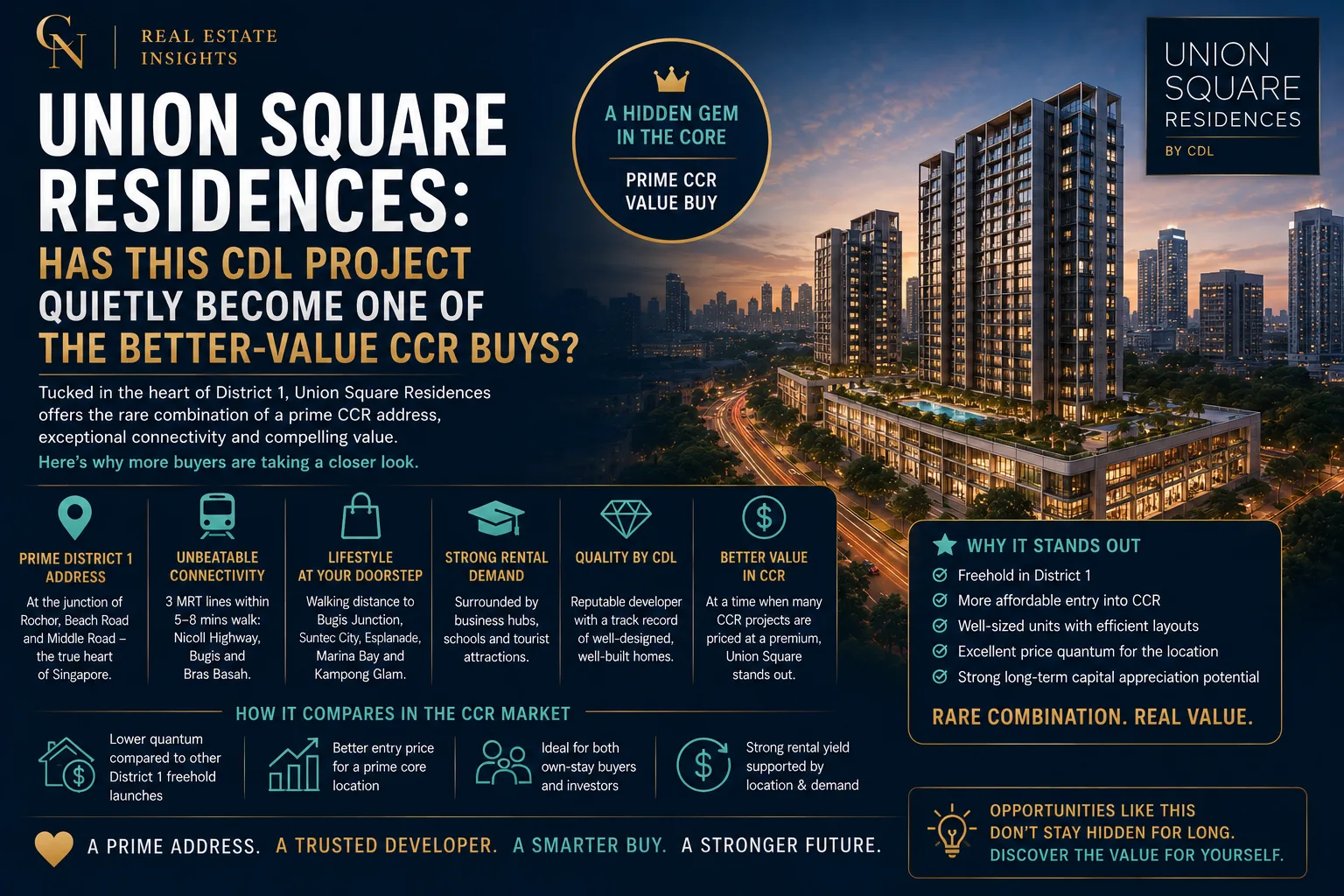
When Union Square Residences launched in November 2024, the market reaction was respectable but not explosive.
CDL sold 75 units on launch day at an average of around $3,200 psf. The project was positioned as a premium District 1 mixed-use development at the gateway to the CBD, with 366 residences, office space, retail and F&B, all within the Singapore River precinct.
At the time, some buyers looked at the price and hesitated.
$3,200 psf was a big number.
Fast forward to 2026, and I think the conversation has changed completely.
River Green has since sold strongly at an average of about $3,130 psf. The Robertson Opus launched at around $3,360 psf. New District 11 projects have crossed the $3,000 psf psychological barrier. And newer land bids are continuing to push replacement costs higher.
Against that backdrop, Union Square Residences suddenly looks very different.
In fact, I think it may have quietly become one of the more interesting hidden-value opportunities in the Core Central Region.
The Market Has Moved Towards Union Square
Sometimes a project becomes cheaper.
Sometimes the market simply becomes more expensive around it.
I think Union Square is experiencing a little of both.
Current developer inventory being marketed in August 2026 shows selected two-bedroom units from about $1.89 million, or roughly the high-$2,600 psf range, with one-bedroom-plus-study units around the high-$2,700 psf range. These are indicative current developer-stock prices and availability moves quickly, but they are materially different from the project’s original $3,200 psf launch average.
That deserves attention.
Because we now have a situation where buyers can potentially enter a brand-new District 1 mixed-use project by CDL at a PSF that is below several newer CCR and even premium city-fringe benchmarks.
That is not something I would dismiss casually.
Why Did Union Square Look Expensive in 2024?
Context matters.
When Union Square launched, the market did not yet have as many $3,000-plus psf reference points as it does today.
Buyers naturally compared it with older completed developments.
Some looked at CanningHill Piers.
Some compared it with Riviere.
Others simply felt that $3,200 psf for a 99-year project was aggressive.
And that hesitation was reflected in the project's initial take-up.
CDL reported that 137 of the 366 units had been sold as at 28 February 2026, or about 37%.
But this is exactly why property investing is interesting.
A project's value proposition changes when the market around it changes.
Today, the question is no longer:
“Why should I pay $3,200 psf for Union Square?”
It may instead be:
“Why can I potentially buy selected Union Square units below some newer competing projects?”
That is a very different conversation.
The Mixed-Use Story Is Stronger Than It First Appears
Union Square Residences is not simply a standalone condominium.
It forms part of a larger mixed-use redevelopment comprising residences, a Grade A office tower, retail and F&B, and a co-living component operating with a hotel licence. CDL describes it as the first large-scale mixed-use redevelopment in the Singapore River Planning Area under URA's Strategic Development Incentive scheme.
To me, this matters for two reasons.
First, mixed-use projects tend to create stronger day-to-day ecosystems.
There are people working there.
Dining there.
Staying there.
Living there.
That creates activity beyond the residential component alone.
Second, mixed-use developments are harder to replicate.
A future buyer is not simply comparing one condo tower with another.
They are comparing an entire environment.
That becomes increasingly important as Singapore produces more generic residential supply.
Location Is Better Than The Project's Sales Rate Suggests
Union Square sits in District 1 at Havelock Road, within the Singapore River precinct and near the edge of the CBD. CDL highlights walking access to Clarke Quay, Chinatown and Fort Canning MRT stations.
That gives residents access to several very different parts of Singapore within minutes.
CBD.
Chinatown.
Clarke Quay.
Robertson Quay.
River Valley.
Orchard.
And the Singapore River itself.
URA continues to actively position the Singapore River as an important lifestyle and placemaking district, supported by conservation, public-space improvements and events across Boat Quay, Clarke Quay and Robertson Quay.
So this is not a speculative “future transformation” story.
The location already works.
The redevelopment simply adds another layer to an established precinct.
The Robertson Opus Comparison Is Getting Interesting
This is probably the comparison I would study most carefully.
The Robertson Opus is a 999-year project in District 9 and achieved about $3,360 psf on launch, with 143 of 348 units sold.
The tenure advantage is obvious.
999-year is valuable.
But if selected Union Square units can now be acquired materially below that pricing, the question becomes:
How much premium should I pay for tenure?
There is no universal answer.
For someone planning to hold for 20 years or pass the property to the next generation, tenure may matter greatly.
For an investor looking at a five- to ten-year window, entry price may matter more.
If I can enter a strong District 1 mixed-use project hundreds of dollars per square foot below a nearby new launch, I want to understand that gap very carefully.
That is exactly where opportunities can appear.
The River Green Comparison Is Also Important
River Green achieved an exceptionally strong launch, selling 88% at an average of around $3,130 psf.
That is a very good project.
Great World MRT.
Strong River Valley location.
Excellent owner-occupier demand.
But its success also tells us something broader.
Buyers have already demonstrated their willingness to pay above $3,000 psf for good central homes.
That gives Union Square a much stronger pricing reference than it had at launch.
If today's selected Union Square entry units sit below that level, the project starts looking less like the “expensive 2024 launch” and more like an earlier CCR project that the market has caught up with.
Is The 99-Year Lease A Problem?
This is probably one of the obvious objections.
Union Square is 99-year leasehold.
And when buyers are spending $2 million, $3 million or $4 million, many naturally ask whether they should simply pay more for freehold or 999-year tenure.
That's fair.
But tenure should never be analysed in isolation.
The better question is:
What discount am I receiving for the leasehold tenure?
If the gap between Union Square and a nearby 999-year alternative is $50 psf, perhaps I would pay for the longer tenure.
If the difference is several hundred dollars per square foot?
Now the conversation changes.
Everything has a price.
Including tenure.
I Think Quantum May Be Union Square's Biggest Opportunity
One thing I like about the current pricing structure is the ability to enter central Singapore without necessarily taking on an enormous total quantum.
Current market listings show genuine two-bedroom units from roughly $1.89 million and three-bedroom units being marketed from around $2.6 million.
That is significant.
For a buyer with $2 million, the alternative might be:
a suburban or RCR new launch,
a resale city-fringe condo,
or a brand-new mixed-use District 1 project.
Once you frame the decision by total quantum, not simply PSF, Union Square becomes much more interesting.
This is especially relevant for investors.
Your eventual buyer pool is always affected by absolute price.
A two-bedroom below $2 million has a very different future buyer audience from a two-bedroom at $2.5 million or $2.8 million.
Why Has Sales Momentum Picked Up?
The available inventory records suggest a noticeable pickup in transaction activity during mid-2026, with numerous units recorded as sold through May, June and July. Third-party inventory tracking indicated the project had crossed the halfway-sold mark by mid-2026.
That makes sense to me.
Buyers are probably beginning to see what the earlier buyers could not.
The rest of the market has moved.
When competing projects get more expensive, an earlier launch begins to look relatively better.
This is exactly the replacement-cost principle I often discuss.
Today's market can validate yesterday's price.
And sometimes it can make yesterday's price look attractive.
Who Should Consider Union Square?
I think the project deserves attention from three buyer groups.
Investors seeking a central location with manageable quantum. A true two-bedroom around the sub-$2 million conversation creates a potentially broad rental and resale audience.
Owner-occupiers who genuinely enjoy city living. Someone who values the Singapore River, CBD access and walkable lifestyle may find the proposition difficult to replicate elsewhere.
Buyers comparing new CCR launches. If you are already prepared to pay $3,100-$3,400 psf elsewhere, Union Square should at least be included in the comparison.
But I would not say every remaining unit is automatically good value.
Unit selection still matters enormously.
What Would I Buy As An Investor?
If my objective were a five-year investment window, I would focus very heavily on two-bedroom configurations with an efficient layout and controlled quantum.
Why?
Because they can potentially appeal to:
singles,
couples,
expatriate tenants,
young professionals,
small households,
and future investors.
Union Square's project mix itself is heavily weighted towards two-bedroom products, so there will be internal resale competition. CDL launched the project with 134 standard two-bedrooms plus another 35 two-bedroom-plus-study units.
That means I would not simply buy “a two-bedroom”.
I would want the right two-bedroom.
Better floor.
Better view.
Sensible entry price.
Good layout.
And enough differentiation from the hundreds of units around me.
What Is The Biggest Risk?
The greatest risk is probably not the location.
It is internal and external competition.
Union Square has 366 homes.
There are many small and medium unit types.
Nearby central Singapore also has substantial new supply.
An investor therefore cannot assume that “District 1” automatically guarantees a profitable exit.
If you overpay for a mediocre stack, the project's overall quality may not rescue you.
This is why I would treat current incentives and lower entry prices as an opportunity to select carefully, not an excuse to buy blindly.
Why I Think Union Square May Be A Hidden Gem Now
To me, a hidden gem is not a project nobody knows about.
Union Square is hardly unknown.
A hidden gem is a project whose current value proposition is better than market perception.
And that may be happening here.
The market remembers:
Union Square launched at $3,200 psf and wasn't an immediate sell-out.
But today's reality is different.
New CCR projects are regularly crossing $3,000 psf.
Robertson Opus achieved around $3,360 psf.
River Green achieved around $3,130 psf.
Selected Union Square inventory is now being marketed from the high-$2,600s to high-$2,700s psf depending on unit type and floor.
So perhaps the market is still judging the project based on its 2024 perception, when it should be judging it based on its 2026 relative value.
That mismatch is exactly what interests me.
My View
I would not have called Union Square Residences cheap when it launched.
Today, I think it deserves another look.
Not because something suddenly changed about the building.
The location is the same.
The developer is the same.
The mixed-use proposition is the same.
What changed is the market around it.
Prices elsewhere have caught up.
Some newer launches have moved beyond it.
And current developer inventory appears to offer entry points materially below the original launch average.
That does not make Union Square automatically undervalued.
But it does make it misunderstood.
And sometimes the most interesting property opportunities are not the projects receiving the loudest launch-weekend headlines.
They are the projects buyers dismissed two years earlier—only to realise later that the rest of the market had moved past them.
For buyers looking at Singapore's central property market today, I think Union Square Residences deserves to be back on the shortlist.
Not because it is new.
Not because it is District 1.
But because at the right unit and the right price, the gap between what you are paying and what the next generation of central projects costs may finally be working in your favour.
Want the tailored version for your portfolio?
Every article here generalises. A 20-minute conversation makes it specific to your numbers.
What is Union Square Residences?
How much did Union Square Residences launch at?
What are Union Square Residences prices in 2026?
Why has Union Square become more attractive now?
Is Union Square Residences directly connected to an MRT?
Is Union Square Residences good for investment?
Which Union Square unit type would I consider?
Is Union Square better than The Robertson Opus?
Is the 99-year lease a disadvantage?
What is the biggest thing buyers should watch?

Written by
Christopher Ng (CEA R014394H)
Singapore Property & Asset Progression Strategist with ERA Realty Network. A NUS Real Estate graduate, Christopher has advised homeowners, investors and property owners since 2004.