
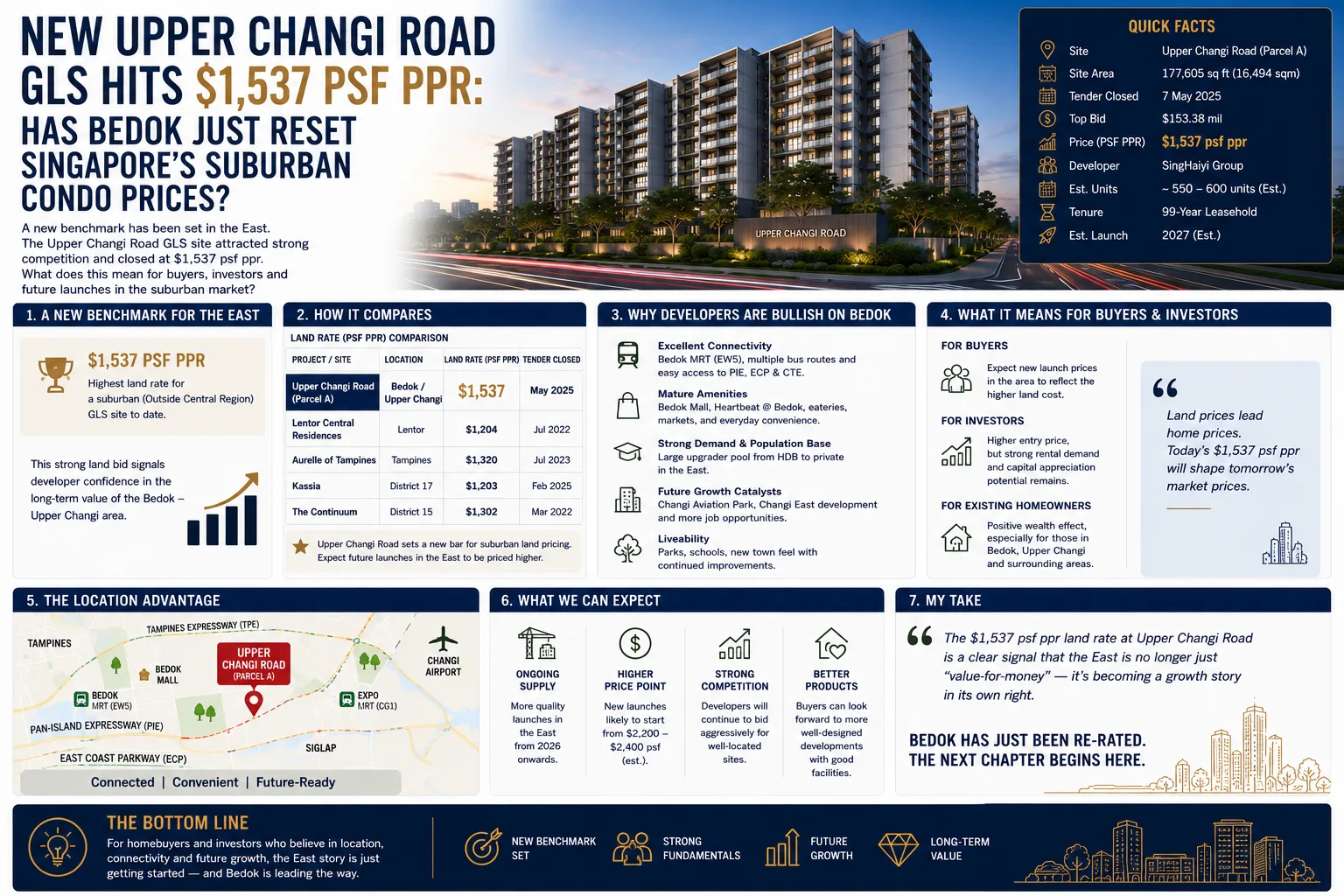
New Upper Changi Road GLS Hits $1,537 PSF PPR: Has Bedok Just Reset Singapore's Suburban Condo Prices?
A recent GLS tender for a New Upper Changi Road site hit a record $1,537 psf ppr, signaling a potential reset for Singapore's suburban condo prices. This aggressive bid by developers suggests strong confidence in Bedok's established market
Another GLS tender closed today, 1 September 2026.
And this one caught my attention.
The New Upper Changi Road site attracted four bids, with the highest coming in at:
$1.425 billion.
That translates to approximately:
$1,537 psf ppr.
For a pure residential site in the Outside Central Region (OCR), this is a new benchmark.
But the number that interests me even more isn't $1,537.
It is:
13.8%.
That's how much higher the top bid was compared with the second-highest bid.
And I think that gap tells us a very interesting story about where developers think Singapore's private residential market could be heading.
First, What Exactly Was Sold?
The New Upper Changi Road GLS site is a substantial one.
According to URA:
New Upper Changi Road GLS | |
|---|---|
Site Area | 30,769 sqm |
Maximum GFA | 86,154 sqm |
Estimated Homes | 1,010 units |
Tenure | 99 years |
Tender Closed | 1 September 2026 |
It sits roughly 300m from Bedok MRT and opposite Bedok Town Centre, in what is already one of Singapore's most mature residential estates.
This is not a small boutique development.
Whoever eventually develops this is committing to a 1,000-unit project and more than $1.4 billion for the land alone.
That makes the bidding particularly interesting.
Look At The Four Bids
Based on the tender results:
Bidder | Bid | Approx. PSF PPR |
|---|---|---|
UOL / SingLand / CapitaLand Development | $1.425b | $1,537 |
CDL / Hong Realty | $1.252b | $1,350 |
GuocoLand / Hong Leong / TID | $1.243b | $1,340 |
Sim Lian | $1.215b | $1,310 |
Look carefully.
The bottom three bids are:
$1,310
$1,340
$1,350 psf ppr.
That's actually quite a tight range.
Then suddenly:
$1,537 psf ppr.
That is the fascinating part.
Three major developer groups appear to have broadly valued the land around $1,300–$1,350 psf ppr.
One consortium has effectively said:
“We see something more.”
Why?
Did UOL, SingLand And CapitaLand Overpay?
This is inevitably going to be the first reaction.
The top bid is approximately 13.8% above CDL/Hong Realty's second bid. It is also around 15.6% above the $1,330 psf ppr Allgreen paid for the nearby Bedok Rise GLS site in late 2025.
On a $1.425 billion land purchase, that's serious money.
But I wouldn't jump immediately to:
“They overpaid.”
Because developers don't necessarily value sites the same way.
They have different:
construction efficiencies,
financing,
existing inventory,
land banks,
sales pipelines,
risk appetite,
product concepts,
and views of the future market.
And in this particular case, I can understand why someone might be prepared to bid aggressively.
Reason 1: This Is Bedok
Sometimes we become so obsessed with transformation areas that we forget the value of something much simpler:
an established neighbourhood.
Bedok doesn't need a 20-year transformation story to become liveable.
People already live here.
The MRT exists.
Bedok Mall exists.
Bedok Town Centre exists.
Schools exist.
Hawker centres exist.
Sports and community facilities exist.
East Coast Park is nearby.
And most importantly:
people already want to stay here.
That matters enormously for a 1,010-unit development.
Reason 2: The Developers Already Know Who Their Buyers Are
This may be one of the biggest reasons behind the confidence.
There were nearly 2,300 HDB flats in the surrounding area reaching MOP between 2022 and 2026. At the same time, newer five-room HDB flats in Bedok were already recording median resale values above $1 million in 2025.
And just recently, a five-room flat at Bedok South Horizon reportedly changed hands for:
$1.45 million.
Think about what this means.
Some HDB owners in Bedok are sitting on substantial housing equity.
When they eventually upgrade, many don't necessarily want to move to:
Tengah,
Lentor,
Woodlands
or Jurong.
They may simply want:
a condo in Bedok.
That creates a very natural upgrader pool.
Reason 3: The Land Is Difficult To Replicate
This is another important point.
The site is within a short walk of Bedok MRT and Bedok Town Centre.
It may be the last GLS parcel within walking distance of Bedok MRT.
That changes how I think about the land.
There may be another condo.
There may be another GLS.
But can the Government easily release another 30,000 sqm site 300m from Bedok MRT?
Probably not.
Developers pay premiums for scarcity too.
Reason 4: The Land Isn't Only Targeting HDB Upgraders
There is another buyer pool surrounding Bedok that I think is sometimes overlooked:
landed owners.
Opera Estate and the wider East Coast landed belt contain many families who may eventually want to right-size.
Imagine an older couple living in a $5 million–$8 million landed property.
Children have moved out.
They don't need the maintenance anymore.
But they still want:
Bedok,
East Coast,
familiar food,
friends,
church,
family,
MRT,
and the neighbourhood they have lived in for decades.
A large new condo near Bedok MRT becomes a very logical right-sizing option.
The developers themselves specifically identified both HDB upgraders and residents from surrounding landed estates as potential buyers.
That tells me something about how they are thinking about the product.
And They Have Already Given Us A Big Clue
This was probably my favourite line from the developers' statement.
They said the project would comprise:
2- to 4-bedroom units, keeping total price quantum realistic.
That sentence tells us quite a lot.
Notice what appears to be missing?
1-bedroom units.
My guess is that they are not approaching this primarily as an investor project.
They are looking at:
couples,
families,
HDB upgraders,
landed right-sizers,
and owner-occupiers.
And they understand the problem created by a $1,537 psf ppr land cost.
If PSF has to be high, then:
unit sizes have to be carefully controlled so that quantum remains buyable.
So What Might They Build?
This part is my speculation, not something announced by the developers.
But if I were looking at their position, I would expect a heavily family-oriented development.
Probably:
efficient 2-bedroom units to maintain a lower entry quantum;
a large concentration of 3-bedroom units because that's where the upgrader market is;
and
selected 4-bedroom units targeting larger families and landed right-sizers.
I wouldn't be surprised if the design emphasis is less about huge luxurious apartments and more about:
making every square foot work.
At this land cost, wasted space becomes very expensive.
Now Comes The $1,537 PSF PPR Question
What could they eventually sell at?
This is where I think things become very interesting.
Vela Bay provides us with an important recent benchmark.
Its Bayshore land was acquired at:
$1,388 psf ppr.
Vela Bay subsequently launched in April 2026 and sold about 72% of its 515 homes during launch weekend at an average of approximately:
$2,886 psf.
The New Upper Changi site has now come in at:
$1,537 psf ppr.
That's about $149 psf ppr higher.
But I wouldn't simply add $149 to $2,886 and conclude:
$3,035 psf.
Development economics don't work that neatly.
Bayshore has a very different waterfront/new-precinct proposition.
Bedok has a different strength:
maturity + MRT + immediate amenities + existing buyer pool.
My Early Guess: We Need To Start Thinking Around $2,800–$3,000 PSF
Official pricing is obviously a long way away.
But given:
the $1,537 psf ppr land cost,
construction costs,
financing,
professional costs,
marketing,
the developer's required margin,
and where new-launch prices are already heading,
I would not be surprised if the eventual project has to target something broadly around:
high-$2,000s psf.
Potentially around:
$2,800–$3,000 psf average
depending on market conditions by launch.
Some premium units could obviously exceed $3,000 psf.
This is my early estimate, not developer guidance.
And that leads to the more important part of today's tender.
This Land Bid Doesn't Only Affect The Future Project
It affects:
everything around it.
This is where today's GLS result becomes relevant even if you have absolutely no intention of buying the future New Upper Changi project.
First Beneficiary: Existing New Launch Inventory
Imagine you are currently considering a remaining developer unit in the East.
You think:
“$2,600 psf is expensive.”
Then today's tender happens.
A developer has just committed $1.425 billion to land at:
$1,537 psf ppr.
Suddenly the existing $2,600 psf new launch looks different.
It hasn't become cheaper overnight.
But its replacement cost has moved.
This is one of the most important concepts buyers need to understand.
Today's Land Price Becomes Tomorrow's Replacement Cost
A developer who bought land several years ago may have paid:
$900,
$1,000,
$1,200,
or $1,300 psf ppr.
They may therefore have been able to launch at:
$2,000,
$2,300,
$2,500 psf.
But once that inventory is gone, what replaces it?
If the next developer is paying:
$1,537 psf ppr just for land,
it becomes increasingly difficult to recreate the previous selling price.
This doesn't guarantee prices will rise.
But it raises the cost floor for future supply.
This Is Why Balance Units Can Suddenly Look Different
I think this is especially relevant to post-launch remaining inventory.
A project may launch strongly and sell:
70%,
80%,
90%.
The remaining units are often:
higher floors,
larger units,
premium facings,
or simply units that buyers initially felt were expensive.
Then a new GLS result appears.
Suddenly the comparison changes.
Yesterday:
“Why pay $2,700 psf for the leftover unit?”
Tomorrow:
“The next project has $1,537 psf ppr land cost and may launch near $2,900 psf.”
Same unit.
Same developer.
Same price.
Different context.
This is why GLS results matter to buyers of existing projects.
Vela Bay Is A Very Interesting Example
Vela Bay launched at an average of approximately $2,886 psf and sold 72% immediately.
As of late August, third-party availability trackers indicate around three-quarters of the development has been taken up, meaning the remaining stock is increasingly concentrated in the units buyers didn't select first.
Before today's tender, a buyer might look at a balance unit approaching $3,000 psf and think:
“Expensive OCR condo.”
After today's tender?
The question becomes:
“What will the next generation of eastern OCR condos cost if developers are already paying $1,537 psf ppr for pure residential land?”
That's a much more uncomfortable question.
Bedok Rise Could Be An Even More Interesting Case
Allgreen acquired the nearby Bedok Rise GLS site for:
$1,330 psf ppr
in late 2025.
It is expected to yield around 380 homes.
Compare:
Bedok Rise: $1,330 psf ppr
versus
New Upper Changi: $1,537 psf ppr.
That's:
$207 psf ppr difference.
And the sites were tendered less than a year apart.
That potentially gives Allgreen something very valuable:
pricing umbrella.
If the market now accepts that future Bedok land is worth $1,537 psf ppr, Allgreen doesn't necessarily need to price its project purely according to its own $1,330 land cost.
Developers don't price:
cost + fixed margin.
They price according to:
what the market will accept.
Today's GLS result potentially gives earlier landowners more room.
This Is Why New GLS Records Can Push Prices Before The New Condo Even Exists
People sometimes assume:
New land sold today.
New condo launches two years later.
Therefore today's buyer doesn't need to care.
I disagree.
The market doesn't wait for the building.
Developers watch GLS prices.
Buyers watch GLS prices.
Agents watch GLS prices.
Valuers watch GLS prices.
Existing developers immediately know:
what their land would cost to replace today.
That influences pricing psychology.
But There Is Another Side: $1.537 Billion PSF PPR Also Creates Risk
We shouldn't turn this into a one-sided bullish argument.
There is a reason three other developers stopped around:
$1,310–$1,350 psf ppr.
They clearly saw value differently.
And that matters.
The top bidder is taking a serious bet.
More than:
$1.425 billion for land alone.
There are also demolition costs, and the successful bidder must deal with existing structures and asbestos survey requirements.
Then they have to build more than 1,000 homes.
Then sell them.
And There Is A Lot Of New Supply Coming To Bedok
This is the other number I would not ignore.
Four major GLS sites in the Bedok planning area are expected to contribute around:
3,185 new private homes
between 2025 and 2028.
That includes the newer Bayshore supply, Bedok Rise and this New Upper Changi parcel.
So yes:
replacement cost is rising.
But:
competition is rising too.
This is why I don't believe the conclusion should simply be:
“Land price up = condo price sure go up.”
No.
The correct conclusion is:
Future developers probably need higher selling prices, but buyers will also have more choices.
That makes project selection and entry price even more important.
Could The Developer Be Deliberately Taking A Lower Margin?
Possible.
This is something buyers sometimes forget.
Not every developer needs the same margin.
A developer may bid aggressively because:
they need to replenish land bank,
they want market share,
they have construction efficiencies,
they expect costs to moderate,
they believe the market will move higher,
or they simply have greater confidence in the site.
UOL and CapitaLand have also worked together successfully before, including Parktown Residence, which sold almost 90% of its 1,193 units during its launch weekend in 2025.
They know how to execute large suburban projects.
That experience probably matters when you are committing to another 1,000-unit development.
I Think The 13.8% Gap Is Actually The Biggest Risk
If all four developers had bid:
$1,500,
$1,510,
$1,525,
$1,537 psf ppr,
I would say:
the developer market has clearly repriced Bedok land.
But that's not what happened.
Three bids were clustered around:
$1,310–$1,350.
One was:
$1,537.
So I would interpret today's result more carefully.
It tells us:
one major consortium is extremely bullish on this site.
It does not yet tell us that every developer believes OCR residential land is worth $1,537 psf ppr.
That's an important distinction.
What Happens To Project Prices From Here?
My view is that we are entering an interesting stage of the market.
The old conversation was:
“Is $2,500 psf expensive for OCR?”
Then Vela Bay sells at around:
$2,886 psf.
Now a pure residential Bedok site attracts a top bid of:
$1,537 psf ppr.
The conversation may increasingly become:
“Is $3,000 psf going to become normal for selected OCR new launches?”
I don't think the answer is:
everywhere.
Absolutely not.
Location still matters.
Product matters.
Quantum matters.
Buyer pool matters.
Land cost matters.
But for scarce MRT-adjacent sites in established suburban towns, I think the ceiling has clearly moved.
And This Could Create A Very Interesting Resale Effect
This is where my recent thoughts about resale condos become relevant again.
Suppose future Bedok new launches reach:
$2,900–$3,000 psf.
And an existing 5- to 10-year-old condo nearby is:
$1,900–$2,100 psf.
Suddenly buyers start asking:
“Am I really willing to pay $800–$1,000 psf more just because it is new?”
For a 1,000 sq ft home, that difference can be:
$800,000–$1 million.
That is when resale starts looking very interesting.
So ironically, aggressive GLS bids can benefit not only existing new launches.
They can eventually create a price umbrella for resale condos too.
This Is The Part Of The Property Cycle I Find Fascinating
New land price rises.
Future launch price rises.
Existing new-launch inventory suddenly looks cheaper.
Those projects sell.
Then relatively young resale properties start looking cheap against the new launches.
Resale prices begin adjusting.
Eventually the entire price ladder moves.
But it doesn't happen overnight.
And it doesn't happen equally.
The gap has to become large enough for buyers to move.
That is why today's land bid matters.
It potentially shifts the next rung of the ladder.
What Would I Do If I Were Holding A Balance New-Launch Unit Today?
If I were a developer with unsold inventory in a good eastern project?
I would be very happy with today's result.
Because I have just received a new comparison point without spending another dollar.
Would I immediately increase prices tomorrow?
Not necessarily.
But I would certainly review my price strategy.
If sales are already healthy, there is less reason to discount.
And if my remaining units are genuinely differentiated?
I might have even more confidence holding price.
What If I Am A Buyer?
I wouldn't panic-buy tomorrow because:
“GLS hit $1,537!”
That's exactly the wrong reaction.
Instead, I would revisit the projects I had previously rejected as:
“too expensive.”
Ask:
What was their land cost?
How much unsold inventory remains?
What is their current PSF?
What is the absolute quantum?
How do their attributes compare with the future Bedok project?
And most importantly:
What will it cost to replace this property in two years?
Sometimes the answer will tell you that today's project is actually reasonably priced.
Sometimes you'll still conclude it is expensive.
That's fine.
The GLS result should change your analysis, not force your decision.
My Early Guesstimate Of The New Upper Changi Project
If the top bidder is ultimately awarded the site, this is roughly how I see the strategy developing.
I expect:
around 1,000 homes,
primarily 2- to 4-bedroom layouts,
very efficient unit sizing,
strong emphasis on family buyers,
a major HDB-upgrader campaign,
heavy positioning around Bedok MRT and mature-estate convenience,
and probably:
a high-$2,000s psf launch conversation.
My early working range would be approximately:
$2,800–$3,000 psf average.
That estimate could change substantially depending on construction costs, market conditions, product positioning and when the development eventually launches.
But at $1,537 psf ppr?
I think anyone expecting a conventional $2,400–$2,500 psf Bedok launch needs to reconsider the maths.
My Bigger Takeaway From Today's Tender
The headline tomorrow will probably be:
“Record OCR land price.”
But I think the more important story is this:
A major developer consortium has just committed almost $1.43 billion to a 1,000-unit suburban residential project and paid nearly 14% more than its closest competitor.
That is conviction.
Whether that conviction proves correct?
We will know only several years from now.
But it sends a message to the market today.
Replacement cost is moving higher.
And when replacement cost moves higher, yesterday's expensive condo can slowly start becoming tomorrow's comparison bargain.
That doesn't mean rush out and buy.
It means:
recalculate.
Because property prices are never determined only by what something cost yesterday.
They are also influenced by:
what it will cost to build the next one.
And after today's New Upper Changi Road tender, that next one just became considerably more expensive.
Want the tailored version for your portfolio?
Every article here generalises. A 20-minute conversation makes it specific to your numbers.
Who won the New Upper Changi Road GLS?
Is $1,537 psf ppr a record?
Why did the top bidder pay so much?
Why is the 13.8% bid gap important?
How many units could be built?
What unit types could we see?
What could the project launch at?
What does this mean for existing new launches?
Will developers immediately increase balance-unit prices?
What does this mean for Vela Bay?
Could resale condos benefit?
Does today's bid mean OCR condos will all become $3,000 psf?
Should buyers rush to buy remaining new-launch units now?

Written by
Christopher Ng (CEA R014394H)
Singapore Property & Asset Progression Strategist with ERA Realty Network. A NUS Real Estate graduate, Christopher has advised homeowners, investors and property owners since 2004.