
Land Betterment Charge Just Went Up: What Does It Mean If I Buy a Detached House to Subdivide Into Two Semi-Detached Homes?
Singapore's Land Betterment Charge (LBC) rates have increased again, impacting those looking to subdivide a detached house into two semi-detached homes. This change affects redevelopment costs and requires careful financial planning beyond
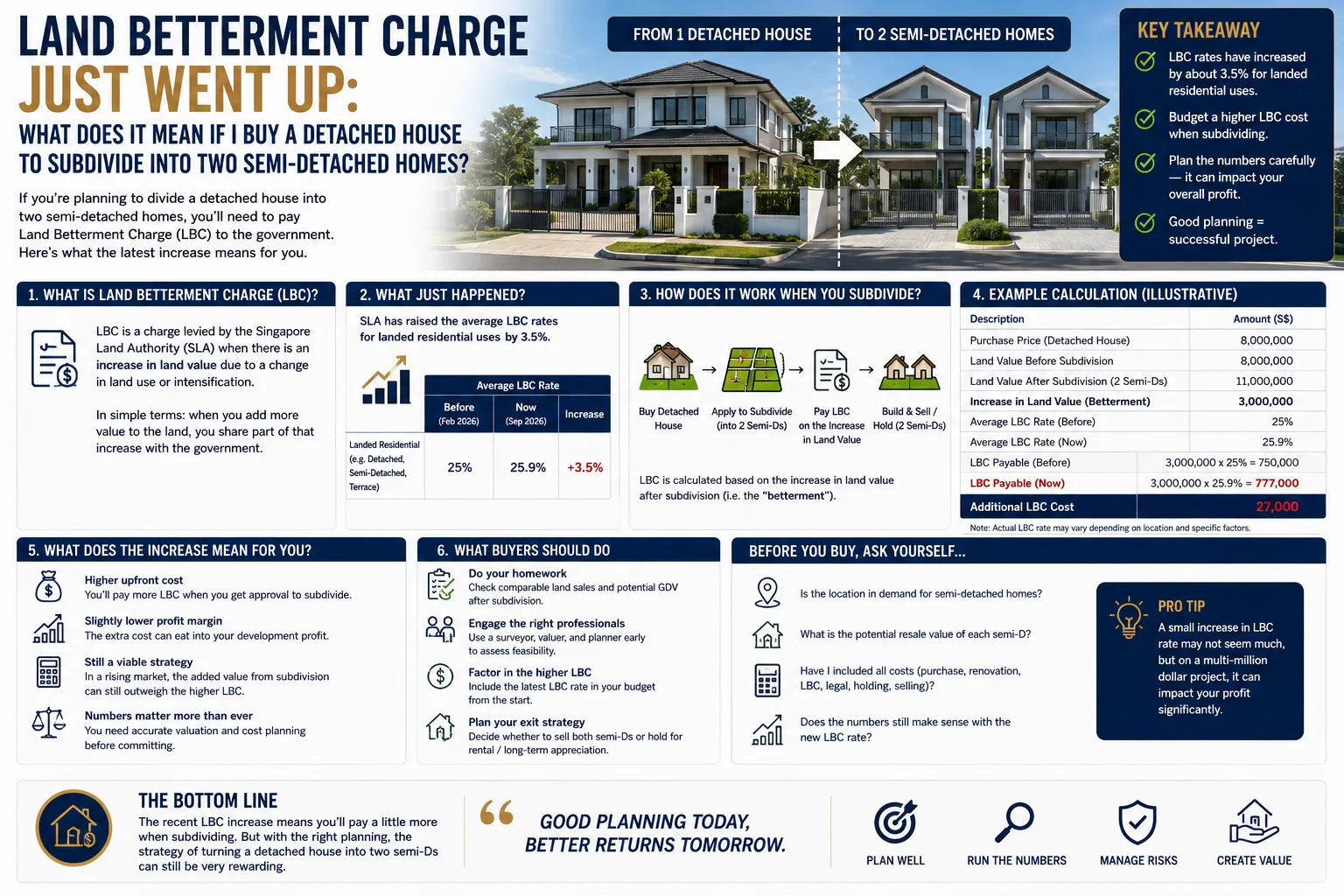
Every six months, Singapore reviews something called the Land Betterment Charge, or LBC.
Most ordinary home buyers probably don't pay much attention to it.
I don't blame them.
Even the name sounds like something meant for developers, architects and valuers rather than someone buying a home.
But if you are looking at landed property, particularly a large detached house with the intention of subdividing the land and redeveloping it into two semi-detached houses, this is something worth understanding.
From 1 September 2026, the Government has increased Land Betterment Charge rates again.
For landed residential property, LBC rates have increased by an average of:
3.5%.
For non-landed residential property, the average increase is:
3.4%.
For landed housing specifically, rates increased in 108 of Singapore's 118 geographical sectors, generally by around 2% to 8%, while 10 sectors saw no change.
So what exactly does this mean?
More importantly:
Does buying a detached house and subdividing it into two semi-Ds just become more expensive?
Potentially.
But it is not as simple as saying:
“LBC went up 3.5%, therefore my development cost went up 3.5%.”
Let me explain.
First: What Is Land Betterment Charge?
Forget the technical language for a moment.
Think about a piece of land.
Today, that land may have a certain approved use and development intensity.
Then you obtain planning approval that allows you to do something that increases the value of the land.
The Government may collect part of that increase in land value through:
Land Betterment Charge.
LBC is therefore not simply another stamp duty that everybody pays when buying property.
It arises in connection with certain chargeable planning permissions or consents that enhance the land's development value.
URA explains that LBC may be determined using either prescribed Table of Rates or, in applicable situations, a Valuation Method based on the increase in land value determined by the Chief Valuer.
The rates vary according to:
what the land is used for
and
where the property is located.
Singapore is divided into 118 geographical LBC sectors.
Landed residential property falls under:
Use Group B1 — Residential (Landed).
So two landed properties in different parts of Singapore can face different applicable LBC rates.
Why Did LBC Rates Increase On 1 September 2026?
The simplest explanation is:
land values have remained firm.
LBC rates are reviewed every six months by the Singapore Land Authority in consultation with the Chief Valuer.
The rates take into account prevailing land values and recent land transactions.
For the six months beginning 1 September 2026, landed residential LBC rates have increased by an average of 3.5%.
This follows another increase in March 2026, when landed residential LBC rates increased by an average of 4%.
So this isn't occurring in isolation.
The Government's underlying land-value benchmarks have been moving upwards.
For someone like me who spends a lot of time looking at landed houses, that is worth paying attention to.
But Please Don't Misunderstand The 3.5%
This is probably the most important thing in this article.
If you buy a:
$10 million detached house,
you DO NOT automatically pay:
3.5% × $10 million = $350,000
in additional LBC.
That is not how this works.
The announcement means the prescribed LBC rates for landed residential use increased by 3.5% on average across Singapore.
Your actual situation depends on things such as:
the property's geographical LBC sector;
its existing approved development;
what you are proposing to do;
whether the proposal creates a chargeable land-value enhancement;
the applicable planning permission;
and the assessment methodology.
So don't simply add 3.5% to your landed redevelopment budget.
Now Let's Come To The Interesting Part: Subdividing A Detached House
This is increasingly something I encounter when analysing larger landed plots.
Imagine I find:
One old detached house
on approximately:
9,000 sq ft of freehold land.
Instead of asking:
“Is this bungalow worth $X million?”
I may immediately start asking another question:
Can this land become two semi-detached houses?
Because that completely changes how I look at its value.
If the site works, the buyer might potentially:
buy one large old house,
redevelop it,
subdivide the land,
build two semi-detached houses,
keep one,
and eventually sell the other.
Or a developer might simply build and sell both.
That creates a completely different residual land-value calculation.
But before you get excited, there are several hurdles.
A Big Plot Doesn't Automatically Mean You Can Split It
This is a very common misconception.
Someone sees:
8,000 sq ft land.
Then thinks:
“Great. Split into two 4,000 sq ft semi-Ds.”
Unfortunately, landed redevelopment doesn't work like cutting a cake.
URA's prevailing landed housing controls look at things such as:
net plot area,
plot width,
configuration,
road reserve,
drainage reserve,
setbacks,
access,
and the applicable landed housing controls for that location.
For a conventional side-to-side semi-detached house, URA's current general minimum is:
200 sqm of land per plot
or approximately:
2,153 sq ft
with a minimum plot width of:
8 metres.
And importantly, these requirements refer to the net site after land required for matters such as Road Reserve or Drainage Reserve has been excluded.
So headline land area alone tells me very little.
This Is Why Frontage Can Be More Important Than Land Size
Suppose House A has:
9,000 sq ft of land
but relatively narrow frontage.
House B has:
8,000 sq ft
but beautiful wide frontage and a regular rectangular plot.
For subdivision purposes?
I may actually prefer House B.
Why?
Because after splitting the site, I need both resulting plots to work.
I need usable width.
I need proper access.
I need setbacks.
I need practical building footprints.
And I need the proposed development to comply with URA requirements.
This is why I always say:
Landed property is not simply $PSF × land area.
The configuration of the land can materially change what that land is worth.
So Where Does LBC Come Into This?
This is where buyers need to be careful.
Suppose you are buying that old detached house specifically because your investment thesis is:
“I can turn one house into two.”
You shouldn't merely calculate:
Purchase price
BSD
architect
demolition
construction
=
total cost.
You also need your professional team to establish whether the redevelopment/subdivision proposal creates an LBC liability and, if so, approximately how much.
Because if there is a significant LBC payable, that directly affects your project economics.
And from 1 September 2026, the relevant landed residential rates have generally moved higher.
A Simple Hypothetical Example
Let's use a simplified example.
You find an old detached house.
Existing Property
Land: 9,000 sq ft
Tenure: Freehold
Existing use: One detached house
Purchase price: $9 million
Your idea:
Subdivide and build two semi-detached houses.
On paper it looks fantastic.
Perhaps you estimate that each completed semi-D could eventually be worth:
$7 million.
Two houses:
$14 million GDV.
Immediately your brain starts calculating:
“Buy at $9m, build two houses and eventually I have $14m of property!”
Not so fast.
Your Real Calculation Looks More Like This
You have:
Purchase price
plus
Buyer's Stamp Duty
plus
legal fees
plus
financing cost
plus
architect and consultants
plus
demolition
plus
construction
plus
survey/subdivision costs
plus
authority requirements
plus
potential road/drainage implications
plus
potential LBC
plus
contingency
plus
time.
Suddenly the $5 million difference between:
$9m land
and
$14m completed value
doesn't look like $5 million profit anymore.
That is why redevelopment buyers should work backwards.
The Question Should Be: What Is My Residual Land Value?
Instead of asking:
“Seller wants $9 million. Is that reasonable?”
I would ask:
“What is the maximum I can pay for this site after accounting for everything required to realise its redevelopment potential?”
Start from your realistic completed values.
Then deduct:
construction,
professional fees,
financing,
taxes,
potential LBC,
contingencies,
marketing/selling expenses,
and the return you require for taking the development risk.
Whatever remains is approximately what the land is worth to you.
This is very different from simply looking at neighbouring landed transactions.
Why The Latest 3.5% Increase Matters
On its own?
Probably not enough to destroy a good redevelopment opportunity.
But development feasibility often works on margins.
Imagine a site where your numbers are already tight.
Then:
construction cost increases,
financing costs change,
your architect discovers a Road Reserve,
your achievable built-up area is lower than expected,
your expected selling price is slightly optimistic,
and your LBC assessment comes in higher than expected.
Individually, none of these may kill the deal.
Collectively?
They can.
That's why the September 2026 increase matters.
It is another reminder that:
the cost of unlocking land value is not static.
There Is Also A Bigger Signal Here
I actually find the LBC revision interesting beyond the immediate cost.
Why?
Because SLA's rates are reviewed in consultation with the Chief Valuer and take prevailing land values into consideration.
Landed residential rates increased:
3% on average in March 2025,
then only 0.4% in September 2025,
then 4% in March 2026,
and now another:
3.5% from September 2026.
To me, this reinforces something we are already seeing on the ground.
Landed land values remain firm.
That doesn't mean every landed property is worth more.
And it definitely doesn't mean you should pay whatever the seller asks.
But the underlying scarcity of landed residential land remains very real.
Why Large Detached Plots Can Be Particularly Interesting
This is also why I find some older detached houses fascinating.
Sometimes buyers walk into an old bungalow and see:
an outdated kitchen,
30-year-old tiles,
an old roof,
strange bedrooms,
and a house requiring $1 million or more of work.
They conclude:
“This house is terrible.”
I may be looking at exactly the same property and thinking:
“Forget the house. What can the land become?”
That is a completely different valuation framework.
If the plot can legally and practically support redevelopment into multiple valuable landed homes, the existing building may have very little relevance.
You are buying:
development potential.
But Don't Pay For Subdivision Potential Before Confirming It
This is probably my biggest warning.
I've encountered buyers who look at a large plot and immediately price in:
“can subdivide.”
Sometimes even the seller is asking a premium because:
“Developer can split into two.”
My response is always:
Show me.
Can the plot dimensions work?
What is the net land area?
Any Road Reserve?
Any Drainage Reserve?
What is the frontage?
What landed housing form is permitted?
Can both resulting plots meet the relevant controls?
What are the setbacks?
What does the Qualified Person say?
And now:
What is the potential LBC implication?
Until these are reasonably established, I would not pay a developer's price for a site based merely on theoretical redevelopment potential.
Detached To Two Semi-Ds: The Simple Buyer Checklist
If I were evaluating a detached house specifically for subdivision into two semi-detached homes, I would investigate these issues before committing to the purchase:
Gross land area — what does the title actually show?
Net usable land area — what remains after any Road Reserve or Drainage Reserve?
Frontage — is there sufficient width to create two practical plots?
Plot shape — rectangular, trapezoidal, triangular or irregular?
URA planning controls — what landed form can actually be developed?
Minimum plot requirements — can each resulting plot satisfy the applicable requirements?
Vehicular access — can the proposed houses be properly accessed?
Setbacks and road buffers — how much building footprint remains?
Building envelope — what can actually be constructed?
Potential LBC — does the proposal trigger a charge and what is the estimated exposure?
Construction cost — what does building two houses actually cost today?
Exit value — what are completed semi-Ds genuinely selling for, not merely asking?
Only after that do I know what I am really buying.
What Should A Buyer Do Before Exercising The OTP?
For a normal family buying a landed house to stay in, you may not need to go through this entire exercise.
But if subdivision forms a material part of why you are paying the asking price, I would involve professionals early.
At minimum, speak with an experienced:
landed architect / Qualified Person,
and where appropriate:
Registered Surveyor, Professional Engineer and property/legal advisers.
For more complex cases, get professional advice on the potential LBC position rather than trying to calculate it from an online table yourself.
URA's subdivision process itself requires plans prepared by a Registered Surveyor and declarations involving the Qualified Person.
This is not something I would leave until after buying the property.
What Does The 1 September 2026 LBC Increase Mean For Landed Buyers?
For the normal person buying a terrace to stay in?
Probably very little immediately.
You should not suddenly panic because:
“LBC increased 3.5%!”
But for buyers looking at:
large redevelopment sites,
old detached houses,
subdivision opportunities,
changes in development intensity,
or sites where value depends heavily on planning potential,
the latest revision deserves attention.
Because you are no longer simply buying a house.
You are buying land together with the rights and limitations attached to that land.
And those rights have an economic value.
My Take: This Makes Due Diligence Even More Important
As landed prices rise, buyers naturally become more creative.
Instead of paying $8 million for a completed semi-D, perhaps you start thinking:
“Can I buy an old detached house with my brother and build two?”
Or:
“Can I buy one large house, split it, sell one side and keep the other?”
These can be very good strategies.
I actually think there will continue to be opportunities in this space.
But the more complicated the strategy, the less useful a simple:
“neighbour sold at $2,200 psf land”
comparison becomes.
You need to understand:
what the land can become.
Then understand:
what it costs to make it become that.
LBC is simply one part of that equation.
One Last Thing: Don't Confuse Potential With Value
This is something I have become increasingly conscious of when walking landed houses.
A seller may say:
“9,000 sq ft! Can build two semi-Ds!”
That sounds exciting.
But theoretical potential has no value to me unless I can actually realise it economically.
If I have to pay:
a huge premium for the land,
more LBC,
more construction,
more financing,
and wait three years,
only to produce two houses worth barely more than my total cost—
then the redevelopment potential isn't an opportunity.
It is just an expensive idea.
On the other hand, if the plot works beautifully, the frontage works, subdivision is feasible, costs are manageable and the finished semi-D values comfortably support the numbers?
Then an ugly old detached house may actually be one of the most interesting properties in the neighbourhood.
That's the beauty of landed property.
Sometimes the house you see isn't really what you are buying.
You are buying what the land can become.
And from 1 September 2026, the price of unlocking some of that potential has just moved a little higher.
Want the tailored version for your portfolio?
Every article here generalises. A 20-minute conversation makes it specific to your numbers.
What is Land Betterment Charge in Singapore?
Did landed residential LBC increase on 1 September 2026?
Does this mean landed property prices increased by 3.5%?
If I buy a $10 million landed property, do I pay another 3.5% LBC?
Does every landed redevelopment incur LBC?
Can I subdivide a detached house into two semi-Ds?
What is the minimum size of a semi-detached plot?
If I own 8,000 sq ft, can I automatically split it into two 4,000 sq ft plots?
Does LBC affect freehold property?
Should I calculate LBC myself before buying?
Is the latest LBC increase bad for landed property?
What is the biggest mistake when buying a detached house for subdivision?

Written by
Christopher Ng (CEA R014394H)
Singapore Property & Asset Progression Strategist with ERA Realty Network. A NUS Real Estate graduate, Christopher has advised homeowners, investors and property owners since 2004.