
Chuan Grove GLS: Everything We Know About the Upcoming Lorong Chuan Condo
Discover Chuan Grove, an upcoming 1,055-unit condo development in Lorong Chuan. This large project by Sing Holdings and Sunway could transform the area into a new private residential cluster.
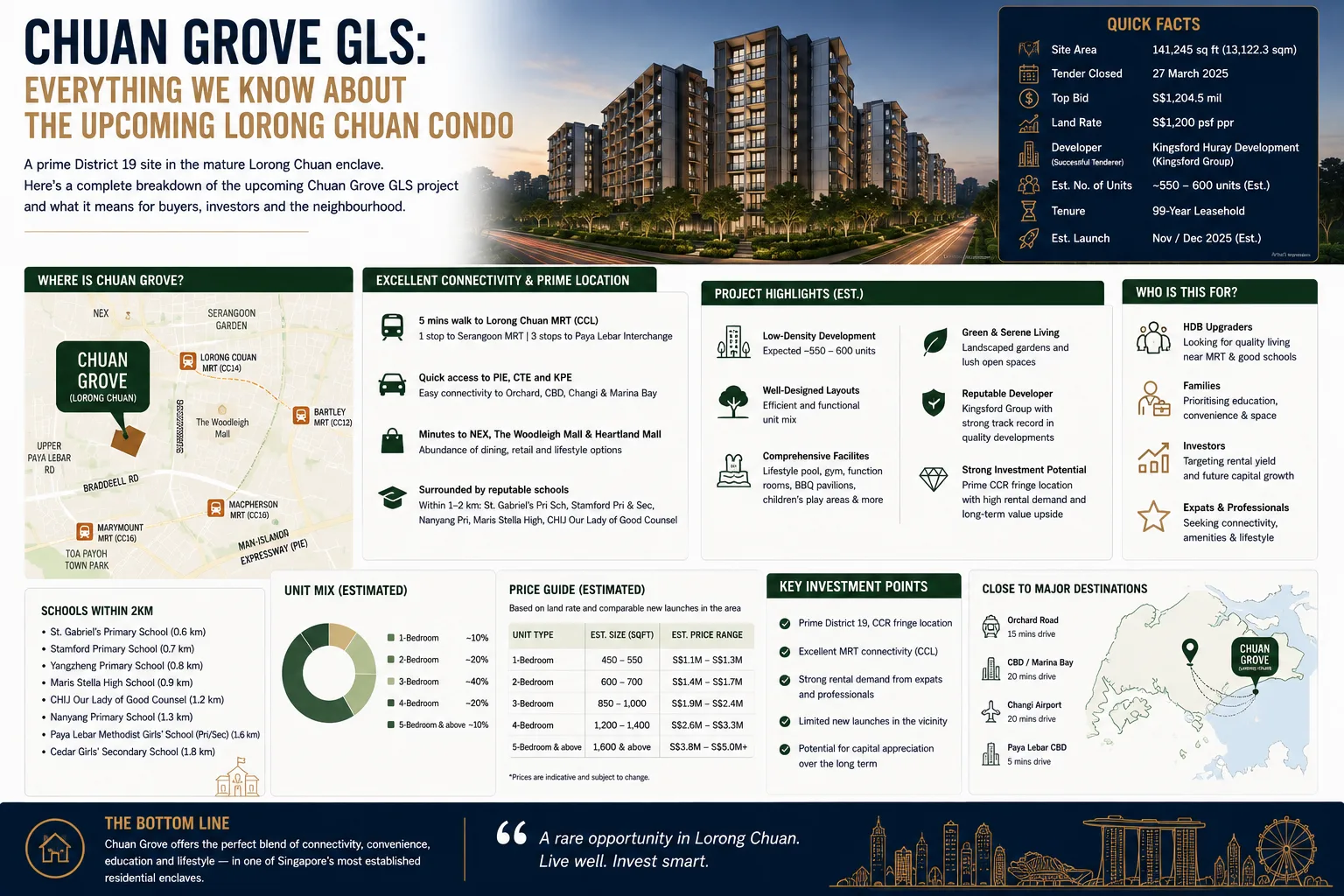
Lorong Chuan is about to get very interesting.
For years, this was one of those established residential neighbourhoods that everybody knew, but where new private housing supply was relatively limited.
Then came Chuan Park.
Its strong sales performance reminded developers and buyers that there is still substantial demand for new homes in this part of District 19.
Now comes the next chapter:
Chuan Grove.
And this one is considerably bigger.
What originally started as two separate Government Land Sale parcels is now expected to become one large development of approximately 1,055 homes, because the same Sing Holdings–Sunway joint venture successfully acquired both adjacent sites.
There is also something else buyers need to know.
Another Chuan Grove site capable of yielding around 935 homes has now been placed on the 2H 2026 GLS Reserve List.
So this isn't merely the story of one upcoming condo.
We may actually be witnessing the creation of a new private residential cluster around Lorong Chuan.
That is why I think Chuan Grove deserves a much deeper look.
Chuan Grove at a Glance
Here is what is confirmed or currently disclosed as at 1 September 2026:
Chuan Grove | |
|---|---|
Location | Chuan Grove / Lorong Chuan, District 19 |
Tenure | 99 years |
Developers | Sing Holdings & Sunway Developments |
Approx. site area | 326,639 sq ft combined |
Approx. GFA | 979,924 sq ft |
Expected units | Around 1,055 |
Proposed blocks | 5 blocks, up to 27 storeys |
Nearest MRT | Lorong Chuan MRT, about 400m |
Combined land cost | About $1.3275 billion |
Combined land rate | About $1,355 psf ppr |
Construction | Targeted to commence in 2H 2026 |
Launch price | Not announced yet |
Sing Holdings' 2026 AGM materials confirm the combined site area, total land cost and $1,355 psf ppr land rate, while Sunway says the developers intend—subject to approvals—to combine the two plots into one approximately 1,055-unit development across five blocks of up to 27 storeys.
One important clarification: “Chuan Grove Residences” is currently a commonly used working/search name, rather than a confirmed official project name. Buyers should expect the final branding to be announced closer to the actual launch.
How Did One Developer End Up With Both Chuan Grove Sites?
This is actually one of the most interesting parts of the project.
The first Chuan Grove parcel attracted seven bids in July 2025.
Sing Holdings and Sunway submitted the highest bid:
$703.6 million
or:
$1,376 psf ppr.
That bid was 7.3% higher than the second-highest offer, indicating that the joint venture was prepared to be relatively aggressive to secure the site.
At that point, Sing Holdings said it intended to develop around 550 homes across three towers.
Then something more interesting happened.
Two months later, the adjacent Chuan Grove parcel closed.
Five developers competed.
And Sing Holdings–Sunway won again.
This time they paid:
$623.91 million
or:
$1,331 psf ppr.
The second site was originally estimated to accommodate approximately 505 homes.
So the same developer suddenly controlled both neighbouring sites.
Combined:
Land cost: approximately $1.328 billion
Average land rate: approximately $1,355 psf ppr
Site area: approximately 326,639 sq ft
GFA: approximately 979,924 sq ft
Potential homes: approximately 1,055
That gives the developer something very valuable:
control of the entire development story.
Rather than having two competing projects sitting beside each other, they can potentially plan one coherent estate.
I like that.
Why Would The Developer Want Both Sites?
There is an obvious economy-of-scale argument.
One larger project allows:
a larger facilities footprint,
better landscape planning,
more unit diversity,
potentially more efficient construction,
larger marketing scale,
and more flexibility in pricing different stacks and unit types.
But I think there is another advantage.
The developer controls its immediate competition.
Imagine if Developer A had Parcel 1 and Developer B owned Parcel 2.
Both projects launch within months of each other.
Both fight over:
the same buyers,
the same agents,
the same schools story,
the same MRT story.
Instead, Sing Holdings and Sunway have effectively secured the entire immediate pipeline.
From a developer perspective, that is strategically quite powerful.
Who Are Sing Holdings And Sunway?
Sing Holdings is a Singapore-listed property developer with a track record that includes projects such as North Gaia EC, Parc Botannia and The Laurels.
Sunway Developments is part of Malaysia's Sunway Group and has participated in numerous Singapore residential developments. Its Singapore portfolio includes projects such as The Continuum, Terra Hill and Novo Place.
The joint venture is structured 65% Sing Holdings and 35% Sunway Developments.
For Chuan Grove, I think the bigger point is not whether buyers consider one developer more prestigious than another.
It is the scale of commitment.
Buying nearly $1.33 billion of land in one location is not a small bet.
They clearly have conviction about Lorong Chuan.
Location: Why Lorong Chuan Works Better Than People Sometimes Realise
Lorong Chuan is one of those locations that does not always sound as glamorous as:
Bukit Timah,
River Valley,
Holland,
or East Coast.
But put it on the map.
Suddenly it becomes quite compelling.
Lorong Chuan MRT sits on the Circle Line.
One stop one way brings you to:
Serangoon MRT, connecting to the North East Line and NEX.
One stop the other way brings you to:
Bishan MRT, connecting to the North-South Line and Junction 8.
That is an unusually useful location.
You are not dependent on one MRT line.
You are effectively one station away from two major interchanges.
And The Circle Line Just Became Much Better
This is one of the biggest changes since Chuan Park originally launched.
On 12 July 2026, Circle Line Stage 6 opened.
Keppel, Cantonment and Prince Edward Road stations completed the missing section between HarbourFront and Marina Bay, finally closing the full Circle Line loop.
The completed Circle Line now spans 33 stations and connects with every existing MRT line through 12 interchange stations.
This matters for Chuan Grove because:
the infrastructure story is no longer future promise.
It has happened.
Someone buying Chuan Grove isn't buying because:
"Circle Line will become better one day."
They can use the completed line today.
That is a meaningful distinction when comparing projects marketed on transport improvements that may still be six or ten years away.
Approximately 400 Metres From Lorong Chuan MRT
Sunway states that the first Chuan Grove parcel is within approximately 400 metres of Lorong Chuan MRT station.
That isn't integrated.
It isn't literally downstairs.
But to me, it is comfortably within what most buyers would regard as a genuinely walkable MRT proposition.
And remember the surrounding context.
The immediate area isn't some new estate waiting 15 years for amenities to arrive.
This is already a mature residential neighbourhood.
The Amenities Story Is Actually Quite Balanced
Immediately around Chuan Grove you have New Tech Park and NTP+.
Then slightly farther out:
NEX at Serangoon.
Junction 8 at Bishan.
Serangoon Gardens.
The Woodleigh Mall.
Heartland shops and food around Serangoon and Bishan.
This is not the Orchard Road definition of convenience.
But for family living?
I find it practical.
You have neighbourhood amenities close by while two major regional centres—Bishan and Serangoon—sit one MRT stop away.
The School Story Could Be One Of Chuan Grove's Biggest Strengths
The Lorong Chuan/Bishan/Serangoon belt is already a very established family area.
Schools around the Chuan Grove vicinity include St Gabriel's Primary, Kuo Chuan Presbyterian Primary, CHIJ Our Lady of Good Counsel and Yangzheng Primary, while Nanyang Junior College is also close by. The Australian International School is another major institution in the immediate area. Exact Primary 1 eligibility should always be checked against the final project address using MOE's official distance tools rather than relying solely on portal estimates.
I think this matters because I expect Chuan Grove to be an overwhelmingly family-driven project.
The location naturally lends itself to:
HDB upgraders,
existing private owners,
families wanting schools,
and households already staying in the Bishan–Serangoon–Hougang–Toa Payoh belt.
Chuan Park Gives Us Something Very Valuable: Actual Evidence
Usually, when analysing an upcoming GLS launch, we have to guess how the micro-market will react.
Here?
We have a live experiment next door.
Chuan Park.
Chuan Park has 916 units and is only a short distance away.
It launched in late 2024 and has subsequently sold extremely well.
By mid-2026, roughly 96% of the project's 916 units had been sold, according to recent market trackers.
That is important.
It demonstrates that buyers are willing to commit to:
Lorong Chuan,
99-year tenure,
large project format,
and new-launch pricing in this location.
And Chuan Park Prices Have Continued Moving
Recent Chuan Park transactions give us another useful reference.
In August 2026:
a 1,206 sq ft 3-bedroom sold at about $2,752 psf,
another similar-sized unit transacted around $2,784 psf,
while a larger 1,485 sq ft unit transacted around $2,386 psf.
This tells us something quite important.
The Chuan Grove developer isn't launching into an area where new homes are still trading at $2,100–$2,200 psf.
Some Chuan Park transactions are already well into the mid-to-high $2,000s psf.
That will influence how Chuan Grove is positioned.
So What Could Chuan Grove Cost?
This is probably the question everybody wants answered.
And the answer today is:
We don't know yet.
There is no official price list.
So anything you see online today should be treated as a forecast.
The combined land cost is approximately:
$1,355 psf ppr.
When the first parcel tender closed, market commentary suggested a potential launch level starting around $2,700 psf, although that was an early estimate before the final combined development had been determined.
My own view?
I would not be surprised if the eventual project establishes pricing somewhere broadly within the mid-$2,000s into the high-$2,000s psf, depending heavily on:
unit size,
floor,
facing,
layout,
launch phase,
and developer pricing strategy.
But I would not anchor too heavily on one average PSF today.
What interests me more is the price gap against Chuan Park.
The Most Important Pricing Question Isn't “What PSF Is Chuan Grove?”
The question I will ask when the price list arrives is:
How much more am I paying over Chuan Park — and what am I getting for that premium?
Suppose an equivalent Chuan Park unit trades at:
$2,600 psf.
And Chuan Grove launches at:
$2,700 psf.
A 4% premium?
Very interesting.
What if Chuan Grove comes in at:
$3,000 psf?
Now the conversation changes.
The buyer needs to believe that:
newer completion,
layout,
project design,
specific facing,
and future resale positioning
justify a very substantial premium.
This is why I don't believe in analysing new launches based only on:
“Developer land cost expensive, therefore property will appreciate.”
Entry price still matters.
Always.
Could Chuan Grove Actually Benefit Chuan Park?
I think so.
This works both ways.
If Chuan Grove eventually establishes higher launch pricing, it creates a new reference point for Chuan Park.
Imagine future buyers seeing:
New Chuan Grove: $2,8xx psf.
Relatively new Chuan Park resale: $2,5xx–$2,6xx psf.
Some buyers may naturally say:
“Maybe Chuan Park is better value.”
That can support Chuan Park's secondary market.
At the same time, if Chuan Park resale remains too close to Chuan Grove new-launch pricing, buyers might instead choose brand new.
The two developments will eventually form a pricing relationship.
This is why I think Chuan Grove will help re-rate the Lorong Chuan micro-market.
There Is Another Chuan Grove Site Coming
This is perhaps the most important fact buyers should know that isn't being discussed enough.
Under the 2H 2026 GLS Programme, another Chuan Grove site has been placed on the Reserve List.
The site is approximately:
3.18 hectares
with proposed plot ratio:
2.5
and an estimated yield of:
935 homes.
It is expected to be made available for application from October 2026. Because it is on the Reserve List, it does not automatically mean the site will be launched immediately; a developer application or government decision is needed before a tender proceeds.
This changes the long-term supply discussion substantially.
Chuan Grove May Eventually Become A 2,000-Home Story
Think about the numbers.
Current Chuan Grove development:
~1,055 units
Potential additional Chuan Grove Reserve List site:
~935 units
That is almost:
2,000 potential new homes
around the wider Chuan Grove area.
Add Chuan Park:
916 units.
Suddenly, this stretch of Lorong Chuan could eventually have close to 3,000 relatively new private homes from these developments alone.
Is that bad?
Not necessarily.
But buyers should understand it.
The Supply Debate: Competition Or Transformation?
This is where I think property analysis needs to be more nuanced.
If another 935-unit project eventually launches beside Chuan Grove, there will clearly be:
competition.
Future buyers will have more choices.
Future sellers will need to compete.
But more housing can also create:
greater neighbourhood activity,
more demand for amenities,
more retail,
more residents,
and potentially a stronger identity for the precinct.
The question isn't simply:
“More supply = bad.”
It is:
What kind of supply, when does it arrive, and at what future land cost?
That last point could become very important.
If the next Chuan Grove GLS site is eventually triggered and developers bid substantially above today's combined $1,355 psf ppr, it could create useful future replacement-cost support.
If the land sells cheaper?
That becomes a different signal.
This is one future tender I will definitely watch.
Who Is Chuan Grove Likely To Attract?
I expect the buyer pool to come primarily from surrounding owner-occupier markets.
Chuan Park's purchaser data already offers some evidence: among caveats tracked by OpenAgent, more than half were buyers previously owning private property, while roughly 22% came from HDB addresses.
That makes intuitive sense.
Think:
Bishan HDB owners.
Serangoon HDB owners.
Toa Payoh owners.
Hougang and Ang Mo Kio families.
Existing condo owners nearby.
Serangoon Gardens landed families right-sizing.
Parents buying close to schools.
This is a very deep residential catchment.
And unlike a pure investment precinct, many of these households buy to stay.
That can make the market more resilient.
Is Chuan Grove An OCR Project?
Technically, yes.
It sits in the Outside Central Region.
But this is another example of why I don't love blindly grouping every OCR project together.
Lorong Chuan does not behave like an outer suburban fringe location.
It sits:
beside Bishan,
near Serangoon,
one MRT stop from two major interchanges,
with the Circle Line,
close to established landed housing,
and relatively close to the geographical centre of Singapore.
So while the classification says OCR, the location characteristics feel much more city-fringe / mature central-suburban to me.
And I think buyers will price it accordingly.
What Do I Like About Chuan Grove?
There are four things I find particularly interesting.
First is connectivity.
Lorong Chuan MRT is already operational and the Circle Line loop is now complete.
Second is proven demand.
Chuan Park has already demonstrated that buyers will pay substantial new-launch prices for the location.
Third is developer control of both adjacent plots.
This allows a more coherent large-scale development rather than two rival projects squeezed together.
And fourth is future land-price discovery.
The upcoming 935-unit Reserve List parcel gives us another future benchmark that could eventually tell us exactly how developers value Lorong Chuan after Chuan Park and Chuan Grove.
What Would I Be Careful About?
The biggest risk is obvious:
price.
If Chuan Grove launches too aggressively relative to Chuan Park and other District 19 alternatives, buyers may be paying away too much future upside.
The second risk is:
supply.
A 1,055-unit project itself is large.
Another potential 935 homes could eventually arrive.
Third:
certain stacks may face different site conditions, including proximity to surrounding roads and existing non-residential uses.
And fourth:
with more than 1,000 units, unit selection becomes extremely important.
Two buyers can purchase in the same development and achieve very different outcomes depending on:
stack,
view,
floor,
layout,
and entry premium.
This links directly to something I have always emphasised in large projects:
Don't only buy the project. Buy the right unit within the project.
Large Project Or Too Large?
Some buyers dislike developments exceeding 1,000 units.
I actually think there are two sides to this.
The downside:
more competition when selling,
more identical units,
busier facilities.
The upside:
potentially lower maintenance cost per household,
full facilities,
strong transaction volume,
continuous resale price discovery,
and generally better resale awareness.
Mega-developments such as:
JadeScape,
Treasure at Tampines,
Florence Residences,
and Parc Esta
have shown that large projects can develop extremely liquid resale markets when the fundamentals and entry prices work.
So 1,055 units does not bother me automatically.
But again:
unit selection becomes more important.
Is Chuan Grove Good For Investors?
Potentially.
But I wouldn't approach it as a pure rental-yield play.
This isn't one-north.
It isn't Marina Bay.
It isn't an investor-heavy CBD project.
I think the investment thesis is more about:
owner-occupier depth + MRT + schools + mature estate + future replacement pricing.
That can actually be a very strong combination.
Because when you sell five or ten years later, you don't only want another investor calculating yield.
You want a family saying:
“I want to live here.”
What Would I Look For As An Investor?
Before I choose the smallest cheapest unit automatically, I would study the eventual unit mix carefully.
In family-driven neighbourhoods, the strongest resale product isn't always the smallest unit.
A well-designed:
3-bedroom,
compact family 3-bedroom,
or efficient 4-bedroom
at the right entry quantum could have a very strong future buyer pool.
The mistake is assuming:
smaller = easier to exit.
Sometimes the project has hundreds of identical small units competing against one another.
I'd rather identify the unit type where:
demand is broad but supply within the project is limited.
We can only properly answer that once the full site plan and unit mix are released.
When Will Chuan Grove Launch?
This is one area where buyers should distinguish confirmed information from speculation.
Sing Holdings has said construction is slated to begin in the second half of 2026, and the company is focusing on execution and launch preparation for the project.
However, an official public preview or launch date has not been announced as at 1 September 2026.
So I would treat any specific Q4 2026 launch date currently circulating online as an estimate, not confirmation.
Given the stage of the project, however, it is clearly becoming one of the important launches to watch moving into the coming months.
My Personal Take On Chuan Grove
The thing I like most about Chuan Grove isn't simply:
“near MRT.”
There are plenty of MRT projects.
It is the combination.
An established neighbourhood.
Circle Line.
One stop to Bishan.
One stop to Serangoon.
Strong family catchment.
Good schools.
Chuan Park has already proven demand.
The developer controls two adjacent sites.
And another future Chuan Grove plot may provide the next land-price benchmark.
That creates a very interesting property-market setup.
But that still doesn't mean:
“Must buy.”
The project has to be priced properly.
What Would Make Me Excited?
If Chuan Grove eventually launches with a reasonable premium over Chuan Park while offering better:
layouts,
site planning,
views,
facilities,
and a newer completion date,
I think it could be extremely attractive.
Especially if the next Chuan Grove land tender eventually establishes a higher land cost.
Then an early Chuan Grove buyer potentially benefits from:
buying before the next replacement-cost benchmark arrives.
That's the scenario I would be watching.
What Would Make Me Cautious?
If launch prices are pushed significantly ahead of current Lorong Chuan values simply because:
“new launch must be more expensive,”
then I would slow down.
At some point, buyers can simply buy:
Chuan Park,
other District 19 resale projects,
or compare other new launches elsewhere.
There must be a value gap.
Property investment isn't about buying the newest project.
It is about buying the future at a price that still leaves something for you.
The Bigger Story: Lorong Chuan Is Changing
This may ultimately be the most important takeaway.
Chuan Park was the first signal.
Chuan Grove is the next.
And the additional Reserve List site could create another chapter after that.
So when we talk about Chuan Grove, I don't think we are merely talking about:
one 1,055-unit condo.
We may be watching Lorong Chuan transition into a significantly larger and more prominent private residential node.
That can have implications for:
amenities,
prices,
resale liquidity,
rental demand,
and how buyers perceive the whole Bishan–Serangoon corridor.
And that is why Chuan Grove is a project I will be watching very closely.
My Final View
Chuan Grove has many of the things I like to see in a new launch:
proven surrounding demand, an operational MRT, established family catchment, strong connectivity, a major developer commitment and future land-price discovery still ahead.
But its greatest strength may also become its biggest challenge.
Lorong Chuan is going to receive a lot more housing.
So buyers should not simply ask:
“Is Chuan Grove a good project?”
I think it probably will be.
The more important question is:
“At what price does Chuan Grove become a good buy?”
That is the question I will be trying to answer once we finally see the site plan, floor plans and actual launch price.
Because the next phase of Lorong Chuan looks exciting.
The trick is making sure we buy into that future without paying for all of it upfront.
Want the tailored version for your portfolio?
Every article here generalises. A 20-minute conversation makes it specific to your numbers.
What is Chuan Grove GLS?
Is Chuan Grove Residences the official project name?
Who is developing Chuan Grove?
How many units will Chuan Grove have?
How much did the developers pay for the land?
How close is Chuan Grove to Lorong Chuan MRT?
Why is the Circle Line important to Chuan Grove?
Is Chuan Grove near Bishan and Serangoon?
How has Chuan Park performed?
How much will Chuan Grove cost?
Will there be another condo at Chuan Grove?
Is the future 935-unit Chuan Grove site bad for existing buyers?
Is Chuan Grove good for families?
Is Chuan Grove good for investment?
Is Chuan Grove better than Chuan Park?
What is the biggest risk for Chuan Grove?
What is the biggest opportunity?
Should buyers register early?

Written by
Christopher Ng (CEA R014394H)
Singapore Property & Asset Progression Strategist with ERA Realty Network. A NUS Real Estate graduate, Christopher has advised homeowners, investors and property owners since 2004.