
Lucerne Grand Sold 61% at Launch — But the 4-Bedroom Result Is the Number I'm Watching
Lucerne Grand sold 350 of 570 homes at launch at an average $2,480 psf. But the statistic I'm watching is the 87.2% take-up of its 4-Bedroom Premium units. Here's why it matters for future West-side projects and Singapore's 2027 launch market.
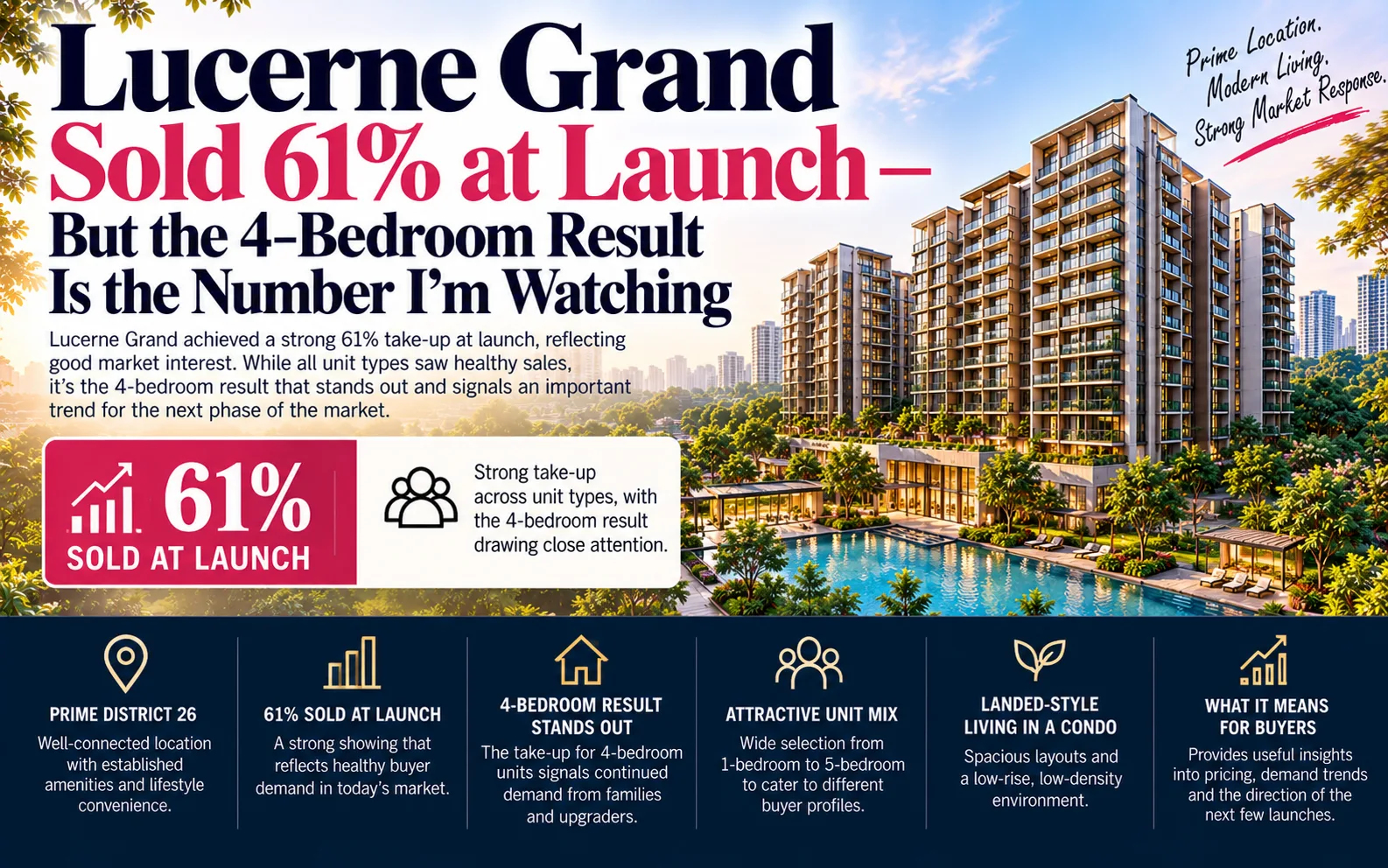
Lucerne Grand has officially launched.
And the headline number is a good one.
350 of 570 units sold over launch weekend.
That's approximately:
61%.
The project achieved an average price of approximately:
$2,480 psf.
About 93% of buyers were Singaporeans, with the remaining 7% Permanent Residents.
On the surface, the conclusion seems straightforward:
Lucerne Grand had a successful launch.
I agree.
But that's not actually the number I find most interesting.
Buried inside the sales results is another statistic that I think tells us much more about where Singapore's new-launch market may be heading.
41 of the 47 4-Bedroom Premium units were sold.
That's:
87.2%.
In other words, almost 9 out of every 10 4-Bedroom Premium units were taken up during launch.
And considering these homes started from approximately $2.788 million, I think that's worth paying attention to.
Because this isn't simply a Lucerne Grand story.
I think it tells us something about:
what buyers actually want,
where upgrader demand is coming from,
what future West-side launches need to get right,
and perhaps most importantly,
what developers launching projects in 2027 should be watching.
Lucerne Grand Launch Results At A Glance
Let's start with the numbers.
Lucerne Grand is a 570-unit, 99-year leasehold development at Lakeside Drive by CDL.
It is directly connected to Lakeside MRT and forms part of a mixed-use development that will include Lucerne Galleria, with supermarket, F&B and retail offerings.
Sales commenced on 3 October 2026.
By 6pm on 4 October:
Total units sold
350 / 570
Take-up
61%
Average project price
$2,480 psf
Singaporean buyers
~93%
PR buyers
~7%
CDL reported that two-, three- and four-bedroom premium units were among the most popular configurations.
But let's go deeper.
The Bedroom Breakdown Is More Interesting Than The 61%
According to launch-weekend transaction analysis:
2-Bedrooms
145 of 222 sold
Take-up:
65%
3-Bedrooms
157 of 253 sold
Take-up:
62%
4-Bedrooms
48 of 95 sold
Take-up:
51%
At first glance, you might therefore say:
“Chris, the 4-bedrooms didn't actually sell the best.”
Correct.
But now look inside the categories.
The standard 2-Bedroom sold:
84 of 96 — 87.5%.
And the 4-Bedroom Premium sold:
41 of 47 — 87.2%.
Those were the two highest proportional take-up rates among the major configurations reported.
That is fascinating.
Because the buyer choosing a 4-Bedroom Premium isn't buying the cheapest ticket into Lucerne Grand.
They're making a much larger financial commitment.
The 4-Bedroom Started From $2.788 Million
Before launch, CDL announced starting prices of:
2-Bedroom — 624 sq ft
From approximately $1.498 million
3-Bedroom — 883 sq ft
From approximately $1.988 million
4-Bedroom Premium — 1,152 sq ft
From approximately $2.788 million.
So we're not talking about buyers snapping up a cheap $1.5 million entry product.
We're talking about households prepared to commit:
around $2.8 million and upwards
for a family-sized home in Lakeside.
And 41 out of 47 of the entry 4-Bedroom Premium supply was taken up.
That's the number I think deserves more discussion.
Why Did The 4-Bedroom Premium Sell So Well?
I think several things came together.
And the first has nothing to do with Jurong Lake District.
1. Singapore Buyers Are Buying For Their Families Again
Look at who bought Lucerne Grand.
Approximately:
93% Singaporeans.
This isn't a launch dominated by foreign investors.
The project is also heavily oriented towards two-, three- and four-bedroom homes rather than tiny investor units.
The launch result therefore looks very much like an:
owner-occupier and upgrader market.
Huttons similarly observed that many buyers were from the West and buying for own stay, helping explain demand for the larger three- and four-bedroom units.
And that changes the way we should think about unit mix.
A family with two children isn't necessarily asking:
“What's the cheapest PSF?”
They're asking:
“Can we stay here for the next 10 or 15 years?”
That's a very different buying decision.
2. Four Bedrooms Solve A Real Upgrader Problem
Think about the typical family upgrading from an HDB.
Perhaps they are coming from:
a 4-room flat,
a 5-room flat,
an Executive Apartment,
or an Executive Maisonette.
One of the biggest challenges when upgrading into a modern condo is that:
the condo can actually feel smaller.
You may be upgrading in property value...
but downgrading in physical space.
That's uncomfortable.
A compact 2-bedroom may make sense to an investor.
A compact 3-bedroom may work for a young couple with one child.
But for a family with:
two children,
parents staying occasionally,
a helper,
work-from-home requirements,
or simply the desire to stay long term,
the fourth bedroom has real utility.
It can become:
a child's room,
a study,
a helper's room,
a guest room,
or simply future-proofing.
And I think more buyers are starting to understand this.
3. $2.788 Million May Have Hit An Important Quantum Sweet Spot
This is where pricing becomes very interesting.
A 4-Bedroom Premium started at approximately:
$2.788 million.
For a 1,152 sq ft brand-new home directly connected to Lakeside MRT, that created a fairly clear proposition.
It isn't cheap.
But buyers don't judge property in isolation.
They compare alternatives.
What else does approximately $2.8 million buy?
How large is the resale alternative?
What new launches elsewhere are available at the same quantum?
How far from MRT?
How old?
How much renovation?
And once the buyer reaches the conclusion:
“I can get a new 4-bedroom beside MRT for under $3 million,”
the psychological proposition becomes quite powerful.
I suspect the important number here wasn't $2,420 psf.
It was:
$2.788 million.
That's the quantum buyers actually have to fund.
4. Scarcity Probably Helped
Lucerne Grand only has:
95 four-bedroom homes
out of 570 units.
That's roughly:
17% of the project.
And within that:
4-Bedroom Premium
47 units
4-Bedroom Premium + Study
16 units
4-Bedroom Premium + Entertainment
32 units.
Compare that with the much deeper supply of 2- and 3-bedroom units.
If you specifically wanted a 4-bedroom, you knew the supply was limited.
This matters during launch.
Buyers can sometimes say:
“There are 100+ units of my 2-bedroom type. I'll wait.”
But when the layout you want only has 47 units?
The decision becomes more urgent.
Scarcity changes buyer behaviour.
5. The Product Wasn't Trying To Be Everything To Everyone
Another thing I find interesting about Lucerne Grand:
There are no 1-bedroom units.
The project starts from 2-bedroom.
That immediately tells you something about the intended buyer.
This is not primarily designed as a small-unit investor project.
The unit mix leans towards:
couples,
families,
upgraders,
and owner-occupiers.
And the launch result seems consistent with that positioning.
Sometimes developers try to optimise the number of saleable units by making everything smaller.
Lucerne Grand's result suggests there is still very strong demand for:
real family homes at the right quantum.
6. MRT + Retail + Family-Sized Unit Is A Very Strong Combination
Lucerne Grand has another advantage that shouldn't be underestimated.
It is directly connected to:
Lakeside MRT.
And the development includes Lucerne Galleria with supermarket, F&B and retail offerings.
For a family, this isn't an abstract investment story.
It's everyday life.
Children going to school.
Parents going to work.
Groceries.
Dinner.
Transport.
Weather.
Convenience.
This is why I think we need to distinguish between:
INVESTMENT AMENITIES
and
DAILY-LIFE AMENITIES.
A beautiful clubhouse is nice.
But MRT and supermarket?
You use them constantly.
For an owner-occupier planning to stay 10 years, that matters enormously.
What Does This Tell Us About The West?
This is where I think Lucerne Grand becomes more than just a launch report.
For years, Jurong Lake District has been marketed around:
Singapore's second CBD.
We've heard that story for a long time.
But property buyers eventually need more than a masterplan.
They need to put money down.
And Lucerne Grand just gave us a useful data point.
Buyers were willing to pay an average project price of:
$2,480 psf
for a new Lakeside project.
And 350 households committed during launch weekend.
That gives future West-side projects a new benchmark.
Lucerne Grand Didn't Launch Into An Empty Market
This is important.
There are already other relatively recent West-side new launches.
The LakeGarden Residences.
Sora.
J'den.
Published comparisons put The LakeGarden Residences' earlier launch pricing around the low-$2,000s psf, Sora around the low-$2,000s, while J'den achieved around $2,451 psf on its launch day.
Now Lucerne Grand has achieved an average project price around:
$2,480 psf.
So another pricing benchmark has been established.
And unlike a hypothetical analyst forecast:
buyers actually transacted.
That matters.
Does This Mean Every Future West-Side Launch Can Charge $2,500 PSF?
No.
Definitely not.
This is where developers and buyers need to be careful.
Lucerne Grand had several specific strengths:
direct MRT connectivity,
mixed-use convenience,
competitive land cost,
family-oriented layouts,
Jurong Lake District positioning,
and relatively attractive starting quantum.
CDL acquired the site for approximately:
$608 million
or:
$1,132 psf ppr.
That land basis gave the developer room to position the project competitively.
Future developers may not have that same advantage.
So don't simply take:
“Lucerne Grand = $2,480 psf”
and conclude:
“West side = $2,500 psf minimum.”
Property doesn't work like that.
In Fact, Lucerne Grand May Create A Problem For Some Future Developers
Here's the interesting part.
Lucerne Grand has now given buyers a benchmark.
Suppose another West-side project launches later.
The developer asks:
$2,800 psf.
What will the buyer ask?
“Why am I paying $300 psf more than Lucerne Grand?”
Maybe there's a good answer.
Better location.
Lower density.
Freehold.
Better school.
Superior product.
Different land characteristics.
But the developer now has to explain the premium.
That's why successful launches don't only help the market.
They also create comparison pressure.
And The 4-Bedroom Result May Influence Future Unit Mix
This is where I think developers planning 2027 projects should be paying close attention.
If 41 of 47 4-Bedroom Premium units can sell during launch weekend, while the project is overwhelmingly bought by Singaporeans and PRs, that's a strong signal that:
larger family-sized units have real demand.
It doesn't mean every development should suddenly build 40% four-bedders.
Location matters.
Quantum matters.
Layout matters.
Buyer catchment matters.
But it does challenge the idea that developers should simply make units smaller to keep headline quantum down.
There may be another strategy:
Keep the home usable — and price the quantum correctly.
Lucerne Grand suggests buyers may reward that.
What This Could Mean For 2027 New Launches
2027 is shaping up to be a very competitive launch year.
Current launch trackers already show a significantly broader pipeline of projects expected across Singapore in 2027. Exact launch dates remain fluid, but buyers are likely to have materially more choice than they have had in some recent periods.
That means developers cannot rely purely on:
“New launch.”
There will be too many new launches.
They will need differentiation.
And I think Lucerne Grand has just shown us four things that may matter.
Lesson 1: Quantum May Matter More Than Headline PSF
This is perhaps the biggest lesson.
A 4-bedroom at $2.788 million can sell strongly even at more than $2,400 psf.
Why?
Because buyers don't finance PSF.
They finance:
$2.788 million.
This is something I keep coming back to across my new-launch analysis.
Developers who manage:
QUANTUM + USABILITY
well may have a big advantage in 2027.
Lesson 2: Don't Underestimate The Family Buyer
For years, a lot of property discussion has centred around:
investors,
1-bedroom units,
rental yield,
small quantum.
But many of the strongest recent launches have reminded us that Singapore's new-launch market is still heavily supported by:
owner-occupiers and upgraders.
Lucerne Grand's 93% Singaporean buyer share reinforces that.
These buyers think differently.
They care about:
schools,
MRT,
space,
layout,
storage,
family growth,
and whether they can stay for 10 years.
2027 developers ignore that at their own risk.
Lesson 3: The 4-Bedroom Could Become The New Battleground
This is the SEO question I think very few people are asking yet.
Everyone talks about:
“What is the cheapest unit?”
I'm increasingly interested in:
“What is the cheapest good family-sized unit?”
Those are not the same question.
A well-priced 4-bedroom may actually have a stronger future resale proposition than a compromised small unit if the project eventually has:
lots of 2-bedders,
lots of 3-bedders,
but relatively few 4-bedders.
Scarcity within a large development matters.
And Lucerne Grand has just given us a useful real-world example.
Lesson 4: Buyers Will Compare Projects More Aggressively In 2027
This will be very important.
Imagine you're a buyer in 2027.
You may have multiple new launches available within months of each other.
So the conversation changes from:
“Should I buy a new launch?”
to:
“Which new launch gives me the best value?”
That's a much harder environment for developers.
And a much better environment for informed buyers.
Price gaps will matter.
Unit-type gaps will matter.
Land-cost differences will matter.
And projects will increasingly be compared on:
WHAT DOES $2 MILLION / $2.5 MILLION / $3 MILLION ACTUALLY BUY ME?
That's where I think 2027 becomes very interesting.
One Chuan Grove Is A Good Example
This is something I'm watching closely because I've been analysing One Chuan Grove extensively ahead of its targeted February 2027 launch.
The preliminary unit mix runs from 1-bedroom to 5-bedroom.
And one of the questions I'm already thinking about is:
How will the family-sized units be priced?
If Lucerne Grand can demonstrate strong demand for a 4-bedroom starting around $2.8 million, that becomes useful market evidence.
Not because Lorong Chuan and Lakeside are identical.
They aren't.
But because it tells us something about Singapore upgrader psychology.
Buyers will pay serious money for family space.
But the quantum must make sense.
That's something I'll be watching very closely when One Chuan Grove's official price list eventually arrives.
The Same Applies To Other 2027 Launches
This isn't just about One Chuan Grove.
Across Singapore, the 2027 pipeline means developers will be fighting for:
the same HDB upgrader,
the same condo upgrader,
the same young family,
the same $2–3 million budget,
and increasingly the same buyer who is willing to wait a few months for another project.
So I expect one of the defining questions of 2027 to become:
WHO GETS THE FAMILY BUYER RIGHT?
Not just:
Who has the nicest clubhouse?
Not:
Who has the most dramatic launch video?
But:
Who gives a family the best combination of:
space + location + connectivity + usability + quantum?
Lucerne Grand has just shown how powerful that combination can be.
Is 61% Sold Actually Good?
I think so.
But context matters.
350 homes sold over one launch weekend is substantial.
It shows there is still meaningful depth in Singapore's new-launch market when:
the location works,
the product works,
and buyers perceive the pricing as reasonable.
But I wouldn't take one project and conclude:
“The entire property market is booming.”
That's too simplistic.
A successful launch can tell us just as much about:
product-market fit
as it does about overall market sentiment.
And I think that's exactly what happened here.
The Number I Would Remember Isn't 61%
If you remember only one statistic from the Lucerne Grand launch, most people will remember:
61% sold.
I'll remember:
87.2% of the 4-Bedroom Premium units sold.
Because that tells me something more specific.
It tells me that buyers were willing to commit close to $3 million for:
space,
family usability,
MRT connectivity,
and a long-term own-stay proposition.
That is useful information.
For developers.
For agents.
For buyers.
And especially for anyone analysing the 2027 launch pipeline.
Final Thoughts: Lucerne Grand May Have Just Given Us A Preview Of 2027
The Lucerne Grand result isn't telling me:
“Everything will sell.”
It isn't telling me:
“The West is definitely going to $3,000 psf.”
And it definitely isn't telling me:
“Buy every 4-bedroom.”
What it is telling me is much more useful.
Buyers are still there.
But they're selective.
Family-sized demand is real.
But quantum matters.
Buyers will pay a premium.
But the product has to justify it.
And:
Bigger units are not necessarily harder to sell.
Sometimes scarcity, usability and the right price make them the units buyers fight for first.
As we head towards a much busier 2027 launch calendar, I think developers should pay very close attention to that.
Because next year, the winning project may not necessarily be the one with the lowest PSF.
It may be the project that best answers the question:
“What can my family actually buy for $3 million?”
Lucerne Grand has just shown us that when the answer is:
“A brand-new 4-bedroom directly connected to MRT.”
a lot of buyers are prepared to say:
Yes.
Want the tailored version for your portfolio?
Every article here generalises. A 20-minute conversation makes it specific to your numbers.
How many units did Lucerne Grand sell during launch weekend?
What was the average selling price at Lucerne Grand?
Which Lucerne Grand unit type sold best?
Why were Lucerne Grand 4-bedroom units so popular?
How many 4-bedroom units are there at Lucerne Grand?
What does Lucerne Grand's launch mean for Jurong property prices?
Does Lucerne Grand prove that larger units sell better?
What does Lucerne Grand mean for 2027 new launches?

Written by
Christopher Ng (CEA R014394H)
Singapore Property & Asset Progression Strategist with ERA Realty Network. A NUS Real Estate graduate, Christopher has advised homeowners, investors and property owners since 2004.