
Feng Shui and Landed Homes in Singapore: Should Buyers Really Consider It?
Many Singapore property buyers consider feng shui when choosing a landed home. This article explores how traditional beliefs often overlap with practical property concerns, guiding you through common considerations.
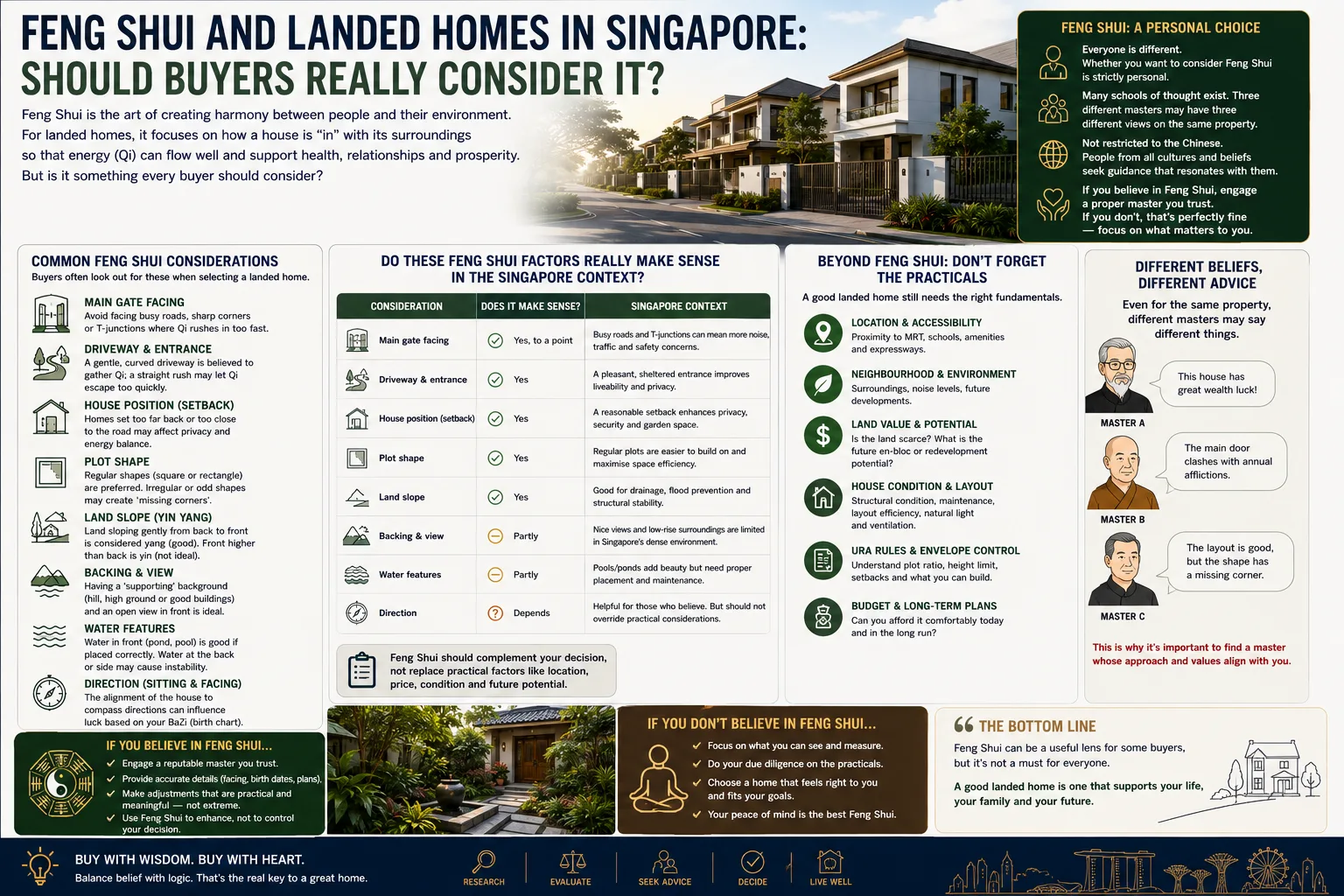
When I bring buyers to view landed homes, there are the usual questions.
How much land?
What is the frontage?
Is the plot regular?
How much will renovation cost?
Can we rebuild?
How far from school?
What are the comparable transactions?
And then, for some buyers, there is another question that matters just as much:
“How is the feng shui?”
My own view is quite simple.
Whether you want to consider feng shui is strictly personal.
Some people believe strongly in it.
Some don't believe in it at all.
Some are somewhere in between — they may not structure their entire property decision around feng shui, but they still prefer to avoid certain house configurations that make them uncomfortable.
And I think all three positions are perfectly reasonable.
What I would not do is pretend there is one universal feng shui checklist that tells everybody whether a landed house is good or bad.
There are different schools of thought.
Different masters.
Different methods.
And sometimes, three masters can walk into the same property and give you three very different opinions.
That is why, if feng shui matters to you, the more important question may not be:
“What does feng shui say?”
It may be:
“Which system and which person do I trust?”
Feng Shui Is Not Only A Chinese Thing
This is another interesting point I have encountered through my work.
People often associate feng shui purely with Chinese buyers.
But the underlying idea of evaluating a home according to orientation, energy, numbers, environment or spiritual principles is much broader than that.
I once had an Indian client who flew a guru in from India specifically to assess the landed house before committing.
On another occasion, I had a Singaporean Chinese lady buyer whose Jewish husband was from the United States.
Before confirming their property purchase, they actually brought in a practitioner specialising in Kabbalah numerology to evaluate the house.
Different culture.
Different framework.
Same fundamental concern:
“Is this the right home for us?”
That experience reinforced something for me.
Whether we call it feng shui, vastu, numerology, Kabbalah or something else, many people have their own framework for deciding whether a home feels aligned with them.
It isn't for the property agent to decide whether that belief is correct.
Our job is to understand that it matters to the client.
Why I Think Feng Shui Comes Up More Often For Landed Homes
Feng shui can obviously be considered for apartments too.
But landed homes bring another layer.
You are not only evaluating the internal unit.
You are evaluating:
the land,
the road,
the orientation,
the neighbouring houses,
the slope,
the shape of the plot,
the approach to the property,
the front door,
the garden,
the surrounding environment.
And unlike a condo, where moving the main entrance or completely reorienting the apartment may be impossible, landed property can sometimes be substantially altered.
You can potentially:
change the gate,
reconfigure the entrance,
move internal rooms,
adjust landscaping,
A&A,
or even rebuild the entire house.
That gives feng shui practitioners much more to work with.
It also means that when someone strongly believes in feng shui, I would rather understand the concerns before purchase rather than after the family has spent several million dollars and then starts trying to fix the property.
My Own Position On Feng Shui
Personally, feng shui forms part of my own landed-home selection process.
My first priorities remain:
budget,
location,
and whether there is value between the price and the address.
After that, feng shui becomes important to me.
Then comes something even harder to quantify:
my own feel for the property.
The vibes.
How I feel when I enter.
Whether I can imagine staying there.
That does not mean I abandon financial analysis.
A $7 million property that is clearly overpriced does not become a good investment because the feng shui master likes it.
Nor would I ignore a serious structural problem because somebody says the house is auspicious.
I see feng shui as one layer of the decision.
Not a replacement for:
valuation,
legal checks,
engineering,
URA planning,
or common sense.
The Important Thing: There Are Many Schools Of Feng Shui
This is where buyers sometimes get confused.
You search online and find:
House facing south = good.
Another article says:
South-west better.
Then someone talks about:
Flying Stars.
Eight Mansions.
Ba Zhai.
San Yuan.
San He.
Landform.
Period 9.
Personal birth elements.
Suddenly a simple house viewing becomes a philosophy degree.
The problem is that feng shui is not one single methodology.
Different practitioners may prioritise different things.
One might focus heavily on the external landform.
Another may look at orientation and time periods.
Another may personalise the analysis around the occupants.
So I think it is entirely possible for:
Master A to like the house,
Master B to dislike it,
and
Master C to say it can work after modifications.
This is why randomly collecting five opinions may actually make your decision worse.
At some point, you need to decide:
Who do I believe?
Some Common Feng Shui Considerations Buyers Ask About
Let me go through some of the things I commonly hear during landed house searches.
Not to tell you whether they are universally “good” or “bad”.
But to ask a more useful question:
Do these concerns have any practical relevance in Singapore even if you remove the feng shui interpretation?
Interestingly, quite a few do.
1. T-Junction Houses
This is probably one of the most famous feng shui concerns.
A house sits directly at the end of a road, with traffic effectively pointing towards it.
Traditionally, some practitioners consider this unfavourable because of the direct flow of energy towards the property.
But let's remove feng shui entirely.
Does a T-junction create practical concerns?
Potentially, yes.
You may experience:
car headlights shining directly into the home,
higher road noise,
vehicles approaching the property directly,
reduced privacy,
and theoretically a greater risk of a vehicle overshooting the junction.
So even a buyer who does not believe in feng shui may still prefer a different road position.
This is a good example where:
feng shui concern and practical property concern can overlap.
2. Cul-De-Sac / Dead-End Roads
Some people like cul-de-sacs because they are:
quiet,
private,
and have less through traffic.
Others may worry about energy becoming stagnant.
From a practical Singapore landed perspective?
I look at:
turning space,
visitor parking,
whether cars congest the end of the road,
and how easy it is to enter and exit.
A good cul-de-sac can be lovely.
A very tight one filled with parked cars can be annoying.
Again, I would evaluate the actual site rather than apply a blanket rule.
3. House Facing A Lamp Post, Tree Or Sharp Object
You will hear terms such as:
“poison arrow”
used when a structure points directly towards the entrance.
In Singapore, this could mean:
lamp post,
large tree,
neighbouring roof edge,
road sign,
or another structure.
From a practical perspective, I would still ask:
Does it obstruct the driveway?
Does it affect visibility?
Does the tree create maintenance issues?
Does the neighbouring structure reduce privacy?
Does it simply look unpleasant when you open the front door?
Even if you don't believe in the metaphysical reasoning, visual comfort matters.
4. Main Door Facing A Staircase
This is another common feng shui concern.
Practically, I also don't love certain staircase arrangements.
A staircase immediately dominating the entrance can:
reduce privacy,
make circulation awkward,
waste valuable floor area,
and cause the house to feel cramped.
In my landed viewing checklist, I already consider staircase placement very important because moving it later can become structurally expensive.
So whether your concern comes from feng shui or architecture, it is worth examining.
5. Main Door Facing The Back Door
Some feng shui practitioners dislike a straight-through configuration where you can see from the main entrance directly out the back.
The traditional explanation often relates to energy entering and leaving too quickly.
Architecturally, this may actually be attractive.
Long sightlines can make a terrace house feel spacious.
Cross ventilation can also be excellent.
So here is a good example where practical architecture and some feng shui interpretations may conflict.
What do you do?
If feng shui matters strongly to you, your practitioner may suggest:
screens,
furniture,
landscaping,
or a changed circulation arrangement.
If it doesn't?
You may actually love the openness.
That is why there is no generic correct answer.
6. West-Facing Houses
This gets lumped into feng shui discussions quite often.
But in Singapore, there is a very practical reason buyers care.
Heat.
Afternoon sun can be brutal.
Particularly on large landed facades.
So when someone says:
“I don't want west-facing.”
Sometimes it has nothing to do with feng shui.
They just don't want the master bedroom baking every afternoon.
But modern design can mitigate western exposure through:
deep overhangs,
screens,
landscaping,
insulation,
window specification,
and internal planning.
So I would not automatically reject the house.
I would understand exactly where the sun hits.
7. North-South Facing
Singapore property buyers love the phrase:
“North-south facing.”
It appears in countless advertisements.
Why?
Partly because of wind and sun patterns.
Partly because of traditional preferences.
But a compass direction by itself is not enough.
A “good facing” house beside a noisy expressway may still be inferior to another orientation on a beautiful internal street.
Similarly, an architect can design around orientation.
I treat direction as one factor.
Not the entire property thesis.
8. Sloping Land
Some feng shui practitioners pay considerable attention to whether land slopes:
towards,
away from,
or across a house.
Again, there are real practical implications.
Slope affects:
drainage,
retaining walls,
access,
construction cost,
and how the house relates to neighbouring plots.
A gently elevated home may feel wonderful.
A property sitting significantly below the road might make me uncomfortable even before anyone mentions feng shui because I immediately start thinking about:
water.
So landform deserves attention regardless of belief.
9. House At A Lower Level Than Neighbours
This is another common concern.
From a practical perspective, I want to understand:
privacy,
overlooking,
retaining walls,
water runoff,
and how future redevelopment next door could affect the property.
If both neighbours rebuild three-storey homes towering over your older two-storey house, your courtyard may suddenly feel much less private.
This isn't metaphysical.
It is simply good landed due diligence.
10. Plot Shape
Regular rectangular plots are commonly preferred in feng shui.
They're also preferred by:
architects,
developers,
buyers,
and valuers.
Why?
Because they're easier to use.
A triangular or severely tapered plot may contain the same 4,000 sq ft, but part of that land can be awkward.
So once again:
traditional preference and property economics overlap.
This is why I wrote an entire article on why two 4,000 sq ft landed plots can be worth very different amounts.
11. Road Curves And “Knife” Roads
Some practitioners consider houses sitting on the outside of a road bend less favourable.
From a practical perspective, the outside of a bend can receive:
more direct headlights,
faster vehicle approach,
different noise exposure.
The inside of a bend may have a different plot geometry.
Again, check the actual site.
Singapore's landed roads are too varied for one universal rule.
12. Drain, Canal Or Water Nearby
Water obviously has a huge role in traditional feng shui.
But in Singapore?
I would also care from a completely practical perspective.
Large drain or canal:
How does it affect view?
Smell?
Mosquitoes?
Flood resilience?
Privacy?
Future works?
URA / PUB planning?
You don't need to believe in feng shui to investigate those things.
13. Electrical Substation Or Transformer Nearby
Some buyers reject houses close to electrical infrastructure based on feng shui or health concerns.
From my perspective, I would simply assess:
visual impact,
noise where relevant,
resale perception,
and how future buyers may react.
Even if you don't care, future buyers may.
Perception becomes market value.
14. Places Of Worship, Cemeteries And Hospitals
This gets very personal.
Some buyers absolutely refuse.
Others genuinely do not care.
Places of worship may create:
traffic,
bells,
crowds,
events,
parking issues.
Hospitals may generate:
ambulance noise,
traffic,
or simply emotional discomfort for some buyers.
Cemeteries obviously have cultural implications for some.
Again:
There is no need for me as an agent to decide whether those beliefs are correct.
I need to understand:
Will this affect my client's willingness to live here and the future buyer pool?
That is property analysis.
15. House Number
This one is fascinating.
Some buyers will pay a premium for numbers they like.
Others reject:
4,
13,
or particular combinations.
Some love:
8,
18,
28,
Then someone practising a completely different numerology system tells you the opposite.
This is exactly why I would not Google:
“Best house number feng shui.”
The meaning may depend on the system being used and the occupants themselves.
And practically?
If you personally dislike the number, you may never stop thinking about it.
That alone could be enough reason not to buy.
What About Period 9?
Anyone researching feng shui today will very quickly encounter:
Period 9.
I am deliberately not going to turn this article into an explanation of Flying Star feng shui because that isn't my expertise.
But this illustrates why casual online feng shui can become dangerous.
You might read:
“Period 9 houses must face X direction.”
Then reject an otherwise excellent $6 million property based on one paragraph written for a completely generic audience.
A professional practitioner may consider:
the building's completion,
renovation history,
orientation,
occupants,
landform,
and many other variables.
If you believe in the system, let someone qualified interpret it properly.
Feng Shui Should Not Replace Structural Due Diligence
This is something I feel strongly about.
Suppose the feng shui master tells you:
“Excellent house.”
But the engineer finds serious structural movement.
Please fix the structural issue.
Suppose:
feng shui excellent,
but the asking price is $1 million above fair value.
You are still overpaying.
Suppose:
feng shui excellent,
but Road Reserve substantially affects your intended redevelopment.
The Road Reserve does not disappear.
That is why I see a landed buying decision as layers.
Layer 1: Financial
Can you afford it?
Is it fair value?
Layer 2: Property
Location.
Land.
Road.
Building.
Layer 3: Technical
Structure.
URA.
Approved plans.
Redevelopment.
Layer 4: Personal
Feng shui.
Lifestyle.
Feel.
Preferences.
All four can matter.
If You Believe In Feng Shui, Use It Early
This is where buyers make an avoidable mistake.
They view 30 houses.
Finally find:
the dream property.
Negotiate for two weeks.
Agree at $6.5 million.
Then:
“Tomorrow I bring feng shui master.”
Master comes.
Says:
“Cannot.”
Now everybody is emotionally exhausted.
If feng shui is going to be a deal-breaker, tell your agent early.
And involve your practitioner when a house becomes genuinely interesting — before you become too emotionally committed.
This can save tremendous time.
But Don't Bring The Master To Every House Either
Unless you want to bankrupt yourself on consultation fees.
I would shortlist first.
Budget works.
Location works.
Price broadly works.
Land works.
Family likes it.
Then bring the feng shui master.
This is much more efficient.
What If Husband And Wife Believe Differently?
This happens.
One spouse:
“I don't believe.”
The other:
“I cannot buy without checking.”
My suggestion?
If your partner strongly believes, just check.
Because imagine you ignore it.
Something goes wrong six months later.
Business bad.
Child falls sick.
Car breaks down.
Guess what the believer will think?
“I told you this house feng shui not good.”
Now the property becomes associated with negativity.
Whether feng shui objectively caused anything is almost irrelevant.
Your family's relationship with the home has changed.
For a long-term family house, psychological comfort matters.
What If Different Masters Give Different Answers?
This is the real problem.
Master 1:
Excellent.
Master 2:
Average.
Master 3:
Don't touch.
Now what?
My view:
You probably involved too many masters.
This comes back to the beginning of the article.
There are different systems.
So before buying, decide:
which practitioner or school you trust.
Then apply that framework consistently.
Otherwise, you can shop for opinions until someone eventually tells you what you want to hear.
That defeats the whole exercise.
Do Not Randomly Google Feng Shui To Confirm A Multimillion-Dollar Purchase
This is probably my strongest opinion in this article.
If you don't believe in feng shui?
Fine.
Don't use it.
Buy based on:
numbers,
property fundamentals,
professional due diligence,
and your own preferences.
But if you do believe in feng shui?
Then I would not recommend building your decision from:
random Google articles,
TikTok videos,
online calculators,
or asking an AI:
“Is south-east facing good for me?”
Because proper feng shui practitioners may consider the property and occupants as a whole.
What works for one household may not necessarily be considered suitable for another under the methodology they follow.
A generic answer can create false confidence.
Or unnecessary fear.
If this belief matters enough to influence a $5 million decision, it deserves the same seriousness you would give:
an architect,
lawyer,
engineer,
or financial adviser.
Use someone you trust.
AI Has The Same Limitation
I say this even though AI is extremely useful for property research.
AI can help you understand:
what a T-junction is,
different schools of feng shui,
terminology,
questions to ask a practitioner,
or even organise your notes.
But I would not use an AI-generated feng shui answer as:
the final verdict on whether your family should buy a particular landed home.
Why?
Because even within the tradition itself, there is no single universally agreed interpretation.
And if your practitioner uses personal birth details and specific landform analysis, a generic online answer is obviously not equivalent.
Use AI to understand.
Not to outsource belief.
A Practical Example
Imagine two properties.
House A
Freehold semi-D
$7m
Great location
Good land
Fair price
But your trusted feng shui master strongly dislikes the house for your household.
House B
Also $7m
Slightly less prestigious street
Similar land
Family likes it
Master is comfortable with it
What should you do?
If feng shui genuinely matters to you?
I would probably buy House B.
Because there is no point spending $7 million on House A and then spending the next 15 years wondering whether you made a mistake.
Another buyer who does not believe in feng shui could rationally buy House A.
Same property. Different decision.
That is why property suitability is personal.
Another Example: A House Everyone Says Has “Bad Feng Shui”
T-junction.
West sun.
House number 44.
Suppose the owner doesn't care.
Excellent land.
Huge discount.
Great architecture.
Family loves it.
Would I tell them:
“Don't buy because internet says bad feng shui”?
No.
If they don't subscribe to that framework, why impose it on them?
I would instead analyse:
road safety,
heat,
resale perception,
land quality,
and the discount.
Perhaps the price more than compensates.
That can be an excellent purchase.
But Future Buyer Perception Still Matters
This is where even non-believers should pay some attention.
You may not care about:
number 4,
T-junction,
certain orientations.
But when you eventually sell, part of the buyer pool may.
So if a property carries a widely recognised stigma or concern, I want to know:
Am I receiving a sufficient discount today?
This is similar to irregular land.
Maybe you can accept it.
Fine.
But don't pay the same price as the uncompromised property next door if the future buyer pool will penalise it.
That is valuation.
Feng Shui Can Also Change Through Rebuilding
This is one advantage landed buyers have.
Suppose:
main entrance location doesn't work.
Staircase position problematic.
Internal layout poor.
If you're buying for full reconstruction, perhaps the practitioner can work with the architect early.
That is very different from buying a condominium, where many structural elements are fixed.
This is another reason feng shui can be particularly relevant in landed redevelopment.
If you believe in it, coordinate:
feng shui consultant + architect
before drawings are finalised.
Not after the house is built.
Don't Let Feng Shui Destroy A Good Floor Plan Either
There needs to be balance.
I have seen buyers become so focused on rules that the resulting house stops functioning.
Door shifted here.
Bed moved there.
Kitchen squeezed somewhere strange.
Staircase becomes awkward.
If the home becomes terrible to live in, we have lost the purpose.
This is why I would want a good master who can work pragmatically with the architect rather than simply producing a list of prohibitions.
A home still needs to work as a home.
The Best Feng Shui Advice May Sometimes Sound Like Good Architecture
This is something I find interesting.
Many traditional preferences align surprisingly well with comfortable housing.
Good natural light.
Good ventilation.
Open entrance.
Balanced proportions.
Regular land.
Avoid dangerous road position.
Avoid water accumulation.
Comfortable internal flow.
Healthy landscaping.
Bedrooms that feel protected and quiet.
Whether you interpret those things as:
qi
or
good residential design,
the occupant may still benefit.
Perhaps this is one reason the subject remains so persistent even among modern buyers.
My Own Viewing Process
For my own landed search, my broad process is:
Can I afford it comfortably?
Do I like the location?
Does the price make sense against the address and land?
Does the feng shui framework I believe in work?
Do Jasmine and I actually like the property?
Then do the deeper technical and financial due diligence.
Some people may reverse #4 and #5.
Some remove #4 entirely.
Perfectly fine.
The important thing is knowing your own decision framework before the emotions of a viewing take over.
This Links Back To The Mr David Story Too
In my recent Christopher Client Stories article on Mr David, we discussed another deeply personal property filter:
freehold versus leasehold.
David originally believed freehold was necessary because he wanted to leave a legacy to his children.
After seeing the actual market choices, that assumption evolved.
Feng shui is similar in one way.
A property requirement is only useful if you understand:
why it matters to you.
If feng shui is genuinely important to your family, respect it.
If it's something you don't actually believe but you're rejecting houses because someone in a Facebook group said:
“This direction no good,”
perhaps you need to ask why you're allowing it to control your decision.
My View: There Is No Right Or Wrong Position On Feng Shui
Believe strongly?
Fine.
Don't believe at all?
Also fine.
What I think is dangerous is the middle ground where someone doesn't really understand or believe in feng shui but becomes terrified after consuming random information online.
Suddenly every property has a problem.
T-junction.
Lamp post.
West.
Numbers.
Door.
Stairs.
Drain.
House becomes impossible to buy.
At that point, the information isn't helping you make a better decision.
It's paralysing you.
If You Believe, Do It Properly
This is ultimately my position.
If feng shui matters to you:
Engage a proper practitioner whom you trust.
Explain:
who will live there,
your intended renovations,
whether you intend to rebuild,
and what matters to your family.
Then make the assessment properly.
And once you choose the person?
Go with it.
Don't then Google for ten opposing opinions.
Don't ask five other masters.
Don't ask AI to overturn your master's conclusion.
Otherwise you will never have certainty.
If You Don't Believe, Don't Force Yourself To
There is no requirement in Singapore property buying that says:
“Must check feng shui.”
Plenty of successful families live in homes somebody else would reject.
If your decision framework is:
location,
land,
price,
schools,
construction,
and investment value,
that is completely legitimate.
But I would still understand that future buyers may have different beliefs.
So obvious perceived issues should still be factored into resale and valuation.
The Property Still Has To Make Sense
This is the line I would never cross.
Whether you use:
feng shui,
Vastu,
Kabbalah numerology,
or no spiritual framework at all...
the property still has to make sense.
Don't overpay.
Don't ignore structural defects.
Don't assume illegal extensions are fine.
Don't stretch your mortgage beyond comfort.
Don't buy bad land at good-land pricing.
And don't replace professional advice with spiritual advice where technical expertise is required.
Different advisers solve different problems.
Final Thoughts: Feng Shui Is Personal, But The Home Is Personal Too
I think landed property brings out a side of buying that spreadsheets cannot fully capture.
You can analyse:
PSF,
land value,
built-up,
GFA,
plot ratio,
renovation cost,
financing,
exit strategy.
All important.
But eventually you walk through the front door and ask:
“Do I want my family to live here?”
For some people, feng shui forms a meaningful part of answering that question.
For others, it doesn't.
I don't think either group is wrong.
I've seen Chinese buyers check feng shui.
I've seen an Indian buyer fly a guru from India to Singapore.
I've seen a Singaporean Chinese buyer and her Jewish American husband bring in a Kabbalah numerology practitioner before confirming their home.
People find confidence in different ways.
So my advice is simple.
If you believe in feng shui:
Take it seriously enough to use someone competent whom you trust.
If you don't:
Don't allow random internet advice to manufacture fears you didn't have in the first place.
And whichever side you fall on, remember:
Feng shui is only one part of a landed purchase.
The right house still needs:
the right location, the right land, the right price, the right financial commitment — and ultimately, the right feeling for the people who are going to call it home.
Want the tailored version for your portfolio?
Every article here generalises. A 20-minute conversation makes it specific to your numbers.
Should I check feng shui before buying a landed house in Singapore?
Is feng shui more important for landed property than condominiums?
Is there one correct school of feng shui?
Can different feng shui masters give different opinions on the same house?
Is feng shui only relevant to Chinese buyers?
Is a T-junction house bad feng shui?
Is west-facing landed property bad?
Is north-south facing always better?
Is an irregular plot bad feng shui?
Should I avoid a house because of the number?
Should I ask AI whether the feng shui of a house is good?
Can I just Google feng shui rules?
When should I bring a feng shui master to view a property?
Should I bring several masters?
Can feng shui problems be fixed through renovation or rebuilding?
Should the feng shui master work with the architect?
Can feng shui replace engineering or URA due diligence?
What if I don't believe in feng shui but future buyers might?
What is your personal approach?
What is the most important takeaway?

Written by
Christopher Ng (CEA R014394H)
Singapore Property & Asset Progression Strategist with ERA Realty Network. A NUS Real Estate graduate, Christopher has advised homeowners, investors and property owners since 2004.