
I Finally Walked the Thomson Reserve Showflat — Here Are the 10 Things That Changed My Mind
After extensively studying Thomson Reserve on paper, a visit to the showflat revealed ten surprising insights. Discover how physical experience can change perspectives on scale, landscaping, unit types, and more.
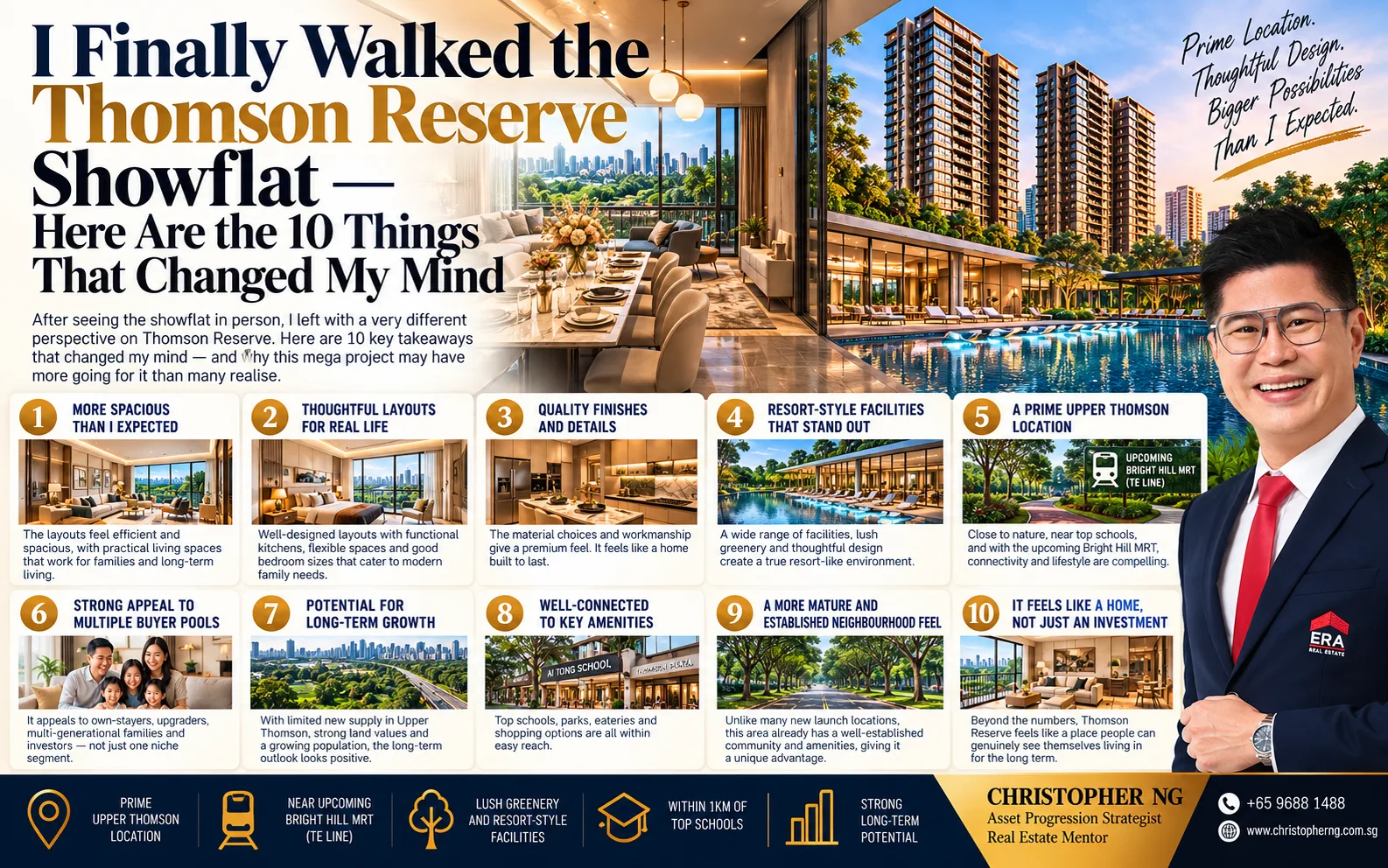
For the past few weeks, I have probably studied Thomson Reserve more than most projects before their showflat even opened.
I studied the land cost.
I went through the site plan.
I examined the floor plans.
I dissected the unit mix.
I looked at Thomson Reserve from an investor's perspective.
I stress-tested the bullish investment case.
I even asked the uncomfortable question:
At $3 million, when does a new launch stop making sense?
But all of that was done on paper.
Last week, the Thomson Reserve showflat finally opened for the agent preview.
So naturally, I went down.
And after actually walking through the sales gallery, studying the model and experiencing the show units physically, some of my earlier views became stronger.
Some became weaker.
And a few changed altogether.
The public preview starts on 17 October.
So before everyone walks in this weekend and gets overwhelmed by the beautiful showflat, landscaping, marble, private lifts and sales presentations, here are the 10 things that stood out to me after seeing Thomson Reserve physically for the first time.
Not the brochure version.
Not the floor-plan version.
My version.
1. My First Thought: This Is A Very Big Project
I knew Thomson Reserve was big.
1,268 units.
Six residential towers.
Approximately 51,567 sqm of land, or around 555,000 sq ft.
Four 21-storey Classic Collection towers.
Two 30-storey Luxury Collection towers.
But numbers don't quite communicate scale.
When you see the model physically, you start appreciating just how substantial the site is.
And this changed one concern I previously had.
When I first heard:
1,268 units
my investor brain immediately thought:
competition.
That's still true.
A mega development creates internal resale competition.
When you eventually want to sell, your biggest competitor may not be another development.
It may be your neighbour upstairs.
But standing in front of the model reminded me of the other side of scale.
Large land gives a developer room to create an actual environment.
Not simply:
tower + swimming pool + gym.
Thomson Reserve has more than 80 facilities organised around three major lifestyle zones — the Island Club, Grand Clubhouse and Wellness Club.
This feels more like an estate.
And that matters.
A large project can create its own identity, community and eventually its own resale market.
We've seen that happen repeatedly in Singapore.
So I still see 1,268 units as both a strength and a weakness.
The important thing is choosing the right unit within those 1,268 homes.
2. I Underestimated How Important The Landscaping Could Be
This was probably one of my bigger changes in perspective.
When analysing property as an investment, landscaping doesn't normally rank very highly on my spreadsheet.
Land cost?
Yes.
Entry price?
Definitely.
MRT?
Of course.
Unit mix?
Very important.
But landscaping?
Harder to quantify.
Yet for a development of this scale, I think it matters more than I initially gave it credit for.
Thomson Reserve is being positioned strongly around nature and wellness, with extensive pools, greenery and landscaped spaces across the site.
And because Upper Thomson already has that green identity — with MacRitchie, Windsor Nature Park and the Central Catchment nearby — the concept doesn't feel completely manufactured.
It fits the neighbourhood.
That gives Thomson Reserve something I hadn't fully appreciated from the plans:
a fairly distinct identity.
Five or ten years after TOP, buyers won't remember the marketing slogan.
But they will remember how a development feels when they enter it.
That emotional reaction matters more than we sometimes acknowledge in property analysis.
Because eventually, resale buyers aren't buying spreadsheets.
They're buying homes.
3. The Classic vs Luxury Collection Difference Is More Important Than I Thought
I wrote previously that Thomson Reserve might eventually develop multiple sub-markets within the same project.
After seeing the showflat?
I believe that even more strongly.
The project comprises:
740 Classic Collection homes
and
528 Luxury Collection homes.
The Classic Collection occupies four 21-storey towers.
The Luxury Collection occupies two 30-storey towers and extends into the larger premium and private-lift formats.
Before visiting, I treated this largely as a developer product-segmentation exercise.
Now I think it could eventually become:
a resale segmentation.
Future buyers may not simply ask:
“How much is Thomson Reserve?”
They may ask:
“Classic or Luxury?”
And then:
“Which tower?”
“Which stack?”
“Which facing?”
“Which floor?”
That differentiation is important when we're dealing with 1,268 units.
Because scarcity within a mega development can be valuable.
Two units can technically have the same Thomson Reserve address and yet appeal to completely different future buyers.
4. The 732 Sq Ft 2-Bedroom + Study Makes More Sense In Person
One of the show units is the 732 sq ft 2-Bedroom Premium + Study.
On paper, I originally looked at this mainly through an investment lens.
Quantum.
Rentability.
Internal competition.
Future resale pool.
All still relevant.
But walking through it reminded me that the modern two-bedroom buyer has changed.
A study isn't simply:
“extra space.”
For many households, it can become:
a work-from-home area,
a child's study corner,
a small nursery,
additional storage,
or simply flexible space as the household's needs change.
That flexibility can materially change how long someone can remain in a two-bedroom apartment.
And holding period matters.
A couple who outgrows a standard two-bedroom after three years behaves very differently from a couple who can comfortably remain for six or seven.
So I appreciate the + Study proposition more after physically seeing it.
But there's a big caveat.
Price.
If the premium from the standard or Premium two-bedroom to the + Study is excessive, the argument disappears.
Which is why I'm waiting very carefully for the actual price ladder.
5. The 1,055 Sq Ft 3-Bedroom Premium Could Be One Of The Most Important Units In The Project
This was interesting.
The 3-Bedroom Premium show unit is 1,055 sq ft.
And after walking it, this may ultimately be one of the categories I watch most carefully.
Why?
Because this is where several buyer pools potentially collide.
You have:
HDB upgraders.
Young families.
Existing two-bedroom condo owners.
Owners of smaller three-bedroom condos.
Families attracted by Ai Tong Primary School.
Buyers who want Upper Thomson but don't necessarily need the Luxury Collection.
And investors who want a deeper future owner-occupier resale pool.
That's a powerful intersection.
In my earlier articles, I spent a lot of time discussing smaller units because of their sheer numbers.
After walking the showflat, I'm increasingly interested in:
the middle.
Sometimes the best investment isn't the cheapest unit.
It's the home that the greatest number of future families can realistically use.
The eventual price gap between the smaller three-bedroom and the 1,055 sq ft 3-Bedroom Premium is therefore something I'll be watching very closely.
If that upgrade gap is reasonable, things could get interesting.
6. At 1,367 Sq Ft, The 4-Bedroom Premium Starts Feeling Like A Different Product
Then I walked into the 1,367 sq ft 4-Bedroom Premium.
Private lift.
Larger living spaces.
More family utility.
Different positioning.
This reinforced something I wrote in my previous article:
Thomson Reserve doesn't have one market.
A buyer considering this unit isn't necessarily comparing it against the 732 sq ft unit downstairs.
Their alternative universe is completely different.
They may compare it against:
a large resale condominium,
another premium new launch,
a freehold apartment,
or perhaps their existing landed home.
And that changes the pricing conversation.
If the eventual quantum moves comfortably into the $3 million range, I'm no longer going to ask:
“Is the PSF okay?”
I'm going to ask:
“What else can I buy in Singapore for the same cheque?”
That's a much tougher test.
I recently wrote an entire article around this idea:
“The $3 Million Question at Thomson Reserve: At What Point Does a New Launch Stop Making Sense?”
Walking this unit reinforced that view.
At higher quantums, buyers must stop comparing Thomson Reserve only against other new launches.
Compare it against the entire market.
7. The 1,808 Sq Ft 5-Bedroom Made The Landed Right-Sizer Argument Much More Real To Me
This is probably the biggest conceptual change for me.
The largest show unit is the 1,808 sq ft 5-Bedroom Suite.
Before seeing it, my landed right-sizer argument was mainly theoretical.
I've been dealing with more landed owners considering right-sizing recently.
And I understand the reasons.
Age.
Maintenance.
Stairs.
Roof.
Garden.
External walls.
Waterproofing.
Pest control.
Security.
Empty bedrooms after the children move out.
But landed owners are used to space.
That's the problem.
Ask someone living in a 4,000 sq ft landed house to move into a 900 sq ft condo and you may technically call it:
“right-sizing.”
They may call it suffering.
A 1,808 sq ft private-lift apartment is different.
It starts creating a credible bridge between:
landed living
and
condominium convenience.
You give up your land.
But you gain:
security,
facilities,
lock-up-and-go convenience,
far less maintenance,
and potentially the ability to remain within a familiar neighbourhood.
And this last point is important.
Imagine someone who has lived around Thomson, Bishan or Ang Mo Kio for 20 or 30 years.
Their friends are here.
Their family is nearby.
Their favourite food is here.
Their routines are here.
They don't necessarily want to leave Upper Thomson just because maintaining a landed house is becoming troublesome.
Suddenly the larger Thomson Reserve units become very interesting.
I think this buyer pool deserves more attention than I initially gave it.
8. The MRT Proposition Feels Less Like An Investment Story And More Like An Everyday-Living Story
I've repeatedly mentioned Upper Thomson MRT in my earlier articles.
But going through the project physically made me think about it differently.
We often talk about MRT proximity as though it is primarily an investment catalyst.
Near MRT = better investment.
That's too simplistic.
The bigger advantage may simply be:
life becomes easier.
Children grow up.
Parents age.
Domestic arrangements change.
Maybe the family eventually owns only one car.
Maybe your teenagers start travelling independently.
Maybe grandparents come over regularly.
Maybe your tenant doesn't drive.
A development close to MRT, food and established amenities reduces friction in everyday life.
That creates owner-occupier demand.
And strong owner-occupier demand is ultimately one of the things I want supporting an investment property.
So after seeing the whole proposition together, I think I was previously treating MRT too much as another line on an investment checklist.
It is more fundamental than that.
9. I Am Now Even More Convinced That Average PSF Will Be Almost Useless
This may sound strange coming from a property agent.
But when Thomson Reserve launches, everyone will ask:
“What's the average PSF?”
And headlines will inevitably publish one number.
Maybe $2,6xx.
Maybe $2,7xx.
Maybe $2,8xx.
Maybe something else entirely.
But after walking show units ranging from:
732 sq ft
to
1,808 sq ft,
I think applying one average PSF across Thomson Reserve could be particularly misleading.
The buyer of a two-bedroom + study and the buyer of a five-bedroom private-lift suite aren't making the same property decision.
Different budgets.
Different motivations.
Different alternatives.
Different future buyers.
Different scarcity.
So when the official price chart comes out, I'll be much more interested in:
the price ladder.
How much more from:
2BR → 2BR Premium?
2BR Premium → 2BR + Study?
3BR → 3BR Premium?
3BR Premium → 4BR?
4BR → private-lift 4BR Premium?
4BR Premium → 5BR Suite?
That's where I suspect some of the real opportunities will appear.
Sometimes another $100,000 or $150,000 can buy disproportionately more utility.
Sometimes another $300,000 buys surprisingly little.
Those are the anomalies I want to find.
10. The Showflat Made Me Like Thomson Reserve More — But It Also Made Me More Price Sensitive
This sounds contradictory.
It isn't.
After seeing the product physically:
I like Thomson Reserve more.
I understand the scale better.
I appreciate the lifestyle proposition more.
I understand the product segmentation better.
I can see the family proposition more clearly.
And I can now better understand why a landed right-sizer might genuinely consider one of the larger units.
But because I like the product more:
I need to become even more disciplined about price.
Beautiful showflats are dangerous.
That's literally their job.
They make us imagine:
our sofa there,
our children in the bedrooms,
our coffee in the morning,
our friends around the dining table.
And once emotion enters the equation, price discipline can disappear very quickly.
That's why I deliberately wrote my previous article:
“The $3 Million Question at Thomson Reserve: At What Point Does a New Launch Stop Making Sense?”
I wanted to establish the framework before becoming emotionally influenced by the physical product.
Because the question remains:
At what price does a good project become a bad buy?
We still need the final numbers.
What Didn't Change My Mind?
Quite a few things.
I still think the historical land cost of approximately $1,178 psf ppr is one of Thomson Reserve's most interesting advantages.
I still think the much higher $1,612 psf ppr Lorong Puntong GLS bid strengthens the replacement-cost argument for this part of Singapore.
I still think 1,268 units creates internal resale competition.
I still think buyers need to pay close attention to how many similar units exist within their chosen category.
And I still think the investment case becomes substantially weaker if buyers pay today for all the upside that is supposed to happen tomorrow.
The showflat didn't change those fundamentals.
It simply helped me understand:
the product behind the numbers.
My Biggest Takeaway After Walking Thomson Reserve
Before seeing the showflat, I thought Thomson Reserve's strongest investment argument was probably:
location + MRT + land cost + future replacement cost.
Now I would add another factor:
product breadth.
There is a very wide spectrum here.
Young couple.
Investor.
HDB upgrader.
Growing family.
Established condo owner.
Multi-generational household.
Landed right-sizer.
Thomson Reserve potentially has a product for each of them.
That's powerful.
But it also creates complexity.
Because a project having something for everyone doesn't mean:
every unit is equally good value.
Quite the opposite.
With this many unit types, stacks, floors and price points, I expect some units to be substantially better buys than others.
There Is Also An Asset Progression Story Here
This is something I increasingly see in my own client work.
Property progression isn't always:
HDB → condo → bigger condo → landed.
Life doesn't move in a perfectly straight line.
A young couple may start with a two-bedroom.
Children arrive.
They move into a three-bedroom.
Income rises.
They upgrade again.
Eventually they buy landed.
Then 20 years later?
The children grow up.
They sell the landed house.
And suddenly a large condominium makes sense again.
So theoretically, Thomson Reserve could serve buyers at very different stages of their property journey.
The 2BR buyer could be near the beginning.
The 3BR buyer could be the growing family progressing upwards.
The 4BR buyer could be an established upgrader.
And the 5BR buyer could actually be someone coming back from landed.
Same development.
Completely different life stages.
From an Asset Progression perspective, I find that quite fascinating.
So What Would I Buy?
I'm not answering that yet.
Deliberately.
Because we're still missing the most important document:
the official price list.
I've already studied the product.
I've walked the showflat.
I know which layouts I prefer.
I know which buyer pools interest me.
But price can completely change the ranking.
A unit I love at $3.1 million might make absolutely no sense at $3.5 million.
A unit I originally overlooked could suddenly become extremely attractive if the developer prices the upgrade gap aggressively.
So I'm keeping my powder dry.
The next stage isn't another theoretical analysis.
It's:
actual unit selection.
If You're Going To The Public Preview On 17 October, Don't Just Look At The ID
This is probably the most practical advice I can give.
Showflats are designed to look beautiful.
Look past the furniture.
Look past the mirrors.
Look past the feature walls.
Instead, stand inside the unit and ask yourself:
1. Where does my actual furniture go?
2. Can I fit a proper dining table?
3. Are the bedrooms genuinely usable?
4. Where do I store things?
5. How much space has been created by ID treatment rather than actual floor area?
6. What will this unit look like without the showflat furniture?
7. Who buys this unit from me eventually?
8. How many identical or similar units exist?
9. What is the quantum difference to the next layout?
And most importantly:
10. If I had the same budget, what else could I buy?
That last question protects you from FOMO.
Final Thoughts: Paper Analysis Can Only Take Us So Far
I've probably analysed Thomson Reserve backwards and forwards by now.
But walking the project reminded me why I don't like making property decisions entirely from spreadsheets.
Property is both:
an asset
and
a home.
Numbers tell us whether something makes financial sense.
But space, flow, privacy, light, surroundings and how a home makes us feel determine whether people actually want to live there.
And remember:
your future buyer needs to want to live there too.
After walking the Thomson Reserve showflat, I understand the project better.
I like certain parts more than I expected.
I'm more interested in the middle and larger unit categories than I was previously.
I think the Classic/Luxury distinction could eventually become meaningful.
And I now believe the landed right-sizer proposition is more credible than I initially gave it credit for.
So yes:
Thomson Reserve moved up slightly in my books.
But we're not done.
Because a beautiful product still has to meet:
the right price.
The public preview starts 17 October 2026.
Then comes the number I've been waiting for.
And once the official price chart is released, we can finally answer the question that matters most:
Which Thomson Reserve would I actually buy — and at what price would I walk away?
That's the next article.
Going To The Thomson Reserve Preview? Come Walk It With Me
One last thing.
If you've been following my Thomson Reserve series, you'll probably realise by now that I've spent quite a bit of time studying this project.
I've looked at the land cost.
I've studied the floor plans and unit mix.
I've looked at it from an investor's perspective.
I've stress-tested the investment story.
I've examined where the new-launch premium stops making sense.
And now I've physically walked the showflat as well.
So during the Thomson Reserve preview period, I'll be available for buyers who want to go through the project with me.
And you don't have to come ready to buy.
Want the tailored version for your portfolio?
Every article here generalises. A 20-minute conversation makes it specific to your numbers.
When does Thomson Reserve open for public preview?
How many units are there at Thomson Reserve?
What is the difference between the Classic and Luxury Collections?
Which Thomson Reserve unit impressed me most?
What about the 2-Bedroom Premium + Study?
Are the larger Thomson Reserve units worth considering?
Is Thomson Reserve a good investment?
Is the cheapest Thomson Reserve unit automatically the best investment?
What price would make me walk away from Thomson Reserve?
Should buyers focus on Thomson Reserve's average PSF?
From a standard 4BR to a private-lift unit?
Should I buy during the Thomson Reserve launch?
Can I visit the Thomson Reserve showflat with Christopher Ng?

Written by
Christopher Ng (CEA R014394H)
Singapore Property & Asset Progression Strategist with ERA Realty Network. A NUS Real Estate graduate, Christopher has advised homeowners, investors and property owners since 2004.