
Terrace to Semi-D: Is the Upgrade Really Worth the Extra $2–3 Million?
This article explores whether upgrading from a terrace to a semi-detached house in Singapore is worth the extra $2–3 million, beyond just the label. It delves into the tangible benefits like land, frontage, privacy, and buildability.
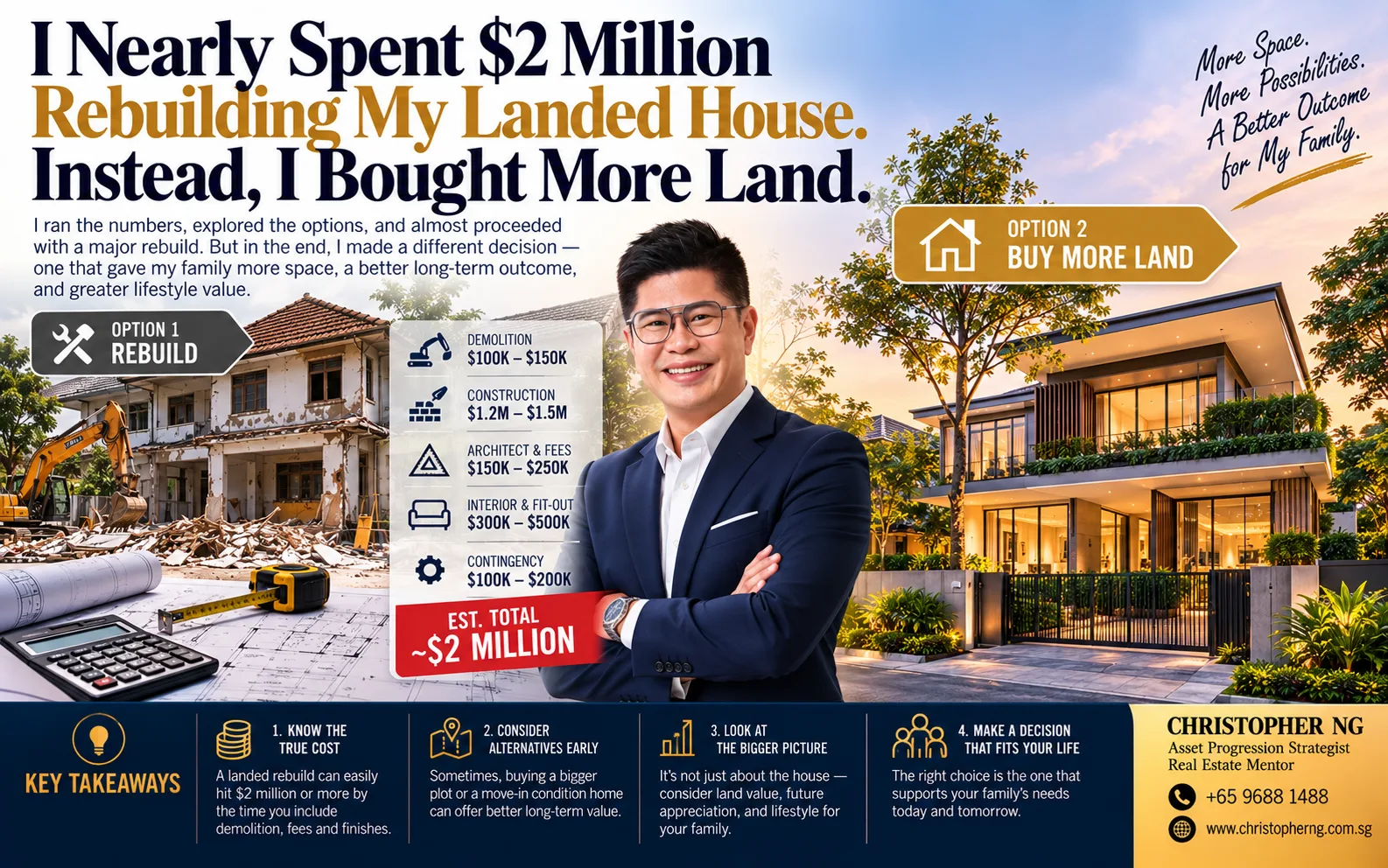
In my last article, I explained why I chose not to spend another $2 million rebuilding my inter-terrace.
Instead, I sold it and bought a semi-detached home.
But that raises the obvious question:
What exactly am I getting for the extra money?
Is a semi-D genuinely a better property?
Or am I simply paying millions more for a strip of air between my house and my neighbour?
This wasn't a theoretical question for me.
When I was considering my next move, the financial difference was substantial.
Moving from a terrace into a semi-D could easily mean putting another $2 million to $3 million — sometimes more — into the property.
For that kind of money, I wanted to understand exactly what I was buying.
Was it more space?
More privacy?
Better redevelopment potential?
A more valuable class of land?
Or simply the prestige of being able to say:
“I stay semi-D.”
Because if it's only the last one, I can think of many better uses for $2 million.
So let's forget the labels for a moment.
Let's look at what you're actually buying when you move from a terrace to a semi-detached house.
First: A Semi-D Isn't Automatically Better Than a Terrace
Let's get this out of the way.
I would rather own an excellent terrace than a poor semi-D.
Give me:
a regular plot,
good frontage,
a quiet road,
good orientation,
efficient land,
a strong location,
and a well-designed house,
and I may happily choose that terrace over a strangely shaped semi-D on an inferior road.
Property type alone doesn't determine value.
This is especially important because once buyers decide:
“My next house must be semi-D.”
they sometimes start compromising on everything else just to get the label.
I wouldn't.
The real comparison is not:
TERRACE vs SEMI-D
It is:
THIS terrace vs THIS semi-D — at THIS price.
And that is how I approached my own move.
1. Land: This Was the Biggest Difference for Me
In my previous article, I explained the question that changed my thinking.
I was considering spending around $2 million rebuilding my terrace.
That could give me a substantially better house.
But I would still own essentially the same land.
So instead, I started asking:
What if I used that capital to buy more land?
This is where a semi-D can become very different.
The upgrade isn't simply about getting another 500 sq ft bedroom upstairs.
You may be moving into a materially larger plot of land.
And unlike a kitchen, bathroom or façade:
You cannot renovate yourself into more land.
You can rebuild a 2,000+ sq ft terrace beautifully.
But after spending $2 million rebuilding it, it is still sitting on that same plot.
If your semi-D alternative gives you substantially more land, then part of that $2–3 million premium is buying an asset that is fundamentally difficult to reproduce.
That mattered to me.
2. You're Also Buying Frontage
Land area alone doesn't tell the whole story.
Suppose I show you two houses.
House A
4,000 sq ft land
Narrower frontage
House B
4,000 sq ft land
Much wider frontage
Same land area.
Same neighbourhood.
Same land PSF.
Are they necessarily worth the same?
I don't think so.
Frontage affects how the house can feel and, depending on the specific plot and planning constraints, how effectively it may be designed.
It can affect:
arrival,
car porch configuration,
internal planning,
light,
ventilation,
façade possibilities,
and the overall sense of space.
This is why I keep telling landed buyers:
Don't just ask me how many square feet of land you're buying. Ask me what those square feet look like.
A wide, regular piece of land can be very different from a long, narrow or awkwardly shaped plot.
And when you're paying millions for land, efficiency matters.
3. The “Strip of Air” Actually Changes the Living Experience
This is probably the most obvious physical difference.
A terrace is attached on both sides, except for end/corner configurations.
A semi-D is attached to one neighbour.
Which means you gain a detached side.
At first glance, that sounds like a fairly small distinction.
One wall.
One side.
One strip of air.
But when you're actually living in the property, it can change the experience considerably.
Potentially more:
natural light,
cross-ventilation,
windows,
privacy,
visual openness,
garden space,
and separation from your neighbour.
It can also change the way the ground floor feels.
A terrace can be beautifully designed to bring in light through courtyards, skylights, air wells and open-plan layouts.
I've seen fantastic terraces.
But all else being equal, having another exposed side gives the designer another opportunity to work with.
So yes:
Part of the $2–3 million really is buying air.
But in landed property, air, light, frontage and separation have value.
4. Privacy Is Hard to Put Into a Spreadsheet
This became more relevant to me as the children grew.
When you're younger, you may care most about:
How many bedrooms?
How big is the living room?
Can I park two cars?
As family life evolves, you start noticing different things.
Can everybody have their own space?
How close are the neighbouring houses?
How exposed is the living area?
Can I open the side of the house towards greenery?
Can the children have friends over without the entire house feeling crowded?
Can Jasmine and I have our own space while the children occupy another part of the home?
These are difficult things to price.
But that doesn't mean they have no value.
In fact, owner-occupiers routinely pay significant premiums for characteristics that don't show neatly in a PSF comparison:
views,
privacy,
quietness,
orientation,
frontage,
light.
A semi-D's detached side can contribute to several of those at once.
For my family, that had real utility.
5. Buildability: Bigger Land Doesn't Automatically Mean a Bigger House
This is where buyers need to be careful.
It is tempting to think:
“My terrace has 2,000+ sq ft of land. This semi-D has 4,000+ sq ft. Therefore I can build twice as much.”
Not necessarily.
Landed development in Singapore is affected by planning controls including building envelopes, setbacks, site coverage and the specific characteristics of the site.
So when I'm comparing a terrace with a semi-D, I don't stop at:
LAND SIZE.
I want to understand:
WHAT CAN THIS LAND BECOME?
This is especially important if the house is old and you're paying a premium partly because of redevelopment potential.
Two semi-D plots with similar land areas can offer very different redevelopment outcomes because of:
plot shape,
frontage,
road reserve,
site levels,
orientation,
existing conditions,
and planning constraints.
So don't pay a semi-D premium just because the land area looks impressive on the listing.
Understand the land.
6. The Bigger Difference May Be Optionality
This is one of the things I value most.
Suppose I buy a beautiful newly rebuilt terrace.
I move in.
It's fantastic.
But perhaps the property is already close to its optimum use.
There may be less for me to change later.
Now consider an older semi-D on substantially more land.
Perhaps I don't rebuild immediately.
Maybe I spend a sensible amount making the existing house comfortable.
Then I live there.
Five years later, circumstances change.
Maybe the children are older.
Maybe my financial position is different.
Maybe construction costs change.
Maybe my idea of the perfect home changes.
I still have options.
I can renovate.
I can A&A, subject to feasibility.
I can potentially reconstruct.
I can potentially rebuild.
Or I can simply continue living in the existing house.
Good land gives you options.
And optionality has value.
That was a major consideration in my own decision.
I didn't necessarily need the final dream house immediately.
I wanted the land that would allow me to decide what the dream house should eventually become.
7. But Here's the Counterargument: The Terrace May Actually Be the Smarter Buy
Let's flip the argument.
Imagine these two properties.
Option A — Excellent Terrace
Purchase price: $6 million
Good location.
Regular land.
Wide enough frontage.
Nicely renovated.
Move-in condition.
Good street.
Good orientation.
Efficient layout.
Option B — Average Semi-D
Purchase price: $8 million
Larger land.
But irregular shape.
Older house.
Needs significant renovation.
Busier road.
Less attractive orientation.
Awkward frontage.
Now tell me:
Is Option B automatically worth the extra $2 million?
No.
In fact, I may buy the $6 million terrace.
Because when we say:
“Semi-D is better.”
we are comparing theoretical property types.
Real properties are messy.
Every plot is different.
Every street is different.
Every house is different.
And every price is different.
That's why I don't believe buyers should upgrade based on housing hierarchy alone.
8. Don't Forget What That Extra $2–3 Million Costs You
This is where the financial analysis becomes more serious.
Suppose:
Terrace
$6 million
versus:
Semi-D
$8 million
You might say:
“It's only $2 million more.”
But the economic difference can be larger.
Depending on how you finance the property, you may have:
additional downpayment,
additional mortgage,
higher interest expense,
higher BSD,
higher renovation requirements,
higher property tax,
and greater opportunity cost on the capital deployed.
That extra $2 million could otherwise remain invested.
It could sit in your business.
It could fund another investment.
It could reduce debt.
So I wouldn't ask:
“Can I afford the semi-D?”
I would ask:
“What am I receiving in exchange for deploying the additional capital?”
If the answer is simply:
“It's a semi-D.”
That's not enough for me.
9. Does the Semi-D Hold Its Value Better?
This is probably what many readers are wondering.
The answer isn't as simple as:
“Semi-D always appreciates more.”
I wouldn't make that assumption.
Property performance depends on:
entry price,
location,
land characteristics,
condition,
supply,
buyer demand,
interest rates,
redevelopment potential,
and what the market looks like when you eventually sell.
But there is one structural point worth understanding.
The potential buyer for a terrace and the potential buyer for a semi-D aren't always identical.
As budgets increase, buyers become more demanding.
At $5–6 million, someone may accept compromises they won't accept at $8–10 million.
Once you're asking buyers to spend serious money, they may start expecting:
better frontage,
more privacy,
better road,
larger land,
better orientation,
and a more substantial home.
So moving up the landed ladder doesn't mean:
“More expensive = safer.”
It means the quality of the underlying property becomes increasingly important.
10. Your Future Buyer Matters
This is something I think about whenever I buy property.
Not because I'm planning to sell tomorrow.
But because eventually:
Someone else has to want what I own.
So when evaluating a semi-D, I ask:
Who buys this from me one day?
A terrace upgrader?
A condo upgrader?
Another semi-D owner?
A family looking for land to rebuild?
Someone right-sizing from a detached house?
Then I ask:
What will that future buyer care about?
Probably many of the same things I care about today:
location,
land size,
frontage,
shape,
privacy,
orientation,
school proximity,
condition,
and redevelopment potential.
This is why I would rather pay for attributes future buyers can recognise than spend excessively on features that only I appreciate.
11. The Extra Money Should Buy Something You Cannot Easily Create Later
This became my rule.
If I'm going to spend another $2–3 million upgrading from a terrace to a semi-D, I want that money to buy things I cannot easily add later.
For example:
MORE LAND
I cannot renovate that into existence.
BETTER FRONTAGE
Very difficult to change.
BETTER PLOT SHAPE
Can't renovate that.
BETTER LOCATION
Can't renovate that either.
DETACHMENT
Fundamental to the property type.
PRIVACY
Often strongly influenced by the land and surroundings.
But:
marble?
I can add later.
Kitchen?
Can change.
Carpentry?
Replace.
Bathroom?
Renovate.
Façade?
Redo.
This is how I started separating:
PERMANENT ATTRIBUTES
from
CHANGEABLE ATTRIBUTES.
When buying landed property, I increasingly prefer to spend my money on the first category.
12. So Was My Semi-D Worth the Upgrade?
For me?
Yes.
But not simply because it was a semi-D.
It was because the move solved the specific problem I was trying to solve.
I wanted more land.
More privacy.
More space for the children as they grow.
More flexibility.
And greater long-term optionality.
Instead of spending around $2 million creating a much better building on my existing terrace plot, I preferred to use that capital as part of the move into a different class of land.
That was the right decision for me.
It doesn't mean it is automatically the right decision for you.
If my terrace had already been sitting on an exceptional plot with enough land for my long-term needs, I might have rebuilt.
If the semi-D options available to me were poor, I might have stayed.
If moving required me to stretch my finances uncomfortably, I wouldn't have done it just to move up the landed hierarchy.
The numbers still have to work.
The Framework I Would Use: What Does the Extra $2–3 Million Actually Buy?
If you're deciding whether to upgrade from terrace to semi-D, don't start with:
“Can I afford a semi-D?”
Put both properties side by side.
1. Land
How much more land am I actually getting?
2. Frontage & Plot Efficiency
Is the additional land usable and well-shaped?
3. Detachment
What does the open side genuinely add to light, ventilation, privacy and planning?
4. Buildability
What can each site realistically become?
5. Location
Am I compromising on neighbourhood just to upgrade housing type?
6. Existing House
How much must I spend after purchase?
7. Optionality
Which property gives me more choices ten years from now?
8. Financial Stretch
What does the additional mortgage/capital deployment do to the rest of my finances?
9. Future Buyer Pool
Who is likely to buy this property from me?
10. Price
Most importantly:
Am I paying the right premium?
Because a great semi-D bought at the wrong price can still be a bad property decision.
The $6 Million Terrace vs $8 Million Semi-D Test
Here's the question I would ultimately ask.
Suppose I have two choices:
$6 Million Terrace
Excellent plot.
Great street.
Move-in condition.
Enough space for my family.
$8 Million Semi-D
Average plot.
Needs another $500,000.
Inferior street.
More land, but not particularly efficient.
I take the terrace seriously.
Now change the semi-D:
$8 Million Semi-D
Much larger regular plot.
Good frontage.
Quiet street.
Good orientation.
Livable existing house.
Strong redevelopment potential.
Now the extra $2 million becomes much more interesting.
Same property type.
Same price.
Completely different decision.
That's landed property.
The label gets you into the category.
The land determines whether the individual property is worth buying.
My Own Landed Journey Changed How I Look at Property
Moving from condo to terrace changed the way I looked at space.
Moving from terrace to semi-D changed the way I looked at land.
And I think that distinction matters.
When we buy condos, we spend a lot of time analysing the building:
layout,
floor,
facing,
facilities,
stack,
developer.
With landed property, the house naturally attracts your attention too.
But over time I've found myself looking increasingly beneath the house.
At the land.
Because houses can change.
Land is much harder to change.
That doesn't mean we should blindly buy the biggest plot we can afford.
It means we should understand what part of the purchase price is paying for something temporary…
and what part is paying for something permanent.
Final Thoughts: Is a Semi-D Worth $2–3 Million More?
Sometimes.
And sometimes absolutely not.
A semi-D isn't worth millions more simply because one side of the house isn't attached.
The premium starts making sense when that additional money buys you a meaningful combination of:
more land,
better frontage,
greater privacy,
better light and ventilation,
more redevelopment flexibility,
and stronger long-term optionality.
But if you're sacrificing location, land shape, financial comfort and another $500,000 of renovation just to own something called a semi-D?
I'd think very carefully.
My own decision wasn't:
“I want a semi-D.”
It was:
“If I'm going to deploy another $2 million into landed property, what do I want that money to buy?”
I could have bought more building.
Instead, I chose more land.
And that leads to what I think is an even more interesting question:
When buying landed property, should you buy the biggest house you can afford — or the best land you can afford?
That's the question I'll explore next.
Want the tailored version for your portfolio?
Every article here generalises. A 20-minute conversation makes it specific to your numbers.
Is a semi-detached house always better than a terrace?
Why are semi-D houses more expensive than terraces?
Is it worth upgrading from a terrace to a semi-D?
Should I rebuild my terrace or upgrade to a semi-D?
Is a $6 million terrace better than an $8 million semi-D?
Does a semi-D appreciate faster than a terrace?
What should I check before buying a semi-D?

Written by
Christopher Ng (CEA R014394H)
Singapore Property & Asset Progression Strategist with ERA Realty Network. A NUS Real Estate graduate, Christopher has advised homeowners, investors and property owners since 2004.