
The $3 Million Question at Thomson Reserve: At What Point Does a New Launch Stop Making Sense?
This article explores the critical question of when a new launch like Thomson Reserve becomes less sensible as prices rise, particularly past the $3 million mark. It challenges the obsession with PSF and urges buyers to consider what their
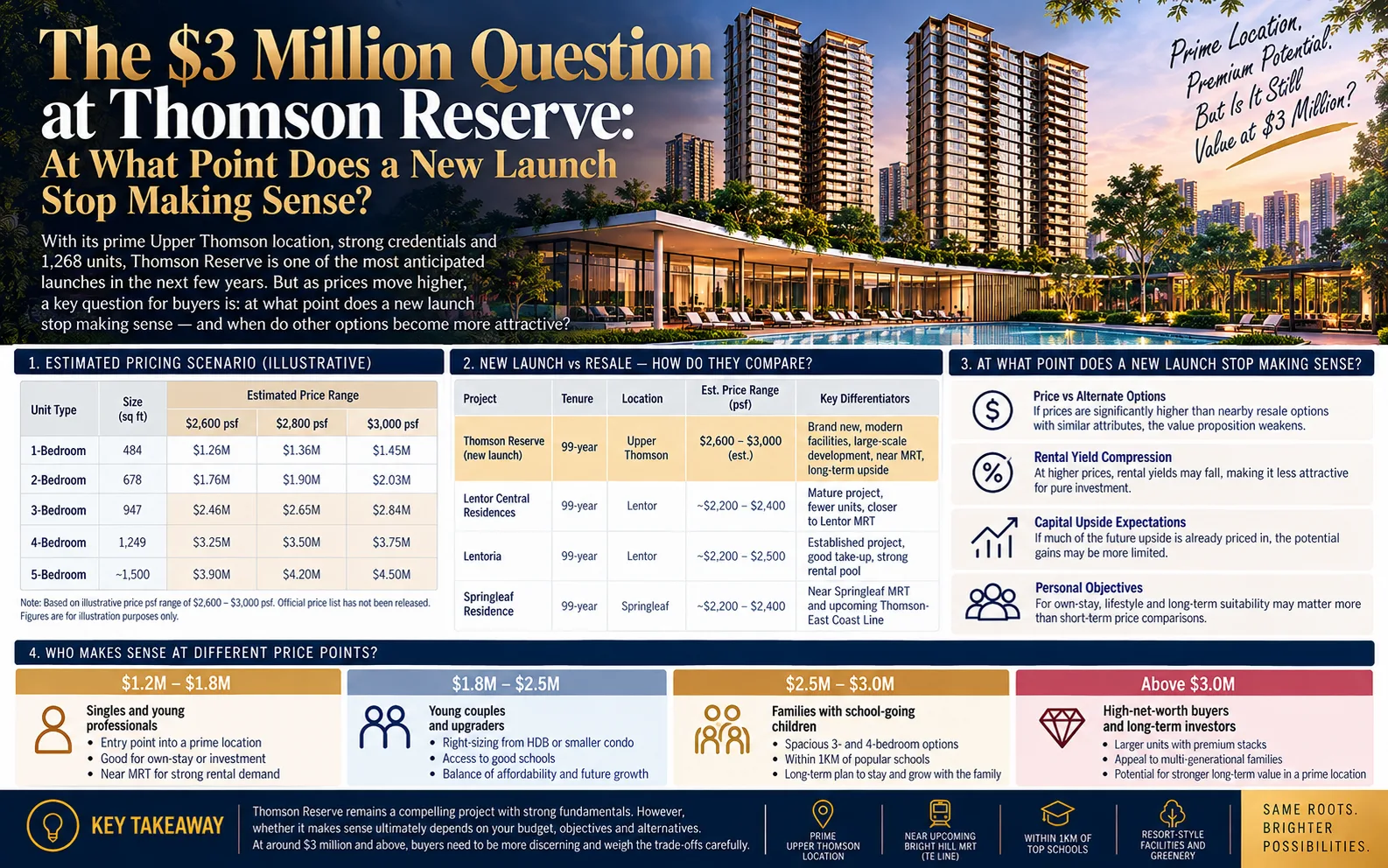
I've spent quite a bit of time studying Thomson Reserve.
And if you've followed my previous articles, you'll know that there is plenty I like about this project.
The land was acquired at an effective cost of around $1,178 psf ppr.
You have Upper Thomson MRT nearby.
Ai Tong Primary School is within 1km.
Thomson Plaza is already there.
There is greenery.
There is scale.
There are 1,268 units, six residential towers, and a product ranging from two-bedroom apartments all the way to large private-lift homes.
I've looked at the floor plans.
I've looked at the unit mix.
I've looked at the investment case.
I've even deliberately tried to stress-test the bullish arguments.
But as we move closer to launch, there is one question I think we haven't discussed enough.
And strangely, it has very little to do with PSF.
What happens when the cheque reaches $3 million?
Because $3 million is a very different property decision from $1.6 million.
At $1.6 million, your choices are limited.
At $2 million, they expand.
At $2.5 million, things become interesting.
But once you are spending around:
$3 million
you are no longer simply choosing which Thomson Reserve unit to buy.
You are choosing between Thomson Reserve and a very large part of Singapore's private-property market.
And that's where I think buyers need to become much more demanding.
First: Why $3 Million?
There's nothing magical about exactly $3 million.
I'm using it because it represents a useful psychological and financial threshold.
Based on the currently published unit sizes and external market estimates, the larger three-bedroom configurations at Thomson Reserve could potentially push towards or beyond $3 million depending on final launch pricing.
The four-bedroom category naturally moves above it.
Official developer pricing has not been released as I write this, so these aren't confirmed prices.
That's important.
I'm not trying to predict the final price chart here.
I'm asking a more useful question:
At each increasing quantum, how strong does Thomson Reserve's value proposition need to become before I should simply buy something else?
That question applies whether the eventual average price is $2,700, $2,800 or $3,000 psf.
We Have Become Too Obsessed With PSF
Singapore property buyers love PSF.
$2,600 psf.
$2,800 psf.
$3,000 psf.
Then we compare it with the neighbouring launch.
But ultimately:
We don't repay our mortgage in PSF.
We repay dollars.
Suppose one apartment is:
1,050 sq ft × $2,800 psf = $2.94 million
and another is:
1,200 sq ft × $2,500 psf = $3 million.
Which one is cheaper?
Technically the first.
But for only another $60,000, the second buyer gets approximately 150 sq ft more space.
Suddenly PSF isn't telling us the whole story.
This is why I increasingly prefer comparing:
What does my total cheque buy me?
And at Thomson Reserve, I think this becomes particularly important once we cross $2.5 million.
The $1.7 Million Buyer Has A Different Decision
Let's start lower.
Imagine the eventual entry-level Thomson Reserve quantum comes in somewhere around the high-$1 million range.
What are you buying?
A new two-bedroom home.
Near MRT.
In an established Upper Thomson neighbourhood.
Within a large development.
New facilities.
Fresh lease.
Low initial maintenance risk.
Potentially easy tenant proposition.
At this quantum, the buyer's alternatives tend to be relatively straightforward.
They can buy:
another compact new launch,
a larger older resale apartment,
or stretch further.
There are alternatives, obviously.
But the new-launch proposition is still relatively easy to understand.
At $2 Million, I Start Asking More Questions
Cross $2 million and the opportunity set becomes wider.
Now I can potentially choose between:
a compact premium new launch,
a significantly larger resale condo,
an older freehold development,
or another new project elsewhere.
So I need Thomson Reserve to give me something meaningful in return for the new-launch premium.
Maybe that's:
location,
MRT,
school,
layout,
future liquidity,
or scarcity of modern stock around Upper Thomson.
That's fine.
I'm prepared to pay a premium for genuine advantages.
What I don't like doing is paying a premium simply because:
it's new.
At $2.5 Million, Space Starts Fighting Back
This is where things become more interesting.
At $2.5 million, the resale market begins offering some genuinely compelling homes.
And this is one of the biggest weaknesses of comparing only new launches with other new launches.
A buyer walks into a showroom and sees:
Project A: $2,800 psf.
Project B: $2,950 psf.
Project C: $3,050 psf.
Suddenly:
“$2,800 psf looks cheap!”
But cheap compared with what?
Other new launches?
Or the entire Singapore property market?
Those are very different comparisons.
A 10- or 15-year-old resale development might give you considerably more internal space for the same cheque.
Perhaps it isn't as pretty.
Perhaps the facilities aren't brand new.
Perhaps the lease is shorter.
But I shouldn't pretend those things don't have value.
Then We Reach $3 Million
This is where I think the decision changes fundamentally.
If I'm writing a cheque of approximately:
$3,000,000
my question is no longer:
“Is Thomson Reserve reasonably priced compared with another 2026 launch?”
My question becomes:
What is the best home or asset I can buy in Singapore for $3 million?
That's a much harder benchmark.
Because now I'm potentially comparing:
a three-bedroom new launch,
a much larger resale condominium,
selected freehold alternatives,
older premium projects,
larger homes in less central locations,
and potentially different asset-progression strategies altogether.
That's why I call this:
The $3 Million Question.
A New Launch Has To Earn Its Premium
I don't have a problem paying more for a new launch.
There are legitimate reasons why buyers do it.
Newer specifications.
New facilities.
Modern layouts.
Fresh lease.
Lower immediate renovation requirements.
Progressive Payment Scheme during construction.
Potential first-mover pricing within the development.
And importantly:
time.
If I buy Thomson Reserve before completion, I'm purchasing something that will still be effectively new several years from now.
Compare that against buying a 15-year-old condominium today.
By the time Thomson Reserve reaches TOP, that competing project may be approaching 20 years old.
That difference matters.
But there is still a limit.
At some point:
the new-launch premium becomes larger than the benefits of buying new.
And that's where I walk away.
So Where Is That Point?
I don't think it can be expressed as one universal PSF.
Instead, I use three tests.
Test 1: What Can The Same Quantum Buy Me Today?
This is the first comparison I would make.
Suppose the Thomson Reserve unit costs:
$3 million.
Don't search only:
“New launches around $3 million.”
Search:
“What are ALL my residential options between $2.8 million and $3.2 million?”
Then compare.
Size.
Tenure.
Age.
Location.
MRT.
School.
Layout.
Renovation.
Maintenance.
Future supply.
And future buyer pool.
You may still conclude Thomson Reserve is superior.
Great.
But at least you've made the comparison properly.
Test 2: What Will My Future Buyer Compare Me Against?
This is even more important.
Imagine buying a three-bedroom Thomson Reserve unit today for $3 million.
Several years later, you want to sell.
Your buyer isn't going to ask:
“How much did Christopher pay?”
They will ask:
“What else can I buy for this money?”
Maybe future new launches cost $3,300 psf.
That's helpful.
Maybe replacement land has become substantially more expensive.
Also helpful.
But perhaps a larger resale condo nearby costs the same.
Perhaps another development has TOP-ed.
Perhaps there are many competing units inside Thomson Reserve itself.
That's why your entry price matters.
You need to leave something for:
the next buyer.
Test 3: How Much Future Appreciation Am I Already Paying For?
This is my favourite test.
Suppose a property has a fantastic future story.
MRT.
Schools.
Transformation.
Expensive future land.
Limited local supply.
Great developer.
All excellent.
But then the launch price already assumes all of those things.
What's left?
This is the mistake buyers sometimes make.
We identify ten future catalysts.
Then happily pay today as though all ten have already happened.
Investment doesn't work that way.
I want:
some future upside that I haven't already paid for.
Thomson Reserve Has A Strong Replacement-Cost Argument
This is where Thomson Reserve remains interesting to me.
The site has a reported effective land basis of approximately:
$1,178 psf ppr.
That is becoming increasingly interesting against newer residential land transactions.
I've written separately about Lorong Puntong's $1,612 psf ppr land bid and what that could mean for the broader Upper Thomson area.
A future project starting from substantially more expensive land will obviously have a different cost structure.
That gives Thomson Reserve's developers pricing flexibility.
But I've said this before and I'll say it again:
Cheap historical land doesn't automatically mean buyers get a cheap condo.
The developer is not obliged to pass the entire land-cost advantage to us.
If the market accepts $3,000 psf, a developer can sell at $3,000 psf.
So land cost gives me:
comfort.
It doesn't automatically give me:
value.
Value only appears when I see the final selling price.
What If Thomson Reserve Crosses $3,000 PSF?
This is where things become interesting.
I'm not saying $3,000 psf automatically makes Thomson Reserve expensive.
That would be too simplistic.
A beautiful high-floor unit with an exceptional view may deserve it.
A scarce large-format private-lift unit may deserve it.
A particular stack may deserve it.
But once we cross $3,000 psf:
I want something special.
Because I'm no longer buying simply on location.
I'm paying a premium for:
product,
scarcity,
view,
floor,
layout,
or some combination of them.
If I'm buying an ordinary unit at an extraordinary price?
That's where I become uncomfortable.
$3 Million Also Has An Asset Progression Question
This is where my Asset Progression framework comes in.
A home shouldn't be viewed completely in isolation.
Where are you today?
Where are you trying to go?
Suppose you're selling a $1.3 million HDB and buying a $3 million condo.
Fine.
Perhaps Thomson Reserve is the home you want to stay in for the next 10–15 years.
Then lifestyle utility deserves significant weight.
But suppose you already own a $2.5 million condo.
And you're spending another $500,000 plus transaction costs to move into a similarly sized Thomson Reserve apartment.
Then I ask:
Have you actually progressed?
Newer?
Yes.
Better location?
Maybe.
Better asset?
Possibly.
But bigger?
Perhaps not.
And financially?
We need to calculate it.
Progression isn't simply:
old condo → new condo.
The next property needs to move you meaningfully closer to your objective.
Sometimes The Better Move Is Not To Buy
This is something property agents probably don't say often enough.
If Thomson Reserve launches at a price that doesn't make sense for your situation:
don't buy it.
There will be more projects.
URA says the Government is deliberately sustaining a high supply of private housing.
The 2026 GLS Confirmed List alone supplies approximately 9,320 units, more than 50% above the annual average of the preceding decade.
As at Q2 2026, about 60,600 private residential units including ECs were expected to complete over the coming years.
And URA reported 15,810 unsold units with planning approval, with further supply still to come.
In other words:
buyers have choices.
This isn't an environment where I feel compelled to chase every launch.
This Is Why I've Been Calling It A Picker's Market
I wrote previously that Singapore may be entering a property picker's market.
Thomson Reserve is actually a perfect test of that idea.
I can like:
the developer,
the location,
the MRT,
the school,
the site,
the landscaping,
the floor plans,
and the long-term Upper Thomson story.
And still say:
Not at this price.
Those aren't contradictory statements.
One of the biggest mistakes in property investing is confusing:
a good project
with
a good buy.
They are not the same thing.
My Personal Framework Once The Price List Comes Out
When the official Thomson Reserve prices are released, this is roughly how I'll approach them.
Below $2 million
Focus on quantum, rental demand and internal competition.
How many similar units exist?
Who buys from me next?
$2 million–$2.5 million
Start comparing aggressively against larger resale alternatives.
How much space am I sacrificing to buy new?
$2.5 million–$3 million
The unit needs to demonstrate a stronger combination of:
layout + location + scarcity + family utility + exit demand.
$3 million–$4 million
Now I want to compare against the entire market, not merely other new launches.
At this level, compromises become harder to accept.
Above $4 million
This becomes an entirely different conversation.
Large resale condos.
Freehold alternatives.
Boutique developments.
Premium new launches.
And depending on location and requirements, even the first conversations around landed property start becoming relevant.
At that quantum:
I want the property to be exceptional.
And That's Why Average PSF Can Mislead Us
Imagine Thomson Reserve launches at an average of $2,850 psf.
Headlines will say:
THOMSON RESERVE LAUNCHES AT $2,850 PSF.
But that number doesn't tell me what I need to know.
Perhaps a particularly efficient three-bedroom at $2.75 million is excellent value.
Perhaps another three-bedroom at $3.2 million is not.
Perhaps a four-bedroom at $3.5 million offers surprisingly good relative value.
Perhaps the private-lift premium is too high.
Or perhaps it's surprisingly small and becomes the obvious upgrade.
The project average doesn't answer any of those questions.
The price ladder does.
The Most Important Comparison May Actually Be Within Thomson Reserve
This connects directly with my previous article:
“Thomson Reserve Doesn't Have One Market: Why Its 1,268-Unit Mix Could Determine Which Buyers Win.”
Once pricing comes out, I want to calculate:
2BR → 2BR Premium
2BR Premium → 2BR + Study
3BR → 3BR Premium
3BR Premium → 4BR
4BR → private-lift 4BR
4BR → 5BR Suite.
Sometimes developers accidentally create:
value gaps.
Maybe another $150,000 suddenly buys significantly more utility.
That's what I'm hunting for.
Not simply the lowest PSF.
My Walk-Away Price Isn't One Number
Readers frequently ask me:
“Chris, what's your walk-away price for Thomson Reserve?”
I don't think there should be one.
My walk-away price for a 592 sq ft two-bedroom cannot be the same framework as my walk-away price for a 1,808 sq ft five-bedroom suite.
Instead, every category needs its own:
fair value
good-buy zone
and
walk-away zone.
And that calculation needs to consider both:
PSF
and
total quantum.
Because eventually:
quantum determines your buyer pool.
The $3 Million Question Is Really An Opportunity-Cost Question
That's the core of this article.
Every property purchase means saying no to something else.
If I spend $3 million on Thomson Reserve, I cannot simultaneously spend that same $3 million on:
a larger resale condo,
a freehold alternative,
another new launch,
or keeping my existing property and investing the difference elsewhere.
So the correct question isn't:
“Can I afford Thomson Reserve?”
It's:
“Is Thomson Reserve the best use of my $3 million?”
That's a much harder question.
But it's the right one.
My Current Position
Before the official price list?
I remain interested.
Very interested.
I like the fundamentals.
I like the scale.
I like the MRT.
I like the established neighbourhood.
I like the potential buyer pools.
And I particularly like that its historical land basis looks increasingly unusual against newer land transactions.
But none of that gives Thomson Reserve a blank cheque.
At:
$1.x million, the discussion is largely accessibility.
At:
$2.x million, alternatives become increasingly important.
At:
$3 million, Thomson Reserve needs to beat a very large universe of properties.
And at:
$4 million-plus, I become extremely demanding.
That's exactly how it should be.
Final Thoughts: Don't Ask Whether Thomson Reserve Is Expensive
Ask:
Expensive Compared With What?
Compared with future new launches?
Perhaps not.
Compared with the developer's historical land cost?
Maybe.
Compared with resale property?
Depends.
Compared with a larger freehold alternative?
Let's see.
Compared with your existing home?
That's an entirely different calculation.
And compared with what the next buyer may eventually pay you?
That's perhaps the most important comparison of all.
The closer Thomson Reserve gets to launch, the less interested I am in predicting one headline PSF.
I want the actual price chart.
Then I want to compare every category:
against the next unit type,
against nearby resale,
against competing new launches,
and against the best alternative use of the same capital.
Because there will eventually be a number where Thomson Reserve stops making sense.
Every property has one.
Our job as buyers is to find that number; before emotion, showflat excitement and FOMO find it for us.
And when the official price list comes out?
That's exactly what I'm going to do.
Want the tailored version for your portfolio?
Every article here generalises. A 20-minute conversation makes it specific to your numbers.
Is $3 million too expensive for Thomson Reserve?
What is Thomson Reserve's official launch price?
Is PSF or total quantum more important?
Does Thomson Reserve's $1,178 psf ppr land cost make it cheap?
Should I buy resale instead of Thomson Reserve?
What happens once my budget reaches $3 million?
What would make you walk away from Thomson Reserve?
Is Singapore facing too much future private housing supply?
Will you analyse the official Thomson Reserve prices?

Written by
Christopher Ng (CEA R014394H)
Singapore Property & Asset Progression Strategist with ERA Realty Network. A NUS Real Estate graduate, Christopher has advised homeowners, investors and property owners since 2004.