
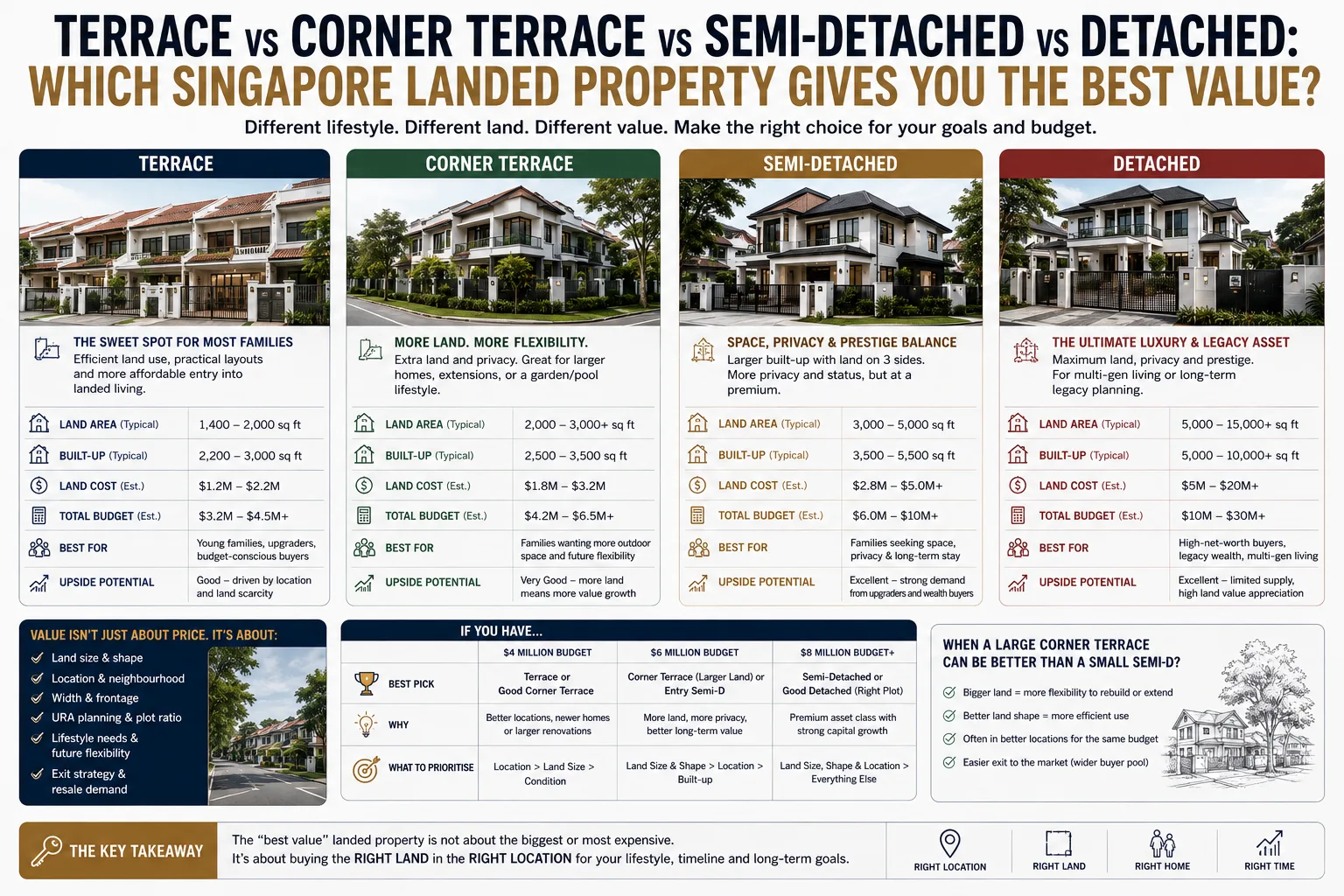
Terrace vs Corner Terrace vs Semi-Detached vs Detached: Which Singapore Landed Property Gives You the Best Value?
When buying landed property in Singapore, it's crucial to compare intermediate terrace, corner terrace, semi-detached, and detached homes not just by their type, but by the actual value they offer. This guide helps you decide which landed h
For many Singaporeans, landed property is not just another housing type.
It is often the destination.
You start with a BTO.
You upgrade to a condo.
Maybe you move into a bigger condo.
Your family grows.
Your income improves.
Your existing property appreciates.
And one day, the question changes from:
“Which condo should I buy next?”
to:
“Can I buy landed?”
I am seeing this more and more among my clients today.
There is something about landed property that continues to appeal to Singaporeans.
Part of it is practical.
More space.
More privacy.
More flexibility.
Part of it is emotional.
Your own land.
Your own gate.
A garden.
A home you can rebuild around your family.
And perhaps eventually, something tangible to leave behind.
But once someone decides:
“I want landed.”
the next question becomes much harder.
Should I buy:
an intermediate terrace?
a large corner terrace?
a semi-detached house?
or stretch further into:
a detached house?
My answer is not:
Detached is always best.
Nor is it:
Buy the largest land you can afford.
The better question is:
Where does my next dollar buy me the most meaningful improvement?
That is how I would compare landed housing types.
Property Hierarchy Is Not The Same As Buyer Value
On paper, the hierarchy looks simple:
Terrace → Corner Terrace → Semi-D → Detached
More separation from neighbours.
More land.
More privacy.
Higher prestige.
Usually higher quantum.
But property decisions are not made on paper.
Imagine:
House A
A beautifully shaped 3,800 sq ft corner terrace on a quiet street.
House B
A 3,600 sq ft semi-D with a narrow, awkward plot beside a busy road.
Technically:
Semi-D > Corner Terrace.
Would I automatically buy House B?
No.
Or:
House C
A regular 4,500 sq ft semi-D with wide frontage.
House D
A detached house sitting on 5,000 sq ft of badly tapered land, requiring major reconstruction.
Again:
Detached > Semi-D on the property ladder.
But the semi-D may be the much better asset.
This is why I tell landed buyers:
Don't buy the label. Buy the land, the house and the outcome.
The Planning Rules Already Tell Us These Homes Are Different
URA's prevailing controls themselves recognise that different landed forms require different physical characteristics.
As at 2026, the broad minimum controls include:
Housing type | Minimum plot size | Minimum width |
|---|---|---|
Intermediate Terrace Type I | 150 sqm | 6m |
Corner Terrace Type I / Semi-D | 200 sqm | 8m |
Detached house | 400 sqm | 10m |
Detached houses are also subject to site-coverage controls, with current general limits outside GCB Areas of 40% for the sub-control and 50% overall site coverage. Terraces and semi-Ds do not have the same site-coverage control.
That matters.
Because upgrading from terrace to semi-D is not simply paying for a more prestigious property type.
You're usually paying for greater width, separation, openness and design flexibility.
Likewise, detached ownership gives you four-sided separation, but site-coverage and setback requirements mean that bigger land does not automatically translate one-for-one into usable house footprint.
Let's Start With The $4 Million Buyer
This is probably where the landed conversation begins for many condo upgraders.
If my realistic landed budget is around $4 million, I would not obsess about buying the highest property type possible.
I would focus on:
Getting the best land and usable home within the entry-level landed segment.
Current asking inventory shows how wide the choice can be. In August 2026, examples under $6 million included a 99-year corner terrace on about 4,000 sq ft at $2.9 million, a freehold corner terrace on about 2,403 sq ft around $4.6 million, and 99-year or smaller freehold options across several landed enclaves. These are asking prices, not transactions, but they illustrate the compromises available at this quantum.
At around $4 million, I would seriously explore:
intermediate terraces,
larger 99-year corner terraces,
older freehold corner terraces,
selected 99-year semi-Ds,
and sometimes strata-landed alternatives.
What I would not do is stretch aggressively into a poor semi-D merely because I want to say:
“I own semi-detached.”
At $4 Million, I Might Prefer A Great Terrace Over A Bad Semi-D
Suppose:
Option A
Freehold intermediate terrace
2,200 sq ft land
Regular plot
Good location
Good condition
$4.0 million
Option B
99-year semi-D
2,300 sq ft land
Awkward plot
Old house
Inferior location
$4.0 million
Which one is better?
If my family's main objective is lifestyle and asset quality, I may easily choose the terrace.
The semi-D label does not compensate for:
poor land,
weak location,
large renovation liability,
or a compromised lease.
At the entry level, quality beats category.
The $4 Million Question: Freehold Terrace Or 99-Year Bigger Landed?
This is where buyers often struggle.
A $4 million budget may buy:
a smaller freehold terrace,
or
a significantly larger 99-year landed property elsewhere.
There is no universal answer.
If your priority is:
legacy and long-term land ownership,
then the smaller freehold option may make sense.
If your priority is:
space for a growing family over the next 20 years,
the larger leasehold landed home might provide much more life for the same money.
This comes back to Asset Progression.
The objective is not:
“Move into the theoretically superior title.”
The objective is:
“Does this next move materially improve my family's position?”
Then We Reach The $6 Million Buyer
Around $6 million, the decision becomes much more interesting.
This is where you begin seeing genuine overlap between:
large corner terraces
and
entry-level semi-detached homes.
Current August 2026 asking examples include freehold semi-Ds around $5.3 million to $6 million with roughly 3,200–4,500 sq ft of land, while large freehold corner terraces can also approach the $5 million–$6 million range depending on location and condition.
This is where I would ask:
What does the semi-D premium actually buy me?
When Is A Semi-D Worth Paying More For?
For me, semi-D becomes worth the premium when that side separation meaningfully improves the property.
You potentially get:
side access,
more windows,
better natural light,
better cross-ventilation,
more privacy,
side garden,
more flexible room planning,
stronger facade presence,
potentially better car-parking configuration.
That difference can be enormous.
In an intermediate terrace, your house is attached on both sides.
Natural light often needs to come from:
front,
rear,
courtyards,
air wells,
or roof openings.
With a semi-D, suddenly one full side opens.
That changes what an architect can do.
And for a family intending to stay 15 or 20 years?
That extra quality of living can justify the premium.
But A Large Corner Terrace Can Be Better Than A Small Semi-D
This is one of my favourite comparisons.
Because a corner terrace can sometimes offer many of the benefits people are really seeking from a semi-D.
Side openness.
More windows.
Side garden.
More parking.
Larger land.
Potentially wider frontage.
And sometimes at a lower price.
Remember that URA groups side-to-side semi-D and Corner Terrace Type I under the same broad 200 sqm minimum plot size and 8m minimum width benchmark.
So physically, the gap may sometimes be less dramatic than buyers assume.
Imagine:
Corner Terrace
Land: 4,200 sq ft
Regular plot
12m frontage
Quiet road
$5.8m
Semi-D
Land: 3,200 sq ft
8m frontage
Long narrow plot
$6.0m
Which would I buy?
I could very easily prefer the corner terrace.
You may get:
1,000 sq ft more land
plus better frontage
for less money.
Again:
property type is not everything.
What Is The Downside Of Corner Terrace?
Corner terrace isn't automatically a “cheap semi-D”.
The side road creates its own considerations.
You may face:
more road exposure,
less privacy depending on site orientation,
additional setbacks on the side,
more traffic/noise,
and sometimes less efficient site usage than the headline land area suggests.
URA's prevailing controls require a 2m side setback for Corner Terrace Type I, just as side separation matters for semi-D forms.
So I look at:
where the side land sits
and
whether I can actually use it meaningfully.
A corner terrace with 500 sq ft of beautifully usable side garden is attractive.
A corner terrace where much of the extra land is a narrow roadside strip?
Different value.
Now Let's Talk About The $8 Million Buyer
This is where many successful condo owners eventually arrive after several rounds of Asset Progression.
At around $8 million, you can often choose between:
a high-quality or rebuilt corner terrace,
a substantial semi-D,
a brand-new semi-D in selected locations,
or entry-level detached/leasehold detached alternatives depending on area and tenure.
Recent asking examples around this level included a newly built freehold semi-D around 3,833 sq ft of land at $8 million and a 999-year newly built semi-D around 3,123 sq ft at about $7.38 million.
At this budget, my bias generally shifts towards:
Buy the best semi-D before buying the weakest detached house.
Why?
Because $8 million is enough money that I want the asset to be fundamentally good.
I don't want to pay another $1.5 million just to move one line higher in the landed hierarchy if the result is worse land.
Why Can A Bad Detached House Be Inferior To A Good Semi-D?
This is where buyers become distracted by the word:
Bungalow.
Detached house.
Four sides open.
Prestige.
Sounds fantastic.
But let's examine the actual asset.
Detached House A
Land: 4,500 sq ft
Very irregular
10m frontage
Badly tapered rear
Old house
Busy road
Asking: $8m
Semi-D B
Land: 4,300 sq ft
Regular rectangular plot
12m frontage
Quiet landed street
Move-in condition
Asking: $8m
Would I automatically choose detached?
No.
In fact, I might strongly favour the semi-D.
Because detached houses are also subject to a general 50% overall site-coverage limit outside GCB Areas, alongside side and rear setback requirements.
So if the land is awkward, the detached classification does not magically turn it into a superior home.
Your architect still has to work with the geometry.
Detached Is Worth It When You Actually Get The Detached Benefits
A good detached house gives you something special.
Four sides separated.
Greater privacy.
More design freedom.
Potentially better daylight from all directions.
More garden.
Better pool placement.
Stronger facade.
No party wall.
For some families, this is the ultimate landed lifestyle.
At that point, paying the premium can absolutely make sense.
But I want the detached property to feel detached.
If the bungalow sits on a small or constrained plot with almost no useful garden and barely meets the width requirement...
I might question how much extra lifestyle benefit I am really receiving.
My Rule: Don't Pay For A Property Type You Cannot Feel
This is a simple test.
When I move from:
Terrace → Corner Terrace
what do I gain?
When I move:
Corner Terrace → Semi-D
what do I gain?
When I move:
Semi-D → Detached
what do I gain?
If I cannot clearly feel the benefit in:
space,
light,
privacy,
land,
layout,
parking,
or redevelopment potential,
then why am I paying another million dollars?
This is especially important because every jump has an opportunity cost.
The Asset Progression Ladder Is Not About Collecting Labels
Singaporeans often imagine property progression like:
BTO → Condo → Landed → Bigger Landed.
But that isn't how I define Asset Progression.
Asset Progression is not:
“Every house must cost more than the last.”
It is:
“Every major move should improve my overall family and financial position.”
Sometimes that means moving:
BTO → condo.
Sometimes:
condo → terrace.
Sometimes:
terrace → semi-D.
But sometimes it means:
staying where you are.
Or:
buying a larger corner terrace instead of an inferior semi-D.
A hierarchy should never override common sense.
Why Do So Many Singaporeans Eventually Aspire To Landed?
I think there are several reasons.
The First Is Space
As families progress financially, their space expectations grow too.
A young couple may be perfectly comfortable in an 850 sq ft apartment.
Then:
children.
Helper.
Home office.
Parents visiting.
More cars.
More storage.
The same family suddenly wants:
four bedrooms,
five bedrooms,
garden,
study,
family area.
Landed solves space differently.
The Second Is Freedom
Condo living comes with restrictions.
Common property.
MCST rules.
Renovation limits.
Shared lifts.
Shared entrances.
Landed feels different.
You have far more control over the home itself, subject of course to planning and building rules.
For someone who has spent 20 years living in apartments, that can be extremely appealing.
The Third Is Scarcity
Singapore can continue adding apartments vertically.
Landed enclaves are fundamentally more constrained.
URA safeguards landed housing areas and prescribes housing forms, plot sizes and building envelopes.
That physical scarcity contributes to the long-term attraction.
The Fourth Is Legacy
This is particularly strong for freehold and 999-year landed.
People start asking:
“What can I leave behind?”
Property becomes more than shelter.
It becomes part of family wealth.
And The Fifth Is Self-Actualisation
This is harder to quantify.
After decades of working, people want to enjoy what they have built.
A landed home can become:
“We made it.”
Nothing wrong with that.
Property isn't only a spreadsheet.
It is also where we live.
The Danger Is Letting Aspiration Override Economics
Because landed is aspirational, buyers can become irrational.
"Anything landed also can."
"Must semi-D."
"Must detached."
"Must freehold."
Then they compromise:
location,
quality,
cash reserves,
commute,
family needs,
and sometimes financial safety.
All to tick a box.
I would rather see a client own:
an excellent terrace comfortably
than:
a poor semi-D uncomfortably.
That is a much healthier Asset Progression strategy.
My $4m / $6m / $8m Framework
This is obviously simplified because location and tenure can completely change the equation.
But if a client asked me today:
“Christopher, where would you focus my landed search?”
this is roughly how I would think.
Around $4 Million
Focus on:
quality entry-level landed.
Good intermediate terrace.
Large leasehold corner terrace.
Selected freehold corner terrace.
Occasional leasehold semi-D.
My priority:
location + land quality + manageable renovation + financial comfort.
Do not force semi-D.
Around $6 Million
This is the interesting crossover.
Focus on:
large corner terrace versus good semi-D.
Now I care about:
width,
frontage,
side openness,
land efficiency,
condition.
This is where a large corner terrace can outperform a mediocre semi-D.
If the semi-D genuinely gives materially better lifestyle and land attributes?
Pay the premium.
Around $8 Million
I would focus heavily on:
high-quality semi-D.
Regular land.
Good frontage.
Strong neighbourhood.
Good built-up or redevelopment potential.
Then compare against entry-level detached opportunities.
I would move into detached only where I am actually getting:
better land,
privacy,
openness,
and long-term scarcity
rather than simply the detached label.
But What If I Can Stretch Another $1 Million?
This is one of the most dangerous property questions.
"If $6m can buy this, maybe $7m can buy something much better."
Then:
"Since already $7m, might as well $8m..."
Suddenly you're $2 million above budget.
That is why I like setting the financial framework first.
Ask:
What mortgage is comfortable?
How much cash remains after purchase?
What renovation is required?
What is my emergency reserve?
What does this do to retirement/investment capital?
Only then decide whether the property upgrade is worth it.
Sometimes The Best Asset Progression Move Is To Stay In Terrace
Imagine you own a terrace worth $5 million.
To move into semi-D costs $7 million.
You must add $2 million.
What do you get?
600 sq ft more land.
Side access.
Better light.
Perhaps more prestige.
Fine.
But what if the same $2 million could instead:
clear your existing mortgage,
fund retirement,
buy other investments,
or significantly improve your existing terrace?
The semi-D must create enough value for your family to justify that $2 million.
Again:
Progression is not maximisation.
And Sometimes Semi-D Is The Sweet Spot
Personally, I think semi-D occupies a very interesting position in Singapore landed housing.
Why?
It captures a lot of detached-house benefits without requiring detached-house quantum.
You get one side open.
Often decent land.
Good redevelopment potential.
More privacy.
Strong family usability.
But your absolute cheque can still be materially below a comparable detached house.
For many families, that may be the landed sweet spot.
Not the ultimate property type.
The ultimate value compromise.
What About Detached?
Detached becomes particularly compelling when your financial position reaches the point where the premium does not compromise other areas of life.
If you can genuinely afford:
excellent land,
excellent location,
and enough capital to build or maintain the house properly,
then detached has a scarcity and living proposition that is difficult to replicate.
But I would rather wait until I can buy a good detached property than rush into a bad one merely because the title says detached.
I Would Rank The Individual Asset Before The Housing Type
When comparing shortlisted houses, my ranking would look more like this:
1. Location
Does my family actually want to live here?
2. Land quality
Shape.
Width.
Frontage.
Road.
3. Financial position after purchase
Can I comfortably own this?
4. Condition / redevelopment liability
What does this really cost after renovation?
5. Usable living space
Does it solve the family's needs?
6. Tenure
How important is legacy?
7. Housing type
Terrace, corner, semi-D, detached.
Notice that property type is not Number One.
That surprises some buyers.
But I think it produces better decisions.
The Future Buyer Matters Too
Before paying another $1 million for a property type, ask:
Will the next buyer recognise this premium?
A well-designed semi-D on a regular plot may attract a very strong family buyer pool.
A weird detached house may require another buyer willing to accept the same weirdness.
Similarly, a large corner terrace with excellent frontage may be extremely attractive because it captures buyers who want semi-D-like living at a lower quantum.
Liquidity matters.
Especially as price rises.
The higher the absolute price, the fewer buyers can afford it.
My View
If you're entering landed property, don't obsess about climbing the hierarchy as quickly as possible.
At $4 million, buy the best landed asset your money can comfortably obtain.
At $6 million, compare large corner terraces and semi-Ds very carefully.
At $8 million, I would generally favour an excellent semi-D over a compromised detached property.
And above all:
Make sure every extra dollar is buying something you can actually use, enjoy or eventually resell.
Singaporeans will continue aspiring towards landed homes.
I don't see that changing.
There is an emotional satisfaction in owning land here that is difficult to reproduce in an apartment.
But the smartest Asset Progression journey is not:
BTO → Condo → Terrace → Semi-D → Detached at all costs.
It is:
BTO → better financial position → better home → stronger asset → more choices.
Sometimes the next choice is landed.
Sometimes a terrace is enough.
Sometimes semi-D is worth the stretch.
Sometimes detached becomes the dream.
There is no medal for reaching the highest property type fastest.
The win is reaching a home that gives your family what it needs without sacrificing the financial progress that allowed you to get there in the first place.
That, to me, is the real meaning of progressing into landed property.
Want the tailored version for your portfolio?
Every article here generalises. A 20-minute conversation makes it specific to your numbers.
Is a semi-detached house always better than a terrace?
Is a corner terrace basically the same as a semi-D?
When is a semi-D worth the premium over a terrace?
Should I buy a large corner terrace or a small semi-D?
Is detached always better than semi-D?
What is the minimum plot size for a detached house in Singapore?
Are detached houses subject to different planning controls?
What landed property should I consider with a $4 million budget?
What should I consider with about $6 million?
What about an $8 million landed budget?
Why do Singaporeans want landed property?
Is buying landed automatically good Asset Progression?
What is the best landed type for Asset Progression?
Is semi-D the best value landed type?
What is the biggest mistake landed buyers make?

Written by
Christopher Ng (CEA R014394H)
Singapore Property & Asset Progression Strategist with ERA Realty Network. A NUS Real Estate graduate, Christopher has advised homeowners, investors and property owners since 2004.