
Peck Hay Road GLS Tender Why Developers Just Sent a Strong Signal About Singapore's Prime Property Market
A recent Government Land Sale (GLS) tender for a Peck Hay Road site reveals strong developer confidence in Singapore's prime property market.
Every time a Government Land Sale (GLS) tender closes, the headlines are almost always the same.
"Developer wins site for $XXX million."
Interesting? Yes.
But if that's all we take away from the story, we're missing the bigger picture.
As someone who has spent more than two decades advising clients on Singapore real estate, I've come to realise that a GLS tender isn't really about land.
It's about confidence.
Developers are committing hundreds of millions of dollars today based on what they believe Singapore's property market will look like four or five years from now. They are making decisions long before the first showflat opens or the first buyer walks through the door.
That's why I always pay close attention to these tenders.
The latest Peck Hay Road GLS is a good example of why.
Four Bidders. One Very Confident Winner.
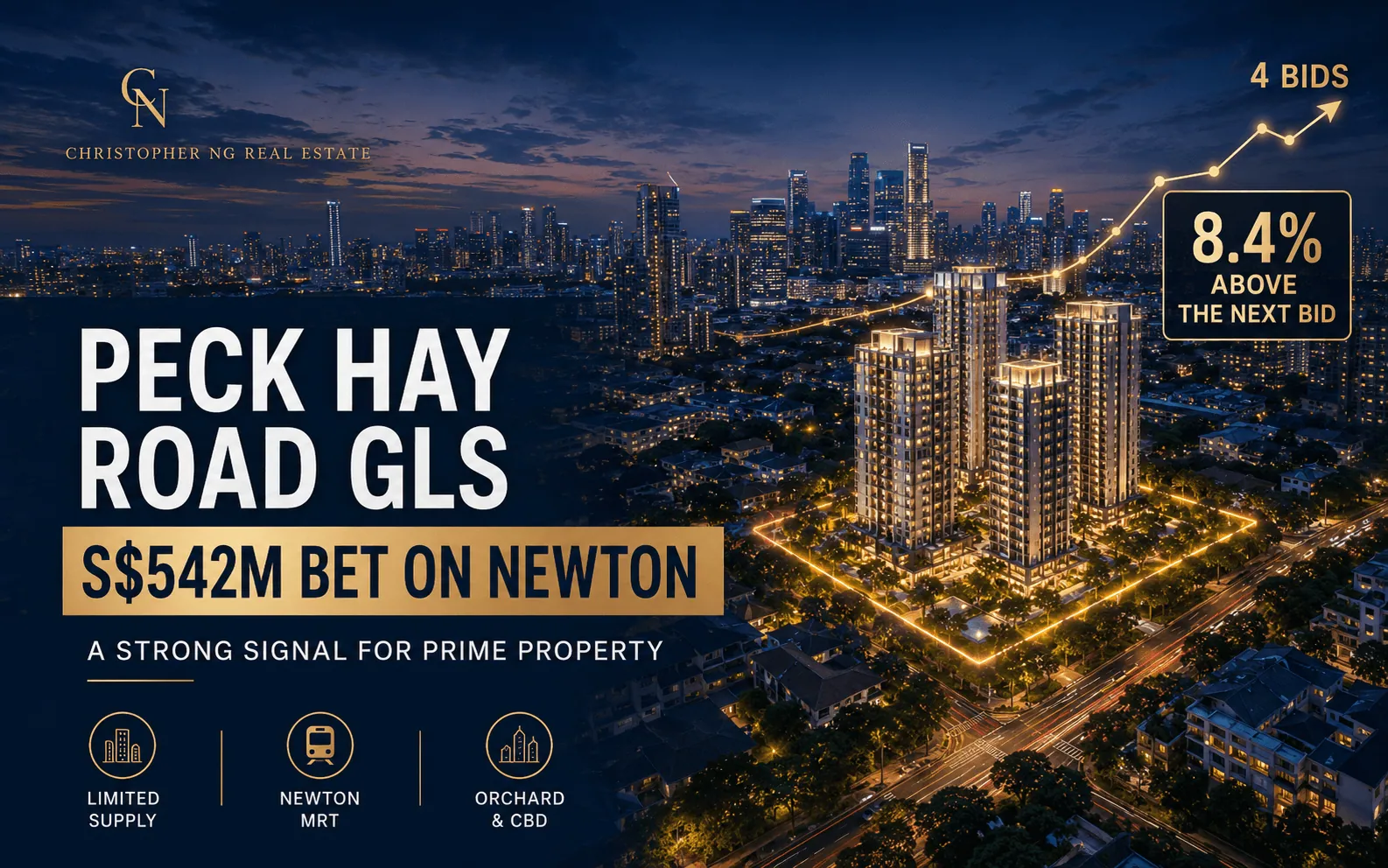
The Peck Hay Road GLS site attracted four bids, with CDL Constellation Pte Ltd and Garden Estates Pte Ltd emerging as the successful bidder with a top offer of $542 million, translating to approximately $1,865 psf per plot ratio (psf ppr).
Some commentators may focus on the fact that only four developers participated.
Personally, I think they're looking at the wrong number.
The more important figure is this:
The winning bid was 8.4% higher than the second-highest offer.
That is a meaningful gap.
Developers don't accidentally overpay by tens of millions of dollars.
When one bidder is prepared to stretch significantly beyond its competitors, it usually reflects a strong conviction that the site possesses long-term value others may have priced more conservatively.
In other words, CDL wasn't simply buying land.
They were buying into the future of Newton.
Why Newton Is Back on Developers' Radar
For many years, Newton has always been known as a prestigious residential address.
Excellent connectivity.
Close to Orchard.
Established schools.
Strong amenities.
Yet despite these strengths, new residential supply has remained relatively limited.
That is beginning to change.
URA's vision of transforming Newton into a more vibrant mixed-use urban village is gradually reshaping how developers evaluate the area.
Rather than viewing Newton purely as a mature residential estate, developers are beginning to see it as a district entering a new phase of growth.
The Peck Hay Road site is only the second GLS released since those transformation plans were announced.
Being among the first developments in a rejuvenated precinct often carries its own strategic advantage.
Scarcity Still Matters
One lesson I've learnt over the years is that buyers often focus on today's launch price.
Developers focus on tomorrow's supply.
There simply haven't been many Government Land Sale sites around Newton in recent years.
That shortage has created pent-up demand for brand-new 99-year developments in one of Singapore's most established central neighbourhoods.
Scarcity has always been one of the biggest drivers of long-term property value.
When supply remains limited while demand continues to grow, developers naturally become more aggressive when opportunities finally arise.
Connectivity Is No Longer Just a Bonus
Location has always mattered.
Today, connectivity matters even more.
Future residents will enjoy immediate access to Newton MRT Interchange, giving them direct access to both the North-South Line and Downtown Line.
One stop to Orchard.
Around fifteen minutes to the CBD.
For many professionals, that's the kind of convenience money cannot easily replace.
Add the site's proximity to ACS Junior and you immediately widen the pool of potential buyers to include families who place significant value on school accessibility.
When transport, education and lifestyle come together in a single location, demand usually becomes much more resilient.
Why Buyers Should Pay Attention to Developer Behaviour
One question I often receive is this:
"If developers are paying record prices for land, does that automatically mean property prices will rise?"
Not necessarily.
Property markets are influenced by many factors including interest rates, economic conditions, employment and government policies.
However, what higher land prices do tell us is this:
Developers believe future selling prices can comfortably support today's acquisition costs.
Otherwise, they simply wouldn't bid.
These companies answer to shareholders.
Every dollar spent must eventually generate a return.
Watching where experienced developers choose to deploy capital often provides valuable insight into where they believe demand will remain strongest.
What Could Future Launch Prices Look Like?
Based on the winning land price, market observers estimate that the future development may launch at average prices starting from around $3,500 psf.
That may appear expensive at first glance.
But context matters.
Prime districts have seen limited new supply over the past few years, while demand for quality city-centre homes has remained remarkably resilient.
Recent launches such as River Modern and Newport Residences have demonstrated that buyers are still prepared to pay for projects that combine excellent location, connectivity and long-term liveability.
The Peck Hay Road development is likely to appeal to a similar buyer profile.
My Thoughts
Every GLS exercise tells a story.
Sometimes it's a story about caution.
Sometimes it's a story about uncertainty.
This one tells me something different.
It tells me developers continue to have confidence in Singapore's Core Central Region despite higher land prices, global economic uncertainty and increasing construction costs.
More importantly, it reinforces a principle I've always believed.
The best property decisions are rarely about chasing today's hottest launch.
They're about understanding where long-term confidence is quietly building.
Developers have just committed more than half a billion dollars to Newton.
That doesn't guarantee future price appreciation.
But it certainly tells us they believe this precinct's next chapter is only just beginning.
Frequently Asked Questions
Why is the Peck Hay Road GLS site important?
It is one of the first Government Land Sale sites released following URA's plans to rejuvenate Newton into a more vibrant mixed-use urban village, making it a significant indicator of developer confidence in the district.
Why did CDL bid so much higher than the other developers?
The sizeable gap suggests CDL sees strong long-term value in the site's location, limited future supply, excellent transport connectivity and the broader transformation of Newton.
Will the future condominium be expensive?
Based on the winning land price, market expectations are that launch prices could average from around $3,500 psf, although actual pricing will depend on design, market conditions and launch timing.
Is Newton still a good place to buy property?
Newton continues to be one of Singapore's most established prime residential districts, offering excellent MRT connectivity, proximity to Orchard Road, reputable schools and limited new housing supply. Buyers should still assess any purchase based on their own financial objectives, lifestyle needs and investment horizon.
Christopher Ng is an Executive Group Division Director at ERA Singapore with over 20 years of experience across residential, commercial and industrial real estate. A graduate of the National University of Singapore's Real Estate programme, he is known for advocating a long-term asset progression approach to property ownership and helps homeowners make structured property decisions. Together with his wife, Jasmine, he leads one of ERA Singapore's fastest-growing divisions while continuing to advise clients across HDB, private residential, landed and Good Class Bungalow transactions.
Want the tailored version for your portfolio?
Every article here generalises. A 20-minute conversation makes it specific to your numbers.
Why is the Peck Hay Road GLS site important?
Why did CDL bid so much higher than the other developers?
Will the future condominium be expensive?
Is Newton still a good place to buy property?

Written by
Christopher Ng (CEA R014394H)
Singapore Property & Asset Progression Strategist with ERA Realty Network. A NUS Real Estate graduate, Christopher has advised homeowners, investors and property owners since 2004.