
Freehold vs 99-Year Leasehold Landed Property in Singapore: Is Freehold Always Worth Paying More For?
This article explores the common Singaporean debate: Is freehold landed property always worth paying more for compared to a 99-year leasehold, especially when considering factors like property condition, location, and family lifestyle?
This article is a follow-up to my recent Christopher Client Stories piece on Mr David.
For those who have not read it, David is a long-time client whom we first helped about six years ago. We sold his 3-bedroom EC and helped him buy a larger 4-bedroom unit in the exact same development, seven storeys higher.
Fast forward to 2026, and his financial position has progressed enough for us to explore the next stage of his property journey:
Landed property.
David started with one very clear instruction.
“Freehold landed only.”
His reason was not speculation.
It was not because someone told him freehold always appreciates more.
It was much more personal.
He wanted something he could leave to his children.
We started looking.
At around his $3.5 million budget, however, the freehold landed homes we saw required major compromises. Some were largely land-value purchases with old houses requiring substantial work. We then considered freehold strata landed, but several felt smaller internally than his existing 4-bedroom condo.
After about two weeks, David eventually opened his mind to another possibility:
99-year leasehold landed homes with more than 80 years remaining.
And suddenly, the options became very different.
Better houses.
Better layouts.
More suitable spaces.
Properties his family could actually enjoy.
That client journey raised a question I think deserves a much deeper discussion:
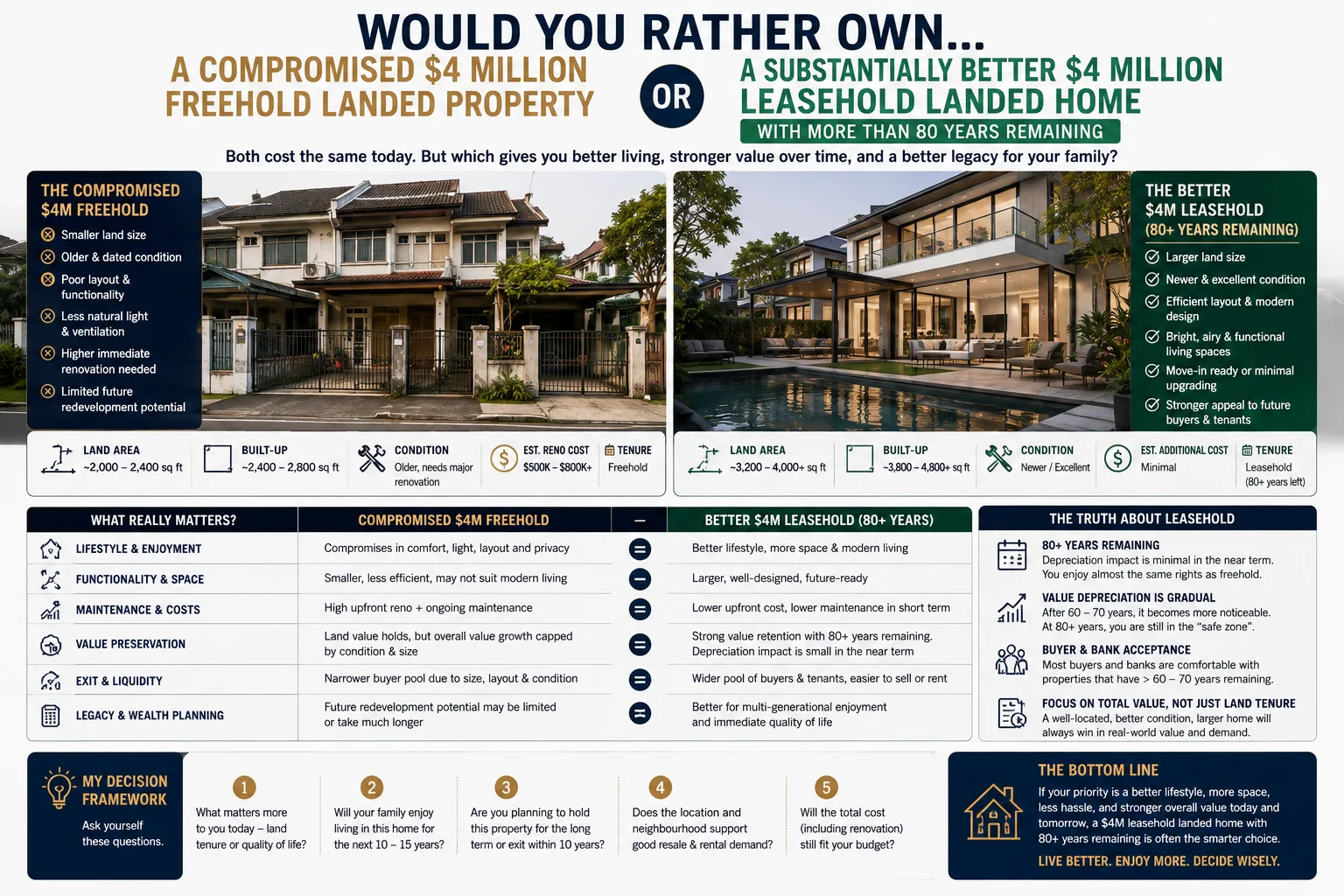
Would you rather own a compromised $4 million freehold landed property, or a substantially better $4 million leasehold landed home with more than 80 years remaining?
There is no universal answer.
But I think too many landed buyers answer:
“Freehold, obviously.”
before asking what they are actually giving up to obtain it.
Why Singaporeans Love Freehold Landed
I understand the attraction completely.
If I am buying an apartment, perhaps I can accept leasehold more easily.
But once I am spending $4 million, $6 million or $8 million buying land, something changes psychologically.
You start thinking:
"If I'm going to own land, shouldn't I own it forever?"
And for many Singaporeans, landed property is closely tied to the idea of legacy.
Parents imagine:
buy house,
raise children there,
eventually pass it to them.
The children may then keep it, redevelop it or pass it to another generation.
That is emotionally powerful.
Freehold also gives owners flexibility that a leasehold property ultimately cannot reproduce.
There is no fixed 99-year countdown.
You can hold for decades without watching the lease shorten.
For very long-term family wealth preservation, that matters.
So I am certainly not arguing that tenure is irrelevant.
Quite the opposite.
Freehold has genuine value.
The question is:
How much should you pay for it?
Tenure Has A Price
This is where I think the discussion becomes more useful.
Suppose two houses cost $4 million.
House A — Freehold
Intermediate terrace
1,800 sq ft land
Original condition
3,000 sq ft built-up
Less convenient location
Requires perhaps $700,000–$900,000 of works
House B — 99-Year Leasehold
Corner terrace / larger terrace
3,000 sq ft land
More than 80 years remaining
4,500 sq ft built-up
Good condition
Better suited to the family
Perhaps $150,000 of improvements
Same purchase price:
$4 million.
Which is better?
If your only criterion is:
“Which title lasts longer?”
House A wins.
If your question is:
“Which property gives my family the better next 20 years?”
House B may win comfortably.
This is why I don't like discussing freehold versus leasehold in isolation.
Tenure is something you are buying.
And like everything else in property, you need to ask whether the premium is worth what you have to sacrifice.
The $4 Million Freehold Trap
This is particularly relevant at the entry end of Singapore's landed market.
Buyers often start with:
Budget: $4 million
Requirement: Freehold
Then they search.
What happens?
They may end up accepting:
smaller land,
older houses,
poorer condition,
less convenient locations,
narrower plots,
or substantially larger renovation requirements.
Technically, they achieved the objective.
They bought freehold landed.
But did they achieve the bigger objective?
Did the family actually improve its living environment?
Did the move strengthen their finances?
Did they buy something they will enjoy?
That is where I think Asset Progression and property hierarchy can conflict.
Asset Progression Is Not A Game Of Labels
I have written this several times because I believe strongly in it.
Asset Progression is not:
HDB → Condo → Landed → Freehold Landed → Semi-D → Detached.
There is no trophy at the end.
A family's property journey should improve:
financial position,
housing suitability,
future options,
or ideally all three.
Sometimes moving from condo to a well-bought 99-year landed property can be a much stronger progression than buying a compromised freehold landed house simply because freehold sounds better.
The title deed doesn't live in the house.
Your family does.
The Most Important Variable Is Your Holding Period
This is where the freehold versus leasehold debate should become mathematical rather than emotional.
Ask yourself:
How long do I actually intend to own this property?
If you're buying at age 40 and intend to stay for 20 years...
a property with 82 years remaining today would still have roughly:
62 years remaining
when you're 60.
Stay 30 years?
Approximately:
52 years remaining.
That is not the same thing as buying an old leasehold landed property with 35 years left.
So when someone says:
“Leasehold landed has lease decay.”
Yes.
But the amount of remaining lease matters enormously.
Leasehold is not one category.
A 99-year home with 90 years remaining is a completely different proposition from one with 40 years remaining.
But Lease Decay Is Real
We should not swing too far in the opposite direction.
The lease does eventually matter.
As remaining tenure falls, the future buyer pool can become more sensitive.
A younger family may ask:
"Will this last long enough for my children?"
Financing can also become more restrictive as leases shorten, depending on the remaining lease, buyer age and prevailing lending/CPF rules at that future point.
Most importantly, buyers start mentally valuing the land differently.
A freehold property carries perpetual underlying land ownership.
A leasehold property's land interest is gradually consumed.
So if your intended holding period is very long—or your explicit objective is multi-generational preservation—freehold becomes increasingly compelling.
Legacy: What Are You Actually Trying To Leave?
This brings me back to David.
When I asked why freehold mattered so much, his answer was essentially:
“I want something for my children.”
Perfectly understandable.
But then I asked myself:
What exactly constitutes a legacy?
Suppose David buys an 80-plus-year lease landed home.
His children spend their growing-up years there.
Twenty-five years later, there may still be roughly 55–60 years left.
They may inherit:
the property,
or the sale proceeds,
or other investments David accumulated because he didn't over-stretch into freehold.
Does that mean he failed to create a legacy?
I don't think so.
We sometimes equate:
Legacy = freehold property.
But wealth can be passed down in many forms.
Property.
Cash.
Equities.
Businesses.
Insurance.
Education.
Financial freedom.
And perhaps something less measurable:
memories created while the family was actually together.
The Children You Want To Leave The House To Are Living With You Now
This is probably the emotional centre of this discussion.
Parents often say:
"I want to buy freehold so I can leave it to my children."
Very noble.
But your children may currently be:
5,
10,
15 years old.
They are living with you now.
What if the freehold house you can afford gives them:
smaller bedrooms,
less living space,
worse location,
longer commute,
and two years of reconstruction?
While the leasehold alternative gives:
larger bedrooms,
a garden,
a family room,
better condition,
and a home everyone enjoys immediately?
How do we value those 20 years?
There is no right answer.
But it deserves to be part of the equation.
Freehold Doesn't Automatically Mean Better Land
This is another misconception.
Two landed homes:
Property A
Freehold
2,000 sq ft
Narrow plot
Busy road
Original house
Property B
99-year
3,500 sq ft
Regular plot
Wide frontage
Quiet estate
Good condition
Some buyers still say:
Property A must be better because freehold.
I wouldn't.
We still need to assess:
plot shape,
width,
road,
location,
building,
land usability,
and redevelopment potential.
As I discussed in my article on why two 4,000 sq ft landed plots can be worth very different amounts, the geometry and planning quality of the land itself matter tremendously.
A freehold title does not straighten an irregular plot.
It does not widen the frontage.
It does not move a noisy road.
Location Can Be More Important Than Tenure
Imagine another choice.
Option A
Freehold terrace.
Farther from work.
Farther from children's school.
Few amenities nearby.
$4 million.
Option B
99-year landed property.
Near parents.
Near school.
Good transport.
Neighbourhood family already enjoys.
$4 million.
If you hold for 20 years, how much value does the location difference create in your family's daily life?
Ten minutes saved every trip.
Children closer to grandparents.
Shorter school journey.
More convenient work commute.
These things may not appear in a property valuation report.
But they absolutely affect the quality of ownership.
And importantly, good location also matters to your eventual resale buyer.
House Condition Can Easily Overwhelm The Freehold Premium
Let's make the numbers more concrete.
Freehold House
Purchase: $4.0m
Major works: $900k
Temporary accommodation: $100k
Professional/miscellaneous costs: $100k
Rough total before other transaction/financing costs:
$5.1m
Leasehold House
Purchase: $4.0m
Renovation: $200k
Total:
$4.2m
Difference:
$900,000.
Now the question becomes:
Is freehold worth an additional $900,000 to you?
Maybe yes.
But perhaps not.
And if you invested that $900,000 elsewhere over 20 years?
That becomes another legacy asset.
This is why I always compare:
all-in property cost, not simply tenure.
The Leasehold Discount Is Your Compensation
This is the conceptual framework I prefer.
Leasehold isn't automatically bad.
It simply needs to be priced appropriately.
If two identical landed homes sit beside each other:
one freehold,
one 80-year remaining lease,
and both cost exactly the same...
I will take freehold.
Easy.
But what if the leasehold property costs 20% less?
Or gives me 40% more land?
Or dramatically better location?
Now we have a trade-off worth analysing.
The leasehold discount is effectively compensating you for:
the finite tenure.
The right question is:
Is the discount large enough?
Likewise, The Freehold Premium Must Be Justified
Many buyers treat freehold premium as something they should pay at almost any cost.
I disagree.
Suppose you have to pay:
$800,000 extra
for freehold.
What does that $800,000 buy?
Permanent tenure.
Good.
But what are you giving up?
Maybe:
500 sq ft of land.
Better location.
Better condition.
Lower mortgage.
Investment capital.
Financial reserves.
Family holidays.
Early retirement.
There is no universal correct trade.
But call it what it is:
You are purchasing tenure with money that could have purchased something else.
The Exit Pool Is Where Freehold Becomes More Powerful
This is one area where I give freehold considerable weight.
Imagine selling after 25 years.
Freehold Property
Still freehold.
Your buyer worries about:
location,
land,
price,
condition.
Tenure remains unchanged.
Leasehold Property
Originally 85 years remaining.
Now:
60 years.
Your buyer now has another question:
“Is 60 years enough for me?”
Some will say yes.
Some will say no.
The buyer pool becomes more tenure-sensitive.
This is important.
Especially for landed property where absolute quantum is already high.
You don't want too many reasons for future buyers to say:
“Not for me.”
This Is Why Entry Price Matters Even More For Leasehold Landed
When buying leasehold landed, I become very disciplined about price.
Because your future buyer will eventually apply another lease discount.
If you overpay today as though the property were freehold...
you may have difficulty recovering that premium later.
I therefore want to understand:
What do comparable freehold properties cost?
What is the current leasehold discount?
What does the remaining lease look like at my expected exit?
Who is likely to buy it?
The lease must be reflected in the price.
Who Should Prefer Freehold?
I would give freehold greater priority if:
You genuinely want to hold across generations.
Not five years.
Not ten.
Decades.
Your children may realistically inherit and retain the property.
The freehold premium is financially comfortable.
You're not sacrificing retirement or liquidity.
The freehold property itself is good.
Good land.
Good location.
Good fundamentals.
You want maximum optionality at exit.
Then I see a strong argument.
Who Should Seriously Consider 99-Year Landed?
I would keep an open mind if:
You have a defined 15–30 year lifestyle horizon.
The remaining lease is still substantial.
Especially 75, 80, 85 years or more.
The leasehold alternative gives materially more property for the same money.
More land.
Better house.
Better location.
Buying freehold would make you financially uncomfortable.
Family enjoyment matters more than perpetual tenure.
For this buyer, insisting on freehold can actually produce a worse overall decision.
What About 999-Year Landed?
This is worth mentioning.
In practice, many buyers treat 999-year tenure almost like freehold because the lease horizon extends far beyond any normal human or even multi-generational ownership period.
Legally, it is still leasehold.
Practically, the difference between 999 years and freehold is far less relevant to most family decisions than:
99 years versus freehold.
So I would generally analyse good 999-year landed much closer to freehold in terms of buyer perception.
Don't Confuse Freehold With Guaranteed Appreciation
Another important point.
A freehold title does not guarantee:
strong capital appreciation,
good rental return,
or easy resale.
If you buy:
wrong location,
bad land,
awkward plot,
terrible entry price...
tenure cannot rescue every mistake.
Likewise, a well-bought leasehold landed home can appreciate because:
location improves,
demand strengthens,
supply remains tight,
and you bought at an attractive discount.
Property performance is multi-variable.
Think About Land Scarcity Separately From Lease Scarcity
All landed housing benefits to some extent from the scarcity of low-density residential land in Singapore.
But freehold adds another layer:
permanent land tenure scarcity.
That can become increasingly valuable over very long periods.
So for a buyer with enough capital, buying good freehold landed remains extremely attractive to me.
The key word is:
good.
Not:
freehold at any cost.
Let's Return To Our Killer Question
Here it is again.
You have $4 million.
Would you rather buy:
House A — Freehold
1,800 sq ft intermediate terrace
Old condition
$800,000 renovation/redevelopment liability
Longer commute
Compromised frontage
But:
freehold forever
or:
House B — 99-Year Leasehold
3,000 sq ft corner terrace
82 years remaining
Move-in condition
Better layout
Good road
Closer to family and schools
Same $4 million
What should you buy?
My answer?
It depends entirely on your priorities.
If you tell me:
"Christopher, I want to preserve landed property for three generations. I don't care if the house is worse today."
I lean House A.
If you tell me:
"I am 42. My children are young. I want the best possible family home for the next 20 years and don't want to stretch financially."
I would look very seriously at House B.
Both can be correct.
That is the point.
Mr David's Case Made This Very Real For Me
This is why I wanted to write this follow-up after sharing David's story.
We didn't start with a philosophical debate about tenure.
David started with:
Freehold only.
We simply went to the market and tested that assumption.
Three freehold conventional landed houses.
Then four freehold strata-landed developments.
And the more we viewed, the clearer the trade-offs became.
The freehold label was giving him what he wanted tomorrow.
Legacy.
But several properties were compromising what he needed today.
Space.
Comfort.
Family enjoyment.
Eventually, opening the search to long-lease 99-year landed homes gave us another set of options.
It didn't mean:
“Freehold doesn't matter anymore.”
It meant:
“Now we understand what freehold is costing us.”
That is a far better position from which to make a decision.
Sometimes The Best Property Consultation Changes The Question
Clients often come to us asking:
“Which freehold landed should I buy?”
But after discussion, the better question may become:
“Should I buy freehold landed at all?”
Or:
“How much should I pay for freehold?”
Or:
“What do I actually want this property to achieve?”
That is what Asset Progression consultation should do.
Not tell someone what to buy.
Clarify the decision.
My View: Freehold Is Better — Until The Price Of Freehold Makes The Rest Of The Property Worse
This is probably the simplest way I can express my view.
All else equal?
I prefer freehold.
Of course.
Who wouldn't?
Same location.
Same land.
Same house.
Same price.
Take freehold.
But all else is almost never equal.
The moment freehold requires you to accept:
worse land,
worse condition,
worse location,
smaller house,
bigger mortgage,
or less family enjoyment...
we need to quantify that compromise.
Sometimes freehold still wins.
Sometimes it doesn't.
And this is precisely why I don't think landed buyers should start every search with:
“Must be freehold.”
Start instead with:
“What are we trying to achieve?”
Then rank:
family needs,
financial comfort,
location,
land quality,
condition,
holding period,
legacy,
and tenure.
Freehold should be part of the decision.
Not the entire decision.
My Asset Progression Perspective
A landed home can play several roles in your property journey.
It can be:
a wealth-preservation asset.
a family home.
a redevelopment opportunity.
a lifestyle purchase.
a legacy asset.
Different buyers put different weights on each.
A 35-year-old owner may prioritise capital appreciation.
A 45-year-old family may prioritise space.
A 60-year-old buyer may prioritise legacy.
That is why the same leasehold property can be excellent for one family and unsuitable for another.
Asset Progression is about matching the asset to the stage of life.
Don't Sacrifice Today's Life Completely For Tomorrow's Inheritance
I am a believer in building assets for the next generation.
But I also think there is a balance.
Your children may eventually inherit your property.
But before that, they may spend the next 20 years living in it with you.
Those years matter too.
Perhaps one of the best legacies isn't simply:
“Dad left me this freehold house.”
Maybe it is also:
“We had a wonderful home growing up.”
If you can achieve both?
Perfect.
Buy great freehold landed.
But when budgets force a choice, families need to decide which outcome matters more.
And there is nothing right or wrong about either answer.
Final Thoughts
The freehold-versus-leasehold debate in Singapore landed property is often treated too simplistically.
Freehold good. Leasehold bad.
I don't see it that way.
I see:
permanent tenure versus finite tenure
combined with:
location,
land size,
plot quality,
building condition,
quantum,
family needs,
holding period,
and
exit strategy.
Freehold deserves a premium.
But not an infinite premium.
And long-lease landed property deserves a discount.
But that does not automatically make it an inferior home or poor investment.
The question is always:
What am I getting for what I am paying?
Which brings us back to David.
His original brief was:
Freehold landed.
Today, our brief has evolved.
Find the landed home that best serves his family while still respecting his desire to create a legacy.
That may ultimately still be freehold.
If we find the right one, fantastic.
Or it may be a well-priced leasehold landed home with more than 80 years remaining that gives his family significantly more enjoyment for the next few decades.
We haven't bought yet.
But the search is already better because the priority is clearer.
And that is ultimately what I hope buyers take away from this article.
Don't buy freehold simply because you have been told freehold is better.
Understand why it is better.
Understand how much extra you are paying for that advantage.
Then decide whether that premium is worth it for you.
Because the best landed property isn't necessarily the one that lasts forever.
It is the one that best fulfils the reason your family bought it in the first place.
Want the tailored version for your portfolio?
Every article here generalises. A 20-minute conversation makes it specific to your numbers.
Is freehold landed property always better than 99-year leasehold landed in Singapore?
Why do Singaporeans prefer freehold landed homes?
Is 80 years remaining on a landed property considered a long lease?
Does 99-year landed property lose value as its lease falls?
Is 999-year landed basically the same as freehold?
Should I pay $500,000 more for freehold?
Is a smaller freehold terrace better than a larger leasehold corner terrace?
Can I pass a 99-year landed property to my children?
Is leasehold landed suitable for Asset Progression?
Why is entry price particularly important for leasehold landed?
What buyer is best suited to freehold landed?
Who should consider 99-year landed?
Does freehold guarantee better appreciation?
Should I stretch financially to buy freehold?
What was the lesson from the Mr David Client Story?
So which would you choose: a compromised $4m freehold or a much better $4m leasehold with 80+ years left?
Are you buying primarily for legacy, lifestyle, investment—or some combination of all three?

Written by
Christopher Ng (CEA R014394H)
Singapore Property & Asset Progression Strategist with ERA Realty Network. A NUS Real Estate graduate, Christopher has advised homeowners, investors and property owners since 2004.