
Thomson Reserve Priority Booking: Who Could Get First Choice — And Can Ordinary Buyers Improve Their Chances?
As Thomson Reserve nears its public preview, many buyers wonder about priority booking and unit selection. This article explores how priority arrangements might work, their impact on ordinary buyers, and what actions buyers can take.
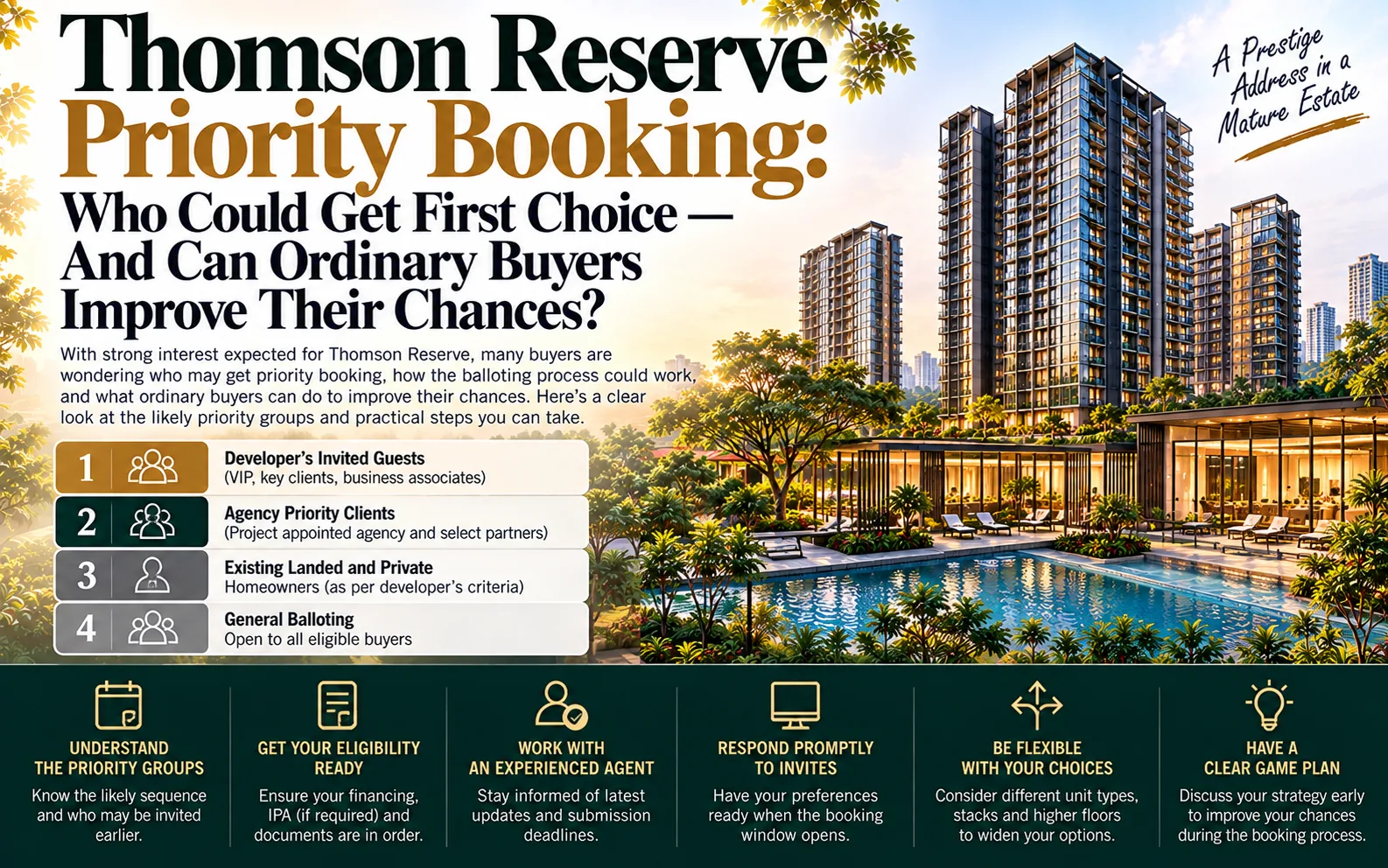
With Thomson Reserve approaching its public preview, one question I've increasingly been discussing with buyers is:
Who gets to choose their unit first?
It's an important question.
Because at a major new launch, getting a good unit isn't just about whether you can afford it.
It's also about whether that unit is still available when your turn comes.
You may have studied the floor plans, shortlisted your favourite stacks, worked out your budget and decided exactly which floor you want.
But imagine arriving on booking day only to discover that your preferred unit has already been taken.
Not necessarily by someone with a better ballot number.
But by someone who had an earlier opportunity to purchase.
This brings us to a topic that has attracted considerable attention in Singapore's property market recently.
Priority booking at new condominium launches.
And with Thomson Reserve having 1,268 units, I think it's worth discussing how priority arrangements have traditionally worked, what could potentially happen at this launch, and what buyers can legitimately do to improve their chances.
Before going further, let me be very clear.
As at 15 October 2026, the Thomson Reserve developer has not announced any priority-booking scheme that I can confirm.
Everything below concerning Thomson Reserve's possible priority order is my discussion of a hypothetical arrangement based on past industry practices.
It is not an official developer announcement, and the eventual process may be different — especially given the recent public scrutiny of priority sales.
First, What Exactly Is Priority Booking?
At many new condominium launches, there may be different stages of sales.
Some buyers may receive an opportunity to purchase before the main public booking exercise.
These arrangements can include developer-related purchasers, selected VIPs, former owners of an en-bloc development, agents purchasing for themselves, or buyers acquiring multiple units.
The precise categories and their order are determined by the developer, subject to applicable rules.
This is different from the public balloting exercise, where registered buyers may be allocated a queue number to select from the available units.
And the difference can be significant.
Let's say you want a particular 3-bedroom stack on the 18th floor.
Even if you receive an excellent public ballot number, that unit might already have been sold during an earlier priority exercise.
A good ballot number gives you an earlier choice among the units available to your booking group. It doesn't necessarily give you first choice of the entire development.
That is why buyers should understand the sales process before becoming too attached to any particular unit.
What Could Thomson Reserve's Priority Order Look Like?
Based on arrangements I've encountered at previous new launches, one possible priority sequence — assuming developers continue with similar practices — could look like this:
Possible order | Buyer category | What it could mean |
|---|---|---|
1 | Developer's staff | Eligible employees purchasing under an internal arrangement |
2 | Developer VIP | Buyers specifically referred and endorsed by the developer's senior management |
3 | Former Thomson View owners | Previous owners of the collective-sale development receiving special consideration |
4 | Multiple-purchase buyers | Eligible buyers purchasing more than one unit under an approved arrangement |
5 | Agent purchasers | Eligible property agents buying for themselves |
6 | Public purchasers | Buyers participating in the general sales exercise |
Important: This table is illustrative, not an announced Thomson Reserve booking sequence. There is no confirmation that all six categories will exist, that they will be offered in this order, or that any particular group will receive an allocation.
I want to explain why these categories sometimes arise.
1. Developer's Staff
Some developers may have internal arrangements for eligible employees.
These can be viewed as staff benefits or part of the developer's internal sales policy.
But this doesn't mean every employee automatically receives priority, nor that staff purchases are always the first category.
The actual conditions can vary between developers and projects.
2. Developer VIPs
This is usually a much narrower category than buyers imagine.
A genuine developer VIP arrangement may involve individuals specifically referred or endorsed by the developer's senior management.
It isn't simply a case of an agent declaring:
"My client is a VIP."
And I would be cautious of anyone promising guaranteed VIP access without an official basis.
If there is such a category, eligibility and approval remain with the developer.
3. Former Thomson View Owners
This category is particularly relevant to Thomson Reserve.
Remember, Thomson Reserve is being developed on the former Thomson View site.
The former owners were part of the collective-sale process that made the redevelopment possible.
At some en-bloc redevelopment launches, developers have extended special consideration to former owners who wish to purchase a unit in the new project.
There's a certain logic to that.
Some owners may have lived there for decades.
They know the neighbourhood.
They may have strong emotional ties to the location.
And they may genuinely wish to return.
Would Thomson Reserve extend such an arrangement to former Thomson View owners?
It's possible, but it has not been confirmed.
I would not advise any former owner to assume they have priority until the developer formally announces it.
4. Multiple-Purchase Buyers
Now we come to a category that could be especially interesting for some buyers.
At certain launches, developers may consider priority arrangements for buyers purchasing multiple units.
From the developer's perspective, the attraction is understandable.
One purchasing group potentially commits to two or more units.
But buyers need to understand that multiple-purchase priority is not an automatic entitlement.
The developer may define exactly what constitutes an eligible multiple purchase, whether the purchases must be simultaneous, who may be named as purchasers, and what supporting documents are required.
This is particularly important for families considering purchases under different family members' names.
I'll come back to that shortly.
5. Agent Purchasers
This is the category that has attracted substantial media attention.
Agents working on a new launch may, under certain developer arrangements, receive an opportunity to purchase before the general public.
This can be controversial because agents are already involved in marketing the development and may have detailed knowledge of the available units.
To be clear, being an agent doesn't automatically guarantee priority.
Eligibility may depend on the appointed marketing agencies, the developer's conditions and disclosure requirements.
And not every agent purchasing a unit is necessarily buying for speculation.
Some are buying homes for themselves.
Others may be purchasing for investment.
The concern is not simply that agents are buying property.
It's whether their professional position gives them an advantage that ordinary buyers cannot access.
6. Public Purchasers
Finally, we have the general public booking exercise.
This is where most buyers will participate.
Depending on the developer's process, registered buyers may receive ballot numbers and select units according to their queue order.
Public booking remains the principal route for ordinary buyers.
And it's important to remember that even where priority exercises exist, there may still be many attractive units available during public booking.
The issue is understanding what has already been sold, what remains available and whether the asking price still represents good value.
Why Has Priority Booking Become Such A Controversial Topic?
This discussion isn't happening in isolation.
Over the past year, mainstream media reports have brought the practice of agent priority purchases into the spotlight.
The Business Times reported in December 2025 that property agents had purchased 635 new private homes through priority queues between September 2024 and October 2025.
That represented approximately 4.2% of all new private homes launched during that period.
At an overall market level, 4.2% might not sound particularly significant.
But the numbers were much higher at certain individual developments.
For example, the report highlighted that agents purchased:
173 of 846 units at Emerald of Katong, approximately 20%.
43 of 524 units at RiverGreen, approximately 8%.
25 of 343 units at LyndenWoods, approximately 7.3%.
The concern is obvious.
Imagine being a genuine homebuyer who has spent months preparing for a launch, only to discover that a significant number of units have already been taken by industry participants.
Would you feel disadvantaged?
I can understand why some buyers would.
At the same time, the Business Times report noted that priority access for agents was a private commercial arrangement and that the practice was not, in itself, a breach of regulations.
The distinction is between something being permitted and whether the market considers it fair.
Those are not always the same thing.
What About CEA And The Controller Of Housing?
The issue attracted further attention in 2026, including reporting on scrutiny of VIP sales and agent priority purchases.
The Council for Estate Agencies (CEA) is concerned with the conduct of property agencies and salespersons, including disclosure obligations and potential conflicts of interest.
The Controller of Housing (COH), operating within the housing-developer regulatory framework, has a different role relating to licensed housing developers and the sale of uncompleted private residential properties.
These responsibilities should not be confused.
Public discussion and regulatory scrutiny do not automatically mean that all priority booking arrangements have been banned.
Nor should we assume that a new universal booking order has already been imposed.
For Thomson Reserve, the practical takeaway is that we should wait for the developer's actual booking procedures rather than treating past practices as guaranteed.
And given the attention this issue has received, I wouldn't be surprised if developers become more cautious about how priority arrangements are structured, communicated and disclosed.
That is my expectation, not an announced regulatory change.
READ ALSO: VIP sales at condo launches under scrutiny | The Straits Times
My View: Priority Booking Isn't Necessarily Wrong, But Transparency Matters
I can see both sides of this argument.
Developers are private businesses.
They invest substantial capital into acquiring land, financing construction and bringing projects to market.
It isn't unreasonable for them to have commercial relationships with staff, business partners and other stakeholders.
Likewise, agents are consumers too.
An agent buying a home for their own family isn't automatically doing something wrong.
But there is another side.
A family buying its first private property may be committing several million dollars.
They've done their homework.
They've registered for the preview.
They've prepared their financing.
They believe they are entering a fair selection process.
Then they discover that the units they wanted were already sold before their turn.
I think the frustration is understandable.
For me, the issue isn't necessarily whether priority categories should exist at all.
The more important questions are how much inventory is allocated to priority groups, whether eligibility is properly disclosed, and whether ordinary buyers are given a fair opportunity.
A small, clearly disclosed priority exercise is quite different from a situation where a substantial proportion of desirable units disappears before the public has a chance to select.
And as agents, we should be careful not to create artificial urgency by exaggerating how many units are supposedly being taken by VIPs.
Buyers deserve accurate information.
Not rumours.
Not pressure.
Not manufactured fear of missing out.
So What Can A Thomson Reserve Buyer Do If They Want Priority?
This is probably the question many readers are most interested in.
And one possible avenue worth exploring — if Thomson Reserve eventually announces a multiple-purchase priority scheme — is whether a family has a genuine need and financial capacity to purchase more than one unit.
For example, imagine a family with two adult children.
The parents may be looking for a home for themselves.
One adult child may be planning to buy a property nearby.
Instead of treating these as completely separate property searches, the family might consider whether purchasing two homes in the same development makes sense.
Or perhaps two siblings independently intend to buy homes and would like to live in the same condominium.
The important point is that these must be genuine purchases.
Not names added merely to obtain a better queue position.
And the developer would need to confirm whether such a family grouping qualifies.
Which Family Relationships Could Potentially Be Considered?
Depending on the developer's rules, a family might explore purchases involving:
Relationship | Example |
|---|---|
Spouse | Husband and wife considering separate or joint property purchases |
Parents | Parents and an adult child each purchasing a home |
Siblings | Two siblings purchasing separate units |
Children | Adult children purchasing in their own names |
Minor children | A proposed purchase involving a trust, subject to legal and tax advice |
These are relationships to explore, not a confirmed list of eligible Thomson Reserve priority purchasers.
And there's a very important distinction here.
Being related doesn't automatically mean two purchases count as an eligible multiple purchase.
A developer might require specific ownership structures, documented relationships, simultaneous bookings or other conditions.
Until those conditions are published, no one should promise that a particular family arrangement will qualify.
Could Parents Buy One Unit And Their Child Buy Another?
Potentially, yes, as two genuine property transactions.
But there are several questions to work through.
Does the child have sufficient income and borrowing capacity?
Is the child already a property owner?
What are the applicable Buyer's Stamp Duty and Additional Buyer's Stamp Duty obligations?
Will the parents be contributing money?
Is that contribution a gift or a loan?
Would the bank accept the proposed financing arrangement?
And most importantly:
Would both purchases still make sense even without priority booking?
That's the question I would ask first.
Because priority should be a possible benefit of a sensible property plan.
It shouldn't be the reason to enter into a multimillion-dollar commitment.
What About Buying Through A Trust For A Child?
This deserves special attention.
Some families may consider purchasing a residential property on trust for a child.
But I would strongly caution against treating this as a simple way to qualify for multiple-purchase priority.
Trust purchases involve significant legal, tax and ownership considerations.
In Singapore, qualifying residential property transfers into living trusts are subject to a 65% ABSD (Trust) upfront, with a possible remission only where the applicable conditions are satisfied.
A trust purchase can also affect who beneficially owns the property, how it may be managed and what can happen to it in the future.
Financing and CPF arrangements can differ materially from an ordinary purchase.
And the developer may not recognise a trust purchase as eligible for any multiple-purchase priority scheme.
So if you're thinking:
"Can I buy one under my name and another under trust for my child to get priority?"
My answer would be:
Don't make that decision until you've spoken to a conveyancing lawyer and tax adviser, and obtained written clarification of the developer's eligibility conditions.
The stamp-duty and legal consequences can be far greater than any benefit from choosing a unit earlier.
READ ALSO: Remission of ABSD (Trust)
Is Buying Two Units Just To Get Priority Worth It?
Let's think about this logically.
Suppose you originally intended to buy one unit.
Then you discover that purchasing two units might qualify you for an earlier booking opportunity.
Would you really commit to a second property solely to improve your queue position?
I wouldn't recommend that.
You're not just buying priority.
You're taking on another property purchase, with its own:
financing requirements,
stamp duties,
holding costs,
market risks,
future exit considerations,
and possible rental obligations.
And the earlier booking opportunity doesn't guarantee that the units will be attractively priced.
Priority gives you earlier access. It does not automatically give you better value.
That's an important distinction.
A buyer who books early at an excessive price can still make a worse decision than a public buyer who selects a fairly priced unit later.
What If You Don't Qualify For Any Priority Category?
Then prepare properly for public booking.
I would rather have a well-prepared buyer with a later queue number than an unprepared buyer with an early one.
Before booking, I want my clients to know their maximum budget, loan eligibility, cash requirements and preferred unit types.
I also want them to shortlist several acceptable stacks and floors.
Not just one dream unit.
At Thomson Reserve, with 1,268 units across different residential blocks and unit configurations, there may be meaningful differences in price and value even within the same bedroom category.
So instead of simply chasing the highest floor or most popular stack, we should be asking:
Where is the best price-to-value gap?
Sometimes the unit that everyone wants isn't the one that offers the best investment proposition.
And sometimes a slightly less popular stack can become very attractive if the price difference is large enough.
That's where proper unit selection matters.
Thomson Reserve: The Question Isn't Just Who Books First
There is another reason this discussion matters particularly for Thomson Reserve.
It is a major development with 1,268 units.
That means there will be multiple unit types, price points, orientations and buyer profiles.
A 2-bedroom investor and a 5-bedroom owner-occupier are not necessarily competing for the same product.
Even among 3-bedroom buyers, preferences may differ substantially.
One buyer wants the lowest possible quantum.
Another wants a better layout.
Another wants a higher floor.
Another prioritises facing and privacy.
So while booking priority matters, I wouldn't allow it to become the entire purchasing strategy.
The real objective is not simply to get into the sales gallery first.
It's to buy the right Thomson Reserve unit at the right price.
And sometimes, knowing when not to buy is just as important.
What I Will Be Watching Before Thomson Reserve Booking Day
As the preview progresses, I will be watching for any official announcement concerning priority sales.
In particular, I want clarity on whether the developer will offer separate arrangements for staff, management-endorsed VIPs, former Thomson View owners, multiple-purchase groups or agents.
I also want to know whether any such arrangements will affect the available inventory before public booking, and how eligibility and documentation will be handled.
Given the recent media attention, the final process could be different from what we've seen at previous projects.
Until it is officially announced, I would advise buyers not to make financial commitments based on an assumed priority entitlement.
Final Thoughts: Don't Confuse Priority With Opportunity
Priority booking is an interesting part of Singapore's new-launch market.
And I understand why buyers want it.
When you're committing $2 million, $3 million or more, naturally you want the best possible selection.
But I think we need to separate three things.
Priority determines when you may get to choose.
Selection determines which unit you choose.
Value determines whether that unit is worth buying.
They are related.
But they're not the same.
For Thomson Reserve, we still need to wait for the developer's official arrangements.
If a legitimate multiple-purchase priority opportunity becomes available, families with genuine plans to purchase more than one home may wish to explore it.
But please don't restructure property ownership, involve family members or establish trusts simply because someone promises an earlier queue.
The property plan must make sense first.
And remember:
Getting first choice is useful. Getting the right unit at the right price is far more important.
That's what I'll be focusing on as we approach Thomson Reserve's booking exercise.
Want the tailored version for your portfolio?
Every article here generalises. A 20-minute conversation makes it specific to your numbers.
Does Thomson Reserve have priority booking?
Who usually gets priority booking at a new condo launch?
Will former Thomson View owners get priority at Thomson Reserve?
Can property agents buy before the public?
Can buying two units give me priority at Thomson Reserve?
Can my spouse, parents or siblings buy together to qualify for priority?
Can I buy a Thomson Reserve unit under trust for my child?
Is priority booking the same as getting a discount?
Will public buyers still get good units at Thomson Reserve?
Has the government banned agent priority booking?

Written by
Christopher Ng (CEA R014394H)
Singapore Property & Asset Progression Strategist with ERA Realty Network. A NUS Real Estate graduate, Christopher has advised homeowners, investors and property owners since 2004.