
I Nearly Spent $2 Million Rebuilding My Landed House. Instead, I Bought More Land.
I was prepared to spend around $2 million rebuilding my inter-terrace. Then I asked a different question: what if I treated that $2 million as investment capital instead? Here's why I eventually chose to sell, buy more land and move into a semi-D.
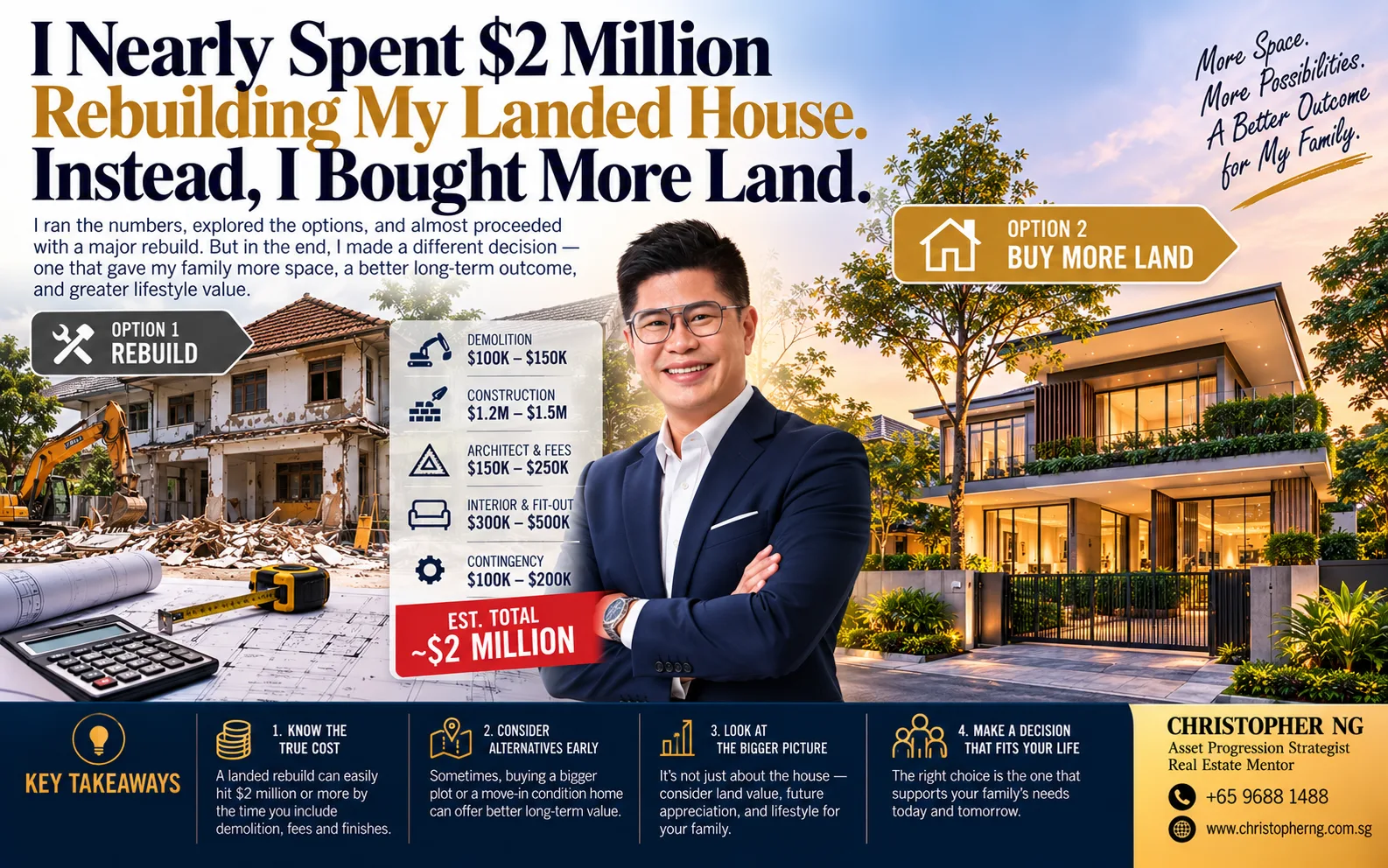
For quite a while, I thought my next property move was obvious.
Rebuild my landed house.
I was already staying in an inter-terrace.
The location worked for us. We were comfortable. We had already made the move from condo living into landed living.
But as my three children grew older, the house started to feel different.
When they were younger, sharing space wasn't a big issue.
Then came the requests.
“Daddy, can I have my own room?”
And once one child asks, you know where this is going.
Three growing children.
Three bedrooms.
More privacy.
More storage.
More family space.
Maybe a proper entertainment area.
Maybe a bigger kitchen.
And since we were already living in landed property, the natural thought was:
Why not just rebuild?
I started looking seriously into it.
I met builders.
I spoke with architects.
I looked at what could potentially be built on my land.
And very quickly, I realised that if I wanted to create the house I had in my head, I could easily be looking at putting another S$2 million or so into the property.
I could afford to do it.
But eventually I realised that was the wrong question.
The question wasn't:
“Can I afford to spend S$2 million rebuilding my house?”
It was:
“Is rebuilding my existing house the best use of the next S$2 million?”
That completely changed the way I looked at the decision.
First, Let Me Be Clear: I Love Rebuilt Landed Homes
This isn't an article arguing against rebuilding.
Far from it.
I've walked through some beautiful rebuilt landed houses.
When done properly, the difference can be enormous.
You get to design the house around your family.
You decide where the kitchen goes.
How big the bedrooms are.
Where the light enters.
Whether you want a lift.
A pool.
A roof terrace.
An entertainment room.
A larger master suite.
You can rebuild the entire house around the way your family actually lives.
There is also something deeply satisfying about creating a home from scratch.
So I understand why people do it.
The question for me was different.
I wasn't deciding between:
old house versus beautiful new house.
I was deciding between:
putting more capital into my existing land
or
using that same capital to own more land.
That distinction became increasingly important.
My Inter-Terrace Wasn't the Problem
This is probably the most important part of the story.
There was nothing fundamentally wrong with my house.
It had served my family well.
It gave us our first experience of landed living.
It gave the children space.
It gave us privacy.
And compared with condo living, we already had many of the things we wanted.
But families change.
A house that works when your children are small may not work the same way when they're older.
My problem wasn't really:
“My house is bad.”
It was:
“My family is starting to outgrow what this house can eventually become.”
Those are very different problems.
And that forced me to look beyond renovation.
Route A: Spend S$2 Million and Build a Much Better House
Let's simplify the numbers.
Suppose I spent approximately:
S$2 million rebuilding.
What would I get?
Potentially a much newer house.
More built-up area.
A better layout.
New electrical and plumbing systems.
New roof.
Modern finishes.
Maybe a lift.
Better bedrooms.
More usable family space.
Essentially, I could turn an older inter-terrace into a much more impressive inter-terrace.
There is absolutely nothing wrong with that.
But one thing wouldn't change.
The land.
My frontage wouldn't suddenly become semi-detached frontage.
My side boundary wouldn't disappear.
My plot wouldn't become significantly larger.
I would have a much better building.
But fundamentally, I would still own the same land.
That was the point that kept bothering me.
Route B: What If I Used That S$2 Million to Buy More Land Instead?
Then I started thinking differently.
What if I sold the inter-terrace?
What if I took the equity from the existing property…
combined it with the capital I was prepared to put into rebuilding…
and used that money towards the purchase of a larger landed property instead?
Suddenly S$2 million wasn't a construction budget anymore.
It became investment capital.
That changed the comparison completely.
Instead of asking:
“How much more house can I build?”
I started asking:
“How much more property can the same money help me own?”
That was the turning point for me.
Building and Land Are Not the Same Asset
This sounds obvious, but I think landed owners sometimes forget it.
When you buy landed property, you're really buying two things:
LAND + BUILDING
And the characteristics of the two are very different.
The building can be changed.
You can renovate it.
Extend it.
Reconfigure it.
A&A it.
Reconstruct it.
Or eventually demolish and rebuild it.
But the land is much harder to change.
You cannot renovate your inter-terrace into a semi-detached plot.
You cannot install another five metres of frontage.
You cannot renovate away an attached neighbour.
You cannot change a 2,000+ sq ft plot into a 7,000 sq ft plot simply by spending more on construction.
That made me ask myself:
Which part of the property did I actually want to upgrade?
The answer was increasingly:
the land.
A S$2 Million Rebuild Doesn't Necessarily Add S$2 Million of Property Value
This was another important consideration.
Suppose I spent S$2 million rebuilding.
Would my property automatically become worth S$2 million more?
Not necessarily.
Some expenditure creates strong market value.
Some creates lifestyle value.
And some creates value mainly for me.
Perhaps I want a very specific kitchen.
A particular marble.
An elaborate entertainment room.
Expensive sanitary fittings.
Custom carpentry everywhere.
The next buyer may appreciate them.
But that doesn't mean the next buyer will reimburse me dollar-for-dollar.
This is why I've always felt landed owners should separate:
COST
from
VALUE.
And also:
PERSONAL VALUE
from
MARKET VALUE.
If I'm going to spend S$2 million because it gives my family an incredible home for the next 20 years, that's perfectly rational.
But I shouldn't automatically assume the market owes me S$2 million back.
Land Is Different
This is where my thinking shifted.
Buildings depreciate physically.
Design preferences change.
Kitchens age.
Bathrooms age.
Air-conditioning systems age.
Waterproofing eventually needs attention.
Today's beautiful façade can look dated 15 years later.
But good land is much harder to reproduce.
Especially landed land in Singapore.
I started thinking about:
plot size,
frontage,
detachment,
privacy,
future rebuilding flexibility,
and what my family might need ten or fifteen years later.
And suddenly I wasn't comparing:
old house versus new house.
I was comparing:
Route A
Better building + same land
against:
Route B
Bigger land + existing building
That was a much more meaningful comparison.
But Buying More Land Doesn't Automatically Mean It's the Better Decision
This needs to be said.
It would be very easy to turn this article into:
“Never rebuild. Always upgrade.”
I don't believe that.
There are situations where I would absolutely choose the rebuild.
Suppose you already own an exceptional plot.
Wide frontage.
Regular land shape.
Excellent street.
Great orientation.
Good neighbourhood.
Enough land for your long-term family requirements.
Maybe you bought it many years ago at a very attractive price.
Why sell it?
In that situation, putting S$2 million or even more into creating your dream house could make perfect sense.
Conversely, a larger plot isn't automatically better.
You could buy more land but compromise on:
location,
shape,
road conditions,
orientation,
convenience,
neighbourhood,
or redevelopment potential.
More land is only better when it's the right land.
For me, the decision came down to my own family's circumstances and the alternatives available to me.
I Also Had to Consider Transaction Costs
Changing property isn't free.
If I rebuilt my existing house, I wouldn't incur another round of property acquisition costs.
If I sold and bought another property, I would.
There would be:
Buyer's Stamp Duty,
legal fees,
agent fees on the sale,
moving costs,
potential financing costs,
and renovation expenses for the next property.
So I couldn't simply say:
“S$2 million rebuild versus S$2 million downpayment.”
That's too simplistic.
The proper comparison was:
ROUTE A — REBUILD
Existing property value
rebuild cost
consultants
temporary accommodation
financing
contingency
time
versus:
ROUTE B — UPGRADE
Sale proceeds/equity
additional cash
new purchase price
BSD
legal costs
renovation
financing
moving costs.
Only then can you compare the two properly.
And Then There Is Time
Money wasn't the only consideration.
A major rebuild is a project.
Meetings.
Plans.
Selections.
Approvals.
Contractors.
Variations.
Site visits.
Material decisions.
Delays.
Problems.
More decisions.
I work in real estate.
My wife works with me.
We have three children.
Our time has value too.
Would I enjoy creating a house?
Probably.
Would I enjoy every part of the process?
Probably not.
That doesn't mean I should avoid rebuilding.
But time and mental bandwidth are costs, even though they don't appear in the contractor quotation.
What About the Emotional Side?
This is harder to put into a spreadsheet.
A home contains memories.
Your children grew up there.
You know your neighbours.
You know the road.
You know where everything is.
There is comfort in familiarity.
So selling isn't purely a financial decision either.
At the same time, I've always believed a property should serve the family — not the other way around.
If your family's needs change, it's reasonable to ask whether your property should change with them.
Sometimes that means renovation.
Sometimes rebuilding.
Sometimes moving.
The right answer isn't the same for everyone.
The Question That Finally Made My Decision Clear
Eventually, I reduced everything to one question:
If I have another S$2 million to deploy into my family's home, where do I want that S$2 million to sit ten years from now?
In a larger and newer building on the same land?
Or helping me control a significantly larger piece of land?
For me, the answer became clear.
I wanted more land.
So I didn't rebuild the inter-terrace.
I sold it.
And instead of using the next S$2 million to build a much bigger house on essentially the same plot…
I bought a semi-detached home on substantially more land.
That was my answer.
Not because rebuilding was wrong.
But because when I looked at my family's needs and how I wanted to allocate capital, upgrading the land made more sense to me than upgrading only the building.
The Funny Part? I May Still Rebuild One Day.
Buying the semi-D doesn't mean I'll never rebuild.
Quite the opposite.
That's another reason I liked this route.
The existing house gives my family the space we need today.
I can renovate it and make it comfortable.
But importantly, the land gives me optionality.
Maybe we live in the existing house for years.
Maybe we do a major A&A later.
Maybe one day I rebuild.
The difference is that if I eventually spend serious money rebuilding:
I'll be rebuilding on substantially more land.
And to me, that changed the economics.
This Is Asset Progression Too
People often think Asset Progression means:
HDB → Condo → Landed.
Or:
small condo → bigger condo.
I don't see it that narrowly.
Asset Progression is about asking:
“What should my next dollar of property capital achieve for me?”
Sometimes the answer is upgrading.
Sometimes right-sizing.
Sometimes reducing debt.
Sometimes unlocking cash.
Sometimes buying for school.
Sometimes improving rental income.
And sometimes:
Instead of building more house, you buy more land.
That was my progression.
If You're Facing the Same Decision, Try This Exercise
If you own an older landed house and are considering a S$1 million, S$2 million or S$3 million rebuild, don't immediately ask contractors for quotations.
First ask:
What is my existing property worth today?
Then:
What would the completed rebuilt property realistically be worth?
Then calculate:
**Existing property value
rebuild cost
professional fees
financing
temporary housing
contingency**
That gives you an approximate economic value of staying and rebuilding.
Then ask:
What else could that same capital buy?
Not another random property.
Something that actually improves what your existing property cannot.
Maybe:
larger land,
wider frontage,
semi-detached status,
better location,
better school proximity,
better orientation,
more privacy,
or a property with stronger long-term flexibility.
Now you're comparing two genuine outcomes.
Rebuild or Upgrade? My Framework
If I already owned a landed home, these are the questions I would ask.
Is my current land already good enough for my long-term needs?
If yes, rebuilding becomes much more attractive.
Is the problem the house or the land?
A bad house can be rebuilt.
A compromised plot is much harder to fix.
What does the rebuild really cost all-in?
Not just contractor PSF.
Include everything.
What would the completed property be worth?
Don't assume cost equals value.
What alternative property could the same capital buy?
This is the question many owners miss.
How long do I intend to stay?
The longer the intended occupation, the easier it may be to justify highly personalised rebuilding expenditure.
What gives my family the better outcome?
Because this isn't purely an investment decision.
It's your home.
The Lesson I Took Away
When I first started this process, I thought I was making a construction decision.
Should I rebuild?
Eventually I realised I was making a capital-allocation decision.
And those are not the same thing.
S$2 million can buy a lot of concrete.
It can buy beautiful finishes.
More built-up.
A lift.
A pool.
A beautiful new façade.
But S$2 million can also form part of the capital that gets you into a completely different class of landed property.
Neither choice is automatically superior.
But before spending millions rebuilding, I think every landed owner should ask:
Am I trying to improve my house — or improve my property?
Sometimes they are the same thing.
Sometimes they aren't.
For me, they weren't.
So I chose the land.
Final Thoughts
I nearly spent approximately S$2 million rebuilding my inter-terrace.
I met the builders.
I spoke with architects.
I explored the possibilities.
And I could see how beautiful the finished house could become.
But eventually I realised I was solving the wrong problem.
My family wasn't just outgrowing the building.
We were outgrowing what I wanted the property to be for the next stage of our lives.
So instead of putting another S$2 million into the same piece of land, I sold the terrace and redeployed my capital into a semi-detached property with substantially more land.
Will that be the financially superior decision ten years from now?
Time will tell.
But it was the decision that best matched what I wanted the next dollar of my property capital to accomplish.
And if you're deciding whether to rebuild your own landed house, perhaps start with the same question:
If I have another S$2 million to deploy, do I want more house — or more land?
That question may completely change the way you look at your next move.
Want the tailored version for your portfolio?
Every article here generalises. A 20-minute conversation makes it specific to your numbers.
Is it better to rebuild a landed house or buy a bigger landed property?
Does spending S$2 million rebuilding add S$2 million to the property's value?
Is buying a semi-D always better than rebuilding a terrace?
Why does land matter so much for landed property?
Should I get rebuild quotations before deciding?
What costs should I compare when deciding whether to rebuild or move?
What is the biggest mistake landed owners make when considering a rebuild?

Written by
Christopher Ng (CEA R014394H)
Singapore Property & Asset Progression Strategist with ERA Realty Network. A NUS Real Estate graduate, Christopher has advised homeowners, investors and property owners since 2004.