
Berlayar Drive Received Only One Bid. Why This Could Matter for Hudson Place
A single bid for the Berlayar Drive GLS site reveals developers are cautious yet confident in prime city-fringe locations, establishing a new benchmark that could reframe the value perception of projects like Hudson Place.
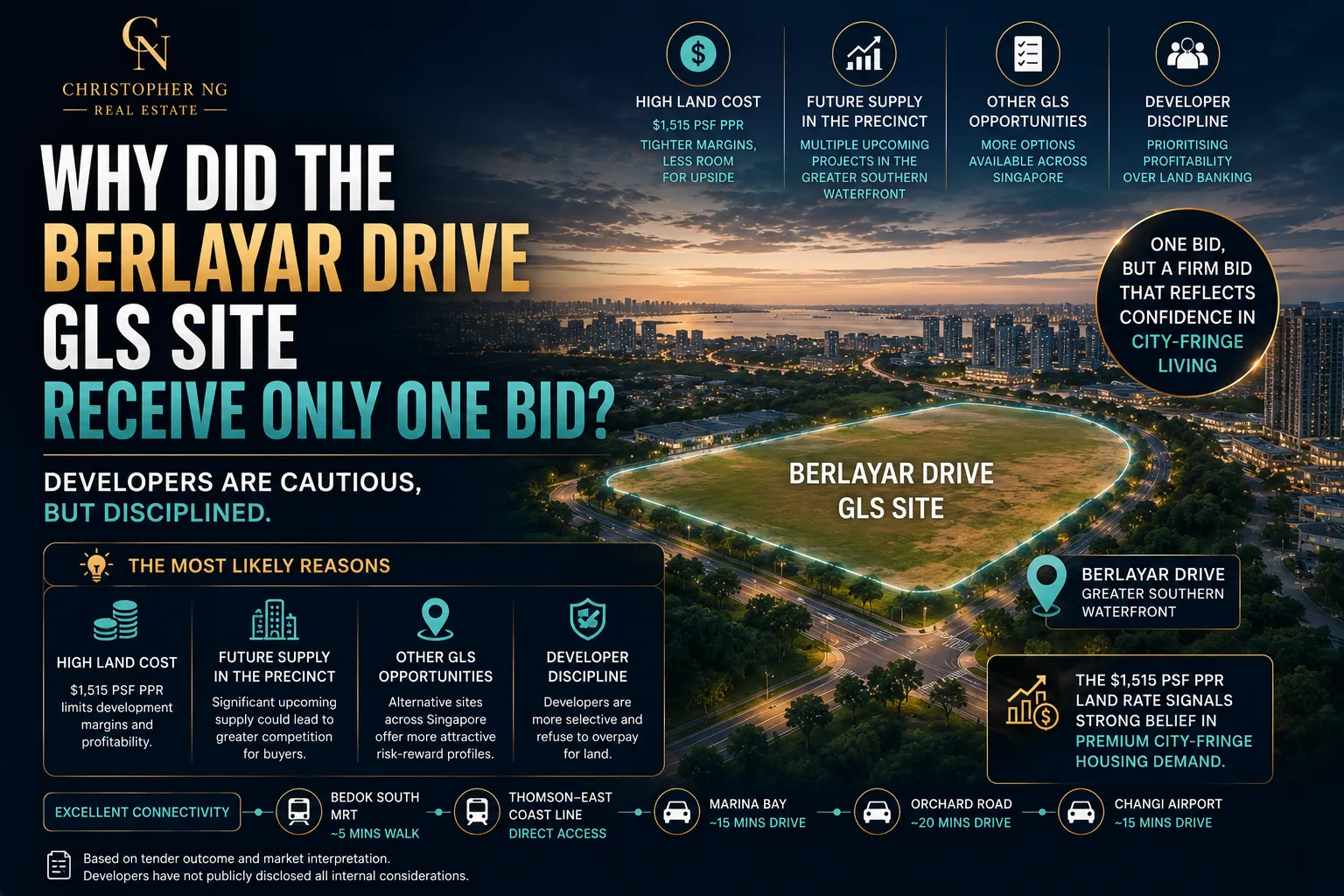
Whenever a Government Land Sale site receives only one bid, the immediate reaction is usually negative.
Developers are worried.
Demand must be weakening.
The site may be unattractive.
But I think the Berlayar Drive tender deserves a more careful reading.
A joint venture between Hong Leong Holdings and GuocoLand submitted the sole bid at approximately $1,515 psf per plot ratio.
That creates an interesting contradiction.
Only one developer group was prepared to participate.
Yet the land price was still firm.
To me, this is not a sign that developers have lost confidence in Singapore’s property market.
It is a sign that developers have become much more selective about risk, margins and where they choose to deploy capital.
More importantly, this land bid may have implications beyond Berlayar itself.
It could also change the way buyers evaluate existing District 5 launches, particularly Hudson Place.
One Bid Does Not Mean No Confidence
The number of bids and the level of the bid tell us two different things.
The single bid suggests caution.
The land rate of $1,515 psf ppr suggests confidence.
Both can be true at the same time.
Developers may continue to believe that well-located city-fringe homes will perform well, while becoming less willing to overpay simply to replenish their land banks.
This is an important distinction.
Developers do not make decisions based only on whether a location is attractive.
They must also consider:
Construction costs.
Financing expenses.
Development restrictions.
Future competing supply.
Expected selling prices.
The margin available after all costs are included.
A developer may like a site but still decide not to bid if the numbers do not provide sufficient room for error.
That is likely part of what happened at Berlayar Drive.
Why Did Berlayar Drive Receive Only One Bid?
I believe several factors may have influenced the low participation.
First, the site requires a substantial commitment at a high land price.
At $1,515 psf ppr, the future developer will need to sell at premium city-fringe prices to achieve a reasonable return.
Other developers may have believed in the location but felt that the margin was too tight.
Second, the site forms part of a much larger transformation.
Berlayar will eventually become an important new residential precinct within the Greater Southern Waterfront.
That long-term story is attractive.
But it also means more supply will arrive progressively.
Developers must consider not only the project they are building today, but the other public and private housing that may enter the area later.
Third, the site comes with development constraints.
A lower-rise residential project can create a more exclusive and attractive environment, but it may also reduce design flexibility and cost efficiency.
Finally, developers now have more land options.
When the GLS supply pipeline is healthy, developers do not need to chase every site.
They can afford to be disciplined.
The Bid Is Still a Vote of Confidence in the Area
Although the site received only one bid, the winning land rate was not weak.
Hong Leong Holdings and GuocoLand have effectively made a major commitment to the future of Berlayar and the Greater Southern Waterfront.
That tells us the consortium believes buyers will eventually pay a premium for:
Proximity to the city.
Access to HarbourFront and the southern waterfront.
Greenery and lifestyle amenities.
Future neighbourhood transformation.
Limited new private housing in the immediate area.
The project will not be positioned as a conventional suburban condominium.
The land price already suggests a premium RCR product.
What Does This Mean for Future Berlayar Pricing?
The land cost does not tell us the exact future launch price.
The eventual pricing will depend on construction costs, project design, unit sizes, market conditions and the developer’s strategy.
However, the direction is clear.
A site purchased at $1,515 psf ppr will not be developed into an entry-priced mass-market project.
The future development will likely need to compete in the upper end of the city-fringe market.
This creates a new replacement-cost benchmark for the southern RCR corridor.
And that is where Hudson Place becomes relevant.
Why Hudson Place May Begin to Look Different
Hudson Place should not be compared directly with Berlayar as though they are identical projects.
They serve different micro-markets.
Berlayar offers the Greater Southern Waterfront story.
Hudson Place is positioned within the Media Circle and one-north ecosystem.
But buyers do compare across locations.
A buyer with a budget for a city-fringe new launch may look at:
One-north and Media Circle.
Queenstown.
Pasir Panjang.
HarbourFront.
Telok Blangah and Berlayar.
When future land costs move above $1,500 psf ppr, existing launches developed from lower land bases begin to look more interesting.
Not automatically cheap.
But potentially better protected by replacement cost.
Hudson Place Has a Lower Cost Base
Hudson Place entered the market from a considerably lower land cost than Berlayar Drive.
That matters because land is one of the biggest components of a new project’s selling price.
A lower land cost gives the developer more flexibility.
It may allow the project to launch at a more accessible price while still maintaining a reasonable margin.
Berlayar’s higher land cost suggests that the next generation of city-fringe projects may need to launch above the pricing of current District 5 developments.
This could make selected Hudson Place units look increasingly reasonable over time.
Especially when buyers compare the total purchase quantum rather than only the price per square foot.
Replacement Cost Can Support Existing Launches
Property buyers often focus on past transactions.
I believe they should also study future replacement cost.
If the next comparable project is built on significantly more expensive land, it becomes difficult for that future development to launch below an earlier project.
This does not mean Hudson Place prices must rise immediately.
It does not guarantee capital appreciation.
But it provides a degree of price support.
A buyer may initially feel that Hudson Place is expensive compared with older resale condominiums.
However, the same buyer may view it differently when upcoming launches enter the market from much higher land costs.
Value is always relative.
Today’s expensive project can become tomorrow’s comparatively affordable project.
The Berlayar Bid Strengthens the City-Fringe Pricing Story
The Berlayar result reinforces one broader trend.
Premium city-fringe land is becoming increasingly expensive.
Developers are paying high prices for sites near employment nodes, transport infrastructure and major transformation areas.
That makes it more difficult to produce new homes at yesterday’s launch prices.
Hudson Place benefits from being earlier in that pricing sequence.
Its buyers are entering before the full impact of newer land costs is reflected across future supply.
That does not make every unit a good purchase.
But it strengthens the argument for carefully selected units with:
Efficient layouts.
Manageable overall prices.
Good orientations.
Strong rental appeal.
Broad future buyer demand.
Clear connection to the one-north employment ecosystem.
Who Is Likely to Buy Hudson Place?
Hudson Place has a potentially diverse demand base.
It may appeal to professionals working in one-north, research, technology and biomedical industries.
It may also attract owner-occupiers who want to remain within District 5 but prefer a new development.
Investors may be drawn to the employment catchment and rental demand.
Upgraders from nearby HDB towns may also compare it with more expensive RCR alternatives.
This broad demand base is important.
Projects that depend on only one buyer profile are generally more vulnerable.
Hudson Place has the potential to appeal to both owner-occupiers and investors, provided the unit type and purchase price remain sensible.
What Buyers Should Not Assume
The Berlayar land bid does not automatically mean that every Hudson Place unit is undervalued.
Buyers must still analyse the individual unit.
A poor-facing unit does not become attractive simply because another site was sold at a higher land rate.
A compact layout does not automatically become good value because future launches may be more expensive.
The correct approach is to compare:
Total purchase price.
Internal efficiency.
Rental prospects.
Future supply.
Exit demand.
Alternative resale options.
The likely pricing of future new launches.
Replacement cost is one part of the decision.
It should not be the only part.
My View
The Berlayar Drive tender sends a nuanced message.
The single bid shows that developers are cautious.
The $1,515 psf ppr land rate shows that confidence in prime city-fringe locations remains strong.
For Berlayar, this reinforces its positioning as a premium Greater Southern Waterfront precinct.
For Hudson Place, the impact may be indirect but meaningful.
A higher future cost base across RCR land makes earlier projects developed on cheaper land increasingly relevant.
Hudson Place may not need Berlayar buyers to choose it directly.
It only needs future city-fringe pricing to move higher.
As replacement costs rise, buyers may look back at current District 5 launches and realise that the entry window was more attractive than it first appeared.
That, in my opinion, is the real significance of the Berlayar tender.
It is not simply about one bid.
It is about how one land price can gradually reshape the value perception of projects that came before it.
Want the tailored version for your portfolio?
Every article here generalises. A 20-minute conversation makes it specific to your numbers.
Why did the Berlayar Drive GLS site receive only one bid?
Is one bid a bad sign for the property market?
What does the $1,515 psf ppr land rate mean?
How does the Berlayar tender affect Hudson Place?
Does this mean Hudson Place prices will definitely increase?
Is Hudson Place now considered cheap?
Which Hudson Place units may benefit most?
Should buyers purchase Hudson Place because of the Berlayar result?

Written by
Christopher Ng (CEA R014394H)
Singapore Property & Asset Progression Strategist with ERA Realty Network. A NUS Real Estate graduate, Christopher has advised homeowners, investors and property owners since 2004.