
Amberwood at Holland Prices Are Out: At Around $3,000 PSF, Is It Still A Hidden Gem?
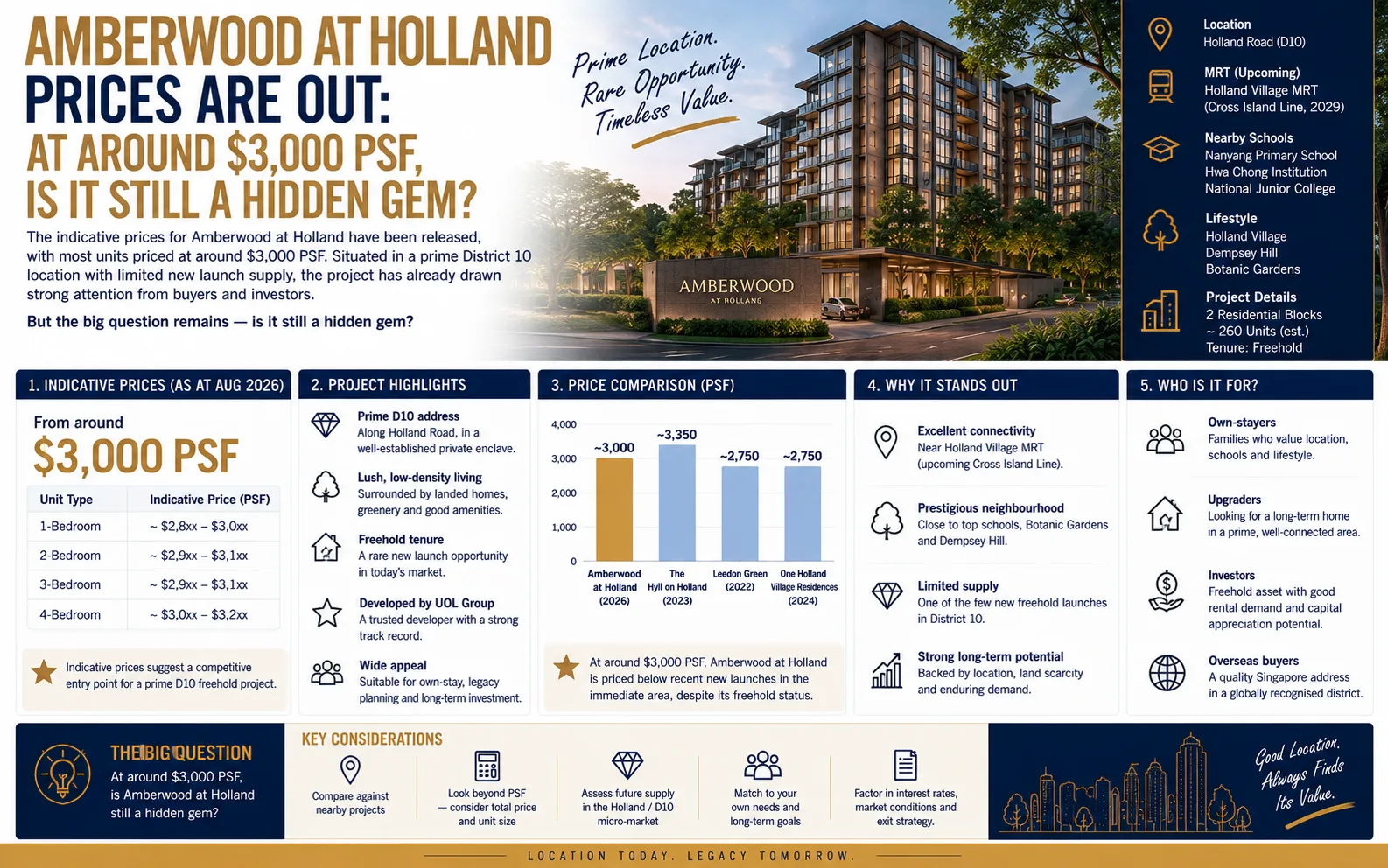
Amberwood at Holland's indicative prices are out at around $3,000 psf. This article evaluates if this new District 10 launch still offers value, considering factors like land cost, future Holland Plain developments, and target buyers.
Three days ago, I wrote an article asking a simple question:
Could Amberwood at Holland actually be one of the quieter hidden opportunities among Singapore's 2026 new launches?
At that point, there was one very important piece of information missing.
The price.
I deliberately stopped short of making a conclusion because no matter how much I like:
the location,
the low-density environment,
the District 10 address,
the surrounding GCB neighbourhoods,
the future Holland Plain transformation,
or Sim Lian's generally practical layouts...
a good project can still become a bad buy at the wrong price.
Well, we don't have to speculate anymore.
The indicative prices have just been released.
And when I saw them this morning, my immediate reaction was:
Okay. Now this gets interesting.
First, What Are The Indicative Prices?
Based on the indicative price sheet released for Amberwood at Holland:
Unit Type | Size | Starting Price | Starting PSF |
|---|---|---|---|
3 Bedroom | 872 sq ft | $2,568,000 | $2,945 psf |
3 Bedroom Flexi | 958 sq ft | $2,841,000 | $2,966 psf |
4 Bedroom | 1,087 sq ft | $3,175,000 | $2,921 psf |
4 Bedroom Premium | 1,227 sq ft | $3,674,000 | $2,994 psf |
5 Bedroom Premium | 1,335 sq ft | $3,992,000 | $2,990 psf |
5 Bedroom Luxe | 1,561 sq ft | $4,699,000 | $3,010 psf |
These are indicative starting prices and remain subject to change.
The developer has separately confirmed that three-bedroom homes start at about $2.6 million, four-bedroom homes from around $3.2 million and five-bedroom units from around $4 million.
The first thing that jumps out at me?
The pricing is remarkably compressed.
Almost everything sits around:
$2,921–$3,010 psf.
There isn't a huge PSF jump as you move into the bigger apartments.
And that creates some interesting opportunities within the project itself.
So Was My Original Prediction Right?
Pretty much.
In my original Amberwood at Holland analysis, I said market expectations were around the:
high-$2,000s to low-$3,000s psf.
But I didn't want to make the call until the actual pricing appeared.
Now it has.
And the starting prices are essentially:
around $3,000 psf.
So now I can ask the question properly:
Is $3,000 PSF Expensive For Amberwood?
My answer is:
Yes — if you look at it through yesterday's lens.
But:
not necessarily — if you look at where replacement cost and prime new-launch pricing are moving.
That distinction is very important.
Let's Start With The Land Price
Sim Lian paid approximately:
$1,432 psf ppr
for the Holland Link GLS site in 2025.
The total land price was about $368.4 million.
And remember something unusual about that tender.
Sim Lian's bid was approximately 22.2% above the second-highest bidder.
At the time, you could argue:
"Did Sim Lian overpay?"
But something interesting happened afterwards.
Sim Lian subsequently secured the next Holland Plain site at approximately:
$1,491 psf ppr.
That is about 4.1% higher than what it paid for Amberwood's land.
Suddenly, Amberwood's $1,432 psf ppr doesn't look quite as aggressive.
And that creates something I always pay attention to:
replacement-cost protection.
If the next piece of land costs more, the next developer doesn't magically get to sell cheaper unless construction costs, margins or other variables fall enough to compensate.
That doesn't guarantee Amberwood will appreciate.
But it gives us an important clue about where the next generation of Holland Plain pricing could start.
Amberwood Has One Advantage Future Holland Plain Projects Cannot Replicate
This is something I think buyers should understand.
Amberwood is:
the first project in Holland Plain.
Normally, being first comes with disadvantages.
You buy before the neighbourhood is completed.
You live through future construction.
Amenities take time to mature.
The precinct story isn't fully visible yet.
But financially, being first can sometimes create an advantage.
You are buying on:
the first land cost.
Future buyers may be buying on:
second land cost,
third land cost,
fourth land cost...
And if those land prices continue rising, the eventual projects could establish higher benchmarks around you.
Of course, the opposite can happen too.
Future GLS tenders could come in lower.
The market could weaken.
Developers could price aggressively.
So I would never tell a buyer:
"Next launch definitely more expensive."
Nobody knows that.
But we already know one thing:
the second Holland Plain site cost Sim Lian more than the first.
That is factual.
But Here's The Question I Think Buyers Should Really Ask
Forget PSF for a moment.
Look at the absolute quantum.
This is where Amberwood becomes much more interesting to me.
A three-bedroom starts from:
$2.568 million.
A four-bedroom:
$3.175 million.
A five-bedroom:
$3.992 million.
For a brand-new District 10 development surrounded by landed and GCB neighbourhoods, that is not cheap.
But neither are those numbers completely outrageous in today's market.
And I suspect that was deliberate.
Sim Lian has not filled Amberwood with:
450 sq ft one-bedders,
550 sq ft one-plus-studies,
or investor-focused compact units.
Every single home is:
3-bedroom and above.
That tells you exactly who this project is designed for.
Amberwood Is Not Really An Investor Project
I said this in my original article and the pricing reinforces my view.
I don't think the natural Amberwood buyer is someone asking:
"Which one-bedder can I buy and rent out?"
There isn't one.
This looks much more like an:
owner-occupier project.
Think:
families,
Bukit Timah/Holland residents,
parents considering schools,
landed right-sizers,
upgraders with substantial equity,
and buyers who value a quieter low-rise environment.
Amberwood has only 212 homes across 11 low-rise blocks of four to six storeys.
That is a very different proposition from a 1,000-unit mega-launch.
The 4-Bedroom Immediately Caught My Eye
Look at the numbers again.
3-bedroom:
872 sq ft — $2.568m — $2,945 psf
4-bedroom:
1,087 sq ft — $3.175m — $2,921 psf
The four-bedroom is actually starting at a lower PSF.
You pay approximately:
$607,000 more
and receive:
215 sq ft more space + an additional bedroom.
That's roughly a 24.7% increase in purchase price for about 24.7% more floor area.
Interesting.
Because normally, when buyers look at new launches, they instinctively gravitate towards the cheapest entry quantum.
But the cheapest apartment is not automatically the best value.
This is exactly why I always tell buyers:
Don't choose the unit type from the price list alone.
Understand who will eventually buy your unit from you.
Who Is The Future Buyer For An 872 Sq Ft 3-Bedroom?
This is where I would think carefully.
An 872 sq ft three-bedroom is efficient.
For some families, it may be enough.
But if you're buying Amberwood specifically because you want:
space,
family living,
low-density lifestyle,
Bukit Timah/Holland positioning,
then the 1,087 sq ft four-bedroom at $3.175 million starts looking interesting.
Your future buyer pool could include:
families with two children,
families with a helper,
HDB/condo upgraders,
landed right-sizers,
parents wanting more study/work space.
That is a broader lifestyle proposition.
Then There Is The 5-Bedroom Premium
This one also caught my attention.
1,335 sq ft.
$3.992 million.
$2,990 psf.
So for just under $4 million, you are getting a five-bedroom home in a 212-unit low-rise District 10 development.
Again:
not cheap.
But let's compare what $4 million actually buys elsewhere.
That's the way I think buyers should approach today's market.
Don't ask:
"Is $4 million a lot of money?"
Of course it is.
Ask:
"What are my alternatives at $4 million?"
That's where property analysis becomes useful.
The Freehold Resale Comparison Is Where Amberwood Gets Challenged
This is probably the strongest argument against Amberwood.
Because around Holland/Bukit Timah, buyers have freehold alternatives.
Take Hyll on Holland.
It is freehold.
Recent transactions have been around the high-$2,000s psf, including a July 2026 1,055 sq ft transaction at approximately:
$2.891 million / $2,891 psf.
Now look at Amberwood:
99-year leasehold.
Starting around:
$2,921–$3,010 psf.
Immediately, a rational buyer should ask:
Why am I paying similar or more PSF for leasehold?
That's a completely fair question.
And This Is Why Amberwood Cannot Win On Tenure
If your number-one priority is:
freehold
then Amberwood probably isn't the project I would use to convince you otherwise.
There are established freehold options nearby.
Amberwood needs to win on something else:
newness.
layout.
facilities.
low-density environment.
school proximity.
future precinct transformation.
first-mover positioning.
And perhaps most importantly:
the exact unit you are buying.
Because once a new 99-year development starts approaching established freehold resale pricing, unit selection becomes extremely important.
But There Is Another Comparison That Makes $3,000 PSF Look Different
Look beyond Holland.
Prime new-launch land costs have continued moving upwards.
Amberwood's land cost:
$1,432 psf ppr.
Its indicative selling price:
around $3,000 psf.
Now compare that with newer prime GLS transactions where developers are paying significantly more for the land itself.
This is the phenomenon I have written about repeatedly:
replacement cost.
Today's launch price is not determined by what a neighbouring condo launched at six years ago.
The next generation of projects has to carry:
today's land price,
today's construction cost,
today's financing,
today's compliance costs,
and today's developer risk.
That's why $3,000 psf — which would once have sounded extraordinary outside the traditional ultra-prime market — is increasingly entering normal conversations for prime new launches.
That doesn't mean we should blindly accept it.
It means we need a better comparison than:
"Last time this area only $2,000+ psf."
The Second Holland Plain Site May Become Amberwood's Best Friend
This is probably the most interesting investment angle to me.
Sim Lian owns Amberwood's site at:
$1,432 psf ppr.
Then it paid:
$1,491 psf ppr
for the next Holland Plain plot.
Imagine the next development eventually launches at:
$3,100 psf.
Or:
$3,200 psf.
Or higher.
I'm not saying it will.
But if it does, buyers may suddenly look backwards and say:
"Amberwood at $2,900+ wasn't that expensive after all."
This is what I call:
future price discovery.
Sometimes your biggest competitor today becomes your strongest comparable tomorrow.
But The Same Future Supply Is Also A Risk
I don't want to sell only one side of the story.
Holland Plain is not finished.
More residential land is planned.
That means Amberwood will eventually face:
competition.
Future buyers may have:
newer projects,
different layouts,
different facilities,
and perhaps better locations within the precinct.
So the Holland Plain story cuts both ways.
Future launches could:
support Amberwood's price
or
compete with Amberwood's resale demand.
Which outcome dominates will depend heavily on:
future land prices,
future launch prices,
and how good Amberwood's own units are.
Something Else About The Price List Is Very Interesting
Look at the PSF spread:
$2,921
to
$3,010.
That's only about:
$89 psf
between the lowest starting PSF and the highest among these indicative entry units.
That tells me something.
The developer appears to be pricing the different unit types relatively evenly on a PSF basis.
So the real battleground may not be:
Which bedroom type has the cheapest PSF?
It may become:
Which particular stack gives me the most value for the premium I pay?
And that's where I would start looking at:
orientation,
afternoon sun,
internal facing versus external facing,
floor level,
privacy,
landed/GCB-facing outlook,
future development-facing stacks,
distance from facilities,
and floor-plan efficiency.
This is where the next layer of analysis begins.
Remember: Amberwood Is Low-Rise
This matters more than people think.
In a 30-storey development, you can have huge price differences between:
#03,
#15,
and
#28.
Amberwood is only four to six storeys.
That changes the unit-selection strategy.
You are not paying enormous premiums to reach the 25th floor.
Instead, I would pay much more attention to:
what exactly am I looking at?
In a low-rise development beside landed and GCB areas, the best unit may not necessarily be:
highest floor at any cost.
It may be:
the unit with the most permanent sense of openness and privacy.
That's different.
My Earlier Personal Connection To The Area Still Matters
I mentioned this in my first article.
I didn't grow up living at Holland Plain.
But a large part of my formative years revolved around this part of Singapore.
I went from:
Henry Park Primary
to:
St Joseph's Institution
to:
National Junior College.
A lot of my bus rides, school journeys and younger years were around the Bukit Timah/Holland area.
Back then, I just knew it as a very nice neighbourhood.
As I grew older and eventually entered real estate, I began understanding why.
The landed homes.
The GCB areas.
The schools.
Bukit Timah.
Holland.
Sixth Avenue.
The greenery.
The scarcity.
It has always been an area associated with wealth — but not necessarily the flashy kind.
And I think Amberwood is trying to sell exactly that feeling.
Quiet wealth rather than flashy luxury.
The question was whether the developer would price that story too aggressively.
At around $3,000 psf?
I think it is at least worth having the conversation.
So Is Amberwood Still A Hidden Gem?
Now that we finally have the indicative prices, I can answer my original question more clearly.
Potentially — but not because it is cheap.
I don't think anyone should call:
$2.568 million for an 872 sq ft three-bedroom
cheap.
And I certainly wouldn't market it that way.
The potential opportunity is different.
Amberwood could become interesting because you are getting:
District 10,
a 212-unit low-density project,
only family-sized units,
GCB/landed surroundings,
MGS within 1km,
future Holland Plain transformation,
future King Albert Park interchange connectivity,
and
entry based on the first Holland Plain land cost.
That combination is relatively unusual.
But I Would Not Buy Every Unit
This is important.
A good project does not mean every unit is a good buy.
Actually, because the indicative PSF range is so compressed, I think unit selection becomes even more important.
I would want to study:
the site plan,
future Holland Plain plots,
which views can eventually be blocked,
sun direction,
distance between blocks,
privacy,
floor plans,
and the developer's actual unit-by-unit pricing.
The headline:
"From $2,921 psf"
is useful for understanding positioning.
It does not tell me which unit to buy.
If I Had To Choose A Unit Type Today?
Based purely on these starting prices — before seeing the final unit-by-unit price chart — the one that catches my attention is:
the 4-bedroom.
1,087 sq ft.
Starting from:
$3.175 million.
At approximately:
$2,921 psf.
It is actually the lowest starting PSF among the indicative types you've shown me.
And I think it sits in an interesting quantum.
Not too compact.
Not yet $4 million.
Four bedrooms.
Family-oriented.
Potentially larger future resale pool.
For me, that deserves a much closer look.
The second unit I would study would be the:
5-bedroom Premium at $3.992 million.
Not because it will necessarily deliver the highest percentage return.
But because a five-bedroom home below the psychological $4 million line in a low-density D10 development may have a very specific future owner-occupier audience.
Again:
layout and stack first.
The Question I Would Ask Before Booking
I wouldn't ask:
"Is Amberwood good?"
That's too broad.
I'd ask:
"At $3 million to $4 million, what else can I buy?"
Then compare Amberwood against:
Hyll on Holland.
Leedon Green.
Leedon Residence.
Wilshire Residences.
One Holland Village.
other D10 resale.
and
other 2026 new launches.
For example, freehold Leedon Residence recorded an August transaction around $3,002 psf, while Hyll on Holland's recent median has been around $2,884 psf.
That's exactly why Amberwood isn't an automatic buy.
At roughly $3,000 psf, the resale competition is real.
But that's also why I find the project interesting.
It forces you to decide what you actually value:
new versus established.
leasehold versus freehold.
future transformation versus proven neighbourhood.
smaller brand-new home versus larger resale home.
Those are proper property decisions.
One More Thing I Would Watch Very Closely: Launch-Day Take-Up
The next data point matters enormously.
The showflat preview starts on 11 September 2026.
The question now becomes:
How will buyers react to $3,000 psf?
If Amberwood sells strongly at these levels, that tells us something beyond Amberwood itself.
It tells us buyers are increasingly accepting:
$3,000 psf for a 99-year District 10 family project outside the traditional Orchard luxury core.
That becomes another price-discovery point for the entire prime residential market.
And importantly:
it gives Sim Lian a benchmark for its next Holland Plain project.
If sales are slow?
That tells us something equally useful.
It could indicate that buyers still see a ceiling around $3,000 psf when freehold resale alternatives are readily available nearby.
Either outcome teaches us something.
My View Has Changed Slightly Since My First Article
Before the price was released, my position was:
Interesting project. Wait for price.
Now?
My position becomes:
Interesting price. Now wait for unit selection.
That's an important distinction.
I don't see the indicative pricing as cheap enough to say:
"Just buy."
But I also don't see it as expensive enough to dismiss Amberwood immediately.
At roughly $3,000 psf, it sits right in the uncomfortable zone where a buyer actually has to do some work.
And sometimes those are the most interesting projects.
Because the obvious bargains attract everyone.
The obviously overpriced projects are easy to reject.
It's the projects in the middle where:
the right unit at the right price can make a big difference.
My Final Take
Two days ago I asked:
Is Amberwood at Holland actually a hidden gem?
Now we finally have the first part of the answer.
The developer has come out at approximately:
$2,921–$3,010 psf
for these indicative starting units.
My conclusion?
I wouldn't call Amberwood cheap.
But I also wouldn't dismiss it at $3,000 psf.
Because we need to understand what is happening around it.
The first Holland Plain land cost:
$1,432 psf ppr.
The next Holland Plain site:
$1,491 psf ppr.
Amberwood:
around $3,000 psf.
Nearby freehold resale:
also increasingly approaching the high-$2,000s and around $3,000 psf depending on project and unit.
The pricing is therefore not screaming:
BARGAIN.
But neither is it screaming:
OVERPRICED.
To me, it is saying:
Choose carefully.
And perhaps that is the most important point.
In the next phase of Singapore's property market, I don't think simply buying the right project is enough anymore.
You need to get:
the project right.
The entry price right.
The unit type right.
The stack right.
The view right.
And eventually:
the exit audience right.
Amberwood has now passed my first test:
the indicative price is reasonable enough for me to keep looking.
Next?
Show me the actual price chart and the stacks.
That's where I think the real opportunity — if there is one — will reveal itself.
Want the tailored version for your portfolio?
Every article here generalises. A 20-minute conversation makes it specific to your numbers.
What are Amberwood at Holland's indicative prices?
When does Amberwood at Holland preview?
How many units are there?
Is Amberwood freehold?
Is $3,000 psf expensive for Amberwood?
What did Sim Lian pay for the land?
Why does the next Holland Plain site matter?
Which Amberwood unit type looks most interesting?
Should I buy Amberwood or a nearby freehold resale condo?
Is Amberwood an investment project?
What should buyers watch next?

Written by
Christopher Ng (CEA R014394H)
Singapore Property & Asset Progression Strategist with ERA Realty Network. A NUS Real Estate graduate, Christopher has advised homeowners, investors and property owners since 2004.