
A&A vs Reconstruction vs Rebuilding a Landed House in Singapore: What Buyers Must Know Before They Buy
Before buying an older landed house in Singapore, it's crucial to understand the difference between renovation, A&A, reconstruction, and rebuilding. These terms describe vastly different scopes of work and costs, impacting your total proper
One of the most common things I hear when viewing older landed homes is:
“Never mind, I’ll just A&A.”
Sometimes that makes sense.
Sometimes it absolutely does not.
Because in Singapore, renovation, A&A, reconstruction and rebuilding are not interchangeable words.
They describe very different scopes of work.
And the difference can easily be:
$300,000 versus $1.5 million versus more than $2 million.
That is why I think every serious landed buyer should understand these terms before exercising an OTP.
Not after.
Because if you buy a $4 million old terrace thinking you only need $500,000 of work, but your architect later tells you that what you want is really a reconstruction costing $1.8 million...
you didn't buy a $4 million house.
You bought a $5.8 million project.
That distinction can completely change whether the property was a good buy.
First: The Hypothetical House We Are Going To Use
To make this article practical, let's use one example throughout.
Imagine an older Singapore intermediate terrace with:
Land: 2,200 sq ft
Existing built-up: approximately 4,000 sq ft
Current form: 2.5 storeys
Age: perhaps 25–35 years
Condition: fundamentally habitable but dated
Objective: create a modern family home
This is the type of property many condo upgraders are looking at.
Good amount of land.
Reasonable existing built-up.
But perhaps:
old bathrooms,
old kitchen,
dated facade,
small windows,
poor internal flow,
old roof,
old electrical wiring,
and a layout designed for the way families lived 30 years ago.
So what are your options?
Option 1: Renovation
Let's start with the simplest.
What Do I Mean By Renovation?
Renovation generally means you're keeping the building substantially as it is.
You might change:
Flooring
Kitchen
Bathrooms
Carpentry
Lighting
Air-conditioning
Paint
Internal finishes
Selected windows and doors
Electrical and plumbing systems
But the main structural form of the house remains.
You're not fundamentally rebuilding slabs, columns and beams or significantly enlarging the house.
Think:
“Make the existing house much nicer.”
Rather than:
“Turn the existing house into a different house.”
What Does Renovating A Terrace Cost In 2026?
Current 2026 Singapore market guides put a full terrace-house renovation broadly around $150,000 to $350,000, with lighter cosmetic work starting below that and more premium or extensive interior scopes going higher. HomeMatch currently estimates roughly $150,000–$300,000 for a full terrace renovation, while Homescape places a full renovation around $150,000–$350,000.
For our 4,000 sq ft built-up terrace, I would personally use a more conservative planning range:
Full renovation: about $250,000–$450,000
Why higher than some headline figures?
Because 4,000 sq ft is already on the larger side for an intermediate terrace.
And older landed houses often need things condo renovations don't:
roof repair,
waterproofing,
external paint,
gate,
drainage,
electrical rewiring,
plumbing replacement,
facade work,
and perhaps window replacement.
A premium interior can easily push beyond this.
When Does Renovation Make Sense?
I like renovation when the house has what I call:
good bones.
Good staircase position.
Good room sizes.
Enough bedrooms.
Useful kitchen location.
Good ceiling heights.
No major structural issues.
Sufficient built-up.
If the structure already works, there is no reason to destroy it purely because the tiles are ugly.
Tiles are cheap compared with structure.
Option 2: A&A — Additions & Alterations
This is where the terminology starts becoming important.
What Does A&A Actually Mean?
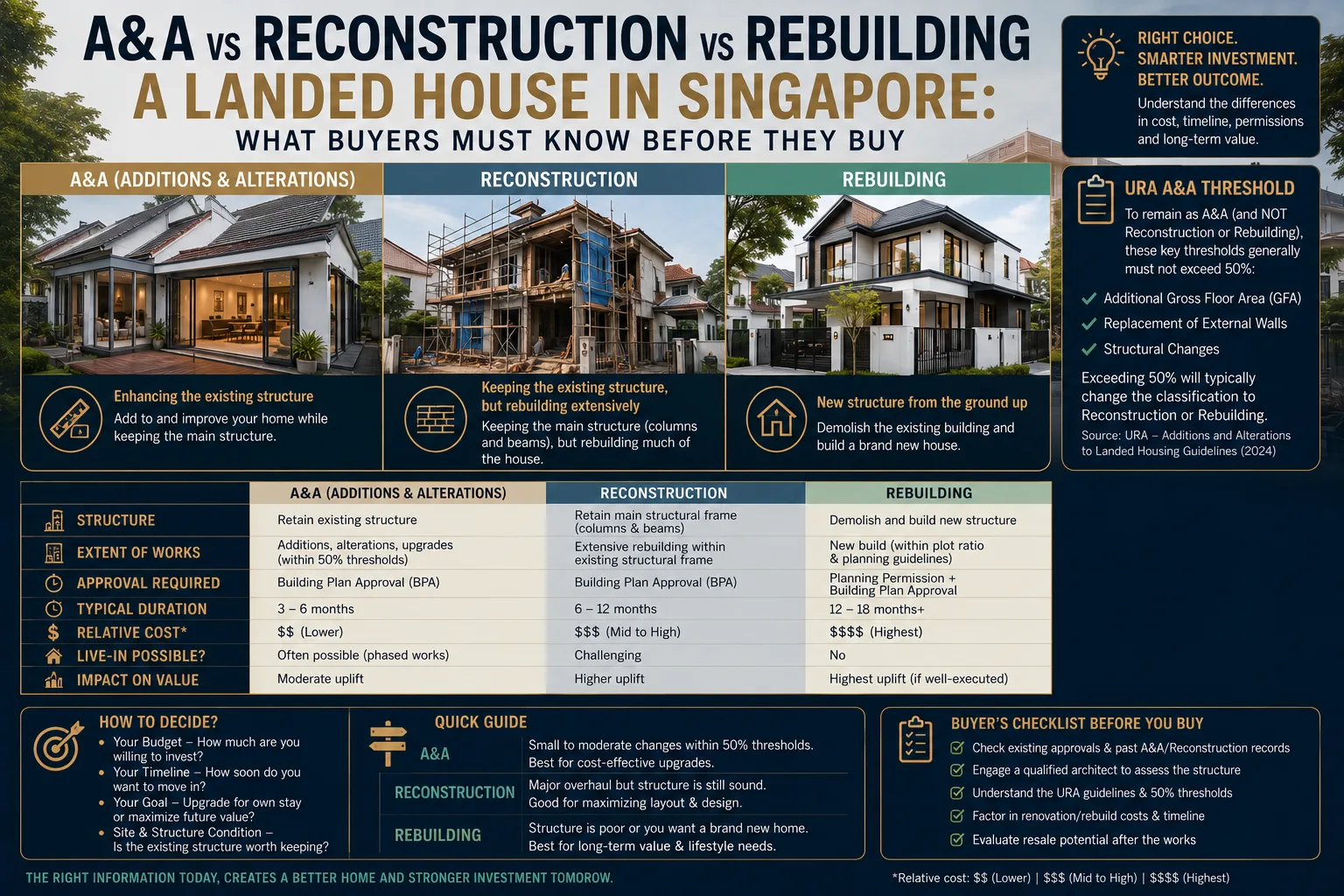
URA has specific criteria for a landed proposal to qualify as Additions & Alterations.
As at August 2026, among the key thresholds:
Additional GFA must generally not exceed 50% of the approved GFA
External walls removed and replaced must generally not exceed 50%
Structural changes to the existing building must generally not exceed 50%
The entire roof can be replaced, provided the works do not create an additional storey
An attic may be added provided the GFA increase remains within the permitted threshold
If the proposed works do not satisfy the A&A criteria, URA treats the proposal as reconstruction.
That's important.
Because people often use “A&A” to mean:
“Big renovation.”
But technically, there are limits to how much of the existing building you can change and still remain within A&A.
What Might A&A Look Like On Our Terrace?
Perhaps you want to:
extend the rear,
reconfigure parts of the floor plan,
replace sections of slabs,
change columns and beams,
change the roof,
add an attic,
open up the living area,
increase bedroom sizes,
and modernise the facade.
You're still retaining a meaningful part of the existing building.
But the transformation becomes much more extensive than normal renovation.
What Does A&A Cost In Singapore In 2026?
This is where published numbers vary significantly because the term covers very different scopes.
An independent quantity surveyor that priced or evaluated 18 landed projects from 2024–2026 currently gives:
Inter-terrace rear-extension A&A: roughly $320–$420 psf
Full inter-terrace A&A: roughly $380–$480 psf
Other 2026 landed renovation guides place terrace A&A/reconstruction broadly from about $500,000 to $1 million+, but those headline ranges can include smaller or less extensive projects.
For our hypothetical 4,000 sq ft existing house, if we are talking about a meaningful full A&A rather than a small rear extension, I would budget approximately:
$1.1 million–$1.7 million
That is my planning range, not a contractor quotation.
A modest project preserving a lot of structure may come below it.
A complex A&A with premium finishes, roof work, major structural alterations, lift, elaborate facade or extensive M&E replacement may exceed it.
And I would still maintain a 10–15% contingency because hidden conditions are one of the biggest risks when opening an old building. One 2026 engineering benchmark similarly recommends a 10–15% contingency for A&A because of concealed conditions revealed during works.
Option 3: Reconstruction
Now we enter another category.
What Is Reconstruction?
URA states quite clearly that works which fall outside the A&A criteria are regarded as reconstruction.
And importantly, certain outcomes are considered reconstruction regardless of whether you've technically crossed all the 50% thresholds.
For example:
Increasing the storey height
Changing the landed housing form
URA's Form DC6 likewise distinguishes reconstruction from A&A based on those structural and GFA limits.
So if your dream is:
"I want to retain some of the existing house, but basically change almost everything else..."
you may well be talking about reconstruction rather than A&A.
What Might Reconstruction Mean For Our Terrace?
Perhaps we retain selected boundary walls or a useful part of the existing structure.
But:
most internal slabs change,
major structural elements change,
the stairs move,
facade changes completely,
roofline changes,
the whole internal planning gets redesigned,
and the end product bears little resemblance to the original house.
Now you are not renovating an existing home.
You are effectively undertaking a small development project.
What Does Reconstruction Cost In 2026?
The independent QS benchmark I found currently places an inter-terrace reconstruction of around 3,500–4,500 sq ft GFA at approximately $420–$540 psf.
For our 4,000 sq ft house, the straight construction arithmetic produces:
4,000 × $420 = $1.68 million
to
4,000 × $540 = $2.16 million
So for planning purposes:
Reconstruction: approximately $1.7 million–$2.2 million construction cost
But this is where buyers need to be careful.
The construction contract may not include everything.
Depending on the quotation, you may still need to account separately for:
Architect/QP
Structural engineer
Quantity surveyor
Authority/submission fees
Temporary utilities
Demolition portions
Loose furniture
Appliances
Landscaping
Special lighting
Smart-home systems
Lift
Solar
Premium stone
Specialist waterproofing
Contingency
The QS benchmark notes that professional and statutory costs can add roughly 9–15% on top of construction for new-build projects.
So your true project budget may be closer to:
$1.9 million–$2.5 million all-in
depending on specification.
Option 4: Full Rebuild / New Erection
And then there is the clean-slate option.
What Does “Rebuild” Actually Mean?
This is another term consumers use loosely.
URA calls complete demolition of the existing dwelling followed by replacement a new erection.
In other words:
Old house gone.
Start again.
This gives the architect the greatest flexibility—subject of course to the prevailing planning controls for that specific site.
The resulting house must comply with the relevant landed envelope controls, setbacks, site conditions and technical requirements.
What Does A Full Rebuild Cost In 2026?
Current 2026 market guides have a wide spread.
A contractor benchmark places a new-build terrace around:
$280–$330 psf mid-spec
$380–$500 psf premium spec
plus roughly $30,000–$80,000 for demolition/disposal.
The independent QS data is more conservative, with inter-terrace reconstruction/new-build-type work around $420–$540 psf, based on recent 2024–2026 tenders.
Another landed specialist published in August 2026 gives a broader full-rebuild planning range around $400–$600+ psf, construction only.
For buyers, I would rather budget conservatively than win an argument about which source has the lowest PSF.
So for our hypothetical 4,000 sq ft replacement terrace, I would plan around:
Full rebuild construction: approximately $1.6 million–$2.4 million
Then add:
demolition,
professional fees,
statutory costs,
contingency,
and your preferred finishes.
A realistic all-in project budget could therefore be:
Around $1.9 million–$2.8 million
And of course you can go higher.
Add:
basement,
lift,
premium facade,
extensive stone,
designer carpentry,
high-end imported sanitaryware,
pool,
complex structural spans,
and suddenly there isn't much of a ceiling.
So What Does Our 2,200 Sq Ft Terrace Really Cost?
For an older inter-terrace with approximately 2,200 sq ft land and 4,000 sq ft built-up, these are the August 2026 planning ranges I would personally use before speaking to a QP/QS and tendering the works:
Scope | What I would broadly assume | Indicative 2026 budget |
|---|---|---|
Renovation | Interiors + M&E + selected external works, structure largely unchanged | $250k–$450k |
Meaningful A&A | Extend/reconfigure while retaining substantial existing structure | $1.1m–$1.7m |
Reconstruction | Major structural transformation, outside A&A limits | $1.9m–$2.5m all-in |
Full rebuild / new erection | Demolish and create a new house | $1.9m–$2.8m all-in |
These are planning estimates, not quotations. Current market sources themselves differ materially, and tender variation can exceed 20%. Site condition, access, soil, structural requirements and specification can move the final number significantly.
That table is probably the most useful part of this article.
Because now when viewing an old house, instead of saying:
"Never mind, just A&A lah."
you can ask:
Which category am I actually entering?
Why Can Reconstruction And Rebuilding Cost Almost The Same?
This surprises buyers.
They assume:
A&A cheapest.
Reconstruction medium.
Rebuild most expensive.
Conceptually, yes.
But real life isn't always so neat.
Imagine trying to retain parts of a 35-year-old structure while constructing new slabs and beams around it.
The contractor has to:
protect existing structure,
sequence works carefully,
solve level differences,
connect old and new construction,
deal with existing foundations,
discover unknown conditions,
and work around things that were never designed for the new scheme.
Sometimes it becomes more complicated than starting again.
That is why a very extensive A&A or reconstruction can creep surprisingly close to rebuild cost.
One 2026 engineering benchmark says A&A is generally around 15–25% cheaper per square foot than new construction, but notes that hidden conditions can eat into those savings.
So don't assume:
retain more = always save more.
Sometimes the structure you're desperately trying to retain is exactly what makes the project expensive.
The Existing Structure Is Therefore Extremely Important
This is why I pay attention to more than just the land during landed viewings.
For an owner who wants to build from scratch, the structure may have little value.
But for someone hoping to save money through A&A, the existing structure can be extremely valuable.
I want to know:
Are the columns where I need them?
Are the slabs useful?
Is the staircase well positioned?
Are ceiling heights adequate?
Does the footprint already maximise the land reasonably well?
Can the existing structure accommodate the intended loads?
Is the roof worth retaining?
Does the current building comply with the approved plans?
A house with good structural bones may save a buyer hundreds of thousands.
A house with terrible bones can tempt someone into an A&A that eventually becomes more painful than rebuilding.
Always Check The Approved Plans
This is something buyers sometimes forget.
What exists physically is not necessarily what was officially approved.
URA specifically advises private-property buyers to verify that there are no unauthorised works and to obtain the approved plans from the seller or through the relevant planning-record process.
If you buy the property, you may inherit responsibility for unauthorised works.
This is especially important when buying older landed houses because previous owners may have:
extended kitchens,
covered voids,
added rooms,
changed roofs,
enclosed car porches,
or created structures over the years.
Your proposed renovation or redevelopment should start from the approved house, not merely the physical house you saw during viewing.
When Would I Choose Renovation?
My decision tree starts here.
If the house already has:
enough built-up,
good rooms,
good layout,
good staircase,
good structure,
and I'm largely unhappy with finishes...
renovate.
Why spend $2 million solving a $300,000 problem?
When Would I Choose A&A?
If I like most of the structure, but I need:
an extension,
better kitchen,
larger rooms,
new attic,
selected structural reconfiguration,
new roof,
or meaningful but controlled additional space...
explore A&A.
This is often the sweet spot.
You retain useful value while improving the home substantially.
But confirm with your QP that the proposal can actually remain within A&A criteria.
When Would I Choose Reconstruction?
If more than half the house has to change for me to be happy...
I become cautious about forcing the project into an A&A mentality.
Perhaps:
staircase in the wrong place,
floor levels wrong,
rooms all too small,
existing slabs limit design,
roof needs replacement,
entire facade needs changing,
and I want a different vertical configuration.
At that point:
reconstruction may be the more honest description of what I'm trying to do.
And I would budget accordingly.
When Would I Rebuild From Scratch?
If I look at the house and realise:
The only thing I want to retain is the address...
then let's stop pretending.
Rebuild.
Especially when:
the existing building is structurally poor,
the footprint is inefficient,
the family wants a very specific layout,
we want substantially more usable space,
or the rebuild economics create meaningful value.
A full rebuild also means the entire home starts its life together.
Structure.
Roof.
Waterproofing.
Electrical.
Plumbing.
M&E.
Everything.
That can matter if the intention is to hold for the next 20 or 30 years.
Don't Forget Time
Cost is only half the equation.
The independent QS benchmark gives typical programmes of around:
6–9 months for single-storey A&A
10–14 months for full two-storey A&A
14–20 months for a three-storey reconstruction
18–28 months for a high-spec detached new erection
An inter-terrace will vary based on design and approvals, but the principle is clear.
The bigger the intervention, the longer your family may be displaced.
And that creates costs beyond construction.
Rental.
Storage.
Moving twice.
Mortgage interest.
And perhaps most importantly:
time you don't get back.
The Property Purchase Price Must Reflect The Scope Of Works
This is where everything connects back to property valuation.
Imagine two identical 2,200 sq ft freehold terraces.
House A
Old.
4,000 sq ft built-up.
Asking:
$4.5 million
Requires full rebuild:
Say $2.2 million
Indicative total before stamp duty/finance:
$6.7 million
House B
Recently rebuilt.
4,000 sq ft.
Asking:
$6.2 million
Needs $100,000 personalisation.
Indicative:
$6.3 million
Which is cheaper?
The supposedly expensive completed house.
This is why I keep repeating:
Buyers must compare finished-house cost, not asking price.
But The Old House Can Still Be The Better Buy
Now change the example.
House A:
$4.5m purchase.
$2.2m rebuild.
Total $6.7m.
But you rebuild to 6,000 sq ft, create an excellent modern product, and comparable completed houses are selling around $7.5m–$8m.
Now?
Interesting.
You're creating value.
This is why old landed homes can be fantastic Asset Progression opportunities.
But only when:
land price + redevelopment cost < resulting property value
by a sufficiently healthy margin.
Otherwise, you're simply paying construction costs to reach market value.
This Is The Question I Ask My Landed Buyers
When we enter an old house, I don't ask:
"Can we renovate this?"
Technically, almost anything can be improved.
I ask:
"What would we have to do to make YOU happy living here?"
That answer tells us the real scope.
If the client says:
"Kitchen, flooring, bathrooms."
Good.
Renovation.
If the answer becomes:
"Move the staircase, enlarge the rear, change all bedroom positions, add an attic, redo the roof, change half the structure..."
Okay.
Now we need a much more serious conversation.
Asset Progression: Construction Can Create Wealth — Or Consume It
For landed buyers, property improvement can be an Asset Progression tool.
Buy an underutilised property.
Improve the building.
Create more usable area.
Improve functionality.
Enhance marketability.
Done correctly, the resulting property may be worth more than the total capital invested.
That's value creation.
But rebuilding is not automatically investing.
Sometimes it is consumption.
You spend $300,000 on marble because you love marble.
Nothing wrong with that.
But perhaps the next buyer values it at $50,000.
That's lifestyle expenditure.
Again, nothing wrong with it.
Just understand the distinction.
I separate:
Value-creating works
from
Lifestyle works.
A better floor plan may improve market value.
A sixth bedroom may widen your future buyer pool.
Better parking may matter.
A tasteful modern reconstruction may command a strong premium.
But highly personalised luxury finishes?
Enjoy them.
Don't automatically expect the market to reimburse you.
Why The 2026 Construction Environment Matters
I also wouldn't assume construction costs are about to suddenly collapse.
BCA expects Singapore construction demand of around $47 billion to $53 billion in 2026, with construction output projected at $43 billion–$46 billion, around 7% higher than the preliminary 2025 level.
That doesn't predict the price of your terrace-house contractor next year.
But it does tell us the wider construction industry remains busy.
So if you're evaluating a landed house today based on an assumed rebuild cost from 2019 or 2020...
I would update the spreadsheet.
My Rule Before Buying Any Old Landed House
Before exercising, I want three numbers.
Number 1: What Is The Land Worth?
Comparable transactions.
Plot quality.
Tenure.
Location.
Frontage.
Road.
Number 2: What Will It Cost To Create The House I Want?
Not:
"roughly renovate maybe $500k."
A realistic planning assessment.
Ideally with input from an architect/QP and, for major work, QS/contractor.
Number 3: What Will The Completed Property Be Worth?
Look at newly rebuilt or comparable completed homes.
Then calculate:
Purchase + works + fees + financing/time costs versus completed value.
Only then do we really understand whether we're buying an opportunity.
My View
I think a lot of landed buyers get seduced by one of two things.
The first is:
Cheap asking price.
The second is:
Beautiful finished house.
Both can mislead you.
The cheap old house may become extraordinarily expensive once you start rebuilding.
The beautiful rebuilt house may carry such an aggressive premium that you are effectively paying the seller for every dollar of their taste.
The sweet spot lies somewhere in between.
Understand the existing structure.
Understand what you actually need to change.
Understand whether those changes qualify as renovation, A&A, reconstruction or new erection.
Then put a realistic 2026 number against them.
For our hypothetical 2,200 sq ft terrace with 4,000 sq ft built-up, I would broadly think:
Renovate: $250k–$450k
Meaningful A&A: $1.1m–$1.7m
Reconstruction: roughly $1.9m–$2.5m all-in
Full rebuild: roughly $1.9m–$2.8m all-in
Not quotes.
Planning numbers.
Enough to tell you whether the property deserves further investigation.
Because once you exercise the OTP, discovering that your "$500,000 A&A" is actually a $2 million reconstruction is a very expensive lesson.
The best time to understand the building is before you buy the land underneath it.
Want the tailored version for your portfolio?
Every article here generalises. A 20-minute conversation makes it specific to your numbers.
What is the difference between renovation and A&A for landed property?
What is URA's 50% rule for landed A&A?
Does adding another storey count as A&A?
What is reconstruction?
What is a full rebuild or new erection?
How much does it cost to renovate a terrace house in Singapore in 2026?
How much does landed A&A cost in Singapore in 2026?
How much does reconstruction cost for a 4,000 sq ft terrace?
How much does it cost to rebuild a landed terrace in Singapore in 2026?
Why does A&A sometimes become almost as expensive as rebuilding?
Should I renovate or rebuild an old landed house?
Should I engage an architect before buying an old landed house?
Why should buyers check approved plans?
How much contingency should I keep?
What is the biggest mistake landed buyers make?

Written by
Christopher Ng (CEA R014394H)
Singapore Property & Asset Progression Strategist with ERA Realty Network. A NUS Real Estate graduate, Christopher has advised homeowners, investors and property owners since 2004.