
The HDB Market Has Changed. Here's What Buyers and Sellers Need to Know for 2H 2026.
Singapore's HDB market has shifted from a seller's to a more balanced market in 2H 2026, with prices showing slight moderation. Buyers now have more choices, while sellers need to adopt realistic pricing strategies.
For almost five years, many Singaporeans got used to one simple idea:
If you owned an HDB flat, chances are it would be worth more next year.
That mindset shaped buyer behaviour.
It shaped seller expectations.
It even influenced upgrading decisions.
But the first half of 2026 tells us that the market has entered a different phase.
Not a crash.
Not a boom.
A normal market.
And in my opinion, that's actually healthy.
The Headlines Say Prices Fell. But That's Not the Whole Story.
The headlines are technically correct.
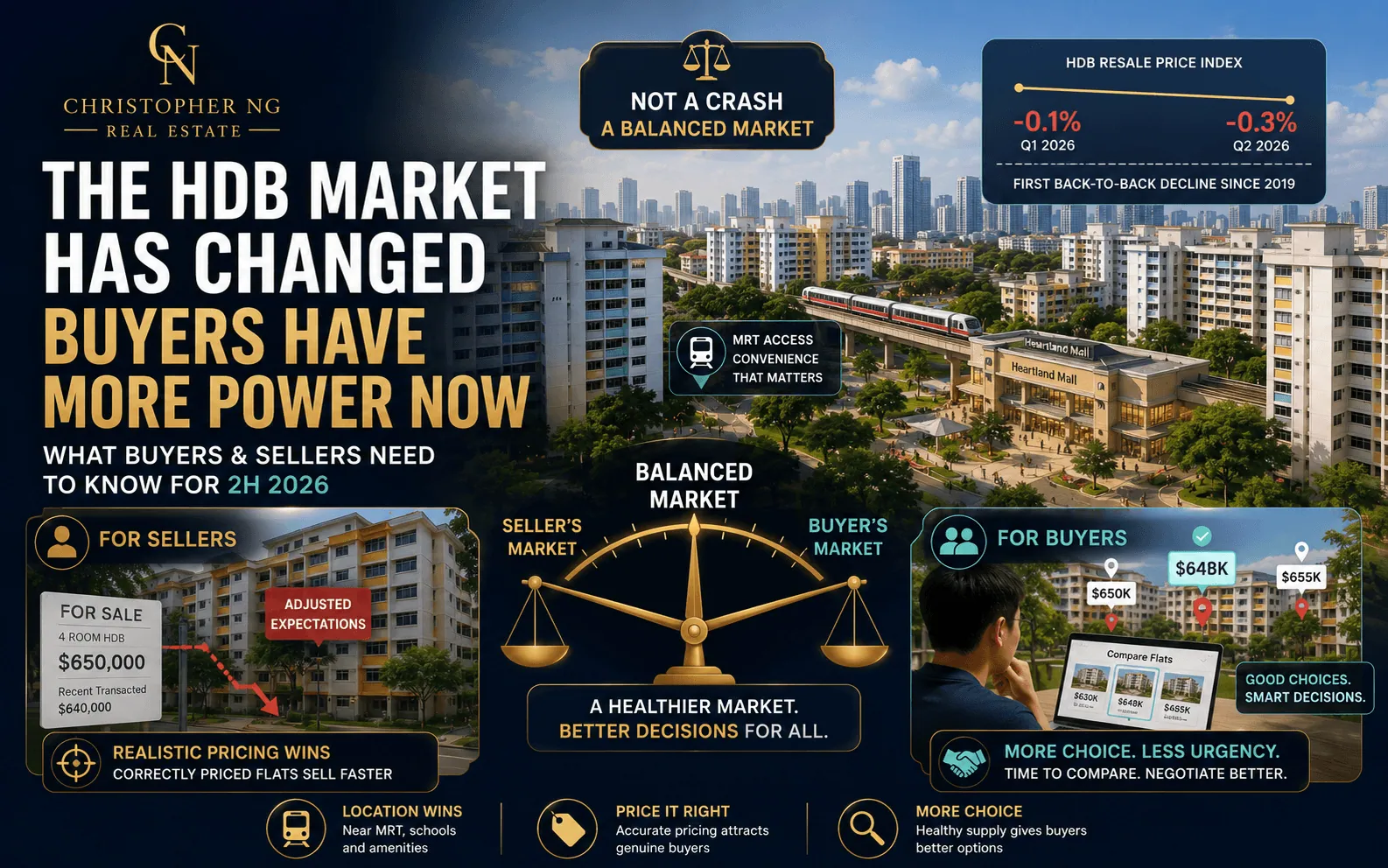
HDB resale prices declined by 0.1% in the first quarter and 0.3% in the second quarter of 2026, marking the first back-to-back quarterly decline since 2019. Resale transaction volumes were also about 10% lower year-on-year.
Whenever people hear the word "decline", they naturally ask:
"Has the HDB market turned?"
I think that's the wrong question.
The better question is:
What kind of HDB market are we entering?
We Are Moving From A Seller's Market To A Balanced Market
During the pandemic years and the immediate recovery period, demand significantly exceeded supply.
Construction delays reduced BTO availability.
Interest rates were low.
Many buyers had little choice but to enter the resale market.
That created an exceptional seller's market.
Almost every reasonably priced flat attracted strong interest.
Those conditions no longer exist today.
BTO supply has increased substantially.
More flats are reaching their Minimum Occupation Period (MOP).
Buyers have more choices than they did two years ago.
When supply improves, buyers naturally become more selective.
That doesn't mean demand has disappeared.
It simply means buyers no longer feel pressured to pay any price.
Not Every HDB Flat Will Perform The Same
One mistake I often see is treating the HDB market as though every flat behaves the same way.
It doesn't.
A mature estate near an MRT station with a popular primary school nearby is very different from an older flat in a less accessible location.
Even within the same town, two blocks can perform very differently.
Going into the second half of 2026, I believe location will matter more than it has over the past few years.
Buyers have choices again.
When buyers have choices, quality wins.
Flats with these characteristics should continue attracting healthy demand:
Walking distance to MRT stations.
Efficient layouts.
Good renovations that reduce immediate renovation costs.
Near established schools.
Close to town centres and amenities.
Remaining lease that comfortably supports CPF usage and financing.
On the other hand, sellers of average units may need to adjust expectations.
The days of listing significantly above recent transactions and waiting for buyers to chase may become less common.
What It Means For Sellers
If you're planning to sell in the second half of 2026, pricing strategy becomes more important than ever.
Many owners are still comparing today's market with what happened in 2024 or early 2025.
That comparison may no longer be realistic.
Today's buyers are doing far more homework.
They compare recent transactions.
They analyse nearby alternatives.
They negotiate with greater confidence because they know more options are available.
This doesn't mean sellers should panic.
Far from it.
Good flats continue to sell.
But they sell because they are priced correctly from the beginning, not because buyers are willing to stretch indefinitely.
The first two weeks of marketing are often the most important.
If genuine buyers consistently walk away after viewing, the market is usually telling us something.
Listening early often produces a better outcome than waiting several months before making adjustments.
What It Means For Buyers
Ironically, buyers may finally have the luxury of making better decisions.
Over the last few years, many buyers purchased under pressure.
They worried prices would rise again next month.
They rushed because every delay meant facing multiple competing offers.
Today's environment feels different.
There is still competition for exceptional flats.
But buyers generally have more time to compare options, conduct proper due diligence and negotiate.
That is a healthier market.
However, buyers should avoid assuming that every seller is desperate.
Many homeowners have built substantial equity over the past five years and are under no financial pressure to sell.
If a flat is genuinely well located and attractively priced, competition can still be intense.
Will Prices Continue To Fall?
This is probably the question I get asked most often.
Personally, I don't expect a sharp correction.
Several factors continue supporting the HDB market.
Singapore maintains high home ownership.
Employment remains relatively resilient.
Mortgage delinquency remains low.
Household balance sheets are generally healthy.
At the same time, affordability has become a much bigger consideration.
Higher interest rates compared to the pandemic period, larger loan commitments and increased housing supply should continue keeping price growth in check.
My expectation is that the HDB market will remain relatively stable through the second half of 2026.
Some towns may outperform.
Others may soften.
The days where almost every resale flat appreciated together appear to be behind us—for now.
The Bigger Story Is Housing Progression
One trend I find particularly interesting is how the HDB market is reconnecting with the broader private residential market.
When HDB resale prices accelerated rapidly, many buyers found the jump to private property surprisingly small.
Today, private home prices have also moderated in many segments while HDB resale prices have softened. That is encouraging some households to revisit their upgrading plans instead of assuming they need to wait several more years.
This is where careful planning becomes even more important.
Buying or selling a home should never be viewed as a single transaction.
It should be viewed as one step within a much longer property journey.
Sometimes holding makes sense.
Sometimes upgrading creates more long-term value.
Sometimes waiting is the smarter move.
The right answer depends on your financial position, life stage and long-term objectives—not on headlines.
My Thoughts
The first half of 2026 has not weakened the HDB market.
It has matured it.
We are moving away from a market driven by urgency and fear of missing out.
Instead, we are entering a market where value, location and pricing discipline matter once again.
For buyers, that means better choices and more negotiating power.
For sellers, it means realistic pricing and strong presentation will become increasingly important.
And for those thinking about their next property move, this may be one of the best times in recent years to plan with a long-term strategy rather than simply reacting to market sentiment.
After all, successful property owners don't just understand today's prices.
They understand where today's decisions can take them tomorrow.
Frequently Asked Questions
Are HDB resale prices falling in Singapore?
Yes, HDB's flash estimates show resale prices declined by 0.1% in Q1 2026 and 0.3% in Q2 2026. However, this reflects a moderation after several years of strong growth rather than a broad market collapse.
Is 2H 2026 a good time to buy an HDB resale flat?
For many buyers, yes. There is more choice, less urgency and greater scope for negotiation than during the peak years of 2022–2024. Exceptional flats, however, are still likely to attract competition.
Should HDB sellers lower their asking price?
Not necessarily. Sellers should price based on recent comparable transactions and the strengths of their flat. Accurate pricing from the outset is becoming more important than testing the market with overly ambitious expectations.
Will HDB prices recover in 2027?
No one can predict future prices with certainty. Much will depend on interest rates, housing supply, employment conditions and government policy. Well-located flats with strong owner-occupier appeal are generally better positioned to remain resilient than average units.
Want the tailored version for your portfolio?
Every article here generalises. A 20-minute conversation makes it specific to your numbers.
Are HDB resale prices falling in Singapore?
Is 2H 2026 a good time to buy an HDB resale flat?
Should HDB sellers lower their asking price?
Will HDB prices recover in 2027?

Written by
Christopher Ng (CEA R014394H)
Singapore Property & Asset Progression Strategist with ERA Realty Network. A NUS Real Estate graduate, Christopher has advised homeowners, investors and property owners since 2004.