
Bayshore Drive GLS Tender Closes at $2.13 Billion: Why This May Be One of Singapore's Most Important Land Sales
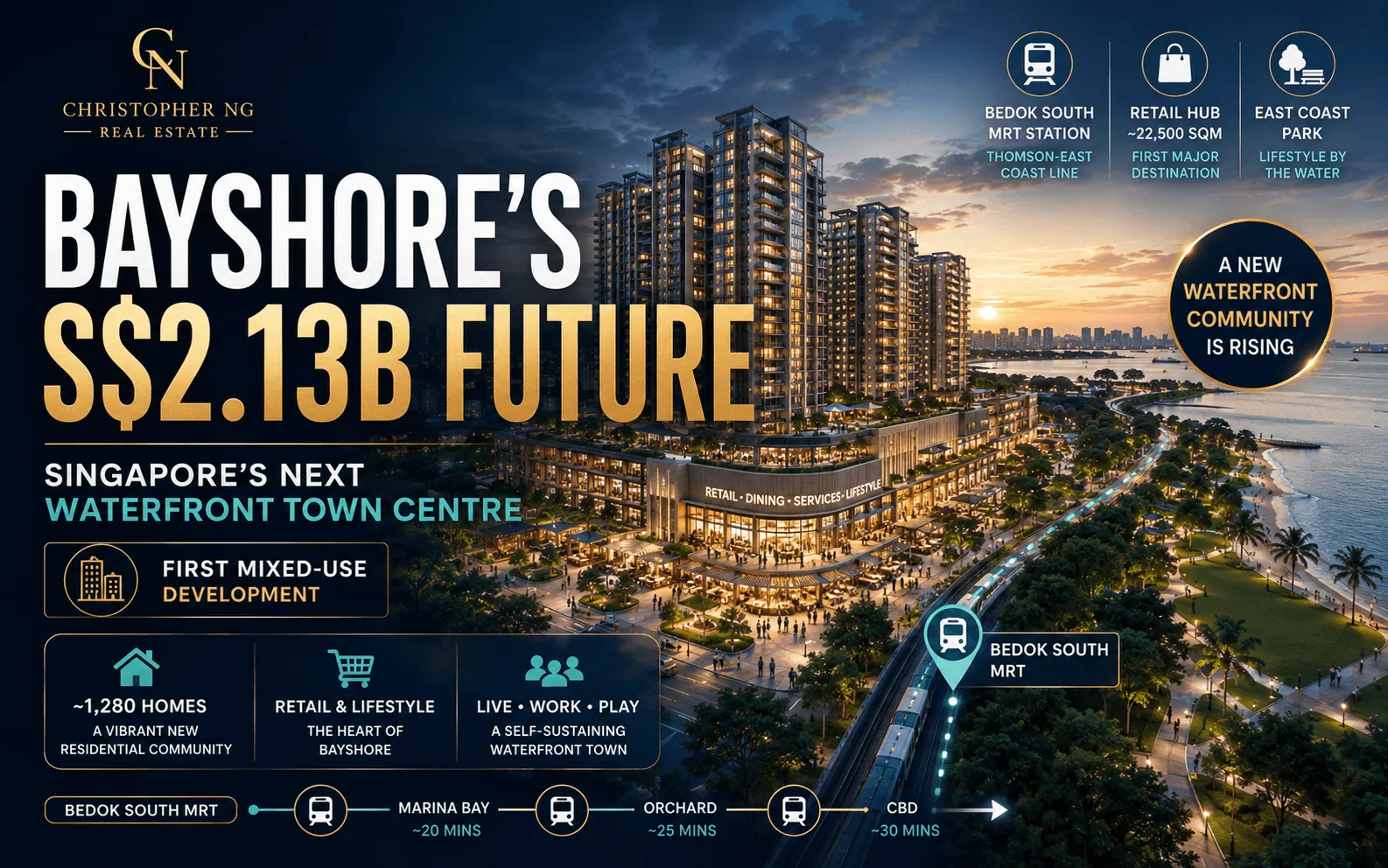
Frasers Property's S$2.13 billion bid for the Bayshore Drive GLS site signals confidence in Singapore's future, as developers invest based on long-term market potential. This mixed-use development, capable of delivering 1,280 homes
When most people hear that a Government Land Sale (GLS) site has closed, the immediate reaction is usually simple:
"Another condo is coming."
But experienced property investors know that a GLS tender is far more than just another piece of land changing hands.
It is one of the clearest windows into how Singapore's largest developers view the future.
Developers commit billions of dollars years before a single home is sold. They aren't buying based on today's market—they're buying based on where they believe Singapore will be five, ten or even fifteen years from now.
That is why I always pay close attention whenever a major GLS tender closes.
The latest Bayshore Drive GLS site is one such example.
Frasers Property's $2.13 Billion Vote of Confidence
The Bayshore Drive mixed-use site attracted three bidders, with Frasers Property submitting the winning bid of $2.13 billion, translating to approximately $1,324 psf per plot ratio (psf ppr).
On paper, three bids may appear modest compared to some recent GLS exercises.
However, the more interesting story lies elsewhere.
Frasers did not merely edge out the competition.
Their bid exceeded the second-highest offer by almost 6%, a sizeable margin considering the scale of the project and the quantum involved.
For a development capable of delivering around 1,280 homes together with approximately 22,500 square metres of commercial space, that pricing reflects conviction rather than optimism.
Developers rarely overpay unless they see a much bigger opportunity ahead.
This Isn't Just Another Condominium
What makes this GLS site particularly different is that it is the first mixed-use development in the entire Bayshore transformation.
Many people focus purely on the residential component.
I think the commercial component deserves just as much attention.
Whoever develops this site will potentially create the neighbourhood's first major retail destination.
As thousands of new homes are progressively completed across Bayshore, this future mall will naturally become the town centre where residents shop, dine, meet and access daily services.
Unlike a pure residential project, the commercial element introduces long-term recurring value that extends beyond the initial sale of apartments.
That additional upside likely gave developers greater confidence when calculating how much they were prepared to pay for the land.
The Market Is Rewarding Well-Planned Locations
One trend has become increasingly clear throughout 2026.
Buyers are no longer purchasing based solely on price.
They are purchasing locations where several factors come together:
- MRT connectivity
- Everyday conveniences
- Schools
- Lifestyle amenities
- Long-term transformation under the URA Master Plan
Bayshore checks almost every one of these boxes.
Future residents will enjoy doorstep access to Bedok South MRT Station along the Thomson-East Coast Line, direct connectivity to the CBD, close proximity to East Coast Park and access to several established schools within a short distance.
These aren't speculative advantages.
They already exist or are firmly planned.
When infrastructure leads, housing demand usually follows.
Why Developers Remain Confident
Some people expected developers to become more cautious after several successful launches earlier this year.
Instead, this tender suggests confidence remains intact.
Recent OCR launches have demonstrated that buyers continue to respond strongly when projects offer genuine lifestyle advantages and future growth potential.
That confidence appears to have carried directly into this GLS exercise.
Rather than slowing down, developers are actively replenishing their land banks because they expect demand for quality projects to remain resilient over the coming years.
This is often something retail buyers overlook.
Developers are effectively making billion-dollar forecasts.
Watching where they choose to deploy capital can provide useful insight into where they believe future demand will be strongest.
What This Means for Homebuyers
If you're considering buying a home in Singapore, this tender offers several important lessons.
Firstly, infrastructure continues to be one of the strongest drivers of long-term value.
Secondly, mixed-use developments remain highly attractive because they create self-sustaining communities instead of standalone residential estates.
Thirdly, areas undergoing comprehensive transformation often experience several stages of appreciation rather than a single spike in prices.
We saw similar patterns in Punggol.
We saw them in Jurong.
Today, Bayshore appears to be entering that same long-term transformation journey.
Of course, no investment is guaranteed.
Property decisions should always be based on one's financial position, objectives and holding horizon rather than headlines.
But understanding where developers are committing billions of dollars provides valuable context when making those decisions.
My Thoughts
For me, the biggest takeaway from this GLS tender isn't the winning price.
It's the confidence behind it.
Frasers Property has effectively made a multi-billion-dollar commitment to Bayshore's future.
That confidence aligns with Singapore's continued investment in transport infrastructure, the East Coast transformation and the government's long-term planning philosophy.
As more GLS sites are launched over the coming years, Bayshore will likely continue evolving into one of Singapore's newest waterfront residential towns.
Whether you're buying your first home, upgrading, or building an investment portfolio, Bayshore is certainly a precinct worth keeping on your radar.
Sometimes the most important signals in the property market aren't found in today's transaction prices.
They're found in where tomorrow's homes are being built.
Christopher Ng is an Executive Group Division Director at ERA Singapore with over 20 years of experience across residential, commercial and industrial real estate. A graduate of the National University of Singapore's Real Estate programme, he is known for advocating a long-term asset progression approach to property ownership and helps homeowners make structured property decisions. Together with his wife, Jasmine, he leads one of ERA Singapore's fastest-growing divisions while continuing to advise clients across HDB, private residential, landed and Good Class Bungalow transactions.
Want the tailored version for your portfolio?
Every article here generalises. A 20-minute conversation makes it specific to your numbers.

Written by
Christopher Ng (CEA R014394H)
Singapore Property & Asset Progression Strategist with ERA Realty Network. A NUS Real Estate graduate, Christopher has advised homeowners, investors and property owners since 2004.